



4 cops sacrifice their lives to prevent suicide bomber from entering Prophet's mosque

[email protected] (CD Network)
July 5, 2016

Madinha, Jul 5: The security forces of Saudi Arabia have proved their competency, dedication and commitment by sacrificing their own lives to foil the plot of dreaded terrorists in the Islamic kingdom. In two separate incidents on Monday, the security forces prevented the suicide bombers from entering the Prophet's Mosque in Madinah and US consulate in Jeddah.
1mosque

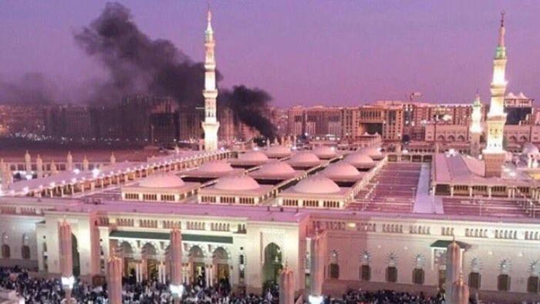
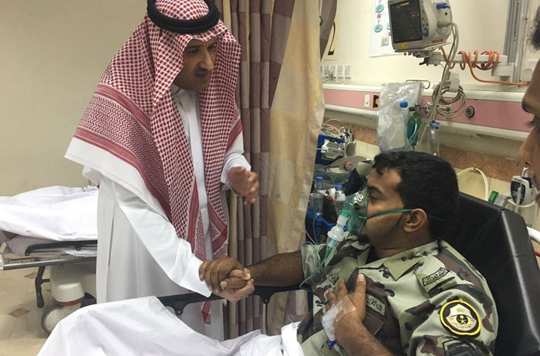
At least four Saudi security force members were killed and five wounded, when a suicide bomber, who was prevented from entering the Prophet's Mosque, Al-Haram Al-Nabawi, regarded as one of Islam's holiest sites, blew himself up.

“With Maghreb prayer drawing near on Monday in Madinah, security men suspected a man who was walking towards the Prophet's Mosque across an open area that is being used as a parking lot for visitors. When they tried to stop him, he blew himself up resulting in his death and the martyrdom of four security men. Meanwhile, five other security men were injured. May they recover quickly,”said Maj. Gen. Mansour Al-Turki, security spokesman of the Ministry of Interior.

Al Arabiya News Channel's correspondent said the suicide bombing took place near a security building parking lot between the city courtyard and the mosque, visited by millions every year.

The attack took place during Maghreb prayers, the time when Muslims break their fast during the holy month of Ramadan. The channel showed images of fire raging in a parking lot with at least one body seen nearby. The suicide bomber also died in the attack.

Before that at 2:15 a.m., a suicide bomber blew himself up near the US Consulate in Jeddah. Security officers endangered their lives and confronted him as he moved suspiciously at a parking lot of the Dr. Soliman Fakeih Hospital. It is learnt that the bomber's intention was to barge into the Consulate and kill maximum people. At least two policemen were wounded lightly in the attack. 

Also Read: Bomb explodes next to Prophet's Mosque as terrorists target Madinah after Jeddah, Qatif

1cop

Comments

Bopanna
 - 
Thursday, 7 Jul 2016

Assam, you are the sick one. I have read the Koran and I know that you are lying. It is mentioned that Mo \thighed\" aisha when she was 9 !!!"

Satyameva jayate
 - 
Thursday, 7 Jul 2016

Boppanna....what are you doing in ksa ..?
Forgot how many gopis Krishna had?
God's wife hijacked by ravana? And monkeys had to help....?
Mahabharata's....hot saree removal scenes?
God's head cut off n replaced by elephants......
God's fighting war cagainstc each other.....

you question about prophet Mohammed......try to learn your religion first and understand it with common sense and then question Islam.......

Bopanna
 - 
Tuesday, 5 Jul 2016

Truth ? Truth is that Mohamad is the worlds first terrorist.
What age did he marry Aisha ? 6 years !
He is not a normal human being

musthafa iruvailu
 - 
Tuesday, 5 Jul 2016

bopanna when you will come up with truth, atleast you cant reveal your real name. what you can teach about peace and reality. just come out from hellness mind

Satyameva jayate
 - 
Tuesday, 5 Jul 2016

At least now people realize that these terrorists are not Muslims....just fake named and Hired goons....

Satyameva jayate
 - 
Tuesday, 5 Jul 2016

Boppanna.......and what you will call our jawans daily dying in our borders....? Respect the martyrs dear......
Are you a Isis goon or saffron goon.....

ali
 - 
Tuesday, 5 Jul 2016

Hats off to Brave Police men. May Allah give patience to their family.

Add new comment

  • Coastaldigest.com reserves the right to delete or block any comments.
  • Coastaldigset.com is not responsible for its readers’ comments.
  • Comments that are abusive, incendiary or irrelevant are strictly prohibited.
  • Please use a genuine email ID and provide your name to avoid reject.
Agencies
January 19,2020

New Delhi, Jan 19: Senior Congress leader Kapil Sibal on Sunday asserted that every state assembly has the constitutional right to pass a resolution and seek the amended Citizenship Act's withdrawal, but if the law is declared constitutional by the Supreme Court then it will be problematic to oppose it.

His remarks came a day after he had said there is no way a state can deny the implementation of the Citizenship Amendment Act (CAA) when it is already passed by the Parliament.

"I believe the CAA is unconstitutional. Every State Assembly has the constitutional right to pass a resolution and seek its withdrawal. When and if the law is declared to be constitutional by the Supreme Court then it will be problematic to oppose it. The fight must go on!" Sibal said in a tweet.

His remarks on the CAA at the Kerala Literature Festival (KLF) on Saturday had caused a flutter as several non-BJP governments, including Kerala, Rajasthan, Madhya Pradesh, West Bengal and Maharashtra, have voiced their disagreement with the CAA as well as National Register of Citizens (NRC) and National Population Register (NPR).

"If the CAA is passed no state can say 'I will not implement it'. It is not possible and is unconstitutional. You can oppose it, you can pass a resolution in the Assembly and ask the central government to withdraw it.

"But constitutionally saying that I won't implement, it is going to be problematic and going to create more difficulties," said the former minister of law and justice.

Comments

Add new comment

  • Coastaldigest.com reserves the right to delete or block any comments.
  • Coastaldigset.com is not responsible for its readers’ comments.
  • Comments that are abusive, incendiary or irrelevant are strictly prohibited.
  • Please use a genuine email ID and provide your name to avoid reject.
Ram Puniyani
March 14,2020

In the wake of Citizenship Amendment Act (CAA) UN High Commissioner, Michele Bachelet, has filed an intervention in the Supreme Court petition challenging the constitutionality of the Citizenship Amendment Act, as she is critical of CAA. Responding to her, India’s Foreign Minister S. Jai Shanker strongly rebutted her criticism, saying that the body (UNHCR) has been wrong and is blind to the problem of cross border terrorism. The issue on hand is the possibility of scores of people, mainly Muslims, being declared as stateless. The problem at hand is the massive exercise of going through the responses/documents from over 120 crore of Indian population and screening documents, which as seen in Assam, yield result which are far from truthful or necessary.

The issue of CAA has been extensively debated and despite heavy critique of the same by large number of groups and despite the biggest mass opposition ever to any move in Independent India, the Government is determined on going ahead with an exercise which is reminiscent of the dreaded regimes which are sectarian and heartless to its citizens, which have indulged in extinction of large mass of people on grounds of citizenship, race etc. The Foreign minister’s assertion is that it is a matter internal to India, where India’s sovereignty is all that matters! As far as sovereignty is concerned we should be clear that in current times any sovereign power has to consider the need to uphold the citizenship as per the principle of non-discrimination which is stipulated in Art.26 of the International Covenant on Civil and Political (ICCPR) rights.

Can such policies, which affect large number of people and are likely to affect their citizenship be purely regarded as ‘internal’? With the World turning into a global village, some global norms have been formulated during last few decades. The norms relate to Human rights and migrations have been codified. India is also signatory to many such covenants in including ICCPR, which deals with the norms for dealing with refugees from other countries. One is not talking of Chicago speech of Swami Vivekanand, which said that India’s greatness has been in giving shelter to people from different parts of the World; one is also not talking of the Tattariaya Upanishad’s ‘Atithi Devovhav’ or ‘Vasudhaiva Kutumbkam’ from Mahaupanishad today.

What are being talked about are the values and opinions of organizations which want to ensure to preserve of Human rights of all people Worldwide. In this matter India is calling United Nations body as ‘foreign party’; having no locus standi in the case as it pertains to India’s sovereignty. The truth is that since various countries are signatories to UN covenants, UN bodies have been monitoring the moves of different states and intervening at legal level as Amicus (Friend of the Court) to the courts in different countries and different global bodies. Just to mention some of these, UN and High Commissioner for Human Rights has often submitted amicus briefs in different judicial platforms. Some examples are their intervention in US Supreme Court, European Court of Human Rights, International Criminal Court, and the Inter-American Court of Human Rights. These are meant to help the Courts in areas where UN bodies have expertise.

 Expertise on this has been jointly formulated by various nations. These interventions also remind the nations as to what global norms have been evolved and what are the obligations of individual states to the values which have evolved over a period of time. Arvind Narrain draws our attention to the fact that, “commission has intervened in the European Court of Human Rights in cases involving Spain and Italy to underscore the principle of non-refoulement, which bars compulsory expulsion of illegal migrants… Similarly, the UN has intervened in the International Criminal Court in a case against the Central African Republic to explicate on the international jurisprudence on rape as a war crime.”

From time to time organizations like Amnesty International and Human Rights Watch have been monitoring the status of Human rights of different countries. This puts those countries in uncomfortable situation and is not welcome by those establishments. How should this contradiction between ‘internal matter’, ‘sovereignty’ and the norms for Human rights be resolved? This is a tough question at the time when the freedom indices and democratic ethos are sliding downwards all over the world. In India too has slid down on the scale of these norms.

In India we can look at the intervention of UN body from the angle of equality and non discrimination. Democratic spirit should encourage us to have a rethink on the matters which have been decided by the state. In the face of the greatest mass movement of Shaheen bagh, the state does need to look inwards and give a thought to international morality, the spirit of global family to state the least.

The popular perception is that when Christians were being persecuted in Kandhmal the global Christian community’s voice was not strong enough. Currently in the face of Delhi carnage many a Muslim majority countries have spoken. While Mr. Modi claims that his good relations with Muslim countries are a matter of heartburn to the parties like Congress, he needs to relook at his self gloating. Currently Iran, Malaysia, Indonesia and many Muslim majority countries have spoken against what Modi regime is unleashing in India. Bangladesh, our neighbor, has also seen various protests against the plight of Muslims in India. More than the ‘internal matter’ etc. what needs to be thought out is the moral aspect of the whole issue. We pride ourselves in treading the path of morality. What does that say in present context when while large section of local media is servile to the state, section of global media has strongly brought forward what is happening to minorities in India.   

The hope is that Indian Government wakes up to its International obligations, to the worsening of India’s image in the World due to CAA and the horrific violence witnessed in Delhi.

Comments

Add new comment

  • Coastaldigest.com reserves the right to delete or block any comments.
  • Coastaldigset.com is not responsible for its readers’ comments.
  • Comments that are abusive, incendiary or irrelevant are strictly prohibited.
  • Please use a genuine email ID and provide your name to avoid reject.
News Network
June 20,2020

Bengaluru, Jun 20: The Karnataka Health Department has issued guidelines on the admission of COVID-19 patients in private hospitals after clinical assessment, mandating that the district surveillance officer (DSO) should be first informed to initiate further procedures, an official said on Friday.

"A health team sent by the DSO should visit the home or hospital where the patient is staying. The team should conduct a rapid assessment of his or her health condition," said Karnataka's Additional Chief Secretary Jawaid Akhtar.

In the rapid health condition assessment, the team should first check the patient's body temperature, followed by SpO2 (oxygen saturation) level and confirm if there are any comorbidities such as hypertension, diabetes, tuberculosis, HIV, cancer, stroke etc.

Depending on the health condition of patients, Akhtar said, two categories have been made.

"Those who have body temperature greater than 37.5 degrees Celsius, SpO2 level below 94 percent, elderly (above 60 years) and suffering from known comorbid conditions should be taken to a dedicated Covid hospital (DCH)," he said.

"All other patients, even if older but not suffering from co-morbidities, those below 60 and suffering from co-morbidities and asymptomatic cases should be taken to a dedicated Covid health centre (DCHC) or a private hospital as opted by the patient," he added.

Private hospitals have been asked to pitch in due to the rising number of cases in Karnataka. Currently, there are 2943 active cases in the state after 337 cases were reported on Friday.

"The patients are assessed clinically and evaluated at DCHCs or private hospitals with appropriate diagnostic tests. After evaluation, if the patients are asymptomatic, they are shifted to a COVID Care Centre (CCC) for further management," said Akhtar.

CCCs are expected to be equipped with ventilated rooms, pulse oximeters, handheld thermal scanners and blood pressure apparatus.

A nurse has to be present round the clock for every 50 patients and should visit each patient twice a day for assessment whereas the medical officer has to visit the CCC once a day. He should also be available on call in case of an emergency.

Staff serving food and others should wear personal protective equipment and an N-95 mask. Explaining the procedures at DCHCs, Akhtar said general examinations for medical conditions like body temperature, BP, pulse, oxygen saturation and urine output should be in place.

Investigations such as complete blood count, fasting blood sugar, random blood sugar, liver function tests, renal function tests, ECG and chest X-ray facilities should be available.

"DCHCs should ensure that above examinations are over in an orderly timeline of 24 hours and depending on the examination, the patient is continued to be lodged at the DCHC or sent to DCH or CCC," said the senior officer.

Likewise, the discharge policy should be done as per the protocols issued by the Health Department from time to time.

The Karnataka government is yet to fix an upper limit on the cost of treating COVID-19 patients in private hospitals. While reports indicated that this could be capped at Rs 5200 per day, health officials are yet to specify this is the case. Private hospitals in the state have asked the government to take a collaborative approach in deciding the fixed cap on treatment cost.

Comments

Add new comment

  • Coastaldigest.com reserves the right to delete or block any comments.
  • Coastaldigset.com is not responsible for its readers’ comments.
  • Comments that are abusive, incendiary or irrelevant are strictly prohibited.
  • Please use a genuine email ID and provide your name to avoid reject.