4 cops sacrifice their lives to prevent suicide bomber from entering Prophet's mosque

[email protected] (CD Network)
July 5, 2016

Madinha, Jul 5: The security forces of Saudi Arabia have proved their competency, dedication and commitment by sacrificing their own lives to foil the plot of dreaded terrorists in the Islamic kingdom. In two separate incidents on Monday, the security forces prevented the suicide bombers from entering the Prophet's Mosque in Madinah and US consulate in Jeddah.

1mosque

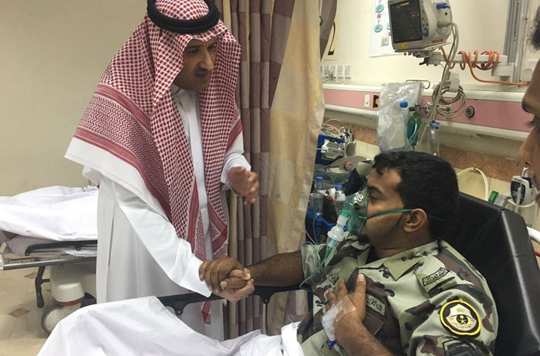
At least four Saudi security force members were killed and five wounded, when a suicide bomber, who was prevented from entering the Prophet's Mosque, Al-Haram Al-Nabawi, regarded as one of Islam's holiest sites, blew himself up.

“With Maghreb prayer drawing near on Monday in Madinah, security men suspected a man who was walking towards the Prophet's Mosque across an open area that is being used as a parking lot for visitors. When they tried to stop him, he blew himself up resulting in his death and the martyrdom of four security men. Meanwhile, five other security men were injured. May they recover quickly,”said Maj. Gen. Mansour Al-Turki, security spokesman of the Ministry of Interior.

Al Arabiya News Channel's correspondent said the suicide bombing took place near a security building parking lot between the city courtyard and the mosque, visited by millions every year.

The attack took place during Maghreb prayers, the time when Muslims break their fast during the holy month of Ramadan. The channel showed images of fire raging in a parking lot with at least one body seen nearby. The suicide bomber also died in the attack.

Before that at 2:15 a.m., a suicide bomber blew himself up near the US Consulate in Jeddah. Security officers endangered their lives and confronted him as he moved suspiciously at a parking lot of the Dr. Soliman Fakeih Hospital. It is learnt that the bomber's intention was to barge into the Consulate and kill maximum people. At least two policemen were wounded lightly in the attack. 

Also Read: Bomb explodes next to Prophet's Mosque as terrorists target Madinah after Jeddah, Qatif

1cop

Comments

Bopanna
 - 
Thursday, 7 Jul 2016

Assam, you are the sick one. I have read the Koran and I know that you are lying. It is mentioned that Mo \thighed\" aisha when she was 9 !!!"

Satyameva jayate
 - 
Thursday, 7 Jul 2016

Boppanna....what are you doing in ksa ..?
Forgot how many gopis Krishna had?
God's wife hijacked by ravana? And monkeys had to help....?
Mahabharata's....hot saree removal scenes?
God's head cut off n replaced by elephants......
God's fighting war cagainstc each other.....

you question about prophet Mohammed......try to learn your religion first and understand it with common sense and then question Islam.......

Bopanna
 - 
Tuesday, 5 Jul 2016

Truth ? Truth is that Mohamad is the worlds first terrorist.
What age did he marry Aisha ? 6 years !
He is not a normal human being

musthafa iruvailu
 - 
Tuesday, 5 Jul 2016

bopanna when you will come up with truth, atleast you cant reveal your real name. what you can teach about peace and reality. just come out from hellness mind

Satyameva jayate
 - 
Tuesday, 5 Jul 2016

At least now people realize that these terrorists are not Muslims....just fake named and Hired goons....

Satyameva jayate
 - 
Tuesday, 5 Jul 2016

Boppanna.......and what you will call our jawans daily dying in our borders....? Respect the martyrs dear......
Are you a Isis goon or saffron goon.....

ali
 - 
Tuesday, 5 Jul 2016

Hats off to Brave Police men. May Allah give patience to their family.

Add new comment

  • Coastaldigest.com reserves the right to delete or block any comments.
  • Coastaldigset.com is not responsible for its readers’ comments.
  • Comments that are abusive, incendiary or irrelevant are strictly prohibited.
  • Please use a genuine email ID and provide your name to avoid reject.
News Network
July 10,2020

Bengaluru, Jul 10: The Karnataka cabinet gave its approval for "The Karnataka Contingency Fund (Amendment) Bill, 2020" to enhance the contingency fund limit to Rs 500 crore in the wake of the COVID-19 pandemic.

This will be an ordinance making one time enhancement in the limit as the government needs money to make payments immediately, Law and Parliamentary Affairs Minister JC Madhuswamy told reporters after a cabinet meeting.

Under the contingency fund, the government had room to spend up to Rs 80 crore without budget provision.

"...but this time due to COVID-19 as we had to give money to some sections that were in distress like barbers, flower and vegetable growers, taxi drivers, among others, we have decided to increase the limit to Rs 500 crore," Mr Madhuswamy said.

"As assembly was not in session and as we had to make payments to those in distress immediately, this decision has been taken," he added.

The cabinet today ratified the administrative approval given to carry out civil and electrical works to install medical gas pipeline with high flow oxygen system at district hospitals, taluk and community health centres coming under Health and Family welfare department in view of COVID-19.

The minister said about Rs 207 crore is being approved for this purpose.

It also ratified procurement of medical equipment and furniture for public healthcare institutions of the health and family welfare department worth Rs 81.99 crore.

According to the minister, the cabinet has decided to bring in an amendment to section 9 of the Lokayukta act, which mandates that the preliminary inquiry contemplated by Lokayukta or Upalokayuta should be completed in 90 days and charge sheeting should be completed within six months.

Noting that at the Agricultural Produce Market Committee (APMC) cess was being collected, he said as the government had brought in an amendment to the APMC act, there was demand to reduce the market cess. "So we have reduced it from 1.5 per cent to one per cent."

Approval has also been given by the cabinet to bring Karnataka Vidyuth Kharkane (KAVIKA) and Mysore Electrical Industries (MEI), which are presently under the control of Commerce and Industries department, under administrative control of the energy department.

Other decisions taken by the cabibinet include deployment and implementation of "e-procurement 2.0" project on PPP at a cost of Rs 184.37 crore and ratification of the action taken to issue orders on March 24 to release interest free loan of Rs 2,500 crore to ESCOMs for payment of outstanding power purchase dues to generating companies.

The cabinet also gave administrative approval for setting up of an Indian Institute of Information technology at Raichur.

"Under this, we are committed to provide Rs 44.8 crore in four years for infrastructure," the minister added.

Comments

Add new comment

  • Coastaldigest.com reserves the right to delete or block any comments.
  • Coastaldigset.com is not responsible for its readers’ comments.
  • Comments that are abusive, incendiary or irrelevant are strictly prohibited.
  • Please use a genuine email ID and provide your name to avoid reject.
Media Release
February 14,2020

Veteran journalist P. Sainath has said that the nation is in a crisis. And this crisis is not limited to just the rural area. It has become a national crisis at various areas such as agriculture, education, economy, job creation etc.

He was delivering the endowment lecture on the topic ‘Indian democracy at the post-liberalization and post-truth era’ at Media Manthan 2020 organized by the PG department of journalism and mass communication at St Aloysius College (Autonomous). 

Mr Sainath said that the many policies adopted in the 90s led to India becoming unusually unequal. Referring to the speech Ambedkar had made at the Constituent Assembly while handing over the draft of the Constitution, Mr Sainath said, “Ambedkar had warned about the weakness of Indian democracy that liberty without equality allows the supremacy of a few over the multitude. Liberty, equality and fraternity must be kept together as we cannot have one without the other.” 

Mr Sainath stated that the agrarian crisis was no longer about the loss of productivity, employment or about farmer suicide; it was a societal, civilizational crisis. Commenting on the lopsided policies such as cow-slaughter ban, he explained how cow slaughter ban had adversely affected many industries due to their interdependency. While Muslims who slaughtered cows were rendered helpless, the cattle traders who were mostly OBCs lost their earnings as the cattle prices crashed. An important industry like Kolhapur sandals industry in Maharashtra went bankrupt as a result of the cow slaughter ban in Maharashtra. He said the policymakers had no idea how the rural industries were interconnected. Demonetisation too devastated the rural economy as 98 percent of rural transactions happen through cash. 

Mr Sainath also spoke about the crisis of inequality which affects the Dalits and the Adivasis far more than anyone else as 90 percent of the rural households take home less than Rs 10,000/- per month. “Women are yet another group whose labour is never counted in the gross domestic product. Women and girls globally do unpaid work which amounts to about 12.5 billion working hours per year. Monetarily speaking, this is worth 10.8 trillion dollars,” Mr Sainath added. 

Speaking about the crisis of jobs Mr Sainath said that major companies were laying off employees just to create more profits for the investors and the adoption of artificial intelligence in the industry would further destroy millions of jobs.

Rector of St Aloysius College Institutions Fr Dionysius Vaz SJ, Principal Dr (Fr) Praveen Martis SJ, HOD of Journalism and Mass Communication department Dr (Fr) Melwyn Pinto SJ were present.

‘Veerappan and Vijay Mallya’s business models are interesting!’

Addressing the gathering during his endowment lecture on Friday, Mr Sainath made an interesting comment on the so called ‘revenue model’. “Whenever I visit IIMs and IITs for lectures on my PARI project, the students there ask me what my revenue model for my project is. I tell them that I do not have a revenue model. In fact, journalism does not begin with a revenue model. Gandhiji, Ambedkar, Bhagat Singh were all great journalists. But they did not have a revenue model,” Mr Sainath said.

On a lighter note, he said that the best revenue model that he liked was that of forest brigand Veerappan and liquor baron Vijay Mallya. “Veerappan ruled the forest for forty years and from the top ministers to the villagers he could dictate terms and liver royally. Similarly, Mallya’s revenue model was to steal the banks and run away abroad and live like a king,” Mr Sainath added.

Journalism is not and can never be a business. It is a calling, he opined. While newspaper can be a business, television can be a business, journalism per se cannot be reduced to a business. “Unfortunately today, journalists are recruited on a contract basis and they have no bargaining power; and there are no unions to fight for their cause. Hence, they are at the mercy of the corporate media houses for their survival and are made to write stories that cannot be called journalism,” Mr Sainath said.

Answering a question as to the pressures he faced as a journalist, he said that external pressures from the government or others could be very well handled. It is the internal pressures from once own media house that journalists find it difficult to manage.


 

Comments

Add new comment

  • Coastaldigest.com reserves the right to delete or block any comments.
  • Coastaldigset.com is not responsible for its readers’ comments.
  • Comments that are abusive, incendiary or irrelevant are strictly prohibited.
  • Please use a genuine email ID and provide your name to avoid reject.
News Network
June 11,2020

Bengaluru, Jun 11: Most COVID-19 deaths in Karnataka occur when infected elderly people, those with Severe Acute Respiratory Illness (SARI) or any other symptoms delay reaching designated hospitals, a top official said.

Munish Moudgil, chief of COVID-19 War Room in the state, said most of those infected with the virus are brought to COVID-19 designated hospitals at a very late stage and recovery then becomes extremely tough.

He said about 65 per cent of those killed suffered from SARI and are aged above 60.

The death rate due to SARI is 43 per cent for those in the 40-60 age group, he said, releasing data on coronavirus deaths, to reporters.

In the same age group, the mortality due to Influenza Like Illness (ILI) was 17.4 per cent, whereas it is 11.1 per cent among people aged above 60 .

He said 25 per cent of symptomatic patients aged above 60 die due to the virus, while it was 10.7 per cent in the 40-60 age group.

The fatalities among those aged 60 is high even if they are asymptomatic, Mr Moudgil, who is secretary in the Department of Personnel and Administrative Reforms, said.

He said the average number of days spent at these hospitals by those who recovered is about 15 days, compared to 3.5 days for those who died of the virus.

Listen to the latest songs, only on JioSaavn.com

"Hence persons who are elderly and who have comorbidities or who have SARI must reach designated Covid hospitals at the earliest," Mr Moudgil said.

As of date, Karnataka has reported 69 COVID-19 deaths As many as 6,041 people have tested positive for COVID-19, including 2,862 discharges and 3,108 active cases.

Comments

Add new comment

  • Coastaldigest.com reserves the right to delete or block any comments.
  • Coastaldigset.com is not responsible for its readers’ comments.
  • Comments that are abusive, incendiary or irrelevant are strictly prohibited.
  • Please use a genuine email ID and provide your name to avoid reject.