Ullal: Murder attempt on youth; locals chase, catch one of the accused

[email protected] (CD Network)
July 13, 2016

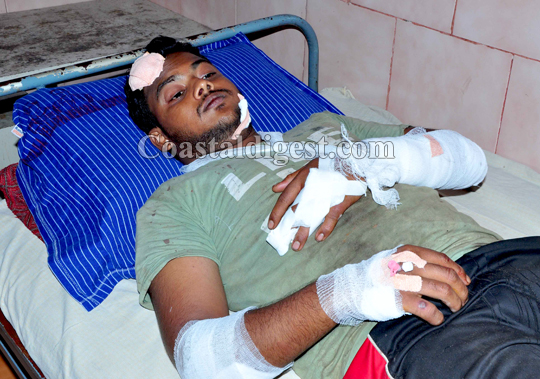
Mangaluru, Jul 13: A gang of three miscreants barged into a beef stall at Mastikatte area in Ullal on the outskirts of the city and attempted to murder a youth in the broad daylight on Wednesday.

murder 1

A severely injured Mohammad Kamaaluddin, 25, son of Nasir, a resident of Alekal, was rushed to a private hospital in Thokkottu for treatment after the attack.

The eye-witnesses have identified the assailants as Arfan, Mitha Nisar and Jafar, the three notorious men, who had allegedly robbed the same beef staff nearly a month ago during Ramadan.

They attacked Kamaaluddin with knife, iron rod and soda bottles and fled the scene before anyone could catch them.

According to sources, the reason for today's murderous attack was that Kamaaluddin had lodged a police complaint against trio and their associates after they allegedly barged into the beef stall in Ramadan, attacked him and other staff before fleeing with Rs 1,200.
Based on the complaint of Kamaaluddin, the Ullal police had nabbed one of the gang members, identified as Mukthar, who is still in custody.

Following this the other gang members had started issuing threats to Kamaaluddin and asked him to withdraw the complaint against them. Arfan's father Jaldi Siddiq, who is said to be a drug peddler, had also threatened to eliminate Kamaaluddin if he failed to withdraw complaint.

Kamaaluddin had reportedly brought this issue to the notice of the local police, who asked him to be careful. However, on Wednesday the three among the accused again barged into the beef stall and attempted to murder him.

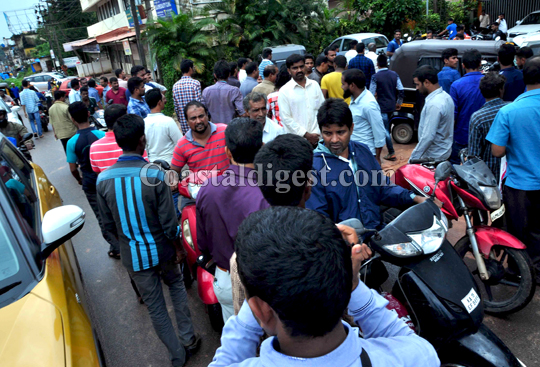
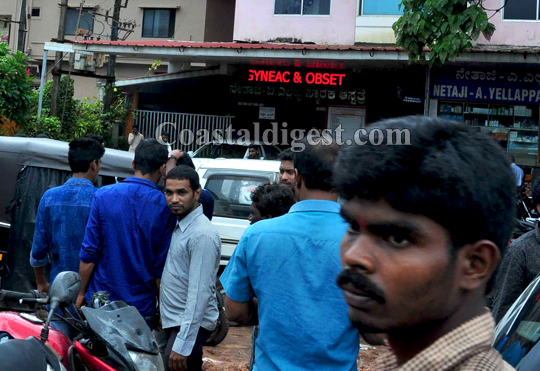
When the injured was admitted to the hospital, a few local residents saw Jaldi Siddiq there. He began to ran. However, locals chased for nearly one kilometre and caught him. He was then handed over to the police.

A case has been registered at Ullal police station in this regard and investigations are on.

murder 3

murder 4

murder 5

murder 2

=

Comments

suhail
 - 
Wednesday, 13 Jul 2016

In few more years... ullal will turn into mini mexico..... 90% of ullal youths are already into drugs.... Drug addict means.... murder.... robbery .... rape... dacoity.....parents of this youngsters are wholely responsible for this.... Save your children...

Rikaz
 - 
Wednesday, 13 Jul 2016

They are all butchers....

Mohammed Akram
 - 
Wednesday, 13 Jul 2016

Dont let the criminals out put them behind bars for lifetime, this kinds of elements are dangerous for the society.

swetha
 - 
Wednesday, 13 Jul 2016

Very easy for them to hack somebody to death.

Karanth
 - 
Wednesday, 13 Jul 2016

most of the people scare to enter this locality because of this goondas.

Karthik
 - 
Wednesday, 13 Jul 2016

Drug Peddling and gang wars are common in ullal.

Ajay
 - 
Wednesday, 13 Jul 2016

what they will get by harming someone very badly,

Sameer Ahmed
 - 
Wednesday, 13 Jul 2016

petty issue and this gang wanted to murder him. what happened to mankind, where they are leading.

Mahabali
 - 
Wednesday, 13 Jul 2016

This is very common in UT Khader's constituency. Yatha raaja thatha praja. god knows when our people will learn!

Fayaz
 - 
Wednesday, 13 Jul 2016

In ramadan time this gang stolen his beef stall. what kind of person they are, dogs from hell.

Priyanka
 - 
Wednesday, 13 Jul 2016

Why all the goondas and drug peddlers at large in ullal ? police department must be very alert in this areas.

Bindu
 - 
Wednesday, 13 Jul 2016

Running a beef stall is not a lesser crime than murder. they are murderers of kaamadhenu.

Mahesh
 - 
Wednesday, 13 Jul 2016

thank god that locals catch the attackers, and cleared the situation of communal violence.

Viren Kotian
 - 
Wednesday, 13 Jul 2016

cattle smugglers vs drug peddlers! let them fight and kill each other. who cares?

Add new comment

  • Coastaldigest.com reserves the right to delete or block any comments.
  • Coastaldigset.com is not responsible for its readers’ comments.
  • Comments that are abusive, incendiary or irrelevant are strictly prohibited.
  • Please use a genuine email ID and provide your name to avoid reject.
Ram Puniyani
February 10,2020

Noam Chomsky is one of the leading peace workers in the world. In the wake of America’s attack on Vietnam, he brought out his classic formulation, ‘manufacturing consent’. The phrase explains the state manipulating public opinion to have the public approve of it policies—in this case, the attack of the American state on Vietnam, which was then struggling to free itself from French colonial rule.

In India, we are witness to manufactured hate against religious minorities. This hatred serves to enhance polarisation in society, which undermines India’s democracy and Constitution and promotes support for a Hindu nation. Hate is being manufactured through multiple mechanisms. For example, it manifests in violence against religious minorities. Some recent ghastly expressions of this manufactured hate was the massive communal violence witnessed in Mumbai (1992-93), Gujarat (2002), Kandhamal (2008) and Muzaffarnagar (2013). Its other manifestation was in the form of lynching of those accused of having killed a cow or consumed beef. A parallel phenomenon is the brutal flogging, often to death, of Dalits who deal with animal carcasses or leather.

Yet another form of this was seen when Shambhulal Regar, indoctrinated by the propaganda of Hindu nationalists, burned alive Afrazul Khan and shot the video of the heinous act. For his brutality, he was praised by many. Regar was incited into the act by the propaganda around love jihad. Lately, we have the same phenomenon of manufactured hate taking on even more dastardly proportions as youth related to Hindu nationalist organisations have been caught using pistols, while police authorities look on.

Anurag Thakur, a BJP minster in the central government recently incited a crowd in Delhi to complete his chant of what should happen to ‘traitors of the country...” with a “they should be shot”. Just two days later, a youth brought a pistol to the site of a protest at Jamia Millia Islamia university and shouted “take Azaadi!” and fired it. One bullet hit a student of Jamia. This happened on 30 January, the day Nathuram Godse had shot Mahatma Gandhi in 1948. A few days later, another youth fired near the site of protests against the CAA and NRC at Shaheen Bagh. Soon after, he said that in India, “only Hindus will rule”.

What is very obvious is that the shootings by those associated with Hindu nationalist organisations are the culmination of a long campaign of spreading hate against religious minorities in India in general and against Muslims in particular. The present phase is the outcome of a long and sustained hate campaign, the beginning of which lies in nationalism in the name of religion; Muslim nationalism and Hindu nationalism. This sectarian nationalism picked up the communal view of history and the communal historiography which the British introduced in order to pursue their ‘divide and rule’ policy.

In India what became part of “social common sense” was that Muslim kings had destroyed Hindu temples, that Islam was spread by force, and that it is a foreign religion, and so on. Campaigns, such as the one for a temple dedicated to the Hindu god Rama to be built at the site where the Babri masjid once stood, further deepened the idea of a Muslim as a “temple-destroyer”. Aurangzeb, Tipu Sultan and other Muslim kings were tarnished as the ones who spread Islam by force in the subcontinent. The tragic Partition, which was primarily due to British policies, and was well-supported by communal streams also, was entirely attributed to Muslims. The Kashmir conflict, which is the outcome of regional, ethnic and other historical issues, coupled with the American policy of supporting Pakistan’s ambitions of regional hegemony, (which also fostered the birth of Al-Qaeda), was also attributed to the Muslims.

With recurring incidents of communal violence, these falsehoods went on going deeper into the social thinking. Violence itself led to ghettoisation of Muslims and further broke inter-community social bonds. On the one hand, a ghettoised community is cut off from others and on the other hand the victims come to be presented as culprits. The percolation of this hate through word-of-mouth propaganda, media and re-writing of school curricula, had a strong impact on social attitudes towards the minorities.

In the last couple of decades, the process of manufacturing hate has been intensified by the social media platforms which are being cleverly used by the communal forces. Swati Chaturvedi’s book, I Am a Troll: Inside the Secret World of the BJP’s Digital Army, tells us how the BJP used social media to spread hate. Whatapp University became the source of understanding for large sections of society and hate for the ‘Other’, went up by leaps and bounds. To add on to this process, the phenomenon of fake news was shrewdly deployed to intensify divisiveness.

Currently, the Shaheen Bagh movement is a big uniting force for the country; but it is being demonised as a gathering of ‘anti-nationals’. Another BJP leader has said that these protesters will indulge in crimes like rape. This has intensified the prevalent hate.

While there is a general dominance of hate, the likes of Shambhulal Regar and the Jamia shooter do get taken in by the incitement and act out the violence that is constantly hinted at. The deeper issue involved is the prevalence of hate, misconceptions and biases, which have become the part of social thinking.

These misconceptions are undoing the amity between different religious communities which was built during the freedom movement. They are undoing the fraternity which emerged with the process of India as a nation in the making. The processes which brought these communities together broadly drew from Gandhi, Bhagat Singh and Ambedkar. It is these values which need to be rooted again in the society. The communal forces have resorted to false propaganda against the minorities, and that needs to be undone with sincerity.

Combating those foundational misconceptions which create hatred is a massive task which needs to be taken up by the social organisations and political parties which have faith in the Indian Constitution and values of freedom movement. It needs to be done right away as a priority issue in with a focus on cultivating Indian fraternity yet again.


Comments

Add new comment

  • Coastaldigest.com reserves the right to delete or block any comments.
  • Coastaldigset.com is not responsible for its readers’ comments.
  • Comments that are abusive, incendiary or irrelevant are strictly prohibited.
  • Please use a genuine email ID and provide your name to avoid reject.
News Network
February 22,2020

Bengaluru, Feb 22: Thanks to joint efforts by the Protector of Emigrants in Bengaluru and Indian Embassy in Qatar, a 26-year-old woman from Karnataka who had been kept in confinement in Qatar has been rescued and brought back to India.

Anupama (name changed) from Holenarasipura in Hassan district arrived in Bengaluru on Thursday night. She was allegedly locked up in a house for 14 days, restrained from using a mobile and wasn't fed. There were three other women with her. On the midnight of February 12, they broke the window panes and fled before contacting local police.

Anupama, a diploma graduate in computer science, was jobless and her friend working in Kuwait suggested she try for a job abroad. She contacted an agency based in Chikkamagaluru which offered her a nanny's job in Qatar. After document verification, the agency demanded she pay Rs 2 lakh but she said she didn't have that kind of money.

The agency sent Anupama on a visitor visa but told her if questioned by immigration officials, she must claim she was visiting her sister. They also gave her a return ticket.

As Anupama was travelling abroad for the first time, she said she was ignorant about several things.

On January 12, Anupama left Bengaluru. But as she reached Qatar, all her documents, including passport, were confiscated by the agency. Her return ticket was cancelled and she was sent to a house to work as babysitter-cum-cook for Rs 30,000. She lived with four other maids in the same house, where they were made to work for 16-18 hours a day.

"I used to wake up around 5.30am every day and had to prepare breakfast for the employers by 6.30am. My work would end around 11pm every day. We never even got time to eat," Anupama told media on Friday. Four days into work, Anupama's nose started bleeding. However, the employers cared little and insisted she continue to work. After 18 days, she requested her employers that she be relieved.

The agency sent her to a house where three women were already present and locked her up with them. "They used to give us a glass of raw rice, an onion, tomato and potato to cook for ourselves. While we got rice every day, we had to use the vegetables for three days. We were not supposed to use mobiles or go out. Two people were monitoring us," she recalled.

Anupama and the others decided to approach police but for that they needed to escape. Around 1.30am on February 12, the four women managed to break window panes and jumped out. They ran for more than a kilometre and managed to approach police, who summoned the agency and got the women to speak to their families.

Anupama called her brother-in-law, who approached the Protector of Emigrants office in Koramangala, Bengaluru. Shubham Singh, PoE in Bengaluru, said they took up the issue with the Indian Embassy in Qatar, which immediately got in touch with Qatar police. Anupama said, "We were kept in prison for a couple of days and were sent to the deportation centre later."

Meanwhile, the Indian embassy got the agency to return the women's documents. However, the agents did not pay their salaries. Two of the women were sent to Hyderabad and the third to Kerala. On Friday, Anupama met Singh at his office, where her statement was recorded. "We have started the process of initiating action against the agency in India," he said.

Comments

Add new comment

  • Coastaldigest.com reserves the right to delete or block any comments.
  • Coastaldigset.com is not responsible for its readers’ comments.
  • Comments that are abusive, incendiary or irrelevant are strictly prohibited.
  • Please use a genuine email ID and provide your name to avoid reject.
News Network
January 20,2020

Chamarajanagara, Jan 20: Karnataka High Court Judge P G M Patil has said that it was the responsibility of the judiciary to ensure that justice was not delayed.

He was speaking at a function marking the inauguration of the first and second floors of the district courts in Chamarajanagar town here last evening. He said that the role of the judiciary was critical in establishing justice in society and hence all efforts must be made to ensure that there was no delay in securing justice.

He observed that the district court has been provided with better amenities that should be utilized for the benefit of the public. The district is no longer backward. It has shown progress and development in recent years and has produced three HC judges, Justice Patil added.

Comments

Add new comment

  • Coastaldigest.com reserves the right to delete or block any comments.
  • Coastaldigset.com is not responsible for its readers’ comments.
  • Comments that are abusive, incendiary or irrelevant are strictly prohibited.
  • Please use a genuine email ID and provide your name to avoid reject.