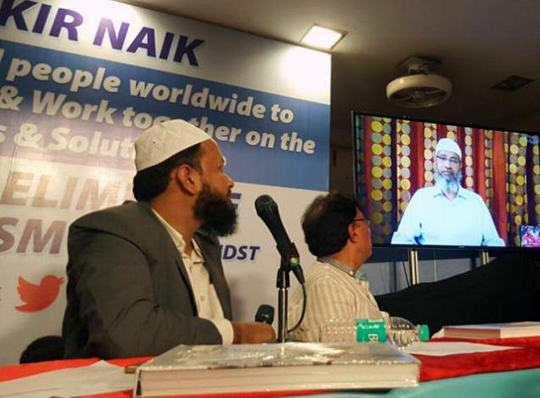
Always opposed terrorism; Ready to face any probe: Dr Zakir Naik

[email protected] (CD Network)
July 15, 2016

Mumbai, Jul 15: Rejecting allegations that his sermons “inspired” terror activity, physician-turned-preacher Dr Zakir Naik on Friday clarified that he never encouraged anyone to kill innocents and said he will cooperate with any probe agency if it approaches him.

ZakirNaik

Talking to media persons via Skype from Medinah, Dr Naik, who is facing the heat over allegations that he inspired some of the Dhaka cafe attackers, condemned all terror attacks and called himself as "a messenger of peace".

“I did not inspire any terrorist... suicide bombings targeting innocent people are condemnable,” Dr. Naik said, adding his statements on terrorism and suicide bombings were “doctored and tampered”.

He said that he has proof to refute all baseless allegations against him.

The Islamic preacher dismissed as “misinformation” that he had ever advocated suicide bombings, saying he always condemned them since innocent people get killed and this is “anti-Islam”.

“However, it (suicide attacks) may be used as a tactic of war to save the country. In all other circumstances where innocents are targeted, it is condemnable.”

The 50-year-old Mumbai-based televangelist, who had earlier cancelled a press conference and had announced his visit to Africa from Saudi Arabia putting off his return to the country, challenged anyone to show him an unedited answer wherein he has not condemned suicide bombings.

Dr Naik also maintained that no government agency has approached him to join investigation in connection with charges levelled against him until now.

“I am willing to cooperate with any probe agency if they approach me,” he added.

He also recalled that he had even addressed IPS officials in the past.

Dr. Naik also stated that he applied for permission to air Peace TV, run by his Islamic Research Foundation, in 2008, but did not get the same as the channel allegedly was “Islamic“.

He also said that terrorists are misguiding innocent Muslims.

Comments

Satyameva jayate
 - 
Friday, 15 Jul 2016

I love zakir Naik........I hate terrorism because of his words..Allah will protect him......it's Allah's promise for the ones who work for his path...

moshu
 - 
Friday, 15 Jul 2016

Only the enemy of peace hate Zakir Naik. Very simple . He is such a personality who cannot be defeated in religious debate. Few frustrated call him joker, few call terrorists and send him to pakistan. Actually these people are coward and afraid take his challenge.

TRUE INDIAN
 - 
Friday, 15 Jul 2016

SADHVI PRAGYA, BABU BAJRANGI INSPIRED BY WHO. ZAKIR NAIK OR MODI.

True indian
 - 
Friday, 15 Jul 2016

Bhagat singh killed a british police officer to save the country. And he is a patriotic and not a terrorist.

Zakir naik said the same. But this barking news on times now. Twisting his answers.

True indian
 - 
Friday, 15 Jul 2016

Bhagat singh killed a british police officer to save the country. And he is a patriotic and not a terrorist.

Zakir naik said the same. But this barking news on times now. Twisting his answers.

Add new comment

  • Coastaldigest.com reserves the right to delete or block any comments.
  • Coastaldigset.com is not responsible for its readers’ comments.
  • Comments that are abusive, incendiary or irrelevant are strictly prohibited.
  • Please use a genuine email ID and provide your name to avoid reject.
News Network
June 9,2020

Bengaluru, Jun 9: JD(S) patriarch H D Deve Gowda on Tuesday filed his nomination as party's candidate for June 19 Rajya Sabha elections from Karnataka.

The former Prime Minister was accompanied by his sons former Chief Minister H D Kumaraswamy and former Minister H D Revanna, state JD(S) chief H K Kumaraswamy and others, as he filed his papers at the office of Legislative Assembly Secretary M K Vishalakshi, who is the returning officer for the polls. JD(S) on Monday had announced that Gowda will be contesting the Rajya Sabha polls.

Announcing the decision, Kumaraswamy had said Gowda decided to contest following the request of Congress President Sonia Gandhi, several national leaders and party legislators, and it was not an easy task to "persuade" him to enter the Rajya Sabha.

The JD(S), which has 34 seats in the assembly, is not in a position to win a seat in Rajya Sabha on its own and will need support from the Congress with its surplus votes. A minimum of 45 votes are required for a candidate to win. If he wins, this will be the second Rajya Sabha entry for 87-year-old Gowda, the first time being in 1996 as the Prime Minister.

Gowda was defeated in Tumkur constituency by BJP's G S Basavaraj by over 13,000 votes in the 2019 Lok Sabha polls. As joint candidate of the then ruling Congress-JDS coalition, Gowda had chosen to contest from Tumkur at the last minute after vacating Hassan-his home turf, to grandson Prajwal Revanna (a current MP).

Election is scheduled on June 19 to fill four Rajya Sabha seats from Karnataka, represented by Rajeev Gowda and BK Hariprasad of Congress, Prabhakar Kore of the BJP and D Kupendra Reddy of JD(S) that will fall vacant on June 25, with their retirement. Today is the last date for filing nominations. With BJP not fielding any candidate against Gowda, his election is likely to be unanimous.

Comments

Add new comment

  • Coastaldigest.com reserves the right to delete or block any comments.
  • Coastaldigset.com is not responsible for its readers’ comments.
  • Comments that are abusive, incendiary or irrelevant are strictly prohibited.
  • Please use a genuine email ID and provide your name to avoid reject.
News Network
June 30,2020

Bengaluru, Jun 30: To instill confidence among its commuters, the Karnataka State Road Transport Corporation (KSRTC) has decided to put stamp on hand of all passengers before they are allowed to board the buses.

In a statement issued here on Tuesday, The decision was taken in the wake of a sudden jump in the number of COVID-19 cases reported from Bengaluru.

The round stamp is, however, different from 'home-quarantine' stamp applied to infected and they were not allowed to travel. Officials said that the measure is aimed at reassuring passengers that those travelling with them do not have symptoms. The left hand will be stamped with an ink which can be washed away by the time they reach home.

Comments

Add new comment

  • Coastaldigest.com reserves the right to delete or block any comments.
  • Coastaldigset.com is not responsible for its readers’ comments.
  • Comments that are abusive, incendiary or irrelevant are strictly prohibited.
  • Please use a genuine email ID and provide your name to avoid reject.
Media Release
February 14,2020

Veteran journalist P. Sainath has said that the nation is in a crisis. And this crisis is not limited to just the rural area. It has become a national crisis at various areas such as agriculture, education, economy, job creation etc.

He was delivering the endowment lecture on the topic ‘Indian democracy at the post-liberalization and post-truth era’ at Media Manthan 2020 organized by the PG department of journalism and mass communication at St Aloysius College (Autonomous). 

Mr Sainath said that the many policies adopted in the 90s led to India becoming unusually unequal. Referring to the speech Ambedkar had made at the Constituent Assembly while handing over the draft of the Constitution, Mr Sainath said, “Ambedkar had warned about the weakness of Indian democracy that liberty without equality allows the supremacy of a few over the multitude. Liberty, equality and fraternity must be kept together as we cannot have one without the other.” 

Mr Sainath stated that the agrarian crisis was no longer about the loss of productivity, employment or about farmer suicide; it was a societal, civilizational crisis. Commenting on the lopsided policies such as cow-slaughter ban, he explained how cow slaughter ban had adversely affected many industries due to their interdependency. While Muslims who slaughtered cows were rendered helpless, the cattle traders who were mostly OBCs lost their earnings as the cattle prices crashed. An important industry like Kolhapur sandals industry in Maharashtra went bankrupt as a result of the cow slaughter ban in Maharashtra. He said the policymakers had no idea how the rural industries were interconnected. Demonetisation too devastated the rural economy as 98 percent of rural transactions happen through cash. 

Mr Sainath also spoke about the crisis of inequality which affects the Dalits and the Adivasis far more than anyone else as 90 percent of the rural households take home less than Rs 10,000/- per month. “Women are yet another group whose labour is never counted in the gross domestic product. Women and girls globally do unpaid work which amounts to about 12.5 billion working hours per year. Monetarily speaking, this is worth 10.8 trillion dollars,” Mr Sainath added. 

Speaking about the crisis of jobs Mr Sainath said that major companies were laying off employees just to create more profits for the investors and the adoption of artificial intelligence in the industry would further destroy millions of jobs.

Rector of St Aloysius College Institutions Fr Dionysius Vaz SJ, Principal Dr (Fr) Praveen Martis SJ, HOD of Journalism and Mass Communication department Dr (Fr) Melwyn Pinto SJ were present.

‘Veerappan and Vijay Mallya’s business models are interesting!’

Addressing the gathering during his endowment lecture on Friday, Mr Sainath made an interesting comment on the so called ‘revenue model’. “Whenever I visit IIMs and IITs for lectures on my PARI project, the students there ask me what my revenue model for my project is. I tell them that I do not have a revenue model. In fact, journalism does not begin with a revenue model. Gandhiji, Ambedkar, Bhagat Singh were all great journalists. But they did not have a revenue model,” Mr Sainath said.

On a lighter note, he said that the best revenue model that he liked was that of forest brigand Veerappan and liquor baron Vijay Mallya. “Veerappan ruled the forest for forty years and from the top ministers to the villagers he could dictate terms and liver royally. Similarly, Mallya’s revenue model was to steal the banks and run away abroad and live like a king,” Mr Sainath added.

Journalism is not and can never be a business. It is a calling, he opined. While newspaper can be a business, television can be a business, journalism per se cannot be reduced to a business. “Unfortunately today, journalists are recruited on a contract basis and they have no bargaining power; and there are no unions to fight for their cause. Hence, they are at the mercy of the corporate media houses for their survival and are made to write stories that cannot be called journalism,” Mr Sainath said.

Answering a question as to the pressures he faced as a journalist, he said that external pressures from the government or others could be very well handled. It is the internal pressures from once own media house that journalists find it difficult to manage.


 

Comments

Add new comment

  • Coastaldigest.com reserves the right to delete or block any comments.
  • Coastaldigset.com is not responsible for its readers’ comments.
  • Comments that are abusive, incendiary or irrelevant are strictly prohibited.
  • Please use a genuine email ID and provide your name to avoid reject.