Mangaluru city police launches dedicated web portal, mobile app

[email protected] (CD Network)
April 7, 2015

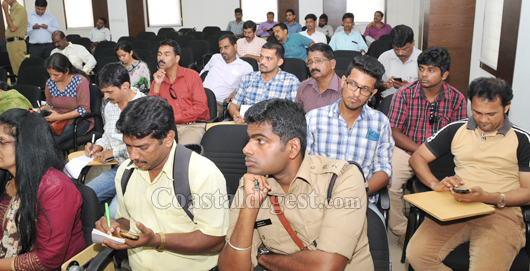
Mangaluru, Apr 7: Five years after the formation of the police commissionerate, Mangaluru city police on Tuesday launched a dedicated web portal to give people online access to the police department.

police app1

Director General and Inspector-General of Police (DG&IGP) Om Prakash formally inaugurated the website www.mangalorecitypolice.com in the presence of IGP (Western Range) Amrit Paul and Mangaluru City Police Commissioner S Murugan on Tuesday, along with launching a new user-friendly mobile application for Android phones for traffic related concerns.

Web portal with FAQs, online forms

The new dedicated website provides details such as contact numbers of top police officials such as the police commissioner, deputy police commissioner and assistant police commissioner along with those of inspectors of all police stations.

Speaking after the inauguration of the web portal, DCP (Law & Order) K Santosh Babu told mediapersons that all application forms pertaining to permits would be available online for the convenience of citizens. The website will also contain a section on frequently asked questions (FAQs), along with which there will be a facility for people to report incidents occurring in the city commissionerate limits with information and images, he said.

One-of-its-kind mobile app

The Mangaluru City Police also launched an app which will be shortly available in Google Play store on Android phones.

DCP Santosh Babu said that the app would primarily include six sections such as – Traffic Offence, Live Traffic, Emergency, Traffic Signs, Report Incident and Contact numbers.

One interesting feature in the app is the option available to view ‘Live Traffic’ – which will show the user convenient traffic routes to get around in Mangaluru city at real-time and also show if chosen routes were congested with traffic.

Similar to the option imbedded in the web portal, the option ‘Report Incident’ can be used to report traffic emergencies or violations directly to top police officials such as police commissioner, two deputies and police control room with information and images.

Besides this, people also can get helpline numbers like women help lines, child help line, fire service, ambulance, control etc.

After inaugurating the web portal, Mr Om Prakash told mediapersons that the demand for three new police stations in Mangaluru city police commissionerate limits (Traffic South, Kaikamba and Jeppu) would be taken into consideration.

With regard to the demands of retired police personnel, he said that the department had formed a committee to go through details of new schemes that could accommodate the demands of retired police personnel, since Arogya Bhagya could not be extended to such personnel.

commissioner ofc 7 1

commissioner ofc 7 1

commissioner ofc 7 1

commissioner ofc 7 1

commissioner ofc 7 1

commissioner ofc 7 1

Comments

Add new comment

  • Coastaldigest.com reserves the right to delete or block any comments.
  • Coastaldigset.com is not responsible for its readers’ comments.
  • Comments that are abusive, incendiary or irrelevant are strictly prohibited.
  • Please use a genuine email ID and provide your name to avoid reject.
News Network
June 6,2020

Jun 6: Private sector lender Karnataka Bank has reported to the RBI that it has been defrauded of over Rs 285 crore consequent to loans gone bad to four entities including DHFL.

A total of Rs 285.52 crore has been reported as fraud wherein the bank was one of the consortium lenders during 2009 to 2014 to Dewan Housing Finance Corporation Ltd (DHFL), Religare Finvest, Fedders Electric and Engineering Ltd and Leel Electricals Ltd, Karnataka Bank said in a regulatory filing on Friday.

The maximum is owed by DHFL at Rs 180.13 crore, followed by Religare Finvest Rs 43.44 crore, Fedders Electric Rs 41.30 crore and Leel Electricals Rs 20.65 crore.

"DHFL (defaulted entity) dealing with us since 2014 had availed various credit facilities under consortium arrangement wherein, we were one of the member banks. In view of Early Warning Signals (EWS) in the conduct of the account and other developments, the account was red flagged on November 11, 2019.

"The borrowing account was classified as Non-Performing Asset on October 30, 2019 and now, for misappropriation & criminal breach of trust & diversion of funds in the credit facilities extended earlier to the company, a fraud amounting Rs 180.13 crore has been reported to RBI," Karnataka Bank said.

Likewise, Religare Finvest Ltd (RFL) was dealing with the bank since 2014, availing various credit facilities.

Following classification of this account as non-performing in October 2019 by a consortium member, Karnataka Bank reported to RBI a fraud amounting to Rs 43.44 crore in the credit facilities extended earlier, on account of diversion of funds.

Leel Electricals was classified as NPA account in March 2019 and it reported to RBI a fraud amounting to Rs 20.65 crore in the credit facilities to the company on account of diversion of funds.

"In all the referred three non-performing accounts, necessary provisions have been made in full to be spread across four quarters," it said.

Fedders Electric and Engineering Limited was reported as NPA in July 2018 by a member bank in consortium, subsequent to which Karnataka Bank reported fraud of Rs 41.30 crore on account of fund diversion.

The account has already been fully provided for, it added.

Comments

Add new comment

  • Coastaldigest.com reserves the right to delete or block any comments.
  • Coastaldigset.com is not responsible for its readers’ comments.
  • Comments that are abusive, incendiary or irrelevant are strictly prohibited.
  • Please use a genuine email ID and provide your name to avoid reject.
News Network
January 27,2020

New Delhi, Jan 27: Non-Muslim refugees from Pakistan, Bangladesh and Afghanistan will have to provide proofs of their religious beliefs while applying for Indian citizenship under the controversial Citizenship Amendment Bill (CAA), officials said on Monday.

The applicants belonging to Hindu, Sikh, Christian, Buddhist, Jain or Parsi faiths will also have to furnish documents to prove that they entered India on or before December 31, 2014.

Those who will seek Indian citizenship under the CAA will have to provide proofs of their religious beliefs and this will be mentioned in the rules to be issued under the CAA, a government official said.

According to the CAA, members of Hindu, Sikh, Buddhist, Jain, Parsi and Christian communities who have come from Pakistan, Bangladesh and Afghanistan till December 31, 2014, due to religious persecution there will not be treated as illegal immigrants and will be given Indian citizenship.

The central government is also likely to give a relatively smaller window of just three months to those who want to apply for Indian citizenship in Assam under the CAA, another official said.

Some Assam-specific provisions are expected to be incorporated in the rules to be issued for the implementation of the CAA.

Assam chief minister Sarbananda Sonowal and his finance minister Himanta Biswa Sarma had made a request about a fortnight ago to keep a limited period window for applying under the CAA and also incorporate some other Assam-specific provisions in the CAA rules.

The move comes in view of continuing protests against the CAA in Assam that have been going on since the legislation was passed by Parliament in December last year.

There has been a growing feeling among the indigenous people of Assam that the newly enacted legislation will hurt their interests politically, culturally as well as socially.

The Assam Accord provides for detection and deportation of all illegal immigrants who have entered the country after 1971 and are living in the state, irrespective of their religion.

The protesters in Assam say that the CAA violates the provisions of the Assam Accord.

Comments

Add new comment

  • Coastaldigest.com reserves the right to delete or block any comments.
  • Coastaldigset.com is not responsible for its readers’ comments.
  • Comments that are abusive, incendiary or irrelevant are strictly prohibited.
  • Please use a genuine email ID and provide your name to avoid reject.
News Network
July 28,2020

Hounde, Jul 28: Coronavirus and its restrictions are pushing already hungry communities over the edge, killing an estimated 10,000 more young children a month as meager farms are cut off from markets and villages are isolated from food and medical aid, the United Nations warned Monday.

In the call to action shared with The Associated Press ahead of publication, four UN agencies warned that growing malnutrition would have long-term consequences, transforming individual tragedies into a generational catastrophe.

Hunger is already stalking Haboue Solange Boue, an infant from Burkina Faso who lost half her former body weight of 5.5 pounds (2.5 kilograms) in just a month. Coronavirus restrictions closed the markets, and her family sold fewer vegetables. Her mother was too malnourished to nurse.

“My child,” Danssanin Lanizou whispered, choking back tears as she unwrapped a blanket to reveal her baby's protruding ribs.

More than 550,000 additional children each month are being struck by what is called wasting, according to the UN — malnutrition that manifests in spindly limbs and distended bellies. Over a year, that's up 6.7 million from last year's total of 47 million. Wasting and stunting can permanently damage children physically and mentally.

“The food security effects of the COVID crisis are going to reflect many years from now,” said Dr. Francesco Branca, the WHO head of nutrition. “There is going to be a societal effect.”

From Latin America to South Asia to sub-Saharan Africa, more poor families than ever are staring down a future without enough food.

In April, World Food Program head David Beasley warned that the coronavirus economy would cause global famines “of biblical proportions” this year. There are different stages of what is known as food insecurity; famine is officially declared when, along with other measures, 30% of the population suffers from wasting.

The World Food Program estimated in February that one Venezuelan in three was already going hungry, as inflation rendered salaries nearly worthless and forced millions to flee abroad. Then the virus arrived.

“Every day we receive a malnourished child,” said Dr. Francisco Nieto, who works in a hospital in the border state of Tachira.

In May, Nieto recalled, after two months of quarantine, 18-month-old twins arrived with bodies bloated from malnutrition. The children's mother was jobless and living with her own mother. She told the doctor she fed them only a simple drink made with boiled bananas.

“Not even a cracker? Some chicken?” he asked.

“Nothing,” the children's grandmother responded. By the time the doctor saw them, it was too late: One boy died eight days later.

The leaders of four international agencies — the World Health Organization, UNICEF, the World Food Program and the Food and Agriculture Organization — have called for at least dollar 2.4 billion immediately to address global hunger.

But even more than lack of money, restrictions on movement have prevented families from seeking treatment, said Victor Aguayo, the head of UNICEF's nutrition program.

“By having schools closed, by having primary health care services disrupted, by having nutritional programs dysfunctional, we are also creating harm,” Aguayo said. He cited as an example the near-global suspension of Vitamin A supplements, which are a crucial way to bolster developing immune systems.

In Afghanistan, movement restrictions prevent families from bringing their malnourished children to hospitals for food and aid just when they need it most. The Indira Gandhi hospital in the capital, Kabul, has seen only three or four malnourished children, said specialist Nematullah Amiri. Last year, there were 10 times as many.

Because the children don't come in, there's no way to know for certain the scale of the problem, but a recent study by Johns Hopkins University indicated an additional 13,000 Afghans younger than 5 could die.

Afghanistan is now in a red zone of hunger, with severe childhood malnutrition spiking from 690,000 in January to 780,000 — a 13% increase, according to UNICEF.

In Yemen, restrictions on movement have blocked aid distribution, along with the stalling of salaries and price hikes. The Arab world's poorest country is suffering further from a fall in remittances and a drop in funding from humanitarian agencies.

Yemen is now on the brink of famine, according to the Famine Early Warning Systems Network, which uses surveys, satellite data and weather mapping to pinpoint places most in need.

Some of the worst hunger still occurs in sub-Saharan Africa. In Sudan, 9.6 million people live from one meal to the next — a 65% increase from the same time last year.

Lockdowns across Sudanese provinces, as around the world, have dried up work and incomes for millions. With inflation hitting 136%, prices for basic goods have more than tripled.

“It has never been easy but now we are starving, eating grass, weeds, just plants from the earth,” said Ibrahim Youssef, director of the Kalma camp for internally displaced people in war-ravaged south Darfur.

Adam Haroun, an official in the Krinding camp in west Darfur, recorded nine deaths linked with malnutrition, otherwise a rare occurrence, over the past two months — five newborns and four older adults, he said.

Before the pandemic and lockdown, the Abdullah family ate three meals a day, sometimes with bread, or they'd add butter to porridge. Now they are down to just one meal of “millet porridge” — water mixed with grain. Zakaria Yehia Abdullah, a farmer now at Krinding, said the hunger is showing “in my children's faces.”

“I don't have the basics I need to survive,” said the 67-year-old, who who hasn't worked the fields since April. “That means the 10 people counting on me can't survive either.”


Comments

Add new comment

  • Coastaldigest.com reserves the right to delete or block any comments.
  • Coastaldigset.com is not responsible for its readers’ comments.
  • Comments that are abusive, incendiary or irrelevant are strictly prohibited.
  • Please use a genuine email ID and provide your name to avoid reject.