The trees I planted have paid me dividends in a different way: Thimmakka

[email protected] (CD Network | Photos by Suresh)
July 25, 2016

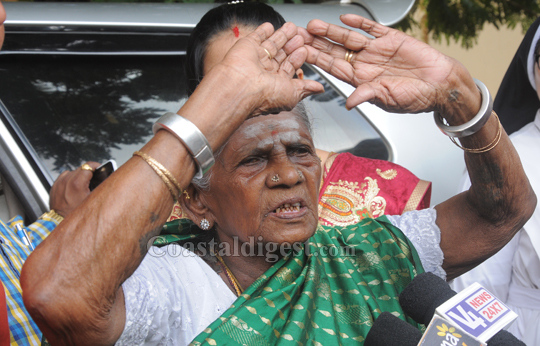
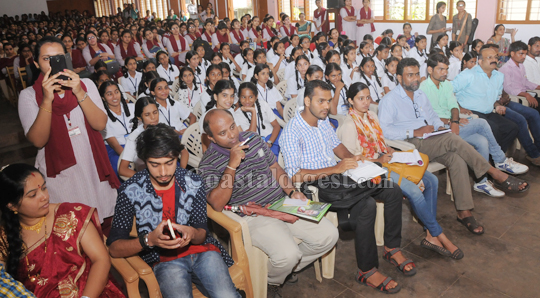
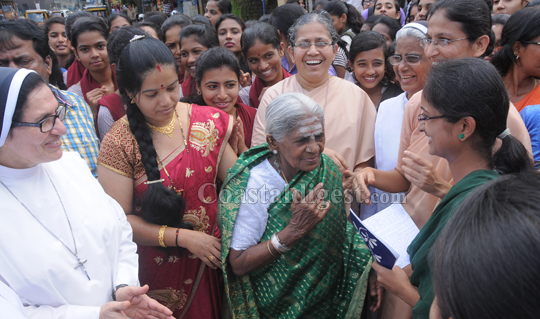
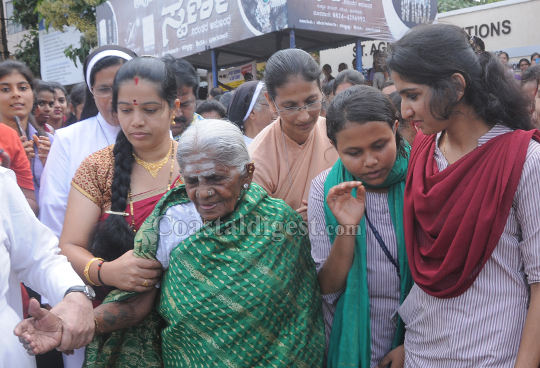
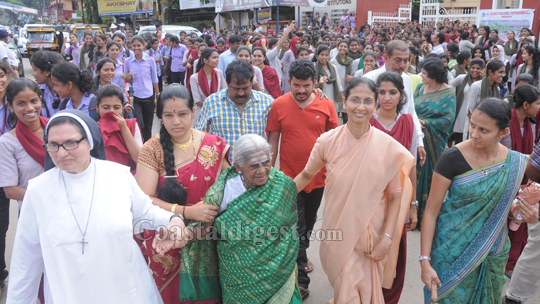
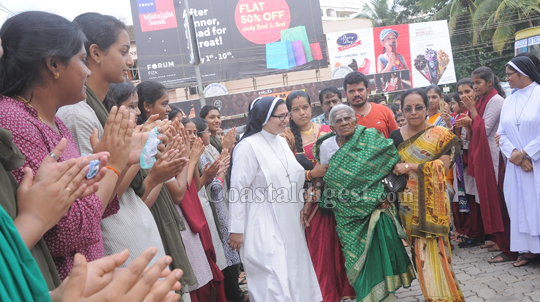
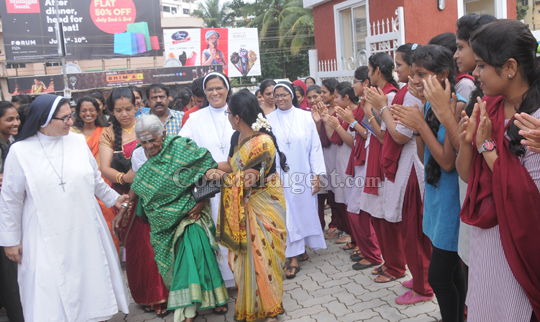
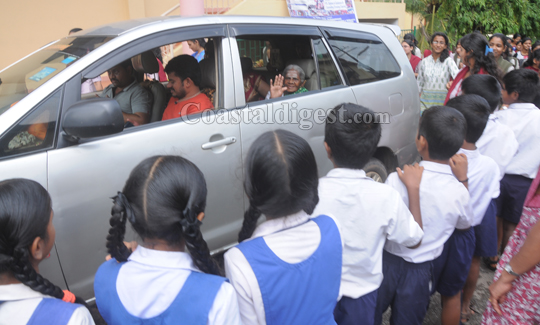
Mangaluru, Jul 25: “I and my husband had planted trees on both sides of the four kilometers of road in my place. We did not waited for any one's help or assistant. In the days of utter poverty we were self-motivated and wanted to fill the void of not having children,” said, environmental activist of international fame SaluMarada Thimmakka, today at Besant Women's College, here.

thimmakka 1

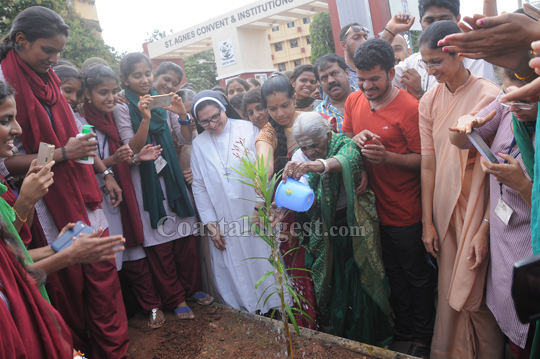
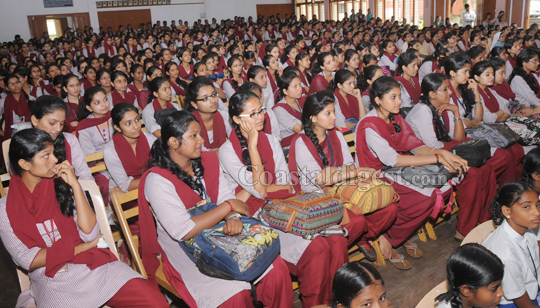
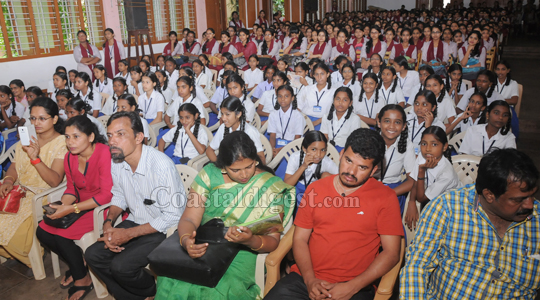
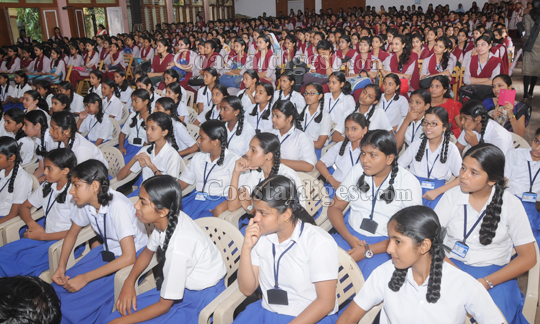
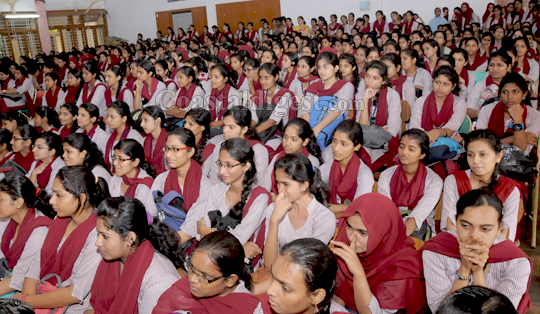
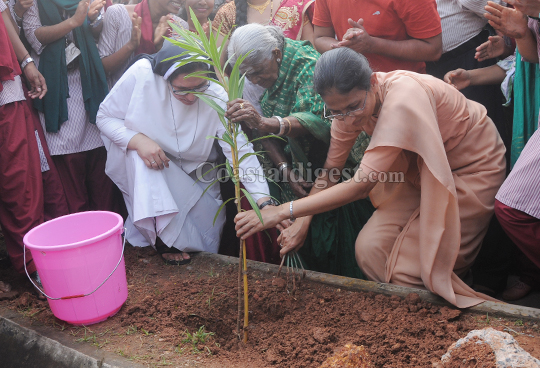
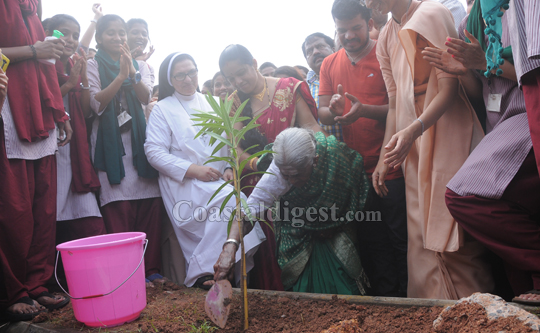
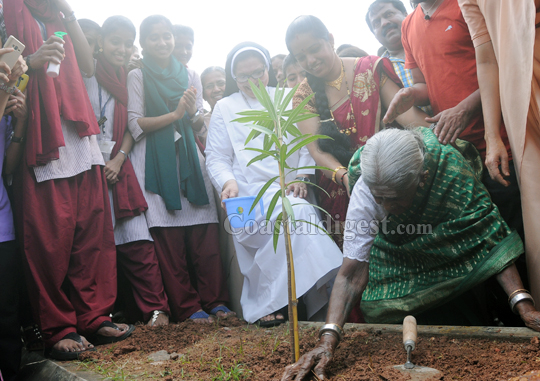
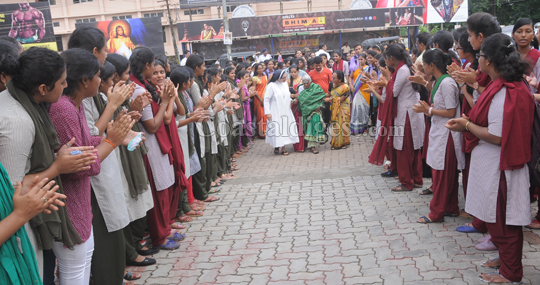
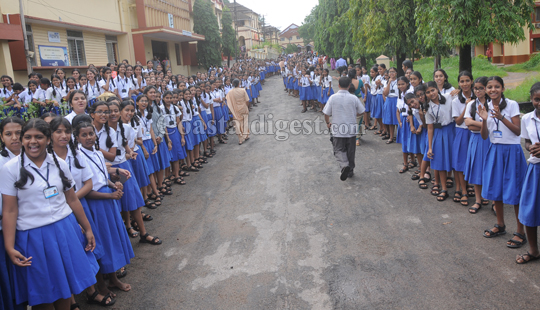
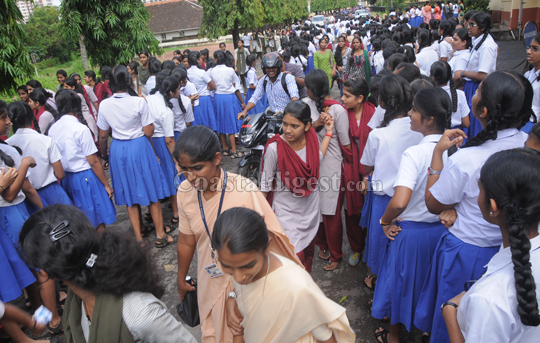
She was addressing the gathering of students after inaugurating Environment club. She planted and watered a sapling in a pot on the dais to inspire NSS students who function as' Green Army' in the college.

“The trees I planted have paid dividends to me in a different way. They, besides giving me satisfaction have provided the whole of the environment there with fresh air and shade. I can also say that the trees are the best things to leave back when we move on,” she said.

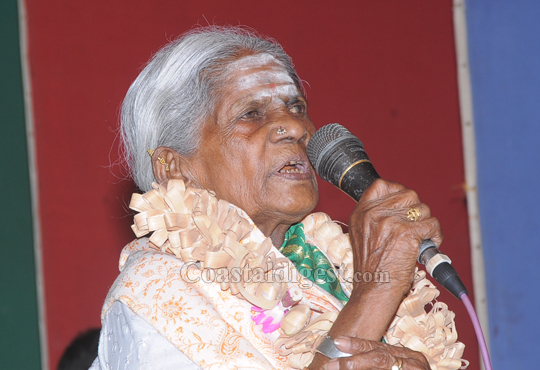
She, on the occasion sang a folk song to explain how nature provided for all its creatures without discrimination. Her son Umesh B.N. who spoke on the occasion said, modern citizens have all the gadgets but lack fresh air.

Technology cannot create clean environment it has to come from tress. We Indians who worshiped nature once have now forgotten is value. He added, Thimmakka is already 105 years old is not a permanent figure the generation next must take inspiration from her and join in protecting trees.

College principal Dr.Sathish Kumar Shetty P. said, Thimmkka's visit has brought in a new hope and has inspired the students to be active in protecting nature.

Shyam Sundar Kamath, Secretary, WNES, presented the college emblem, a traditional brass lamp to Thimmakka. Environmentalist Dinesh Hollaand Thimakka's family members were present among the audience. Girish Kumar, Convenor of Environment Club welcomed, Prof. Jayashree NSS Co-ordinator thanked. Students, Apoorva J.K invoked and Kavana compeered.

thimmakka 15

thimmakka 3

thimmakka 4

thimmakka 5

thimmakka 6

thimmakka 7

thimmakka 8

thimmakka 9

thimmakka 10

thimmakka 11

thimmakka 12

thimmakka 13

thimmakka 14

thimmakka 16

thimmakka 17

thimmakka 18

thimmakka 19

thimmakka 20

thimmakka 21

thimmakka 2

Comments

TRUTH WILL
 - 
Tuesday, 26 Jul 2016

Masha ALLAH productive work...

Prophet Muhammad pbuh said :
There is none amongst the Muslims who Plants a tree or sow seeds, and then a bird or a person or an animal eats from it, But is regarded as a Charitable gift for him.

Even if you fear that the last day has arrived, plant the sapling you hold in your hand.

suleman beary
 - 
Tuesday, 26 Jul 2016

Great Thimmakka....your bangles are very attractive.

Add new comment

  • Coastaldigest.com reserves the right to delete or block any comments.
  • Coastaldigset.com is not responsible for its readers’ comments.
  • Comments that are abusive, incendiary or irrelevant are strictly prohibited.
  • Please use a genuine email ID and provide your name to avoid reject.
News Network
June 26,2020

Bengaluru, Jun 26: Karnataka Congress president DK Shivakumar on Thursday suggested that the cost of building and installing a new statue of Nada Prabhu Kempegowda in the Bengaluru airport should be borne by Kempegowda international airport (KIAL).

Shivakumar wrote to Chief Minister BS Yediyurappa and welcomed the decision of erecting a statute of Bengaluru founder Kempegowda at KIAL but he also suggested that the chief minister should not spend state government's money on this.

He said that the Karnataka government has done many favours to airport authority earlier.

Comments

Add new comment

  • Coastaldigest.com reserves the right to delete or block any comments.
  • Coastaldigset.com is not responsible for its readers’ comments.
  • Comments that are abusive, incendiary or irrelevant are strictly prohibited.
  • Please use a genuine email ID and provide your name to avoid reject.
Ram Puniyani
January 14,2020

In the beginning of January 2020 two very disturbing events were reported from Pakistan. One was the attack on Nankana Sahib, the holy shrine where Sant Guru Nanak was born. While one report said that the place has been desecrated, the other stated that it was a fight between two Muslim groups. Prime Minister of Pakistan Imran Khan condemned the incident and the main accused Imran Chisti was arrested. The matter related to abduction and conversion of a Sikh girl Jagjit Kaur, daughter of Pathi (One who reads Holy Guru Granth Sahib in Gurudwara) of the Gurudwara. In another incident one Sikh youth Ravinder Singh, who was out on shopping for his marriage, was shot dead in Peshawar.

While these condemnable attacks took place on the Sikh minority in Pakistan, BJP was quick enough to jump to state that it is events like this which justify the Citizenship Amendment Act (CAA). Incidentally CAA is the Act which is discriminatory and relates to citizenship with Religion, which is not as per the norms of Indian constitution. There are constant debates and propaganda that population of Hindus has come down drastically in Pakistan and Bangla Desh. Amit Shah, the Home minister stated that in Pakistan the population of Hindus has come down from 23% at the time of partition to 3.7% at present. And in Bangla Desh it has come down from 22% to present 8%.

While not denying the fact that the religious minorities are getting a rough deal in both these countries, the figures which are presented are totally off the mark. These figures don’t take into consideration the painful migrations, which took place at the time of partition and formation of Bangla Desh later. Pakistan census figures tell a different tale. Their first census was held in 1951. As per this census the overall percentage of Non Muslim in Pakistan (East and West together) was 14.2%, of this in West Pakistan (Now Pakistan) it was 3.44 and in Eat Pakistan it was 23.2. In the census held in Pakistan 1998 it became 3.72%. As far as Bangla Desh is concerned the share of Non Muslims has gone down from 23.2 (1951) to 9.6% in 2011.

The largest minority of Pakistan is Ahmadis, (https://minorityrights.org/country/pakistan/) who are close to 4 Million and are not recognised as Muslims in Pakistan. In Bangla Desh the major migrations of Hindus from Bangla Desh took place in the backdrop of Pakistan army’s atrocities in the then East Pakistan.

As far as UN data on refugees in India it went up by 17% between 2016-2019 and largest numbers were from Tibet and Sri Lanka.  (https://www.un.org/en/development/desa/population/migration/publication…)

The state of minorities is in a way the index of strength of democracy. Most South Asian Countries have not been able to sustain democratic values properly. In Pakistan, the Republic began with Jinnah’s classic speech where secularism was to be central credo of Pakistan. This 11th August speech was in a way what the state policy should be, as per which people of all faiths are free to practice their religion. Soon enough the logic of ‘Two Nation theory” and formation of Pakistan, a separate state for Muslim took over. Army stepped in and dictatorship was to reign there intermittently. Democratic elements were suppressed and the worst came when Zia Ul Haq Islamized the state in collusion with Maulanas. The army was already a strong presence in Pakistan. The popular formulation for Pakistan was that it is ruled by three A’s, Army, America and Allah (Mullah).

Bangla Desh had a different trajectory. Its very formation was a nail in the coffin of ‘two nation theory’; that religion can be the basis of a state. Bangla Desh did begin as a secular republic but communal forces and secular forces kept struggling for their dominance and in 1988 it also became Islamic republic. At another level Myanmar, in the grip of military dictatorship, with democratic elements trying to retain their presence is also seeing a hard battle. Democracy or not, the army and Sanghas (Buddhist Sang has) are strong, in Myanmar as well. The most visible result is persecution of Rohingya Muslims.

Similar phenomenon is dominating in Sri Lanka also where Budhhist Sanghas and army have strong say in the political affairs, irrespective of which Government is ruling. Muslim and Christian minorities are a big victim there, while Tamils (Hindus, Christians etc.) suffered the biggest damage as ethnic and religious minorities. India had the best prospect of democracy, pluralism and secularism flourishing here. The secular constitution, the outcome of India’s freedom struggle, the leadership of Gandhi and Nehru did ensure the rooting of democracy and secularism in a strong way.

India so far had best democratic credentials amongst all the south Asian countries. Despite that though the population of minorities rose mainly due to poverty and illiteracy, their overall marginalisation was order of the day, it went on worsening with the rise of communal forces, with communal forces resorting to identity issues, and indulging in propaganda against minorities.

While other South Asian countries should had followed India to focus more on infrastructure and political culture of liberalism, today India is following the footsteps of Pakistan. The retrograde march of India is most visible in the issues which have dominated the political space during last few years. Issues like Ram Temple, Ghar Wapasi, Love Jihad, Beef-Cow are now finding their peak in CAA.

India’s reversal towards a polity with religion’s identity dominating the political scene was nicely presented by the late Pakistani poetess Fahmida Riaz in her poem, Tum bhi Hum Jaise Nikle (You also turned out to be like us). While trying to resist communal forces has been an arduous task, it is becoming more difficult by the day. This phenomenon has been variously called, Fundamentalism, Communalism or religious nationalism among others. Surely it has nothing to do with the religion as practiced by the great Saint and Sufi traditions of India; it resorts mainly to political mobilization by using religion as a tool.

Comments

Ashi
 - 
Tuesday, 14 Jan 2020

If Malaysia implement similar NRC/CAA, India and China are the loser.

Add new comment

  • Coastaldigest.com reserves the right to delete or block any comments.
  • Coastaldigset.com is not responsible for its readers’ comments.
  • Comments that are abusive, incendiary or irrelevant are strictly prohibited.
  • Please use a genuine email ID and provide your name to avoid reject.
News Network
April 12,2020

Raipur, Apr 12: As many as 108 out of the 159 people that were quarantined by the Chhattisgarh government last week for allegedly taking part in Delhi’s Tablighi Jamaat congregation are Hindus, according to reliable sources. 

The names of these 159 people, who were said to be in Delhi’s Nizamuddin area when the Tablighi Jamaat congregation was held mid-March, were mentioned in a list issued by the state home department last month. 

The list has been accessed by the many media outlets. But, Raipur Collector S. Bharti Dasan and the state’s Principal Secretary, Home, Subrata Sahu, claimed no such list was issued.

However, a senior state home department official, who didn’t want to be named, said: “Listing of the names was done on the basis of location of mobile phones traced in Nizamuddin in the month of March during the period when congregation of Tablighi Jamaat was held.

“It was subsequently sent to the chief medical officers in the respective districts for further action,” the official added.

These 159 people have either been quarantined at their homes or at government isolation centres. The quarantine exercise took place between 31 March and 1 April.

Interestingly, almost all the people named in the list have denied attending the massive Jamaat congregation, which had seen the participation of over 3,000 people, including foreigners.

Under quarantine “forcefully”, these people alleged they are facing social boycott as they have been “linked to the Tablighi”.

Those placed under quarantine, told media if their phone locations have shown their presence in the Nizamuddin area that didn’t necessarily mean they had attended the Tablighi congregation.

“My neighbours are no longer like my family. After 31 March, I have received more than 500 calls (from relatives and friends) and had to convince them that I didn’t attend the Jamaat event,” Umesh Pandey, a resident of Ambikapur, said.

“People in my area have started saying that some Brahmins took part in the event. I have no objection to being kept in quarantine, but it should be explained why it is being done,” said Pandey, who is a consumer rights activist.

Pandey said, like every year, he had gone to Delhi in March to participate in a consumer protection programme and had stayed at a hotel in Nizamuddin. “I came back on 17 March. After I was quarantined, a false propaganda is being spread about me that I am linked with Tablighi Jamaat activities.”

Pandey said he and his family are now being “looked at as suspects”. 

Kamal Kumar Popatani, a businessman from Bilaspur district, has faced similar problems. Popatani and his family have been living in isolation since 31 March.

“I am completely flabbergasted by this step taken by the state government. I always visit Delhi to procure items for my shop. This time too I had completed my procurement and had returned home on 16 March. Everything was usual till 30 March, but suddenly after 31 March, when this so-called list of 159 alleged suspects was released by the government, we were placed under isolation,” Popatani said.

“My own family members, neighbours and everyone I know are now accusing me that I had joined the Tabligi Jamaat gathering. How can it ever happen? This strange attitude of the government has made my entire family a victim of social boycott.”

Trader Abdul Rahman, a resident of Lutra Sharif area of Bilaspur district, also echoed similar sentiments.

“I returned from Delhi along with my wife on 15 March, but my entire family has been kept in isolation since 31 March. All this is way beyond my comprehension… Blood samples of the entire family were taken. Now everyone is keeping a distance from us and calling us corona suspects,” said Rahman, who had gone to Delhi for a holiday.

“People not only from my village but also in the nearby villages are pointing fingers at me and my family… We are the ones who condemn Tablighi Jamaat and their activities. We have nothing to do with them. The quarantine… has brought…infamy to us,” he added.

In another goof-up, the list even includes names of some people who no longer live in the state but carried mobile numbers issued in Chhattisgarh. One such name is that of BSF sub-inspector Shantanu Mukherjee, who was working in Bhilai about two years ago, but is currently posted in Delhi.

“What kind of list is this? Who released it in the first place? At first, I received a call from the Covid-19 control room in Chhattisgarh and then from the State Police Control Centre. They inquired about my health and current place of posting,” said Mukherjee, whose office is located close to the Nizamuddin area. 

Makkhan Singh Yadav, a sub-inspector with the CRPF, is another case in point. Yadav, who is posted somewhere close to Nizamuddin, had bought a SIM card from Dantewada, when he was posted there five years ago.

“I had received calls from both Delhi and Chhattisgarh police after being marked as a corona suspect. But when I explained the reality to them, no calls were made thereafter. I could not understand how all this is taking place,” said Yadav, who is a native of Rampur, Uttar Pradesh.

A first-year Delhi University student, who belongs to Mahasamund district of Chhattisgarh, has been kept under isolation at a local government hospital.

The student, who didn’t want to be named, said she had gone to Nizamuddin railway station to catch a train for Chhattisgarh.

“I came home immediately after it was announced that educational institutions are shutting down. After returning from Delhi, I spent around 19 days at my own home, but suddenly I was admitted to the hospital on 1 April. Why have I been brought here (hospital) if I have no symptoms? All this feels like some sort of torture.”

“Despite my repeated denial, I was brought here by the health department on the pretext of being associated with the Tablighi Jamaat,” she said. 

Asked about the Tablighi quarantine list, principal secretary Sahu said: “The government has issued no such list. We have received inputs from the social media about three such lists but the state government has not officially prepared any list.

“All those put under quarantine have been done as per the orders issued by the state government. This order states that those who came to the state after 1 March should be kept under isolation,” he added.

Raipur Collector Dasan refused to say anything about the list and added that people have been kept under quarantine after obtaining their “detailed travel history” based on the guidelines issued by the ICMR.

On the allegation of social boycott, Dasan said: “No person or their families placed under home quarantine or isolation should be subjected to any social boycott or misconduct. They also need not have any social inferiority complex in their minds.

“If any person placed under quarantine feels like this (social inferiority complex), the government has arranged counsellors for them. Our counsellors are convincing and assuring such people by reaching out to them.”


Comments

Add new comment

  • Coastaldigest.com reserves the right to delete or block any comments.
  • Coastaldigset.com is not responsible for its readers’ comments.
  • Comments that are abusive, incendiary or irrelevant are strictly prohibited.
  • Please use a genuine email ID and provide your name to avoid reject.