


Those who killed cow and ate beef were Hindu Jagarana Vedike members

[email protected] (CD Network)
July 28, 2016

Chikkamagaluru, Jul 28: The members of a Dalit family in Koppa taluk of Chikkamagaluru district, who were attacked by Bajrang Dal activists for slaughtering cow and eating beef, have revealed that they were also members of a hard-line Hindutva outfit.
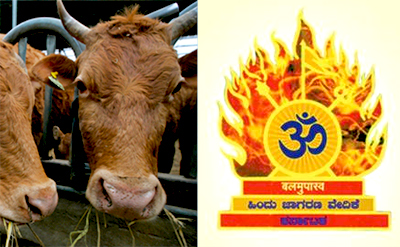
JagaranaGurumurthy, one among the five Dalits attacked on July 10 in Shantipura colony, was in fact one of the founders of Hindu Jagarana Vedike's branch in Kunduru village near here. Four years ago, he conducted an event in the village organising all Dalits.

However, the family members gradually distanced themselves from the Hindutva activities after facing discrimination by the leaders of the Vedike.

“We stopped participating in the events of Hindu Jagarana Vedike after we realised that the leaders were opposed to our food habits,” the family members said.

“If they are Hindus, what are we then? Even though we eat beef we are also Hindus. Many Hindus eat beef in our region,” they claimed.

23-year-old Dhanush, who suffered severe injuries in Bajrang Dal attack, admitted that beef was part of their diet and food culture. “If consuming it is against law, let the police take action. How can anyone else beat us up?”

Many Dalit families in the village have expressed solidarity with the victims and claimed that beef had been part of their food culture for ages. “Beef is affordable and healthily. We can't afford mutton (sheep or goat), which costs more than Rs 400 a kg,” said a housewife.

A few Dalit families held upper caste families in the neighbourhood responsible for atrocities on them. “The upper caste people in the village do not tolerate if we move around wearing good clothes. They look for some reason to assault us,” lamented Mr Gurumurthy.

Comments

Roosevelt Larochelle
 - 
Monday, 29 Aug 2016

Once the cow became sacred and the Broken Men continued to eat beef, there was no other fate left for the Broken Men except to be treated unfit for association, i.e., as Untouchables. There was a time when the ancestors of the present day Untouchables were not Untouchables vis-a-vis the villagers but were merely Broken Men, no more and no less, and the only difference between them and the villagers was that they belonged to differ

Satyameva Jayate
 - 
Friday, 29 Jul 2016

Naren and Viren.....if you dont like the journalism of CD why waste your time here....Go and read any RSS note books...you can learn more hatred....and Burn your GAaf........and then Use Itch Guard...

kr
 - 
Friday, 29 Jul 2016

Hey has keep there women in burkha ha ha

Unity
 - 
Thursday, 28 Jul 2016

Days to come (In-Shaa Allah) all the LIES and Deceptions of Hindutuva terrorist will come out.
The Dalit should not fear in exposing their Discriminations... cheddis hold outs are getting fired from the bottom... and they already started feeling the burn when muslims started to oppose their discrimination. We Muslims & Dalits should unite to fight their discrimination agenda... We Muslims know their hatred propaganda.. but WE believe ALLAH will take care of their evil agenda. Till now we know many things are exposed. When it is out of their hands they resort to acts like Cowards like killing.

naren kotian
 - 
Thursday, 28 Jul 2016

ya ya .. CD digest journo ( i dont think he has passed journalism course ) has seen and was seeing Beeef eating of HJV ... cmon guys .. right sensible articles ...

noor
 - 
Thursday, 28 Jul 2016

may be this cow has got married to bull

Shaad
 - 
Thursday, 28 Jul 2016

The same Gujarat dalit was used against Muslims in Godhra communal riots. Big fishes supplied all the weapons to Dalit prior riots and Dalits used that opportunity more than big Fish's expectations. Thousands of lives irrespective women, child, old age, youths, teens burned everywhere and thousands of rapes, loot since law and order tied up by Gujarat CM.

Faizal
 - 
Thursday, 28 Jul 2016

World beef exports - Ranking of countries.............

1. India

2. Australia

3. Brazil

4. USA

Rikaz
 - 
Thursday, 28 Jul 2016

I think it is better change their religion to Islam....where they would get desired respect and dignity....there is no upper and lower caste in it....Well come guys!

Add new comment

  • Coastaldigest.com reserves the right to delete or block any comments.
  • Coastaldigset.com is not responsible for its readers’ comments.
  • Comments that are abusive, incendiary or irrelevant are strictly prohibited.
  • Please use a genuine email ID and provide your name to avoid reject.
News Network
July 4,2020

Bengaluru: The Secondary School Leaving Certificate (SSLC) examinations in Karnataka concluded on Friday with an overall average of about 98 per cent attendance amid the coronavirus scare. Chief Minister B S Yediyurappa congratulated the lakhs of students who appeared for the crucial exercise braving the coronavirus pandemic situation.

An average of about 98 per cent of 8.5 lakh odd enrolled students took the exams which began on June 25, after the government stuck to its decision to go ahead with them despite rising coronavirus cases but laid down a string of safety measures, including face masks and maintaining distancing by seating only one student a bench.

Examinations for all main subjects had been completed and alternative subjects such as music would take place on Saturday, Education department officials said.

"I heartily congratulate students who faced the examination even during the coronavirus pandemic," Mr Yediyurappa tweeted.

Expressing happiness over the successful completion of the examination, he greeted state Primary and Secondary Education Minister S Suresh Kumar, officers and employees of education department, health department, police and transport personnel.

"The exam is a proof that anything can be made possible if all the government departments work in tandem," Mr Kumar tweeted.

Later addressing a press conference, he said on Friday 98.10 per cent attendance was recorded compared to 98.76 for the same paper last year.

"Credit goes to children. First day, parents were scared and students were sceptical and there was a big challenge before us. But the children appearing for the exam instilled confidence. They came with masks, sanitisers and were careful about maintaining social distancing. Our children have set an example for others to follow," Mr Kumar said.

Lauding the students, parents and the government staff who made the exam possible ignoring the virus scare, Medical Education Minister Dr K Sudhakar said Karnataka has set an example by successfully conducting the examination.

The Karnataka Secondary Education Examination Board, which conducted the examination, faced various challenges. While protecting students from coronavirus infection was the top priority, transportation, security and convincing the parents to allow their children to take up the exam were the other factors it encountered.

According to sources in the department, the education officers had directed authorities of all the schools to call the parents and students to make sure that they appear for the examinations.

The Central Board of Secondary Education (CBSE) and boards of various neighbouring states either gave general promotion or decided to give marks to the students based on their performance in the earlier tests conducted by the schools.

The exams were conducted at a time when there was a sudden spurt in coronavirus cases in Karnataka, especially Bengaluru. Expressing apprehension, former chief minister and JD(S) leader H D Kumaraswamy had appealed to the government to postpone the examination but the government went ahead with its decision.

Comments

Add new comment

  • Coastaldigest.com reserves the right to delete or block any comments.
  • Coastaldigset.com is not responsible for its readers’ comments.
  • Comments that are abusive, incendiary or irrelevant are strictly prohibited.
  • Please use a genuine email ID and provide your name to avoid reject.
News Network
July 6,2020

Bengaluru, jul 6: With coronavirus cases surging and hospitals saturated with patients, the Karnataka government is setting up intensive care units (ICUs) at COVID Care Centres (CCC) in the state for severe cases needing oxygen, Deputy Chief Minister C N Ashwath Narayan said on Sunday.

Covid Care Centres are usually meant for patients who are asymptomatic or have mild symptoms.

"Initially, 10 ICUs will be set up at every CCC in Bengaluru and in other cities and towns across the state subsequently," Narayan said in a statement in Bengaluru.

The state government has set up CCCs at the GKVK campus, the Haj Bhavan and the Art of Living Foundation campus in the city so far. The government has also set up a more than 10,000 bed CCC facility in BIEC, on Tumkur road, on the outskirts of the city.

"About 100 ICUs will be set up soon at the new CCCs opened at the Bangalore International Exhibition Centre (BIEC), Ayurveda College, and Koramangala Indoor Stadium," said Narayan.

The sprawling BEIC in the city's northwest will soon have 10,100 beds for treating Covid patients and asymptomatic cases from state-run hospitals.

The state government has also relieved all Health Department employees from administrative and non-medical duties to depute them at the CCCs.

On complaints about the poor quality of food served to Covid patients and the medical staff, Narayan warned the vendors of cancelling their contracts if they did not supply good quality food as per the guidelines.

The minister also directed the Health Department to ensure adequate supply of drugs and medical equipment to all CCCs and state-run hospitals for treating Covid patients.

With a record 1,925 new cases reported on Sunday, the state's tally touched 23,474, including 13,251 active after 9,847 were discharged (including 603 on Sunday), while 372 succumbed to the infection since March 9, with 37 more deaths on Sunday.

Of the total cases across the state, Bengaluru accounted for 1,235, taking its tally to 9,580, including 8,167 while 145 died so far.

Comments

Add new comment

  • Coastaldigest.com reserves the right to delete or block any comments.
  • Coastaldigset.com is not responsible for its readers’ comments.
  • Comments that are abusive, incendiary or irrelevant are strictly prohibited.
  • Please use a genuine email ID and provide your name to avoid reject.
News Network
February 23,2020

The euphoria over the claim that around 3,000 tonnes of gold reserves, worth Rs 12 trillion, have been discovered in Uttar Pradesh’s Sonbhadra district could not last even 24 hours, with the Geological Survey of India (GSI) clarifying on Saturday there had been no such discovery.

The GSI, headquartered in Kolkata, rebutted the claims of the Uttar Pradesh Directorate of Geology and Mining (UPDGM), and said “miscommunication” must have led to the wrong reporting of facts.

M Sridhar, director general of the GSI, said nobody in the agency gave any such data. He said 52,806 tonnes of gold ore was found in Sonbhadra district during the exploration work in 1998-2000. From this reserve, only 160 kg of gold can be extracted.

“There must have been some miscommunication of facts because of which the gold ore deposits have been overestimated. We have written a letter to Uttar Pradesh (UPDGM), stating the facts. The GSI has not estimated such kind of vast resource of gold deposits in Sonbhadra,” Sridhar said.

ALSO READ: 2,900-tonne gold mine found in Sonbhadra, 4 times that of India's reserves

The UPDGM had said on Friday that gold deposits were found in Son Pahadi and Hardi areas of the district. Sridhar said while gold ore was found in the area during the GSI’s exploration work in 1998-2000, it had told the state government about the discovery in November last year.

Under the new regulation, which came into effect from 2015, the GSI has to inform the state government when ore deposits are discovered. Earlier, no such action was mandatory. In its report, the GSI estimated that only 3.03 gm of gold can be extracted from a tonne of ore. It also clarified that even the extraction amount was tentative and could not be established for certain.

Moreover, Sridhar said the deposits were spread across only 0.5 sq km in forest land, which made the mining of ore economically unviable. “When there are several mines nearby, we can club it into a block and then it makes sense to mine the ore. But in this case, the deposits are too small to make it viable for any company to mine it,” he said. The GSI usually prioritises its exploration work based on the needs of the Centre. While strategic minerals like tin, cobalt, lithium, beryllium, germanium, gallium, indium, tantalum, niobium, selenium, and bismuth are atop the list in GSI exploration, gold is another commodity on its priority list.

According to the World Gold Council, India has reserves of 630 tonnes of gold.

Comments

Add new comment

  • Coastaldigest.com reserves the right to delete or block any comments.
  • Coastaldigset.com is not responsible for its readers’ comments.
  • Comments that are abusive, incendiary or irrelevant are strictly prohibited.
  • Please use a genuine email ID and provide your name to avoid reject.