


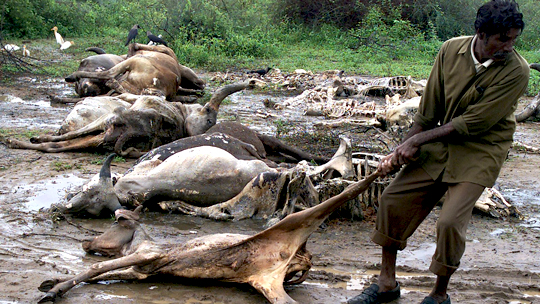
Dead cows rot on Gujarat streets as frustrated Dalits refuse to touch them

July 29, 2016

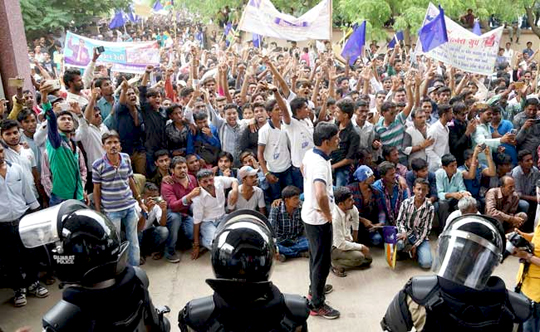
Ahmedabad, Jul 29: Protesting against the thrashing of Dalits in Una, members of the community traditionally engaged in skinning and tannery work have refused to dispose of the dead cattle in several parts of Gujarat demanding that they be provided protection and I-card by the government to prevent harassment from 'gau-rakshaks'.
cow

The decision to stay away from the work by the community members has left the administration harried, particularly in Surendranagar city where the civic body staff has disposed of more than 80 dead cattle using their own resources during the last one week.

According to Surendranagar district Collector Udit Agrawal, he will discuss the demands put forward by the Dalit bodies with the government in coming days.

"Skinners are on strike since last one week. Thus, we are engaging municipality staff to dispose of the carcasses. Even some maldharis (cattle rearers) are also helping us. Till now, we have disposed of 88 cattle in the city. We are making sure that people don't face any problem due to the ongoing stir," Agrawal said.

"Once the dust settles, I will call Dalit leaders to discuss their demands, as they have not given me anything in written yet. One of their main demands is issuance of I-cards for skinners. I will definitely put forward this demand to higher authorities for a long-term solution," he said.

The strike has been called by Dalit Manav Adhikar Movement, which is an umbrella body of several Dalit rights groups, including Navrsarjan Trust.

According to Natu Parmar of Navsarjan Trust, many Dalits across Gujarat are joining the movement.

"Many members of the community across Gujarat have joined our movement and announced that they will stay away from the work of disposing carcasses. Surendranagar has received huge response to our call, as most families of this community have completely detached themselves from this work since last one week," he said.

Parmar claimed that the district administration is now forced to dispose of at least 200 cattle every day.

According to him, around 120 cattle, mostly cows, die in 14 to 15 cattle shelters in the district every day.

"Apart from them, around 100 such cattle, owned by maldharis, die in different villages of the district every day. We will not resume our work till our demands are met. People came to know about atrocities on us only after the Una incident. Otherwise, skinners face such problems every day. We want assurance of protection from government," said Parmar.

On July 11, four Dalit youths were beaten up by cow vigilantes at Mota Samadhiyala village in Una taluka of Gir Somnath district when they were skinning a dead cow.

Though the youths pleaded that they are from the skinning community, the cow vigilantes thrashed them alleging that they were involved in cow slaughter.

One of the key demand of the community is the issuance of I-cards, so that police or 'gau-rakshaks' do not harass them while transporting or skinning a dead cow.

"We want I-cards for all the skinners, so that they do not face any problem or don't fall pray to any misunderstanding. The I-card can help us in establishing that we are not into cow slaughter. We also want government to provide land to carry out skinning work in each taluka," Parmar added.

Gujarat 

Comments

Sameer
 - 
Sunday, 31 Jul 2016

Oh My Cowsee... This is sad... Cow Mata is lying on ground and no protector is available!

babu bajarangi
 - 
Saturday, 30 Jul 2016

HELLO BAJARANGIS AND CHADDI PARIVAR YOUR MAA AND MAAKI HUSBAND'S ARE DEAD IN GUJARATH GO AND DO LAST RIGHTS, NOW YOU ARE NOT FEELING ANYTHING? CHEEEE SHAME ON YOU...

SK
 - 
Saturday, 30 Jul 2016

Ahmed I agree with you, If our muslim brothers and Moulanas had little brain, such a situation would have been seen long before.....Still it is not TOO LATE.... we can make the farmers to suffer and make them to revolt against sanghis.....

SK
 - 
Saturday, 30 Jul 2016

Chaddis like Naren, Bopanna are required in Gujrat, to clean the roads filled with dead go matahs.......

Ahmed
 - 
Saturday, 30 Jul 2016

Moklena appe saadi d naarondundu, Itte appe bodcha?

Ahmed
 - 
Saturday, 30 Jul 2016

I predicted this situation 10 years ago, i told our friends stop eating beef, these cows will stink on the roads

TR
 - 
Saturday, 30 Jul 2016

This is what we Muslims also get united and protest.

One month is enough, stop eating ALL types of Beef then see what will happen.

REALITY
 - 
Saturday, 30 Jul 2016

Proud HINDUTUVA Deceiver will take care as they love their cows more than HUMANS .....

Were are YOU cheddis...?

ummar
 - 
Saturday, 30 Jul 2016

Please Hindhu Brothers U are calling Cow Matha RIght,

U people need to take care of ur matha

arrange one group for that and for anthya samskra

Suresh
 - 
Saturday, 30 Jul 2016

Naren!! Where are u. Please join the govt to bury the mother cow.

Naren na amme
 - 
Friday, 29 Jul 2016

Ollullambe Naren ? Ninna gaw mate road du narondu ulla? Puna geppareg popujja?

Rikaz
 - 
Friday, 29 Jul 2016

Dead cow must be given respectful burial....should not allow for skinning...gou mata is sacred.....

shahid
 - 
Friday, 29 Jul 2016

where are this sanghis your mother is dying in streets and no one is there to give them last rites.... what type of son ur are shame on you chaddis

Satyameva Jayate
 - 
Friday, 29 Jul 2016

Maa ke Bete kidhar hai.....
Naren, Viren and all other GO TEam......please bury your maas.......
Time for Service, now we can see how many people love thier GO mothers......ha ha........
Bajrangi Naatak....Also cows are mating on streets.....Make Sauchalay later...try to make some good bedrooms for Cows and Bull mating......
Hum to sadak pe scene dekh dekh ke thak gaya..... Maas need privacy.

Ahmed
 - 
Friday, 29 Jul 2016

We will arrange free flight to RSS AND BAJRANGI to gujrath

Ahmed
 - 
Friday, 29 Jul 2016

Mr Nareen kotian will send to BE GUJRATAH free air ticket will be provided .....

muhammed rafique
 - 
Friday, 29 Jul 2016

Why the \Gau Rakshaks\" disown their dead mother?"

Ahmed
 - 
Friday, 29 Jul 2016

What non-sense, talking about I-Card?
They think Bajrangis will understand what is I-Card? or will they have any respect to the I-Card issued by Government?
Rather, give them Guns with license to protect them selves

Add new comment

  • Coastaldigest.com reserves the right to delete or block any comments.
  • Coastaldigset.com is not responsible for its readers’ comments.
  • Comments that are abusive, incendiary or irrelevant are strictly prohibited.
  • Please use a genuine email ID and provide your name to avoid reject.
News Network
June 2,2020

Bengaluru, Jun 2: Chief Minister BS Yediyurappa on Tuesday interacted with District Collectors (DCs) and Superintendents of Police (SPs) regarding COVID- 19 situation in the State.

In the meeting held through a video conference, he said that DCs, SPs and the District Panchayat Chief Executive Officer (CEO) be divided into taluks and ordered them to take appropriate measures to control COVID-19.

He was speaking today in a video conversation with District Collector, District Panchayat Chief Executives and Superintendents of Police in Kalaburgi, Vijayapura, Udupi, Yadagiri, Raichuru and Belagavi districts regarding measures to control the spread of COVID-19.

The Chief Minister instructed officials to monitor the investments in taluka centres. He also ordered to create a task force in the village panchayats, who will be monitoring things closely.

The Chief Minister also directed for the creation of ward-level watchdog committee in every village and city and an FIR should be registered in case of a home quarantine violation.

Home Minister Basavaraja Bommai, Revenue Minister R Ashok, Chief Secretary TM Vijayabhaskar, Development Commissioner Vandita Sharma, Police Chief Director Praveen Sood, Health Department general secretary Javed Akhtar and secretary Pankaj Kumar Pandey were also present in the meeting.

Comments

Add new comment

  • Coastaldigest.com reserves the right to delete or block any comments.
  • Coastaldigset.com is not responsible for its readers’ comments.
  • Comments that are abusive, incendiary or irrelevant are strictly prohibited.
  • Please use a genuine email ID and provide your name to avoid reject.
Indians
May 2,2020

We, the undersigned express our solidarity with Dr Zafarul Islam Khan, renowned scholar, journalist and presently Chairman of the Delhi Minorities Commission.

We strongly condemn the continued media trial and targeting of Dr Zafarul Islam Khan for his Facebook post thanking Kuwait for expressing solidarity with Indian Muslims. In his Facebook post, he mentioned the appalling deterioration of human rights of Indian Muslims who have been targeted by Hindutva bigots. A few politicians with ulterior motives and news channel anchors known for spreading bigotry and Islamophobia have mischievously sought to misinterpret his statement and ridiculously label him as anti-Hindu and anti-India.

He has only reiterated what many citizens of India, public figures, international institutions, various European governments, the United States of America and United Nations human rights mechanisms have repeatedly underlined their concern at the increasing human rights abuse and violations of religious minorities in India.

Dr Zafarul Islam Khan is a man of integrity. He is a scholar who is known to stand up for constitutional freedoms and values.

His work as the Chairman of Delhi Minorities Commission has been warmly applauded by human rights activists and NGOs across different faiths. His timely interventions on problems of minorities in Delhi have made him a respectable figure among not only Muslims but Sikh, Christians, Jains and Parsis. He is a humanist in the truest sense of the word.

The hateful propaganda against Dr Khan is one more illustration as how certain Indians fail to differentiate between Hinduism, a religion and Hindutva which is a supremacist political ideology.

Dr Zafarul Islam Khan is a leading Indian intellectual whose niche area is Islamic studies and Arab world. He enjoys great respect in the Arab and Muslim world for his understanding and knowledge. He is an alumni of the esteemed Jamia Al-Azhar and Manchester University.

Dr Khan is known for taking bold public positions. He was the first Muslim scholar in the world who denounced ISIL, which later became IS or ISIS. He issued a statement opposing the barbaric crimes of ISIL (IS or ISIS) and Boko Haram against minorities. He takes strong stands against extremism of all sorts. That makes him a prominent critic of RSS.

Dr Khan is a scholar ambassador and earned international prestige for the India. Any attack and targeting of him, is actually an insult to Indian constitution and ethos.

We demand the appropriate authorities of the Government of India take strong legal action against those who are distorting Dr Khan’s Facebook post, and spreading vicious false propaganda against him.

Signed by:

Swami Agnivesh

Mohammad Adeeb
Arun Kumar (Prof)

Zafar Jung

Kamal Faruqui

Annie Namala

Kavita Krishnan

Subhash Gatade

Jawed Naqvi

Indu Pratap Singh

Avinash Kumar

Iftikhar Gilani

Anil Chamadia

Xavier Dias

Denzil Fernandes (Dr)

Irfan Engineer

Faisal Khan

John Dayal (Dr)

Mujtaba Farooque

Ravi Nair

Abubakr Sabbaq (Adv)

Gopal Menon

Bilal Khan

Ashok Choudhury

Jaffer Latief Najar

Mujahid Nafis

Aseem Sundan

Poojan Sahil

Ankur Otto

Mariya Salim

Tanweer Alam

Juned Khan

E M Abdul Rahiman

Aditi Dutta

Devika Prasad

Ameeque Jamei

Suhaib Ansari

Gurminder Singh

A C Michael

Neelima Sharma

Aftab Alam (Dr)

Dhruva Narayan

Syed Saif Ur Rahman

Tanweer Fazal (Dr)

Thouseef Madikeri (Dr)

N.D. Jayaprakash

Salahuddin Ansari

Satyajeet Nambiar

Suhail KK

Abu Sufiyan

Sujata Madhok

Tariq Khan

Violin Mathew Benjamin

Shamsul Islam (Prof)

Sreedhar Ramamurthi

Mohd. Shahid (Prof)

Anand Vivek Taneja (Dr)

Kush Kumar Singh (Dr)

Mangla Verma

Vipul Kumar

Waquar Hasan

Braham Prakash

Abdul Rashid Agwan

Fawaz Shaheen

Guman Singh

Mohammed Hafeez Ulla

Kp Sasi

Mushfique Raza Khan

Partha S Banerjee

Gautam Majumdar

S.Q. Masood

Aiman J Khan

M. K. Faizy

Tasleem Rehmani (Dr)

Mohammed Shafi

Lenin Raghuvanshi (Dr)

Malik Motasim Khan

Kripal Singh Mandloi

Labeed Shafi

Qamar Intakhab

Raees Ahmed Siddiqui

Laeeq Ahmed Khan

Anthony Arulraj

Sadiq Zafar

Biju Gopidasan

George Pulikuthiyil

Mohd Abdullah

Mohd Sorab Hussain

Mukunda Kattel

Sandeep Pendse

Paul Newman

Ovais Sultan Khan

Comments

Add new comment

  • Coastaldigest.com reserves the right to delete or block any comments.
  • Coastaldigset.com is not responsible for its readers’ comments.
  • Comments that are abusive, incendiary or irrelevant are strictly prohibited.
  • Please use a genuine email ID and provide your name to avoid reject.
News Network
July 28,2020

Hounde, Jul 28: Coronavirus and its restrictions are pushing already hungry communities over the edge, killing an estimated 10,000 more young children a month as meager farms are cut off from markets and villages are isolated from food and medical aid, the United Nations warned Monday.

In the call to action shared with The Associated Press ahead of publication, four UN agencies warned that growing malnutrition would have long-term consequences, transforming individual tragedies into a generational catastrophe.

Hunger is already stalking Haboue Solange Boue, an infant from Burkina Faso who lost half her former body weight of 5.5 pounds (2.5 kilograms) in just a month. Coronavirus restrictions closed the markets, and her family sold fewer vegetables. Her mother was too malnourished to nurse.

“My child,” Danssanin Lanizou whispered, choking back tears as she unwrapped a blanket to reveal her baby's protruding ribs.

More than 550,000 additional children each month are being struck by what is called wasting, according to the UN — malnutrition that manifests in spindly limbs and distended bellies. Over a year, that's up 6.7 million from last year's total of 47 million. Wasting and stunting can permanently damage children physically and mentally.

“The food security effects of the COVID crisis are going to reflect many years from now,” said Dr. Francesco Branca, the WHO head of nutrition. “There is going to be a societal effect.”

From Latin America to South Asia to sub-Saharan Africa, more poor families than ever are staring down a future without enough food.

In April, World Food Program head David Beasley warned that the coronavirus economy would cause global famines “of biblical proportions” this year. There are different stages of what is known as food insecurity; famine is officially declared when, along with other measures, 30% of the population suffers from wasting.

The World Food Program estimated in February that one Venezuelan in three was already going hungry, as inflation rendered salaries nearly worthless and forced millions to flee abroad. Then the virus arrived.

“Every day we receive a malnourished child,” said Dr. Francisco Nieto, who works in a hospital in the border state of Tachira.

In May, Nieto recalled, after two months of quarantine, 18-month-old twins arrived with bodies bloated from malnutrition. The children's mother was jobless and living with her own mother. She told the doctor she fed them only a simple drink made with boiled bananas.

“Not even a cracker? Some chicken?” he asked.

“Nothing,” the children's grandmother responded. By the time the doctor saw them, it was too late: One boy died eight days later.

The leaders of four international agencies — the World Health Organization, UNICEF, the World Food Program and the Food and Agriculture Organization — have called for at least dollar 2.4 billion immediately to address global hunger.

But even more than lack of money, restrictions on movement have prevented families from seeking treatment, said Victor Aguayo, the head of UNICEF's nutrition program.

“By having schools closed, by having primary health care services disrupted, by having nutritional programs dysfunctional, we are also creating harm,” Aguayo said. He cited as an example the near-global suspension of Vitamin A supplements, which are a crucial way to bolster developing immune systems.

In Afghanistan, movement restrictions prevent families from bringing their malnourished children to hospitals for food and aid just when they need it most. The Indira Gandhi hospital in the capital, Kabul, has seen only three or four malnourished children, said specialist Nematullah Amiri. Last year, there were 10 times as many.

Because the children don't come in, there's no way to know for certain the scale of the problem, but a recent study by Johns Hopkins University indicated an additional 13,000 Afghans younger than 5 could die.

Afghanistan is now in a red zone of hunger, with severe childhood malnutrition spiking from 690,000 in January to 780,000 — a 13% increase, according to UNICEF.

In Yemen, restrictions on movement have blocked aid distribution, along with the stalling of salaries and price hikes. The Arab world's poorest country is suffering further from a fall in remittances and a drop in funding from humanitarian agencies.

Yemen is now on the brink of famine, according to the Famine Early Warning Systems Network, which uses surveys, satellite data and weather mapping to pinpoint places most in need.

Some of the worst hunger still occurs in sub-Saharan Africa. In Sudan, 9.6 million people live from one meal to the next — a 65% increase from the same time last year.

Lockdowns across Sudanese provinces, as around the world, have dried up work and incomes for millions. With inflation hitting 136%, prices for basic goods have more than tripled.

“It has never been easy but now we are starving, eating grass, weeds, just plants from the earth,” said Ibrahim Youssef, director of the Kalma camp for internally displaced people in war-ravaged south Darfur.

Adam Haroun, an official in the Krinding camp in west Darfur, recorded nine deaths linked with malnutrition, otherwise a rare occurrence, over the past two months — five newborns and four older adults, he said.

Before the pandemic and lockdown, the Abdullah family ate three meals a day, sometimes with bread, or they'd add butter to porridge. Now they are down to just one meal of “millet porridge” — water mixed with grain. Zakaria Yehia Abdullah, a farmer now at Krinding, said the hunger is showing “in my children's faces.”

“I don't have the basics I need to survive,” said the 67-year-old, who who hasn't worked the fields since April. “That means the 10 people counting on me can't survive either.”

Comments

Add new comment

  • Coastaldigest.com reserves the right to delete or block any comments.
  • Coastaldigset.com is not responsible for its readers’ comments.
  • Comments that are abusive, incendiary or irrelevant are strictly prohibited.
  • Please use a genuine email ID and provide your name to avoid reject.