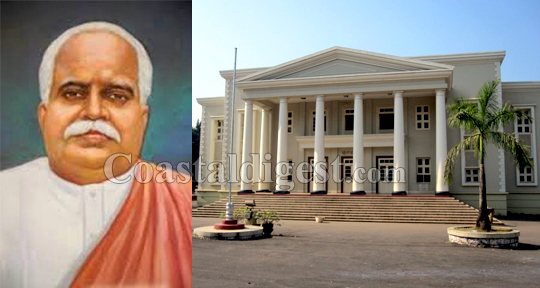
Mangaluru Town Hall to be named after social reformer Kudmul Ranga Rao

[email protected] (CD Network )
July 30, 2016

Mangaluru, Jul 30: The Mangaluru City Corporation has resolved to name the Town Hall after social reformer late Kudmul Ranga Rao, who fought for the rights of depressed classes and strived for their welfare.

kudmol

The decision comes about six months after the renovation of the five decade old Town Hall of Mangaluru, which hosted thousands of political, social and cultural events in the past 50 years.

Who is KRR?

Kudmul Ranga Rao (29 June 1859 – 30 January 1928) was a social reformer from Kudmul, a village in the erstwhile Madras Presidency, (in the present-day Dakshina Kannada district) who established "Depressed Classes Mission" in 1897 in Mangaluru for providing education, better housing, drinking water and empowering the backward classes socially by guarding them against exploitation by upper classes.

He was born into a middle-class Goud Saraswat Brahmin community. His father, Devappayya, worked as a clerk under a landlord and his mother, Gauri, a housewife. Rangarao completed his primary education in Kasaragod, before losing his father when he was 16.

Moving to Mangaluru in search of a job, he began working as a teacher for a monthly salary of R 8. Completing his matriculation amid financial difficulties through a correspondence course, he cleared the pleadership examination, that certified him argue for a client in courts. Following this, he began his career as a lawyer in Mangaluru.

Rangarao as an advocate in profession was better known as 'the poor man's lawyer'. 'Education is the source of progress' was his tenet. At a time when the depressed classes had no schools, when they were treated with scorn, Rangarao stepped forward as a crusader for the cause. Albeit facing grave opposition, Kudmul Rangarao continued to combat the orthodox beliefs of the then superstitious Indian society.

Rangarao set up schools in Kankanadi, Bannanje, Mulki, Beloor, Udupi, Nejaru, Atthavara, Baabuguddde, Dhaddal forests for the downtrodden. He called them 'Panchama schools'. To persuade the kids to attend schools, he arranged for mid day meals and 2 paise per day to the parents to develop an interest and motivate the families to get their progeny to schools. It is said that he bathed the young kids, sat with them for lunch, slept in their huts to win over their hearts. He freed many servants and slaves from the clutches of demanding and barbarous masters. Despite being threatened myriad times, his grit and gusto could not be dampened.

By marrying off his own daughter, RadhaBai to Dr. Subrayan of Madras, he set an example of inter-caste marriage in India. Following his inspiration, M K Gandhi's son entered wedlock with Chakravarthi Rajagopalachari's daughter. Mahatma Gandhi had once said, "I discerned social loyalty from Mr. Rangarao. He is an inspiration and a guide for me. He is my teacher when it comes to the upliftment of the untouchables".

Comments

LEON F VIEGAS
 - 
Thursday, 8 Dec 2016

There are other citizens who have done lots for the mangalore city. what about them ? town hall is good name please dont change it.

LEON F VIEGAS
 - 
Thursday, 8 Dec 2016

i feel town hall is the good name.

Raghuraj.
 - 
Sunday, 7 Aug 2016

Thank u city corporation.

Raghuraj.
 - 
Sunday, 7 Aug 2016

Good work done by mangalore city corporation .i personally apriciating you all.thank u im also one of the devotee of shri kudmul ranga rao.

Sameer
 - 
Sunday, 31 Jul 2016

If thy decide to name is has Late APJ Abdul Kalam, then we could have seen the frustation here!

Mehul Kamdar
 - 
Saturday, 30 Jul 2016

Great people who worked for their fellow human beings deserve to be honored. Kudos to Mangaluru for renaming it's Town Hall in the memory of this great gentleman.

True commentator
 - 
Saturday, 30 Jul 2016

Why not. It can be named as KRR Town Hall.
Let us start discovering our old ancestors who fought for us.

Let this be a good beginning.
But we should name all those regardless from what community.

Narendra Nayak
 - 
Saturday, 30 Jul 2016

Kudmul Ranga Rao is a much sweeter name. I strongly support the belated decision of the Mangalore City Corporation authorities to the name the town hall after him. It is not a honor done to him- the honor is for the city to have a town hall named after this great man. He said the day a dalit boy becomes a DC and comes to my village in his car raising the dust, I will make a tilak of that on my forehead and consider my life's ambition as fulfilled.

Ahmed
 - 
Saturday, 30 Jul 2016

Town Hall is the sweet name please no need to change in to KRR.....

Add new comment

  • Coastaldigest.com reserves the right to delete or block any comments.
  • Coastaldigset.com is not responsible for its readers’ comments.
  • Comments that are abusive, incendiary or irrelevant are strictly prohibited.
  • Please use a genuine email ID and provide your name to avoid reject.
Ram Puniyani
January 22,2020

Shivaji is a great icon in Maharashtra. Different sections of society have given him very high status, though for diverse reasons. Folklores about him abound in the state. His statues, popular songs on him are very prevalent. These folk songs (Powadas) praise his multifarious actions. So it was no surprise that when Jayabhagwan Goyal, released his book, ‘Aaj ka Shivaji: Narendra Modi’, at religious-cultural meet organized by Delhi BJP, there was a strong resentment in Maharashtra. Various leaders from Maharashtra were furious. The Shiv Sena leader Sanjay Raut challenged the Shivaji’s descendent, Sambhaji Raje who is in BJP and is member of Rajya Sabha, to resign on the issue. Sambhaji Raje in turn stated that "We respect Narendra Modi, who was elected as the prime minister of the country for the second time. But neither (Narendra) Modi nor anybody else in the world can be compared with Chhatrapati Shivaji Maharaj,"

Not to be left behind Jitendra Awhad of NCP felt Modi-BJP are insulting the pride of Maharashtra. It is not the first time that controversy is erupting around the Maharashtra warrior of medieval period. Earlier we had seen Sambhaji Brigrade demanding the ban on James Laine book, Shivaji: ‘A Hindu King in an Islamic Kingdom’, for its objectionable content. Bhandarkar Institute in Pune, which had helped James Laine in his research, was also vandalized. At another level there was a talk that Babasaheb Purandare, a Brahmin, who has written some popular material on Shivaji will be made as the Chairman of the committee for statue of Shivaji. Maratha Mahasangh and Shiv Dharm officials objected to a Brahmin heading the committee for a statue for the Maratha warrior. The caste angel in Shivaji’s case is coming to the fore from quite some time.

While there is no dearth of controversies around Shivaji, it is also true that each political tendency has created Shivaji’s image from their political point of view. Who was the real Shivaji, is the question. One can see two clear streams of projection in this matter. On one hand there is an attempt to present Shivaji as the anti Muslim King, a king who was respecting Cows and Brahmins (Go Brahman pratipalak). This view was brought forward from the times of Lokmanya Tilak and picked up by Hindu nationalists, who have been looking for icons in history to suit their political agenda. Nathram Godse, while criticizing Gandhi says that Gandhi’s nationalism was dwarf in front of the one of Shivaji or Rana Pratap.

In tune with this the Hindu nationalists are promoting both these as icons of Hindu nationalism and giving anti-Muslim slant to the whole discourse. This discourse also hides in this the Brahmanical agenda of Hindu nationalism as Cows and Brahmins are presented as the central object of veneration by Shivaji. This image of Shivaji fits well into the current agenda of Hindu nationalists, being spearheaded by RSS Combine.

It is because of this that for seeking votes in Mumbai Narendra Modi on the eve of 2014 elections stated that Shivaji attacked Surat to plunder the treasury of Aurangzeb. This also presents Shivaji-Aurangzeb, Shivaji-Afzal Khan interactions as battle between Hindus and Muslims. The truth is that Surat was plundered for its wealth as it was a rich port city and Bal Samant’s book on the topic gives in depth description of the same. It is noteworthy that Shivaji began his real career of conquest in 1656 when he conquered Javli from the Maratha Chief Chandra Rao More. He took over the treasures of this kingdom. That it was not a Hindu Muslim battle becomes clear when we know that in confrontation with Aurangzeb it was Mirza Raja Jaisingh who was negotiating and engaging with Shivaji on behalf of Aurangzeb. And Shivaji had Muslim officers like Kazi Haider as confidential secretary and many Muslim Generals in his army.

Darya Sarang was chief of armor division, Daulat Khan was in-charge of his naval division; Ibrahim Khan was another general of significance in his army.  This mixed up administration just shows that the kings were not having Hindu or Muslim administration depending on their religion. In the confrontation between Shivaji and Afzal Khan, Rustam-e-Jaman was Shivaji’s side and Afzal Khan had Krisnaji Bhaskar Kulkarni on his side.

As far as Shivaji’s popularity is concerned it was due to his being a King with welfare of his subjects in his mind. He lightened the burden of taxation on the average peasants, and reduced the domination of landlords over the serfs. This picture of Shivaji is well documents in the booklets by Com. Govind Pansare (Who was Shivaji) and Jayant Gadkari (Shivaji: Ek Lok Kalyankari Raja- Shivaji: King doing People’s Welfare). He did not belong to the warrior caste so Brahmins had refused to coronate him, for which purpose Gaga Bhatt a Brahmin from Kashi was brought in with heavy fees. Teesta Setalvad’s hand book on History for teachers underlined this fact.

Today while BJP-Brahmanical forces want to present Shivaji as worshipper of Brahmins and cows, the non upper caste have seen through the game. As such it was Jotirao Phule who brought forward the caste angel of Shivaji as he wrote Powada (Poem) in his honor and today dalit Bahujan are not toeing Hindu Nationalist projection on the issue.

The likes of Jayabhagwan Goyal of BJP as such are trying to give two messages through such attempts. One hand they want to paint Shivaji in anti Muslim and Brahmanical color, they also want to give the subtle message of similarity of this presentation of Shivaji with what Modi is doing. Non BJP forces have seen this game and want to present the other picture of Shivaji, which was highlighted by the likes of Jotirao Phule and which today many of those standing for rights of dalit-Bahujan are trying to articulate. The criticism of the said, book, since withdrawn is on these twin aspects. One about the picture of Shivaji who was concerned about welfare of the farmers, and two his respect for people of all religions.

Comments

Add new comment

  • Coastaldigest.com reserves the right to delete or block any comments.
  • Coastaldigset.com is not responsible for its readers’ comments.
  • Comments that are abusive, incendiary or irrelevant are strictly prohibited.
  • Please use a genuine email ID and provide your name to avoid reject.
Ram Puniyani
June 29,2020

In Minneapolis, US an African American, George Floyd lost his life as the white policeman, Derek Chauvin, caught hold of him and put his knee on his neck. This is a technique developed by Israel police. For nine long minutes the knee of the while policeman was on the neck of George, who kept shouting, I can’t breathe.

Following this gruesome murder America erupted with protests, ‘Black lives matter’. The protestors were not just African Americans but also a large section of whites. Within US one police Chief apologized for the act of this. In a touching gesture of apology the police force came on its knees. This had reverberations in different parts of the World.

The act was the outcome of the remnants of the racial hatred against blacks by the whites. It is the hatred and the perceptions which are the roots of such acts of violence. What was also touching that the state of democracy in US is so deep that even the police apologized, the nation, whites and blacks, stood up as a sensitive collective against this violence.

US is not the only country where the brutal acts of violence torment the marginalized sections of society. In India there is a list of dalits, minorities and adivasis who are regularly subjected to such acts. But the reaction is very different. We have witnessed the case of Tabrez Ansari, who was tied to the pole by the mob and beaten ruthlessly. When he was taken to police station, police took enough time to take him to hospital and Tabrez died.

Mohsin Sheikh, a Pune techie was murdered by Hindu Rashtra Sena mob, the day Modi came to power in 2014. Afrazul was killed by Shambhulal Regar, videotaped the act released on social media. Regar believed that Muslims are indulging in love Jihad, so deserve such a fate. Mohammad Akhlaq is one among many names who were mob lynched on the issue of beef cow. The list can fill pages after pages.

Recently a young dalit boy was shot dead for the crime of entering a temple. In Una four dalits were stripped above waste and beaten mercilessly. Commenting on this act the Union Minister Ramvilas Paswan commented that it is a minor incident. Again the list of atrocities against dalits is long enough. The question is what Paswan is saying is the typical response to such gruesome murders and tortures. In US loss of one black life, created the democratic and humane response. In India there is a general silence in response to these atrocities. Some times after a good lapse of time, the Prime Minister will utter, ‘Mother Bharati has lost a son’. Most of the time victim is blamed. Some social groups raise their voice in some fora but by and large the deafening silence from the country is the norm.

India is regarded as the largest democracy. Democracy is the rule of law, and the ground on which the injustices are opposed. In America though the present President is insensitive person, but its institutions and processes of democratic articulations are strong. The institutions have deepened their roots and though prejudices may be guiding the actions of some of the officers like the killer of George, there are also police officers who can tell their President to shut up if he has nothing meaningful to say on the issue. The prejudices against Blacks may be prevalent and deep in character, still there are large average sections of society, who on the principles of ‘Black lives matter’. There are large sections of vocal population who can protest the violation of basic norms of democracy and humanism.

In India by contrast there are multiple reasons as to why the lives of Tabrez Ansari, Mohammad Akhlaq, Una dalit victims and their likes don’t matter. Though we claim that we are a democracy, insensitivity to injustices is on the rise. The strong propaganda against the people from margins has become so vicious during last few decades that any violence against them has become sort of a new normal. The large populace, though disturbed by such brutalities, is also fed the strong dose of biases against the victims. The communal forces have a great command over effective section of media and large section of social media, which generates Hate against these disadvantaged groups, thereby the response is muted, if at all.

As such also the process of deepening of our democracy has been weak. Democracy is a dynamic process; it’s not a fixed entity. Decades ago workers and dalits could protest for their rights. Now even if peasants make strong protests, dominant media presents it as blocking of traffic! How the roots of democracy are eroded and are visible in the form where the criticism of the ruling dispensation is labelled as anti National..

Our institutions have been eroded over a period of time, and these institutions coming to the rescue of the marginalized sections have been now become unthinkable. The outreach of communal, divisive ideology, the ideology which looks down on minorities, dalits and Adivasis has risen by leaps and bounds.

The democracy in India is gradually being turned in to a hollow shell, the rule of law being converted in to rule of an ideology, which does not have faith in Indian Constitution, which looks down upon pluralism and diversity of this country, which is more concerned for the privileges of the upper caste, rich and affluent. The crux of the matter is the weak nature of democracy, which was on way to become strong, but from decades of 1980s, as emotive issues took over, the strength of democracy started dwindling, and that’s when the murders of the types of George Floyd, become passé. One does complement the deeper roots of American democracy and its ability to protect the democratic institutions, which is not the case in India, where protests of the type, which were witnessed after George Floyd’s murder may be unthinkable, at least in the present times. 

Comments

Add new comment

  • Coastaldigest.com reserves the right to delete or block any comments.
  • Coastaldigset.com is not responsible for its readers’ comments.
  • Comments that are abusive, incendiary or irrelevant are strictly prohibited.
  • Please use a genuine email ID and provide your name to avoid reject.
News Network
July 20,2020

Bengaluru, July 20: The Karnataka government has reiterated that no final decision has so far been taken on reopening of schools in the state.

The clarification comes after minutes of the July 15 HRD ministry meeting where Karnataka education department officials said schools are reopening on September 1 went viral on social media. 

“The state government has not decided yet on starting schools. That they will reopen in September was only a general opinion expressed by our officials at the meeting. At present, we have no plans to start schools unless there is a conducive environment. There’s no need for anxiety,” said primary and secondary minister S Suresh Kumar.

Kumar said the government is involved in meeting the education sector’s changed priorities in the current scenario.

The minutes were of a virtual conference on school-safety plans, with representatives of state governments and Union territories expressing views on reopening of schools. 

Against the name of Karnataka, “After September 1” was written. Similar datelines were given by Kerala, Ladakh, Manipur, Rajasthan, Odisha and Andhra Pradesh, while in case of many other states it said “no decision”.

An education department official said Karnataka submitted to MHRD that it will be able to take a decision only after September 1, depending on the situation in the state.

Comments

Add new comment

  • Coastaldigest.com reserves the right to delete or block any comments.
  • Coastaldigset.com is not responsible for its readers’ comments.
  • Comments that are abusive, incendiary or irrelevant are strictly prohibited.
  • Please use a genuine email ID and provide your name to avoid reject.