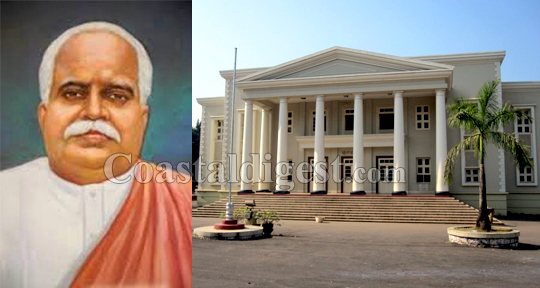
Mangaluru Town Hall to be named after social reformer Kudmul Ranga Rao

[email protected] (CD Network )
July 30, 2016

Mangaluru, Jul 30: The Mangaluru City Corporation has resolved to name the Town Hall after social reformer late Kudmul Ranga Rao, who fought for the rights of depressed classes and strived for their welfare.

kudmol

The decision comes about six months after the renovation of the five decade old Town Hall of Mangaluru, which hosted thousands of political, social and cultural events in the past 50 years.

Who is KRR?

Kudmul Ranga Rao (29 June 1859 – 30 January 1928) was a social reformer from Kudmul, a village in the erstwhile Madras Presidency, (in the present-day Dakshina Kannada district) who established "Depressed Classes Mission" in 1897 in Mangaluru for providing education, better housing, drinking water and empowering the backward classes socially by guarding them against exploitation by upper classes.

He was born into a middle-class Goud Saraswat Brahmin community. His father, Devappayya, worked as a clerk under a landlord and his mother, Gauri, a housewife. Rangarao completed his primary education in Kasaragod, before losing his father when he was 16.

Moving to Mangaluru in search of a job, he began working as a teacher for a monthly salary of R 8. Completing his matriculation amid financial difficulties through a correspondence course, he cleared the pleadership examination, that certified him argue for a client in courts. Following this, he began his career as a lawyer in Mangaluru.

Rangarao as an advocate in profession was better known as 'the poor man's lawyer'. 'Education is the source of progress' was his tenet. At a time when the depressed classes had no schools, when they were treated with scorn, Rangarao stepped forward as a crusader for the cause. Albeit facing grave opposition, Kudmul Rangarao continued to combat the orthodox beliefs of the then superstitious Indian society.

Rangarao set up schools in Kankanadi, Bannanje, Mulki, Beloor, Udupi, Nejaru, Atthavara, Baabuguddde, Dhaddal forests for the downtrodden. He called them 'Panchama schools'. To persuade the kids to attend schools, he arranged for mid day meals and 2 paise per day to the parents to develop an interest and motivate the families to get their progeny to schools. It is said that he bathed the young kids, sat with them for lunch, slept in their huts to win over their hearts. He freed many servants and slaves from the clutches of demanding and barbarous masters. Despite being threatened myriad times, his grit and gusto could not be dampened.

By marrying off his own daughter, RadhaBai to Dr. Subrayan of Madras, he set an example of inter-caste marriage in India. Following his inspiration, M K Gandhi's son entered wedlock with Chakravarthi Rajagopalachari's daughter. Mahatma Gandhi had once said, "I discerned social loyalty from Mr. Rangarao. He is an inspiration and a guide for me. He is my teacher when it comes to the upliftment of the untouchables".

Comments

LEON F VIEGAS
 - 
Thursday, 8 Dec 2016

There are other citizens who have done lots for the mangalore city. what about them ? town hall is good name please dont change it.

LEON F VIEGAS
 - 
Thursday, 8 Dec 2016

i feel town hall is the good name.

Raghuraj.
 - 
Sunday, 7 Aug 2016

Thank u city corporation.

Raghuraj.
 - 
Sunday, 7 Aug 2016

Good work done by mangalore city corporation .i personally apriciating you all.thank u im also one of the devotee of shri kudmul ranga rao.

Sameer
 - 
Sunday, 31 Jul 2016

If thy decide to name is has Late APJ Abdul Kalam, then we could have seen the frustation here!

Mehul Kamdar
 - 
Saturday, 30 Jul 2016

Great people who worked for their fellow human beings deserve to be honored. Kudos to Mangaluru for renaming it's Town Hall in the memory of this great gentleman.

True commentator
 - 
Saturday, 30 Jul 2016

Why not. It can be named as KRR Town Hall.
Let us start discovering our old ancestors who fought for us.

Let this be a good beginning.
But we should name all those regardless from what community.

Narendra Nayak
 - 
Saturday, 30 Jul 2016

Kudmul Ranga Rao is a much sweeter name. I strongly support the belated decision of the Mangalore City Corporation authorities to the name the town hall after him. It is not a honor done to him- the honor is for the city to have a town hall named after this great man. He said the day a dalit boy becomes a DC and comes to my village in his car raising the dust, I will make a tilak of that on my forehead and consider my life's ambition as fulfilled.

Ahmed
 - 
Saturday, 30 Jul 2016

Town Hall is the sweet name please no need to change in to KRR.....

Add new comment

  • Coastaldigest.com reserves the right to delete or block any comments.
  • Coastaldigset.com is not responsible for its readers’ comments.
  • Comments that are abusive, incendiary or irrelevant are strictly prohibited.
  • Please use a genuine email ID and provide your name to avoid reject.
News Network
February 21,2020

Thiruvanthapuram, Feb 21: Rape-accused Bishop Franco Mulakkal has been accused of sexual abuse by another nun. Police sources say that there is at least one more nun who has given a statement of sexual assault against the bishop.

This nun is a witness in the rape case registered against Franco Mulakkal. She is the 14th witness in the case and in her statement, she said that the bishop made sexually-colored and lewd remarks to her over the phone.

As per the nun, they were in communication via phone calls, chat and video calls for a period of two years from 2015 to 2017.

In the statement, the nun said that she kept quiet as she was scared of the bishop.

In her witness statement in September 2018, she said that in 2017, the bishop visited the convent she was in and hugged and kissed her.

Police say that the witness was not ready to file a complaint against the bishop. They had alerted the police in the jurisdiction and when the team met her, she refused to file a complaint. Hence a separate case wasn't registered against Bishop Franco

The first nun of Missionaries of Jesus had accused Franco of raping her multiple times at the Kuruvilangadu convent in Kottayam. The FIR in the case was registered in June 2018.

Then after protests, Franco was arrested on September 21, 2018.

The chargesheet in the case was submitted in April 2019. In the chargesheet, Bishop Franco Mullackal has been charged under various sections of the IPC: 342 (wrongful confinement), 376 (2k) (rape on a woman incapable of giving consent), 376 (2n) (causing grievous bodily harm during rape), 376 (c) (a) 377 (unnatural offence) and 506 (1) (criminal intimidation).

Comments

Add new comment

  • Coastaldigest.com reserves the right to delete or block any comments.
  • Coastaldigset.com is not responsible for its readers’ comments.
  • Comments that are abusive, incendiary or irrelevant are strictly prohibited.
  • Please use a genuine email ID and provide your name to avoid reject.
Ram Puniyani
January 14,2020

In the beginning of January 2020 two very disturbing events were reported from Pakistan. One was the attack on Nankana Sahib, the holy shrine where Sant Guru Nanak was born. While one report said that the place has been desecrated, the other stated that it was a fight between two Muslim groups. Prime Minister of Pakistan Imran Khan condemned the incident and the main accused Imran Chisti was arrested. The matter related to abduction and conversion of a Sikh girl Jagjit Kaur, daughter of Pathi (One who reads Holy Guru Granth Sahib in Gurudwara) of the Gurudwara. In another incident one Sikh youth Ravinder Singh, who was out on shopping for his marriage, was shot dead in Peshawar.

While these condemnable attacks took place on the Sikh minority in Pakistan, BJP was quick enough to jump to state that it is events like this which justify the Citizenship Amendment Act (CAA). Incidentally CAA is the Act which is discriminatory and relates to citizenship with Religion, which is not as per the norms of Indian constitution. There are constant debates and propaganda that population of Hindus has come down drastically in Pakistan and Bangla Desh. Amit Shah, the Home minister stated that in Pakistan the population of Hindus has come down from 23% at the time of partition to 3.7% at present. And in Bangla Desh it has come down from 22% to present 8%.

While not denying the fact that the religious minorities are getting a rough deal in both these countries, the figures which are presented are totally off the mark. These figures don’t take into consideration the painful migrations, which took place at the time of partition and formation of Bangla Desh later. Pakistan census figures tell a different tale. Their first census was held in 1951. As per this census the overall percentage of Non Muslim in Pakistan (East and West together) was 14.2%, of this in West Pakistan (Now Pakistan) it was 3.44 and in Eat Pakistan it was 23.2. In the census held in Pakistan 1998 it became 3.72%. As far as Bangla Desh is concerned the share of Non Muslims has gone down from 23.2 (1951) to 9.6% in 2011.

The largest minority of Pakistan is Ahmadis, (https://minorityrights.org/country/pakistan/) who are close to 4 Million and are not recognised as Muslims in Pakistan. In Bangla Desh the major migrations of Hindus from Bangla Desh took place in the backdrop of Pakistan army’s atrocities in the then East Pakistan.

As far as UN data on refugees in India it went up by 17% between 2016-2019 and largest numbers were from Tibet and Sri Lanka.  (https://www.un.org/en/development/desa/population/migration/publication…)

The state of minorities is in a way the index of strength of democracy. Most South Asian Countries have not been able to sustain democratic values properly. In Pakistan, the Republic began with Jinnah’s classic speech where secularism was to be central credo of Pakistan. This 11th August speech was in a way what the state policy should be, as per which people of all faiths are free to practice their religion. Soon enough the logic of ‘Two Nation theory” and formation of Pakistan, a separate state for Muslim took over. Army stepped in and dictatorship was to reign there intermittently. Democratic elements were suppressed and the worst came when Zia Ul Haq Islamized the state in collusion with Maulanas. The army was already a strong presence in Pakistan. The popular formulation for Pakistan was that it is ruled by three A’s, Army, America and Allah (Mullah).

Bangla Desh had a different trajectory. Its very formation was a nail in the coffin of ‘two nation theory’; that religion can be the basis of a state. Bangla Desh did begin as a secular republic but communal forces and secular forces kept struggling for their dominance and in 1988 it also became Islamic republic. At another level Myanmar, in the grip of military dictatorship, with democratic elements trying to retain their presence is also seeing a hard battle. Democracy or not, the army and Sanghas (Buddhist Sang has) are strong, in Myanmar as well. The most visible result is persecution of Rohingya Muslims.

Similar phenomenon is dominating in Sri Lanka also where Budhhist Sanghas and army have strong say in the political affairs, irrespective of which Government is ruling. Muslim and Christian minorities are a big victim there, while Tamils (Hindus, Christians etc.) suffered the biggest damage as ethnic and religious minorities. India had the best prospect of democracy, pluralism and secularism flourishing here. The secular constitution, the outcome of India’s freedom struggle, the leadership of Gandhi and Nehru did ensure the rooting of democracy and secularism in a strong way.

India so far had best democratic credentials amongst all the south Asian countries. Despite that though the population of minorities rose mainly due to poverty and illiteracy, their overall marginalisation was order of the day, it went on worsening with the rise of communal forces, with communal forces resorting to identity issues, and indulging in propaganda against minorities.

While other South Asian countries should had followed India to focus more on infrastructure and political culture of liberalism, today India is following the footsteps of Pakistan. The retrograde march of India is most visible in the issues which have dominated the political space during last few years. Issues like Ram Temple, Ghar Wapasi, Love Jihad, Beef-Cow are now finding their peak in CAA.

India’s reversal towards a polity with religion’s identity dominating the political scene was nicely presented by the late Pakistani poetess Fahmida Riaz in her poem, Tum bhi Hum Jaise Nikle (You also turned out to be like us). While trying to resist communal forces has been an arduous task, it is becoming more difficult by the day. This phenomenon has been variously called, Fundamentalism, Communalism or religious nationalism among others. Surely it has nothing to do with the religion as practiced by the great Saint and Sufi traditions of India; it resorts mainly to political mobilization by using religion as a tool.


Comments

Ashi
 - 
Tuesday, 14 Jan 2020

If Malaysia implement similar NRC/CAA, India and China are the loser.

Add new comment

  • Coastaldigest.com reserves the right to delete or block any comments.
  • Coastaldigset.com is not responsible for its readers’ comments.
  • Comments that are abusive, incendiary or irrelevant are strictly prohibited.
  • Please use a genuine email ID and provide your name to avoid reject.
News Network
January 10,2020

Bengaluru, Jan 10: The Special Investigation Team (SIT), probing the murder case of journalist-activist Gauri, arrested absconding suspect Rushikesh Devdikar alias Murali (44) from Dhanbad district in Jharkhand on Thursday evening and is bringing him to the city.

Rushikesh is the 18th suspect arrested in the case, Chief Investigating Officer M N Anucheth said. The investigation has revealed that he was primarily involved in the conspiracy to murder Gauri.

Rushikesh, who was hiding in a house in Katras, Dhanbad, will be produced before the local Judicial Magistrate in Dhanbad on Friday, said Anucheth, adding that the SIT had searched his house for clues. "We will obtain a transit warrant from the court and then bring him to Bengaluru," the officer said.

Originally from Aurangabad in Maharashtra, Rushikesh's family still lives there.

Gauri Lankesh was shot dead near her residence at around 8.20 pm on September 5, 2017, by two bike-borne men.

Comments

Add new comment

  • Coastaldigest.com reserves the right to delete or block any comments.
  • Coastaldigset.com is not responsible for its readers’ comments.
  • Comments that are abusive, incendiary or irrelevant are strictly prohibited.
  • Please use a genuine email ID and provide your name to avoid reject.