Assault on Dalits was a good thing, says BJP MLA; slams media for criticising it

July 31, 2016

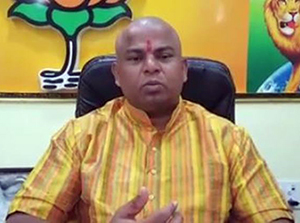
New Delhi, July 31: Justifying the assault on Dalits in Una by cow vigilante groups recently, BJP MLA MLA from Hyderabad Raja Singh has said it was a very good thing to happen. Singh, in a video uploaded on Facebook, said “Jo Dalit gaye ke maas ko le ja raha tha, jo uski pitai hui hai, woh bohut hi achhi hui hai (Those Dalits who were taking the cow, the cow meat, those who were beaten, it was a very good thing to happen).raja singh

Condemning media and leaders who have criticissed the assault on the Dalits, Singh said that many members of the community have devoted their lives to protecting cows. He also asked if it is necessary to kill cows, or eat their meat.

Extending support to gau rakshaks who took it upon themselves to teach the Dalits “a valuable lesson”, Singh claimed that because of such “galeez (filthy)” Dalits, others in the community who are patriotic and religious are getting a bad name. He told other gau rakshaks that while the task ahead of them is difficult, they must overcome them, and not stay silent “till the cow mother is mother India”.

Meanwhile, thousands of Dalits took a pledge in Ahmedabad on Sunday not to lift carcasses in protest against the attacks on Dalits by upper caste Hindu activists. The collective pledge was taken at a Dalit rally called by as many as 30 Dalit groups from across Gujarat and backed by the quasi religious body Jamiat-e-Ulema-Hind.

Although the Acher ST Depot ground here can accommodate only about 5,000 people, witnesses said the venue was swelling, with thousands taking up every inch of space available in the vicinity. Organisers said the Dalit show of strength was meant to protest against what they said were atrocities against the community, in particular the brutal thrashing of four Dalit youths in Una.

Comments

Suresh
 - 
Monday, 1 Aug 2016

Send this guy to gujarat to lift the carcasses of cow and keep the city clean.

True commentator
 - 
Monday, 1 Aug 2016

This man himself looks like from Dalit family.
He might have forgotten his root.

BJP all the leaders are like this because, it is built on DESTRUCTIVE IDEOLOGY

Muhammed Rafique
 - 
Monday, 1 Aug 2016

Beginning of end of Modi and gang

Add new comment

  • Coastaldigest.com reserves the right to delete or block any comments.
  • Coastaldigset.com is not responsible for its readers’ comments.
  • Comments that are abusive, incendiary or irrelevant are strictly prohibited.
  • Please use a genuine email ID and provide your name to avoid reject.
News Network
June 5,2020

Bengaluru, Jun 5: An earthquake of magnitude 4.0 on the Richter Scale jolted Karnataka on Friday morning while another with a magnitude of 4.7 was felt in Jharkhand.

The tremors were felt in Hampi (Karnataka) and Jamshedpur (Jharkhand), according to the National Center for Seismology (NCS).

According to NCS, the aftershocks were felt at 6:55 am in both the places today.

Comments

Add new comment

  • Coastaldigest.com reserves the right to delete or block any comments.
  • Coastaldigset.com is not responsible for its readers’ comments.
  • Comments that are abusive, incendiary or irrelevant are strictly prohibited.
  • Please use a genuine email ID and provide your name to avoid reject.
Agencies
February 12,2020

New Delhi, Feb 12: Senior Karnataka BJP leader Umesh Katti, who has been left out of the latest cabinet expansion, on Wednesday met party president Jagat Prakash Nadda over the issue.

On Tuesday, Karnataka Chief Minister BS Yediyurappa allotted portfolios to 10 newly inducted ministers. The leader was sulking after he was left out from the cabinet.

According to sources, Katti urged JP Nadda to consider his seniority in the party and give him a ministerial berth.

Earlier, Yeddyurappa had announced that Umesh Katti would be given a place in the state cabinet, but his name was dropped from the list of ministers at the last moment.

According to sources, Umesh Katti also urged Nadda for a Rajya Sabha berth for his brother Ramesh Katti.

Comments

Add new comment

  • Coastaldigest.com reserves the right to delete or block any comments.
  • Coastaldigset.com is not responsible for its readers’ comments.
  • Comments that are abusive, incendiary or irrelevant are strictly prohibited.
  • Please use a genuine email ID and provide your name to avoid reject.
Agencies
May 8,2020

Washington D.C., May 8: The prime time for brain development in a child's life is the first year, where the infant spends most of the time asleep. It is the time when neural connections form and sensory memories are encoded.

However, when sleep is disrupted, as occurs more often among children with autism, brain development may be affected, too.

New research led by the University of Washington finds that sleep problems in a baby's first 12 months may not only precede an autism diagnosis but also may be associated with altered growth trajectory in a key part of the brain, the hippocampus.

The study, which was published in the American Journal of Psychiatry, researchers report that in a sample of more than 400 taken of 6- to 12-month-old infants, those who were later diagnosed with autism were more likely to have had difficulty falling asleep.

It also states that this sleep difficulty was associated with altered growth trajectories in the hippocampus.

"The hippocampus is critical for learning and memory, and changes in the size of the hippocampus have been associated with poor sleep in adults and older children.

As many as 80 per cent of the children with autism spectrum disorder have sleep problems," said Annette Estes, director of the UW Autism Center and senior author of the study.

"In our clinical experience, parents have a lot of concerns about their children's sleep, and in our work on early autism intervention, we observed that sleep problems were holding children and families back," added Estes, who is also a UW professor of speech and hearing sciences.

"It could be that altered sleep is part-and-parcel of autism for some children. One clue is that behavioural interventions to improve sleep don't work for all children with autism, even when their parents are doing everything just right. This suggests that there may be a biological component to sleep problems for some children with autism," said Estes.

To consider links among sleep, brain development, and autism, researchers at the IBIS Network looked at MRI scans of 432 infants, surveyed parents about sleep patterns, and measured cognitive functioning using a standardized assessment.

At the outset of the study, infants were classified according to their risk for developing autism: Those who were at higher risk of developing autism -- about two-thirds of the study sample -- had an older sibling who had already been diagnosed.

Infant siblings of children with autism have a 20 per cent chance of developing autism spectrum disorder -- a much higher risk than children in the general population.

In the current study, 127 of the 432 infants were identified as "low risk" at the time the MRI scans were taken because they had no family history of autism.

They later evaluated all the participants at 24 months of age to determine whether they had developed autism. Of the roughly 300 children originally considered "high familial risk," 71 were diagnosed with autism spectrum disorder at that age.

Problems with sleep were more common among the infants later diagnosed with an autism spectrum disorder, as were larger hippocampi. No other subcortical brain structures were affected, including the amygdala, which is responsible for certain emotions and aspects of memory, or the thalamus, a signal transmitter from the spinal cord to the cerebral cortex.

The authors note that while parents reported more sleep difficulties among infants who developed autism compared to those who did not, the differences were very subtle and only observed when looking at group averages across hundreds of infants.

Sleep patterns in the first years of life change rapidly as infants transition from sleeping around the clock to a more adult-like sleep/wake cycle. Until further research is completed, Estes said, it is not possible to interpret challenges with sleep as an early sign of increased risk for autism.


Comments

Add new comment

  • Coastaldigest.com reserves the right to delete or block any comments.
  • Coastaldigset.com is not responsible for its readers’ comments.
  • Comments that are abusive, incendiary or irrelevant are strictly prohibited.
  • Please use a genuine email ID and provide your name to avoid reject.