Saudi bizman murder: Bhat swallows diamond ring to avoid arrest

[email protected] (CD Network)
August 9, 2016

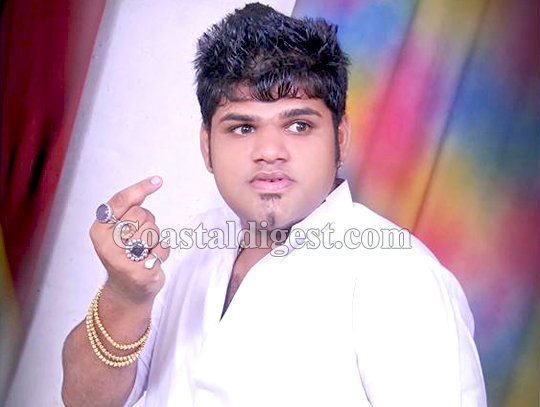
Udupi, Aug 9: Astrologer Niranjan Bhat, one of the key suspects in the murder of businessman Bhaskar Shetty, had attempted suicide by swallowing a diamond-studded finger ring and ear studs just a day before his arrest, police said.

niranjan

Niranjan Bhat, the astrologer (file photo)

Bhat had swallowed the ring and studs in Bengaluru on August 7, Additional Superintendent of Police Vishnuvardhan N siad. He was arrested at Nitte in Karkala, Udupi district, a day later but didn't show any signs of ill health.

Around 11 pm, he complained of severe stomach pain. Police rushed him to hospital but he tried to avoid undergoing scan.

Investigation Officer S V Girish made him undergo the scan to locate the ornaments in the stomach and intestine. He was fed natural laxatives such as bananas and raw vegetables.

The ornaments may take some time to come out of the body through the bowels. Doctors are checking his stools (faeces).

As of now, Bhat is out of danger as the ring he had swallowed was a whole one. The ring or studs were not powdered. But doctors fear harm to his intestines from the sharp edges of the ear studs.

Bhaskar Shetty, a prominent businessman from Udupi, who owned a chain of supermarkets in Saudi Arabia, had gone missing on July 28 and was found murdered later.

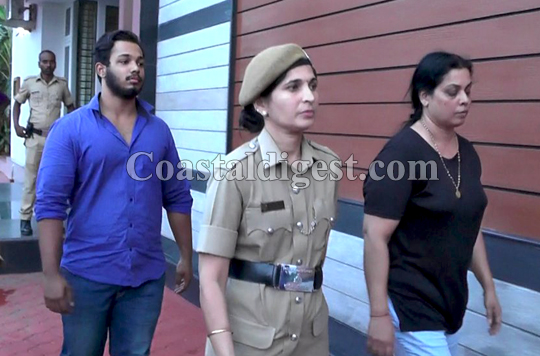
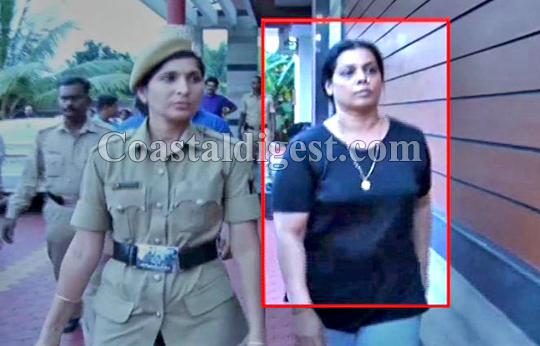
Police have arrested his wife Rajeshwari B Shetty, son Navneeth Shetty and Bhat for the murder. They suspect Rajeshwari was having an affair with Bhat and misappropriating Shetty's money.

Shetty had also threatened to divorce Rajeshwari and disown her as well as Navneeth.

Mom-son in custody

Rajeshwari and son Navneeth Shetty were on Monday remanded in police custody for five days. Manipal police had sought nine days of custody when they were produced before Additional Civil Judge (Senior Division) Rajesh Karnan of Udupi court.

Sources said that apart from Rajeshwari, Navneeth and astrologer Niranjan Bhat, some others could have been involved in the murder, said sources.

Also Read:

Saudi bizman Bhaskar Shetty murdered by wife, son in Udupi with priest's help

Days after assault by wife and son, Udupi hotelier Bhaskar Shetty goes missing

Udupi

udupi 1

udupi 2

udupi 3

udupi 4

udupi 5

Comments

Satyameva jayate
 - 
Wednesday, 10 Aug 2016

Astrologer could not decide his own plans and future

IBRAHIM ABDULLAH
 - 
Tuesday, 9 Aug 2016

BY THE WAY MR. NAREN >WHERE ARE YOU, MISSING YOUR COMMENTS.
ARE YOU SLEEPING LIKE KUMBAKARNA. IF ANY ONE INVOLVED FROM
PARTICULAR COMMUNITY YOU START TO BARK ... WHERE ARE YOU

Ahmed
 - 
Tuesday, 9 Aug 2016

naren is hidden behind homa..hhahaa

Indian
 - 
Tuesday, 9 Aug 2016

Naren, Where are you!! No comments!!!!

Oh understand your guys right!!!

Mahendra
 - 
Tuesday, 9 Aug 2016

he should not be released he should not be allowed in the society another monster to born should not be allowed.

Jeevith kumar
 - 
Tuesday, 9 Aug 2016

Really its horrible to keep him the category of son's place. he s just an animal. he lost the humanity.

PREM
 - 
Tuesday, 9 Aug 2016

They are walking like cheddi members.. Usually cheddis create mischief in the society and then claim peace maker and protectors of hindus . in reality they care only the upper caste and for the rest they only wake up for few days when things get exposed... thats the reality we should understand and recognise their deception of love for hindu brothers

Add new comment

  • Coastaldigest.com reserves the right to delete or block any comments.
  • Coastaldigset.com is not responsible for its readers’ comments.
  • Comments that are abusive, incendiary or irrelevant are strictly prohibited.
  • Please use a genuine email ID and provide your name to avoid reject.
News Network
March 27,2020

Mysuru, Mar 27: A 35-year old man from Mysuru, Karnataka was tested positive for coronavirus infection on Thursday, taking the state-wide count to 52 altogether.

This new case could be an indication that Covid-19 has entered into the third stage of community transmission in Karnataka, as the infected person neither has any travel history nor have been in contact with Covid-affected persons.

The patient works in the quality assurance section of a pharmaceutical company in Nanjangud in Mysuru district, and has been in continuous contact with medical care professionals.

Mysuru DC Mr Abhiram G Shankar informs that detailed investigation is under process.

He is currently undergoing treatment at an isolation ward in a designated hospital in Mysuru. So far his seven primary contacts have been traced and they are under home quarantine, Mr Abhiram Shankar said.

A 35 year old Mysurean, and another 46 year old Keralite, both who had come from Dubai, were the first and second cases tested positive for Covid-19 in Mysuru. They are also currently kept under isolation.

Mysuru district administration has identified 898 international passengers in Mysuru district including 152 in the taluks. Among them, while 149 persons have completed home quarantine period by now, the rest are still in isolation.

Comments

Add new comment

  • Coastaldigest.com reserves the right to delete or block any comments.
  • Coastaldigset.com is not responsible for its readers’ comments.
  • Comments that are abusive, incendiary or irrelevant are strictly prohibited.
  • Please use a genuine email ID and provide your name to avoid reject.
Ram Puniyani
January 14,2020

In the beginning of January 2020 two very disturbing events were reported from Pakistan. One was the attack on Nankana Sahib, the holy shrine where Sant Guru Nanak was born. While one report said that the place has been desecrated, the other stated that it was a fight between two Muslim groups. Prime Minister of Pakistan Imran Khan condemned the incident and the main accused Imran Chisti was arrested. The matter related to abduction and conversion of a Sikh girl Jagjit Kaur, daughter of Pathi (One who reads Holy Guru Granth Sahib in Gurudwara) of the Gurudwara. In another incident one Sikh youth Ravinder Singh, who was out on shopping for his marriage, was shot dead in Peshawar.

While these condemnable attacks took place on the Sikh minority in Pakistan, BJP was quick enough to jump to state that it is events like this which justify the Citizenship Amendment Act (CAA). Incidentally CAA is the Act which is discriminatory and relates to citizenship with Religion, which is not as per the norms of Indian constitution. There are constant debates and propaganda that population of Hindus has come down drastically in Pakistan and Bangla Desh. Amit Shah, the Home minister stated that in Pakistan the population of Hindus has come down from 23% at the time of partition to 3.7% at present. And in Bangla Desh it has come down from 22% to present 8%.

While not denying the fact that the religious minorities are getting a rough deal in both these countries, the figures which are presented are totally off the mark. These figures don’t take into consideration the painful migrations, which took place at the time of partition and formation of Bangla Desh later. Pakistan census figures tell a different tale. Their first census was held in 1951. As per this census the overall percentage of Non Muslim in Pakistan (East and West together) was 14.2%, of this in West Pakistan (Now Pakistan) it was 3.44 and in Eat Pakistan it was 23.2. In the census held in Pakistan 1998 it became 3.72%. As far as Bangla Desh is concerned the share of Non Muslims has gone down from 23.2 (1951) to 9.6% in 2011.

The largest minority of Pakistan is Ahmadis, (https://minorityrights.org/country/pakistan/) who are close to 4 Million and are not recognised as Muslims in Pakistan. In Bangla Desh the major migrations of Hindus from Bangla Desh took place in the backdrop of Pakistan army’s atrocities in the then East Pakistan.

As far as UN data on refugees in India it went up by 17% between 2016-2019 and largest numbers were from Tibet and Sri Lanka.  (https://www.un.org/en/development/desa/population/migration/publication…)

The state of minorities is in a way the index of strength of democracy. Most South Asian Countries have not been able to sustain democratic values properly. In Pakistan, the Republic began with Jinnah’s classic speech where secularism was to be central credo of Pakistan. This 11th August speech was in a way what the state policy should be, as per which people of all faiths are free to practice their religion. Soon enough the logic of ‘Two Nation theory” and formation of Pakistan, a separate state for Muslim took over. Army stepped in and dictatorship was to reign there intermittently. Democratic elements were suppressed and the worst came when Zia Ul Haq Islamized the state in collusion with Maulanas. The army was already a strong presence in Pakistan. The popular formulation for Pakistan was that it is ruled by three A’s, Army, America and Allah (Mullah).

Bangla Desh had a different trajectory. Its very formation was a nail in the coffin of ‘two nation theory’; that religion can be the basis of a state. Bangla Desh did begin as a secular republic but communal forces and secular forces kept struggling for their dominance and in 1988 it also became Islamic republic. At another level Myanmar, in the grip of military dictatorship, with democratic elements trying to retain their presence is also seeing a hard battle. Democracy or not, the army and Sanghas (Buddhist Sang has) are strong, in Myanmar as well. The most visible result is persecution of Rohingya Muslims.

Similar phenomenon is dominating in Sri Lanka also where Budhhist Sanghas and army have strong say in the political affairs, irrespective of which Government is ruling. Muslim and Christian minorities are a big victim there, while Tamils (Hindus, Christians etc.) suffered the biggest damage as ethnic and religious minorities. India had the best prospect of democracy, pluralism and secularism flourishing here. The secular constitution, the outcome of India’s freedom struggle, the leadership of Gandhi and Nehru did ensure the rooting of democracy and secularism in a strong way.

India so far had best democratic credentials amongst all the south Asian countries. Despite that though the population of minorities rose mainly due to poverty and illiteracy, their overall marginalisation was order of the day, it went on worsening with the rise of communal forces, with communal forces resorting to identity issues, and indulging in propaganda against minorities.

While other South Asian countries should had followed India to focus more on infrastructure and political culture of liberalism, today India is following the footsteps of Pakistan. The retrograde march of India is most visible in the issues which have dominated the political space during last few years. Issues like Ram Temple, Ghar Wapasi, Love Jihad, Beef-Cow are now finding their peak in CAA.

India’s reversal towards a polity with religion’s identity dominating the political scene was nicely presented by the late Pakistani poetess Fahmida Riaz in her poem, Tum bhi Hum Jaise Nikle (You also turned out to be like us). While trying to resist communal forces has been an arduous task, it is becoming more difficult by the day. This phenomenon has been variously called, Fundamentalism, Communalism or religious nationalism among others. Surely it has nothing to do with the religion as practiced by the great Saint and Sufi traditions of India; it resorts mainly to political mobilization by using religion as a tool.


Comments

Ashi
 - 
Tuesday, 14 Jan 2020

If Malaysia implement similar NRC/CAA, India and China are the loser.

Add new comment

  • Coastaldigest.com reserves the right to delete or block any comments.
  • Coastaldigset.com is not responsible for its readers’ comments.
  • Comments that are abusive, incendiary or irrelevant are strictly prohibited.
  • Please use a genuine email ID and provide your name to avoid reject.
News Network
April 9,2020

Bengaluru, Apr 9: The Karnataka government is currently engaged in discussions with experts, specialists and other stakeholders to decide on its lockdown exit strategy and would take a final view by April 13, a key Minister said on Thursday.

"Day after tomorrow we have a VC (videoconference) with the Prime Minister," Medical Education Minister Sudhakar K, who is in-charge of all matters related to COVID-19, noted when asked about the States strategy.

He said a task force of specialist doctors on Wednesday submitted its report to the government, giving its recommendations.

"We are meeting lot of stakeholders of the society taking their views," the Minister said, adding, the Cabinet would also hold discussions.

"Finally, day after tomorrow, after discussing with the Prime Minister during the VC, the government will take a view on this by April 13 or so. As of now, we have not taken any view on it. We are studying all the reports," Sudhakar told PTI.

The Minister observed that the COVID-19 cases were slowly spiking in India but not multiplying the way they have in some other countries like Italy, Spain and the United States as the government had declared 21-day national lockdown early and taken other strict measures. "Let's see for one week and see."

"We need to fight this out collectively and by strictly following the quarantine methods and social distancing," Sudhakar stressed.

The Chief Minister B S Yediyurappa had on Wednesday said his government was in favour of lifting lock-down in districts which remained free from COVID-19 after April 14 subject to approval from the Centre.

"If the Prime Minister suggests to States to take decision (on lock-down) based on the situation in their respective States, my position is to take a call (on roll- back) in districts free from COVID-19," he had said.

"This is to allow people to go about their business and move about within the district and not from one district to another, after April 14, after taking the approval of the Prime Minister."

According to State officials, as many as 12 districts continue to remain free from COVID-19.

The task force has recommended continuation of lockdown at "hot spots" beyond April 14.

It has suggested that schools and colleges be shut till May 31, while non-air-conditioned shops can be opened.

Also, IT/BT companies, government offices providing essential services and factories can function with 50 per cent staff, the task force said in its recommendations for 15-day period after April 14.

Comments

Add new comment

  • Coastaldigest.com reserves the right to delete or block any comments.
  • Coastaldigset.com is not responsible for its readers’ comments.
  • Comments that are abusive, incendiary or irrelevant are strictly prohibited.
  • Please use a genuine email ID and provide your name to avoid reject.