


Don't tolerate cow vigilantism: Centre tells State govts

[email protected] (CD Network)
August 9, 2016

New Delhi, Aug 9: Cracking the whip on cow vigilantism, the Centre tonight asked all states not to tolerate anyone taking law into their hands in the name of protecting cow and take prompt action against such offenders.
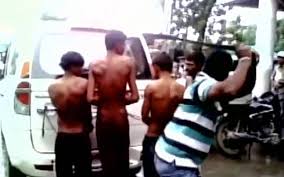
cowHome Ministry advisory came two days after Prime Minister Narendra Modi denounced cow vigilantes and asked people to beware of its 'fake' protectors trying to divide society and the country and asked the states to severely punish them.

The advisory said historically cattle have a very special, respected and venerated status in Indian culture and history and even the father of the nation had stated that 'cow protection to me is not mere protection of cow, it means protection of that (which) lives, is helpless and weak in the world'.

However, that does not entitle any individual or group of persons to take action on their own to prevent the alleged slaughter or punish the alleged wrong doers.

"Recently, some incidents have been reported where certain persons or groups have taken law into their hands in the name of protecting cows and have committed crimes in pursuance thereof. This is not an acceptable situation.

"The states are, therefore, enjoined upon, and expected to ensure that any person who takes law into his/ her own hands is dealt with prompt, and punished as per law. There should be no tolerance at all for such persons and full majesty of law must come to bear on them, without exception," it said.

The advisory said no person can, under any circumstances, take the law into their hands and any person, or persons, doing so have to be dealt with strictly under the relevant laws, and brought to justice in the quickest possible fashion, for the strictest punishment.

The central government initiative came at a time when the Modi government and BJP are facing flak over incidents of violence against Dalits and Muslims by cow vigilantes in various states including Uttar Pradesh, Gujarat and Madhya Pradesh.

Quoting the Directive Principles of State Policy, which provides for the preservation of cows, the Home Ministry advisory said the state shall endeavour to organise agriculture and animal husbandry on modern and scientific lines and shall in particular, take steps for preserving and improving the breeds, and prohibiting the slaughter of cows and calves and other milch and draught cattle.

Entry 15 of the State list of the 7th Schedule allocates the work of 'Preservation, protection and improvement of stock and preservation; veterinary training and practice' to the states, it said.

Consequently laws pertaining to cow preservation on prohibition of slaughter vary from state to state.

"In states where slaughter of cows is prohibited by law, such slaughtering would be in violation of law and an offence.

"However, that does not entitle any individual or group of persons to take action on their own to prevent the alleged slaughter or punish the alleged wrong doers," it said.

The advisory said Section 39 of the CrPC requires that any person aware of the commission of certain offences or intention thereof, is required to give information to the nearest magistrate or police officer of such commission or intention.

"Therefore, if an offence is committed, or about to be committed, such an offence, or possibility of offence is required to be brought to the notice of the concerned police authorities or magistrate for appropriate action as per law," it said.

Comments

Abdul Latif
 - 
Tuesday, 9 Aug 2016

now people will realize that Government has wake up from 'HIGH SLEEP'

Add new comment

  • Coastaldigest.com reserves the right to delete or block any comments.
  • Coastaldigset.com is not responsible for its readers’ comments.
  • Comments that are abusive, incendiary or irrelevant are strictly prohibited.
  • Please use a genuine email ID and provide your name to avoid reject.
News Network
January 31,2020

Bengaluru, Jan 31: Senior IPS officer Praveen Sood is the new Head of Police Force in Karnataka as the current DG and IG Neelamani Raju today retired.

Praveen Sood, the DIG of CID’s Economic Offences Wing, introduced several reforms that sped up investigation processes. He introduced the Crime and Criminal Tracking Network System all over the state by networking all police stations in the country and ensuring data entry and retrieval of all information in police stations and higher police officers online.

Born in 1964, Sood graduated from IIT Delhi and joined the Indian Police Service in 1986. He kicked off his career as the Assistant Superintendent of Police in Mysuru in 1989. He has served as the SP of Ballari and Raichur before being posted as the Deputy Police Commissioner (Law and Order) of Bengaluru.

In 1999, he served as the police officer on foreign deputation as the police advisor to the Government of Mauritius for 3 years.  He was posted as Police Commissioner of Mysuru City between 2004 and 2007.

He took over as the Additional Commissioner of Police (Traffic) in Bengaluru in 2008 and continued in the post till 2011. He has won the Chief Minister’s Gold Medal for excellence in service in 1996, the Police Medal for Meritorious Service in 2002  and the President’s Police Medal in 2011.

During 2013-14 he took over as Managing Director of Karnataka State Police Housing Corporation. He later worked as the Principal Secretary to the Home  Department as the Additional Director General of Police (Karnataka State Reserve Police) and the ADGP of Administration.

In 2017, he was appointed the Bengaluru Police Commissioner. He was also instrumental in launching “Suraksha” App and “Pink Hoyasalas” managed by all-women police officers.

As the DIG of the CID, Economic offences and Special Units, he is credited for opening the Centre for Cyber-crime Investigation, Training and Research for training police officers, prosecutors and the judiciary in handling cyber crime cases.

Comments

Add new comment

  • Coastaldigest.com reserves the right to delete or block any comments.
  • Coastaldigset.com is not responsible for its readers’ comments.
  • Comments that are abusive, incendiary or irrelevant are strictly prohibited.
  • Please use a genuine email ID and provide your name to avoid reject.
coastaldigest.com news network
August 2,2020

Mangaluru/Udupi, Aug 2: The twin coastal districts of Dakshina Kannada and Udupi witnessed sporadic movement of vehicles and relatively less commercial activities today in spite of the withdrawal of ‘Sunday lockdown’ by the state government. 

After the central government announced guidelines under Unlock 3.0, the Karnataka government has removed the complete lockdown concept on Sundays and done away with the night curfews too. So from today (August 2), there will be no lockdown on Sundays.

KSRTC operated its buses as usually. However, compared to other days, today the number of private and city buses on the roads in Dakshina Kannada was limited. 

In Udupi, city buses remained off the roads as the number of passengers was less. However, KSRTC and NARM buses were seen transporting passengers.

In containment zones ban on movement of people will continue till August 31 in Udupi. The Santhekatte market used to function on Saturdays, as there was Sunday lockdown on earlier Sundays. Now the market will be open on Sundays only.

Comments

Add new comment

  • Coastaldigest.com reserves the right to delete or block any comments.
  • Coastaldigset.com is not responsible for its readers’ comments.
  • Comments that are abusive, incendiary or irrelevant are strictly prohibited.
  • Please use a genuine email ID and provide your name to avoid reject.
Ram Puniyani
February 4,2020

As democracy is seeping in slowly all over the world, there is an organization which is monitoring the degree of democracy in the individual countries, The Economist Intelligence Unit. As such in each country there are diverse factors which on one hand work to deepen it, while others weaken it. Overall there is a march from theoretical democracy to substantive one. The substantive democracy will herald not just the formal equality, freedom and community feeling in the country but will be founded on the substantive quality of these values. In India while the introduction of modern education, transport, communication laid the backdrop of beginning of the process, the direction towards deepening of the process begins with Mahatma Gandhi when he led the non-cooperation movement in 1920, in which average people participated. The movement of freedom for India went on to become the ‘greatest ever mass movement’ in the World.

The approval and standards for democracy were enshrined in Indian Constitution, which begins ‘We the people of India’, and was adopted on 26th January 1950. With this Constitution and the policies adopted by Nehru the process of democratization started seeping further, the dreaded Emergency in 1975, which was lifted later restored democratic freedoms in some degree. This process of democratisation is facing an opposition since the decade of 1990s after the launch of Ram Temple agitation, and has seen the further erosion with BJP led Government coming to power in 2014. The state has been proactively attacking civil liberties, pluralism and participative political culture with democracy becoming flawed in a serious way. And this is what got reflected in the slipping of India by ten places, to 51st, in 2019. On the index of democracy India slipped down from the score of 7.23 to 6.90. The impact of sectarian BJP politics is writ on the state of the nation, country.

Ironically this lowering of score has come at a time when the popular protests, the deepening of democracy has been given a boost and is picking up with the Shaheen Bagh protests. The protest which began in Shaheen Bagh, Delhi in the backdrop of this Government getting the Citizenship amendment Bill getting converted into an act and mercilessly attacking the students of Jamia Milia Islamia, Aligarh Muslim University along with high handed approach in Jamia Nagar and neighbouring areas.  From 15th December 2019, the laudable protest is on.

It is interesting to note that the lead in this protest has been taken by the Muslim women, from the Burqa-Hijab clad to ‘not looking Muslim’ women and was joined by students and youth from all the communities, and later by the people from all the communities. Interestingly this time around this Muslim women initiated protest has contrast from all the protests which earlier had begun by Muslims. The protests opposing Shah Bano Judgment, the protests opposing entry of women in Haji Ali, the protests opposing the Government move to abolish triple Talaq. So far the maulanas from top were initiating the protests, with beard and skull cap dominating the marches and protests. The protests were by and large for protecting Sharia, Islam and were restricted to Muslim community participating.

This time around while Narendra Modi pronounced that ‘protesters can be identified by their clothes’, those who can be identified by their external appearance are greatly outnumbered by all those identified or not identified by their appearance.

The protests are not to save Islam or any other religion but to protect Indian Constitution. The slogans are structured around ‘Defence of democracy and Indian Constitution’. The theme slogans are not Allahu Akbar’ or Nara-E-Tadbeer’ but around preamble of Indian Constitution. The lead songs have come to be Faiz Ahmad Faiz’s ‘Hum Dekhenge’, a protest against Zia Ul Haq’s attempts to crush democracy in the name of religion. Another leading protest song is from Varun Grover, ‘Tanashah Aayenge…Hum Kagaz nahin Dikhayenge’, a call to civil disobedience against the CAA-NRC exercise and characterising the dictatorial nature of the current ruling regime.

While BJP was telling us that primary problem of Muslim women is Triple talaq, the Muslim women led movements has articulated that primary problem is the very threat to Muslim community. All other communities, cutting across religious lines, those below poverty line, those landless and shelter less people also see that if the citizenship of Muslims can be threatened because of lack of some papers, they will be not far behind in the victimization process being unleashed by this Government.

While CAA-NRC has acted as the precipitating factor, the policies of Modi regime, starting from failure to fulfil the tall promises of bringing back black money, the cruel impact of demonetisation, the rising process of commodities, the rising unemployment, the divisive policies of the ruling dispensation are the base on which these protest movements are standing. The spread of the protest movement, spontaneous but having similar message is remarkable. Shaheen Bagh is no more just a physical space; it’s a symbol of resistance against the divisive policies, against the policies which are increasing the sufferings of poor workers, the farmers and the average sections of society.

What is clear is that as identity issues, emotive issues like Ram Temple, Cow Beef, Love Jihad and Ghar Wapasi aimed to divide the society, Shaheen Bagh is uniting the society like never before. The democratisation process which faced erosion is getting a boost through people coming together around the Preamble of Indian Constitution, singing of Jan Gan Man, waving of tricolour and upholding the national icons like Gandhi, Bhagat Singh, Ambedkar and Maulana Azad. One can feel the sentiments which built India; one can see the courage of people to protect what India’s freedom movement and Indian Constitution gave them.

Surely the communal forces are spreading canards and falsehood against the protests. As such these protests which is a solid foundation of our democracy. The spontaneity of the movement is a strength which needs to be channelized to uphold Indian Constitution and democratic ethos of our beloved country.

Comments

Add new comment

  • Coastaldigest.com reserves the right to delete or block any comments.
  • Coastaldigset.com is not responsible for its readers’ comments.
  • Comments that are abusive, incendiary or irrelevant are strictly prohibited.
  • Please use a genuine email ID and provide your name to avoid reject.