


Staring at a woman for over 14 seconds can land you in jail: Kerala official

August 16, 2016

Kochi, Aug 16: A top Kerala official's comments that staring "annoyingly" at a woman for 14 seconds can land a man in jail as per certain sections of law has gone viral on social media with a state minister terming them "irritating".
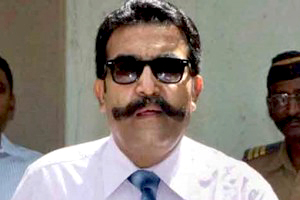
kerofficer"There are sections in law to jail a man for annoyingly staring at a woman for 14 seconds. Please use it (the provisions in the law), if it is the case," State Excise Commissioner Rishiraj Singh said.

He made the comments at an event organised by a charitable trust here two days ago.

Urging women to fight the hooligans disturbing them, Singh had also asked them to carry knives and chili spray in their bags to protect themselves from such elements.

"Are you carrying a knife in your bag? Are you carrying chilly spray? Time is over for taking such precautions" he had said.

While Singh's words drew varied reactions on social media, Kerala Sports Minister E P Jayarajan termed them as "irritating".

"The remarks are irritating. If a bureaucrat makes remarks which are not in law, certainly the minister concerned will examine it and necessary steps will be taken," he told reporters.

Singh's comments drew humorous reactions on social media, with jokes such as -- how a man who went to see a woman at her home following a marriage proposal ended up in jail for staring at her for more than 14 seconds.

Some also expressed doubts over the points made by Singh.

They asked, "What will happen if a man blinks while staring at her continuously for 14 seconds?... what about a man who stares at a woman wearing a sunglass?".

Rishiraj Singh had courted controversy in July last year for not saluting the then Kerala Home Minister Ramesh Chennithala at a passing out parade in Thrissur.

Supreme Court lawyer KV Dhananjaya who spoke to media persons brought some perspective to the statement made by Singh. "This is an unbelievably mindless statement to make. There is no such provision in any law of this country and there cannot be such a mindless provision of law in any other country of the world. The offence of outraging the modesty of a woman is a very serious issue and it is a matter of concern that such a high ranking public servant is publicly saying an evidently false and mindless thing about it."

Comments

Morality
 - 
Wednesday, 17 Aug 2016

Manku Thimma udupi,

Please try with your house hold members with an outsiders and SEE HOW It feels and wats your reaction??????????????????????.

Satyameva jayate
 - 
Tuesday, 16 Aug 2016

If a person stares at a girl more than 10 seconds....she feels irritated and move away....what does this mean.....will anyone love to see someone staring at his wife or daughter continuously for sometime....will you not react.....this guy is somewhere right....trying to protect women...at least someone trying to do something....if modi said it....

MN DSouza
 - 
Tuesday, 16 Aug 2016

The one who gave this statement is wearing sun glasses. I think he wants to stare for more than 14 seconds and not get arrested.

Manku Thimma
 - 
Tuesday, 16 Aug 2016

Ok boss. Next time I will carry a timer with me and stare only 13 seconds.. Hope its not an offence ???

Add new comment

  • Coastaldigest.com reserves the right to delete or block any comments.
  • Coastaldigset.com is not responsible for its readers’ comments.
  • Comments that are abusive, incendiary or irrelevant are strictly prohibited.
  • Please use a genuine email ID and provide your name to avoid reject.
News Network
January 11,2020

Bengaluru, Jan 11: The Chief Justice of India Justice Sharad Arvind Bobde on Saturday inaugurated the phase-1 of the new building of the Karnataka Judicial Academy on Crescent Road in Bengaluru.

The new building has three floors, besides, the ground floor and two basement floors.

While Chief Minister B S Yediyurappa inaugurated the 319-seater multi-purpose auditorium, at which Chief Justice of the High Court of Karnataka Justice Abhay Shreeniwas Oka felicitated Justice Bobde.

Justice Ravi Malimath, President of the Karnataka Judicial Academy and Judge of the High Court of Karnataka, in his welcome address said that the academy has so far trained as many as 4000 judicial officers and striving for excellence in the field of judiciary.

The building, built in the first phase, has parking in the lower and the upper basement, which can accommodate 44 cars and 124 two-wheelers, the ground floor consists of a 319-seater multi-purpose air-conditioned auditorium, a lecture hall with 84 seats, two lecture halls with 40 seats each and a VIP lounge. The First Floor has a lecture hall with 84 seats, two lecture halls with 40 seats each, a VIP lounge, two discussion rooms and an administrative office for the staff of the academy.

The second phase, to be built has a parking facility for 36 four-wheelers and 22 two-wheelers in the lower basement and 32 four-wheelers and 30 two-wheelers in the upper basement.

The total cost of the project, including Phase-1 and Phase-2, to be executed by the Public Works Department in the sprawling 2.2 acres plot of the Karnataka Judicial Academy is around Rs 96.02 Crore.

Comments

Add new comment

  • Coastaldigest.com reserves the right to delete or block any comments.
  • Coastaldigset.com is not responsible for its readers’ comments.
  • Comments that are abusive, incendiary or irrelevant are strictly prohibited.
  • Please use a genuine email ID and provide your name to avoid reject.
News Network
February 29,2020

Bengaluru, Feb 28: Bengaluru Police Commissioner Bhaskar Rao on Friday said that Section 144 will be imposed near Vidhana Soudha for Budget session starting from March 2.

"Section 144 of the CrPC (prohibits assembly of more than 4 people in an area) will be imposed in the area around Vidhana Soudha from March 2 to March 31 ahead of the Budget session,"Bhaskar Rao said.

The police said that they have intelligence inputs of protests near Vidhana Soudha.

Comments

Add new comment

  • Coastaldigest.com reserves the right to delete or block any comments.
  • Coastaldigset.com is not responsible for its readers’ comments.
  • Comments that are abusive, incendiary or irrelevant are strictly prohibited.
  • Please use a genuine email ID and provide your name to avoid reject.
Media Release
February 14,2020

Veteran journalist P. Sainath has said that the nation is in a crisis. And this crisis is not limited to just the rural area. It has become a national crisis at various areas such as agriculture, education, economy, job creation etc.

He was delivering the endowment lecture on the topic ‘Indian democracy at the post-liberalization and post-truth era’ at Media Manthan 2020 organized by the PG department of journalism and mass communication at St Aloysius College (Autonomous). 

Mr Sainath said that the many policies adopted in the 90s led to India becoming unusually unequal. Referring to the speech Ambedkar had made at the Constituent Assembly while handing over the draft of the Constitution, Mr Sainath said, “Ambedkar had warned about the weakness of Indian democracy that liberty without equality allows the supremacy of a few over the multitude. Liberty, equality and fraternity must be kept together as we cannot have one without the other.” 

Mr Sainath stated that the agrarian crisis was no longer about the loss of productivity, employment or about farmer suicide; it was a societal, civilizational crisis. Commenting on the lopsided policies such as cow-slaughter ban, he explained how cow slaughter ban had adversely affected many industries due to their interdependency. While Muslims who slaughtered cows were rendered helpless, the cattle traders who were mostly OBCs lost their earnings as the cattle prices crashed. An important industry like Kolhapur sandals industry in Maharashtra went bankrupt as a result of the cow slaughter ban in Maharashtra. He said the policymakers had no idea how the rural industries were interconnected. Demonetisation too devastated the rural economy as 98 percent of rural transactions happen through cash. 

Mr Sainath also spoke about the crisis of inequality which affects the Dalits and the Adivasis far more than anyone else as 90 percent of the rural households take home less than Rs 10,000/- per month. “Women are yet another group whose labour is never counted in the gross domestic product. Women and girls globally do unpaid work which amounts to about 12.5 billion working hours per year. Monetarily speaking, this is worth 10.8 trillion dollars,” Mr Sainath added. 

Speaking about the crisis of jobs Mr Sainath said that major companies were laying off employees just to create more profits for the investors and the adoption of artificial intelligence in the industry would further destroy millions of jobs.

Rector of St Aloysius College Institutions Fr Dionysius Vaz SJ, Principal Dr (Fr) Praveen Martis SJ, HOD of Journalism and Mass Communication department Dr (Fr) Melwyn Pinto SJ were present.

‘Veerappan and Vijay Mallya’s business models are interesting!’

Addressing the gathering during his endowment lecture on Friday, Mr Sainath made an interesting comment on the so called ‘revenue model’. “Whenever I visit IIMs and IITs for lectures on my PARI project, the students there ask me what my revenue model for my project is. I tell them that I do not have a revenue model. In fact, journalism does not begin with a revenue model. Gandhiji, Ambedkar, Bhagat Singh were all great journalists. But they did not have a revenue model,” Mr Sainath said.

On a lighter note, he said that the best revenue model that he liked was that of forest brigand Veerappan and liquor baron Vijay Mallya. “Veerappan ruled the forest for forty years and from the top ministers to the villagers he could dictate terms and liver royally. Similarly, Mallya’s revenue model was to steal the banks and run away abroad and live like a king,” Mr Sainath added.

Journalism is not and can never be a business. It is a calling, he opined. While newspaper can be a business, television can be a business, journalism per se cannot be reduced to a business. “Unfortunately today, journalists are recruited on a contract basis and they have no bargaining power; and there are no unions to fight for their cause. Hence, they are at the mercy of the corporate media houses for their survival and are made to write stories that cannot be called journalism,” Mr Sainath said.

Answering a question as to the pressures he faced as a journalist, he said that external pressures from the government or others could be very well handled. It is the internal pressures from once own media house that journalists find it difficult to manage.


Comments

Add new comment

  • Coastaldigest.com reserves the right to delete or block any comments.
  • Coastaldigset.com is not responsible for its readers’ comments.
  • Comments that are abusive, incendiary or irrelevant are strictly prohibited.
  • Please use a genuine email ID and provide your name to avoid reject.