


'Azadi' slogans raised at Amnesty event: Bengaluru Police Commissioner

August 17, 2016

Bengaluru, Aug 17: Three days after the controversial event, Bengaluru Police Commissioner N S Megharikh on Tuesday night confirmed that 'Azadi' (freedom) slogans were raised at a cultural programme Amnesty International India organised here on alleged human rights violations in Jammu and Kashmir.
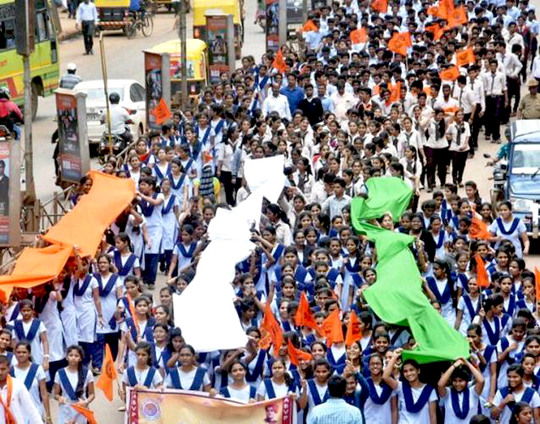
Antiamnesty

"Towards the end of the programme, a group of persons who were among the audience raised slogans seeking 'Azadi'. When the situation was getting volatile, the organisers suspended the programme and the police dispersed the people gathered there," said Megharik in a statement on Tuesday night.

Clarifying that police permission was neither sought nor given, as the event was an indoor function at United Theological College in the city on August 13, Megharikh said police persons were, however, deployed as the programme was brought to the notice of the local police station.

"During the function, it appears that some argument took place among the members of the audience regarding the action taken by the Indian army in Kashmir," the police chief pointed out.

Amnesty organised the programme, Broken Families' , which had an interactive discussion on peace and justice in Kashmir and where three families from the strife-torn valley shared human rights violations they faced with the rest of India.

"During the course of investigation, all possible evidence, including video footage will be collected, examined and appropriate legal action will be taken against the perpetrators of the alleged offence," Megharikh asserted.

The event is supposed to be part of a three-city tour of select families, covering Bengaluru, Mumbai and New Delhi.

The police chief also noted that Akhila Bharatiya Vidyarthi Parishad's (ABVP) organising secretary Jayaprakash had given a complaint, alleging that Amnesty representatives and other participants had indulged in anti-national slogans and criticised the role of Indian army.

The Rashtriya Swayamsevak Sangh's (RSS) affiliated student wing also submitted with the complaint a video footage of the function, showing some of the participants raising 'Azadi' slogans loudly a couple of times in unison.

"The complainant demanded legal action against such persons. After obtaining legal opinion, an FIR was registered on the complaint on August 15 under various sections of the IPC (Indian Penal Code)," Megharikh added.

The case has been entrusted to the assistant commissioner of police in the J C Nagar sub-division, as charges of sedition, rioting, unlawful assembly and promoting enmity were mentioned in the FIR.

None of our employees shouted anti-India slogans at event: Amnesty

Bengaluru, Aug 17: Amnesty International India chapter on Tuesday said none of its employee shouted any anti-India slogan at an event in Bengaluru on Kashmir, allegations based on which the sedition charge was slapped against the human rights body.

Amensty India said the allegation mentioned in a complaint by an ABVP representative against it were “without substance” and that the only discussion at the event on Saturday was about allegations of human rights violations and denial of justice in Jammu and Kashmir.

The local police slapped sedition charge against Amnesty on Monday based on the allegation that anti-India slogans were raised at the event organised by it.

“No Amnesty International India employee shouted any slogans at any point,” the human rights organisation said in a statement referring to allegations that “slogans were raised that Indian Kashmir should be a part of Pakistan.”

To the charge that the event indirectly supported terrorists, Amnesty said the only discussion that had taken place was about allegations of human rights violations and denial of justice to families in Kashmir.

“These are issues that have regularly been discussed in the media. They have been written about at length by members of Parliament, politicians, judges and civil society,” it said.

The event was held as part of a campaign based on the report “Denied: Failures in accountability for human rights violations by security force personnel in Jammu and Kashmir”, published in July 2015, it said.

Amnesty said the report was based on in-depth research in Jammu and Kashmir, including interviews with family members of “victims”, RTI applications, examination of police and court records, and interviews with civil society groups, lawyers, and government officials.

The families of three Kashmiri victims that were interviewed for the report were invited to share their stories at the event, said Amnesty.

About allegations that some people at the event tried to assault ABVP activists, it said, “No Amnesty International India employee was involved in any form of assault.”

“Towards the end of the event, some of those who attended raised slogans, some of which referred to calls for 'Azaadi' [freedom]. Amnesty International India as a matter of policy does not take any position in favour of or against demands for self-determination. However, Amnesty International India considers that the right to freedom of expression includes the right to peacefully advocate political solutions. Amnesty International India had invited the Bengaluru police to be present at the event in the interest of the security of the invited families and other attendees,” the statement said.

About allegations that a women employee of Amnesty and two others raised raised anti-national slogans, it said they were not present on stage at any point during the event.

Amnesty said footage of the event was shared with the police.

The rights body said Amnesty had worked extensively on human rights violations in Pakistan, including “the enforced disappearances and unlawful killings of political activists in Balochistan, violations by security forces in the Federally Administered Tribal Areas (FATA), and violence against journalists by groups including the ISI”.

Comments

Shuaib
 - 
Thursday, 18 Aug 2016

RSS is scared of Azadi MOvement

Rashid
 - 
Wednesday, 17 Aug 2016

Azadi slogans was also raised by JNU students also.. but not from India,, Azadi from RSS, Azadi from Poverty, Azadi from cruel laws like afspa...
Azadi slogans from India also raised in JNU also... but by whom , still under investigation... here also , as per commissioners report.. when ABVP goondas tried to stop the programme, some people raised anti India slogans... but who ? must be investigated.... sangh affiliated org are expert in such activities... there is probability of their involvement.

Fairman
 - 
Wednesday, 17 Aug 2016

The solution for Kashmir problem is not militarily.

This is pre-existing problem, dating back to independence era.
There was a treaty which calls for referendum when they want to quit the Indian union. There was a resolution witnessed by UNO.

The previous gov't has sent fact finding team consisting of very senior most journalists. Their finding was also the same as what the Kashmiris are asking for referendum.

Now who is the looser. Not only Kashmiris, our innocent military and police force. Let we Indian look deeply for solution, keeping our spirit of truth and justice.
The ruling come on the basis of fairness to all sides, regardless how dearly it costs as long as the justice is done to all.

There is a easy solution, but our leaders don't want to do it for personnel benefits.

We should stick to 1 point of Justice and fairness.
- That is if keeping Kashmir with us a just and fair without causing injustice, we should not bow to anybody.

- If losing of Kashmir is justified then we should do it with our conscience as long as justice and truth are prevailed. God will help us for our honesty.

Bottom line, why should our people, our police, our military die and their entire family should suffer. Who will fill this loss.

Our these brave soldiers to defend the nation from external invasion. Their life is not cheaper for dying for leaders selfishness.
These leaders may die without solving and carrying forward the problems to our future generation where future generation has to die, sacrifice for nothing.
May God help us.

Add new comment

  • Coastaldigest.com reserves the right to delete or block any comments.
  • Coastaldigset.com is not responsible for its readers’ comments.
  • Comments that are abusive, incendiary or irrelevant are strictly prohibited.
  • Please use a genuine email ID and provide your name to avoid reject.
News Network
April 27,2020

Bengaluru, Apr 27: Former Prime Minister H D Deve Gowda on Monday demanded that the Karnataka government announce a special package for farmers who are on the verge of quitting agriculture as their profession following losses due to the COVID-19 pandemic.

"Please announce special package for the farmers to bail them out of the loss due to the lockdown.

Drop many of the schemes in the budget but don't leave the farmers in distress," Gowda said in his letter to Chief Minister B S Yediyurappa.

The JD(S) supremo said the way relief has been announced for the milk producers by procuring the unsold milk and distributing it to the slum dwellers, the same assistance should be provided to the farmers of the state.

"If you don't come forward to assist the farmers, then they will be forced to sell their land," Gowda cautioned the Chief Minister.

The former prime minister said the farmers are on the verge of falling in the debt trap and may be compelled to take the extreme step of suicide due to the losses.

Gowda said the farmers are unable to sell their crop because they are not getting proper price for their produce and are selling their crop at a throwaway price to minimise their losses.

"In just one month farmers reached the brink of bankruptcy as they are unable to sell the standing crops in lakhs of acres of land," Gowda said.

The JD(S) supremo has been championing the cause of farmers in the state and highlighting their sufferings.

On April 3 Gowda has appealed to Prime Minister Narendra Modi to look into the plight of farmers, labourers and the middle class people due to the lockdown.

"In such times of crisis, we should see to it that there is no disruption in farming activities by ensuring proper marketing channels to agricultural produce, especially perishables.

Only then we can sustain our long battle against this pandemic," Gowda said in a tweet.

Comments

Add new comment

  • Coastaldigest.com reserves the right to delete or block any comments.
  • Coastaldigset.com is not responsible for its readers’ comments.
  • Comments that are abusive, incendiary or irrelevant are strictly prohibited.
  • Please use a genuine email ID and provide your name to avoid reject.
News Network
July 14,2020

Kasaragod, Jul 14: Kerala State Excise department officials confiscated hawala money to the tune of Rs 2.85 crore from a person hailing from Mangaluru.

According to sources, the officials of the Kumbala Range Excise had noticed the huge baggage containing hundreds of bundles of unaccounted currencies when they intercepted a vehicle at the border check-post at Thoominad in Manjeshwar early on Tuesday morning.

The accused Shamsudheen, who was trying to transport the illegal money into Kerala has been arrested and handed over to the Manjeshwar police authorities for further action, sources added.

Comments

Add new comment

  • Coastaldigest.com reserves the right to delete or block any comments.
  • Coastaldigset.com is not responsible for its readers’ comments.
  • Comments that are abusive, incendiary or irrelevant are strictly prohibited.
  • Please use a genuine email ID and provide your name to avoid reject.
Ram Puniyani
February 10,2020

Noam Chomsky is one of the leading peace workers in the world. In the wake of America’s attack on Vietnam, he brought out his classic formulation, ‘manufacturing consent’. The phrase explains the state manipulating public opinion to have the public approve of it policies—in this case, the attack of the American state on Vietnam, which was then struggling to free itself from French colonial rule.

In India, we are witness to manufactured hate against religious minorities. This hatred serves to enhance polarisation in society, which undermines India’s democracy and Constitution and promotes support for a Hindu nation. Hate is being manufactured through multiple mechanisms. For example, it manifests in violence against religious minorities. Some recent ghastly expressions of this manufactured hate was the massive communal violence witnessed in Mumbai (1992-93), Gujarat (2002), Kandhamal (2008) and Muzaffarnagar (2013). Its other manifestation was in the form of lynching of those accused of having killed a cow or consumed beef. A parallel phenomenon is the brutal flogging, often to death, of Dalits who deal with animal carcasses or leather.

Yet another form of this was seen when Shambhulal Regar, indoctrinated by the propaganda of Hindu nationalists, burned alive Afrazul Khan and shot the video of the heinous act. For his brutality, he was praised by many. Regar was incited into the act by the propaganda around love jihad. Lately, we have the same phenomenon of manufactured hate taking on even more dastardly proportions as youth related to Hindu nationalist organisations have been caught using pistols, while police authorities look on.

Anurag Thakur, a BJP minster in the central government recently incited a crowd in Delhi to complete his chant of what should happen to ‘traitors of the country...” with a “they should be shot”. Just two days later, a youth brought a pistol to the site of a protest at Jamia Millia Islamia university and shouted “take Azaadi!” and fired it. One bullet hit a student of Jamia. This happened on 30 January, the day Nathuram Godse had shot Mahatma Gandhi in 1948. A few days later, another youth fired near the site of protests against the CAA and NRC at Shaheen Bagh. Soon after, he said that in India, “only Hindus will rule”.

What is very obvious is that the shootings by those associated with Hindu nationalist organisations are the culmination of a long campaign of spreading hate against religious minorities in India in general and against Muslims in particular. The present phase is the outcome of a long and sustained hate campaign, the beginning of which lies in nationalism in the name of religion; Muslim nationalism and Hindu nationalism. This sectarian nationalism picked up the communal view of history and the communal historiography which the British introduced in order to pursue their ‘divide and rule’ policy.

In India what became part of “social common sense” was that Muslim kings had destroyed Hindu temples, that Islam was spread by force, and that it is a foreign religion, and so on. Campaigns, such as the one for a temple dedicated to the Hindu god Rama to be built at the site where the Babri masjid once stood, further deepened the idea of a Muslim as a “temple-destroyer”. Aurangzeb, Tipu Sultan and other Muslim kings were tarnished as the ones who spread Islam by force in the subcontinent. The tragic Partition, which was primarily due to British policies, and was well-supported by communal streams also, was entirely attributed to Muslims. The Kashmir conflict, which is the outcome of regional, ethnic and other historical issues, coupled with the American policy of supporting Pakistan’s ambitions of regional hegemony, (which also fostered the birth of Al-Qaeda), was also attributed to the Muslims.

With recurring incidents of communal violence, these falsehoods went on going deeper into the social thinking. Violence itself led to ghettoisation of Muslims and further broke inter-community social bonds. On the one hand, a ghettoised community is cut off from others and on the other hand the victims come to be presented as culprits. The percolation of this hate through word-of-mouth propaganda, media and re-writing of school curricula, had a strong impact on social attitudes towards the minorities.

In the last couple of decades, the process of manufacturing hate has been intensified by the social media platforms which are being cleverly used by the communal forces. Swati Chaturvedi’s book, I Am a Troll: Inside the Secret World of the BJP’s Digital Army, tells us how the BJP used social media to spread hate. Whatapp University became the source of understanding for large sections of society and hate for the ‘Other’, went up by leaps and bounds. To add on to this process, the phenomenon of fake news was shrewdly deployed to intensify divisiveness.

Currently, the Shaheen Bagh movement is a big uniting force for the country; but it is being demonised as a gathering of ‘anti-nationals’. Another BJP leader has said that these protesters will indulge in crimes like rape. This has intensified the prevalent hate.

While there is a general dominance of hate, the likes of Shambhulal Regar and the Jamia shooter do get taken in by the incitement and act out the violence that is constantly hinted at. The deeper issue involved is the prevalence of hate, misconceptions and biases, which have become the part of social thinking.

These misconceptions are undoing the amity between different religious communities which was built during the freedom movement. They are undoing the fraternity which emerged with the process of India as a nation in the making. The processes which brought these communities together broadly drew from Gandhi, Bhagat Singh and Ambedkar. It is these values which need to be rooted again in the society. The communal forces have resorted to false propaganda against the minorities, and that needs to be undone with sincerity.

Combating those foundational misconceptions which create hatred is a massive task which needs to be taken up by the social organisations and political parties which have faith in the Indian Constitution and values of freedom movement. It needs to be done right away as a priority issue in with a focus on cultivating Indian fraternity yet again.

Comments

Add new comment

  • Coastaldigest.com reserves the right to delete or block any comments.
  • Coastaldigset.com is not responsible for its readers’ comments.
  • Comments that are abusive, incendiary or irrelevant are strictly prohibited.
  • Please use a genuine email ID and provide your name to avoid reject.