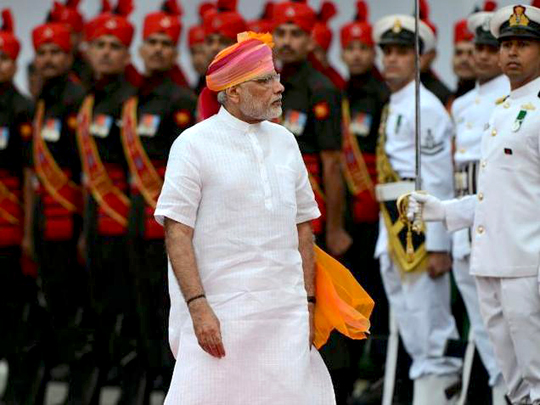
I-Day lie exposed: Village mentioned by PM Modi still without power!

August 18, 2016

Lucknow, Aug 18: Nagla Fatela village in Uttar Pradesh's Hathras district, which found mention in Prime Minister Narendra Modi's Independence Day speech as being “electrified” 70 years after freedom, is still “powerless”.

modi

According to the UP Power Corporation officials here, Nagla Fatela did have power lines, but they were meant only for supplying power for irrigation and running the tubewells and not lighting homes. Some residents, however, had electrified their homes through illegal connections, the officials said. They said that the village was being supplied power for irrigation purposes for the last 25 years.

The corporation sources here said that the work of installing transformers, poles and wires, which was taken up under the Deen Dayal Upadhyaya Village Electrification Project, had almost been completed in the village, but power was yet to be supplied.

A resident of the village said power lines had been installed almost a year ago. The residents also said that the village where the people were shown watching TV during the prime minister's speech in a post on social media by a Union minister was not theirs.

Sources said that power officials rushed to the village to conduct a survey after Modi mentioned the village in his speech. “We are expecting supply of power within a few days,” said a senior official.

Modi, during his I-Day speech, said that Nagla Fatela village was three hours drive from Delhi, but it took 70 years for power to reach the village.

Comments

Manku Thimma
 - 
Thursday, 18 Aug 2016

I really do not understand why these media people are exposing that man's lies day by day? Who world knows he is a liar. Once in a week he speaks truth also. make it a news saying man with 56 inch chest finally spoke a truth!

UMMAR
 - 
Thursday, 18 Aug 2016

modhiji good for publicity then nothing

fekuu jii... ab ki baar fekuuu sarkaar...

Sameer
 - 
Thursday, 18 Aug 2016

Fekna mera kaam hey sun'na ulluon k kaam hey..

Shuaib
 - 
Thursday, 18 Aug 2016

fekna mera janma sidh adhikar hai!

Add new comment

  • Coastaldigest.com reserves the right to delete or block any comments.
  • Coastaldigset.com is not responsible for its readers’ comments.
  • Comments that are abusive, incendiary or irrelevant are strictly prohibited.
  • Please use a genuine email ID and provide your name to avoid reject.
News Network
July 28,2020

Bengaluru, Jul 27: Andhra Pradesh and Karnataka crossed the grim milestone of one lakh Covid-19 cases while Tamil Nadu logged nearly 7,000 fresh infections for the third straight day on Monday as the sharp spike in recent weeks continued unabated in the southern states.

Kerala's tally inched toward the 20,000-mark and Telangana saw the total infection count beach the 55,000-mark while the cumulative cases rose to 2,872 in the tiny union territory of Puducherry as the six together added 20,629 fresh cases and their aggregate shot to 5.02 lakh.

A total of 291 deaths were reported on Monday from these states with Tamil Nadu accounting for the maximum of 77 closely followed by Karnataka with 74 fatalities, according to bulletins issued by respective states.

The cases have been rising in the region since last month when the lockdown norms were eased and thousands of people returned even as testing had been given a push.

The worst-hit was Andhra Pradesh where the Covid-19 count doubled in just eight days as the day's 6,051 cases pushed the tally to 1,02,349. It had crossed the 50,000-mark on July 20.

East Godavari district registered a high of 1,210 cases. After 16,86,446 tests were completed on Monday, the Covid-19 positivity rate in the state shot past the 6 per cent mark, a record high.

From 15,252 confirmed cases on July 1, the number swelled to the current level as every district in the state has been witnessing a severe surge in the pandemic.

The toll rose to 1,090 with 49 fresh deaths. The state now has 51,701 active cases after a total of 49,558 patients had recovered, a bulletin said.

Covid-19 cases in Karnataka spiralled to 1,01,465 as the state reported the biggest single-day spike of 5,324 new infections and 75 fatalities, taking the death toll to 1,953, the health department said.

The day also saw 1,847 patients getting discharged, taking the cumulative recoveries to 37,685.

Tamil Nadu reported highest single-day spike of 6,993 cases, taking the tally to 2,20,716 while 77 deaths propelled the toll to 3,571.

The state has added 45,038 cases since last Monday while the active cases stood at 54,896 and recoveries touched 1,62,249, including 5,723 people discharged today.

Chennai accounted for 95,857 cases of the state's tally.

In Kerala, at least 43 health workers were among the 702 people who tested positive while 745 others recovered, as the state's total infection tally touched 19,727.

The death toll climbed to 63 with two more fatalities from Kozhikode and Kottayam districts, while 9,611 people were presently under treatment, Chief Minister Pinarayi Vijayan said.

A total of 10,054 patients have recovered so far and over 1.55 lakh people were under observation, he told reporters in Thiruvananthapuram.

Telangana's total infection count rose to 55,532 with the addition of 1,473 cases, including 506 from Greater Hyderabad Municipal Corporation (GHMC) areas, a government bulletin said on Monday, providing data as of 8 pm on Sunday.

With eight more deaths, the Covid-19 toll in the state rose to 471. The death rate was 0.85 per cent as against 2.3 per cent in the country, it said.

As many as 42,106 people have recovered from the infection so far, while 12,955 were under treatment.

Puducherry logged 86 new cases, pushing the overall tally to 2,872 and the toll increased to 43 with three more deaths. It has 1,109 active cases, an official statement said.

Comments

Add new comment

  • Coastaldigest.com reserves the right to delete or block any comments.
  • Coastaldigset.com is not responsible for its readers’ comments.
  • Comments that are abusive, incendiary or irrelevant are strictly prohibited.
  • Please use a genuine email ID and provide your name to avoid reject.
News Network
May 24,2020

Bengaluru, May 24: A couple got married in Bengaluru today, even as Karnataka government has announced a complete lockdown on Sundays, as part of the fourth phase of COVID-19 shutdown till the end of this month.

The marriage ceremony on this Sunday was possible thanks to a clarification given by the state government for marriages, which has been already scheduled for May 24 and May 31 to be exempted from the Sunday complete lockdown.

At today's wedding, the rituals were performed with compliance of all guidelines including ensuring social distancing and capping the number of guests at 50.

Satish, the groom said, "Government has allowed weddings with up to 50 people in attendance but we decided to invite only 25 people to the ceremony".

Meanwhile, in the Honnali Honnali area of Davanagere, BJP MLA MP Renukacharya distributed masks to three newly-wed couples.

As per an earlier advisory issued by the State government more than 50 guests, no air conditioning, and the consumption of liquor and paan are among the guidelines to be followed for holding weddings in the state. Also, people aged above 65 and below 10 as well as pregnant women have been barred from participating in the event.

According to the advisory, sanitisers should be provided at the entry and other appropriate places at the venue. Also, thermal screening of all persons shall be conducted at the entry of the venue. The scanner should be held 3-15 cms away from a person's forehead.

Apart from this, the venue shall be "clean and hygienic," and a "nodal person shall be identified for overseeing the arrangements and coordination at the venue." Also, a list of attendees with contact details has to be maintained and all guests should have downloaded Aarogya Setu app.

Comments

Add new comment

  • Coastaldigest.com reserves the right to delete or block any comments.
  • Coastaldigset.com is not responsible for its readers’ comments.
  • Comments that are abusive, incendiary or irrelevant are strictly prohibited.
  • Please use a genuine email ID and provide your name to avoid reject.
News Network
July 28,2020

Hounde, Jul 28: Coronavirus and its restrictions are pushing already hungry communities over the edge, killing an estimated 10,000 more young children a month as meager farms are cut off from markets and villages are isolated from food and medical aid, the United Nations warned Monday.

In the call to action shared with The Associated Press ahead of publication, four UN agencies warned that growing malnutrition would have long-term consequences, transforming individual tragedies into a generational catastrophe.

Hunger is already stalking Haboue Solange Boue, an infant from Burkina Faso who lost half her former body weight of 5.5 pounds (2.5 kilograms) in just a month. Coronavirus restrictions closed the markets, and her family sold fewer vegetables. Her mother was too malnourished to nurse.

“My child,” Danssanin Lanizou whispered, choking back tears as she unwrapped a blanket to reveal her baby's protruding ribs.

More than 550,000 additional children each month are being struck by what is called wasting, according to the UN — malnutrition that manifests in spindly limbs and distended bellies. Over a year, that's up 6.7 million from last year's total of 47 million. Wasting and stunting can permanently damage children physically and mentally.

“The food security effects of the COVID crisis are going to reflect many years from now,” said Dr. Francesco Branca, the WHO head of nutrition. “There is going to be a societal effect.”

From Latin America to South Asia to sub-Saharan Africa, more poor families than ever are staring down a future without enough food.

In April, World Food Program head David Beasley warned that the coronavirus economy would cause global famines “of biblical proportions” this year. There are different stages of what is known as food insecurity; famine is officially declared when, along with other measures, 30% of the population suffers from wasting.

The World Food Program estimated in February that one Venezuelan in three was already going hungry, as inflation rendered salaries nearly worthless and forced millions to flee abroad. Then the virus arrived.

“Every day we receive a malnourished child,” said Dr. Francisco Nieto, who works in a hospital in the border state of Tachira.

In May, Nieto recalled, after two months of quarantine, 18-month-old twins arrived with bodies bloated from malnutrition. The children's mother was jobless and living with her own mother. She told the doctor she fed them only a simple drink made with boiled bananas.

“Not even a cracker? Some chicken?” he asked.

“Nothing,” the children's grandmother responded. By the time the doctor saw them, it was too late: One boy died eight days later.

The leaders of four international agencies — the World Health Organization, UNICEF, the World Food Program and the Food and Agriculture Organization — have called for at least dollar 2.4 billion immediately to address global hunger.

But even more than lack of money, restrictions on movement have prevented families from seeking treatment, said Victor Aguayo, the head of UNICEF's nutrition program.

“By having schools closed, by having primary health care services disrupted, by having nutritional programs dysfunctional, we are also creating harm,” Aguayo said. He cited as an example the near-global suspension of Vitamin A supplements, which are a crucial way to bolster developing immune systems.

In Afghanistan, movement restrictions prevent families from bringing their malnourished children to hospitals for food and aid just when they need it most. The Indira Gandhi hospital in the capital, Kabul, has seen only three or four malnourished children, said specialist Nematullah Amiri. Last year, there were 10 times as many.

Because the children don't come in, there's no way to know for certain the scale of the problem, but a recent study by Johns Hopkins University indicated an additional 13,000 Afghans younger than 5 could die.

Afghanistan is now in a red zone of hunger, with severe childhood malnutrition spiking from 690,000 in January to 780,000 — a 13% increase, according to UNICEF.

In Yemen, restrictions on movement have blocked aid distribution, along with the stalling of salaries and price hikes. The Arab world's poorest country is suffering further from a fall in remittances and a drop in funding from humanitarian agencies.

Yemen is now on the brink of famine, according to the Famine Early Warning Systems Network, which uses surveys, satellite data and weather mapping to pinpoint places most in need.

Some of the worst hunger still occurs in sub-Saharan Africa. In Sudan, 9.6 million people live from one meal to the next — a 65% increase from the same time last year.

Lockdowns across Sudanese provinces, as around the world, have dried up work and incomes for millions. With inflation hitting 136%, prices for basic goods have more than tripled.

“It has never been easy but now we are starving, eating grass, weeds, just plants from the earth,” said Ibrahim Youssef, director of the Kalma camp for internally displaced people in war-ravaged south Darfur.

Adam Haroun, an official in the Krinding camp in west Darfur, recorded nine deaths linked with malnutrition, otherwise a rare occurrence, over the past two months — five newborns and four older adults, he said.

Before the pandemic and lockdown, the Abdullah family ate three meals a day, sometimes with bread, or they'd add butter to porridge. Now they are down to just one meal of “millet porridge” — water mixed with grain. Zakaria Yehia Abdullah, a farmer now at Krinding, said the hunger is showing “in my children's faces.”

“I don't have the basics I need to survive,” said the 67-year-old, who who hasn't worked the fields since April. “That means the 10 people counting on me can't survive either.”


Comments

Add new comment

  • Coastaldigest.com reserves the right to delete or block any comments.
  • Coastaldigset.com is not responsible for its readers’ comments.
  • Comments that are abusive, incendiary or irrelevant are strictly prohibited.
  • Please use a genuine email ID and provide your name to avoid reject.