


Elderly woman mauled to death by stray dogs; another injured

August 20, 2016

Thiruvananthapuram, Aug 20: The stray dog menace in Kerala continues unabated with a 65-year-old woman being mauled to death by a large pack on a suburban beach at nearby Kanjiramkulam in the state capital.
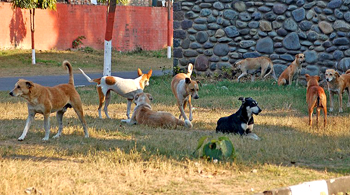
straydogs

The hapless woman, Siluvamma, a resident of the coastal belt, was attacked by a large number of stray dogs at Pulluvila beach, according to her family.

She suffered dog bites all over her body and succumbed to injuries while on her way to hospital.

The dogs also attacked the local people who tried to rescue the woman by chasing them away.

Siluvamma's son Selvan, who was also attacked by the dogs while trying to rescue his mother, escaped by jumping into the sea.

"My mother went to the beach in the night. As she did not return, I went out searching for her. What I saw was shocking. She was being attacked by over 100 stray dogs.She was bleeding all over the body," Selvan told reporters later.

Meanwhile, in a separate incident, another native of Pulluvila, Daisy, was also attacked and severely injured by stray dogs last night.

The 52-year-old woman said she was attacked by a pack of dogs when she went out of the house at around 11.30 PM.

She was rushed to the government medical college here and given a shot of anti-rabies vaccination

Medical college hospital sources said though she had injuries on her hands and legs, her condition was stable.She was shifted to Pulluvila primary healthcare centre for further treatment in the morning, they added.

Stray dogs have been posing a great threat to people, especially women, children and the elderly in coastal stretches in Kerala, including Pulluvila, for some time.

The issue has been a point of debate in Kerala for the last few years after increase in incidents of stray dog attacks and was also raised in the Assembly earlier this year.

According to a report submitted in the Supreme Court recently in a connected case, more than one lakh people in Kerala have been bitten by dogs in 2015-16.

The report was submitted by a committee appointed by the apex court to look into the aspect of treatment of people bitten by stray dogs and claims of compensation in the state.

The report also said Kerala is estimated to have stray dog population of 2.5 lakh, which feed lavishly on the waste and garbage dumps across cities and towns.

According to the panel, the maximum reported cases of dog bites were from Thiruvananthapuram- 5948, Palakkad-4916, Kollam-3670, Pathanamthitta-2892, Alappuzha-2967, Ernakulam - 2050, Thrissur-2044 cases and Koattayam-1614.

Comments

Muzzamil
 - 
Saturday, 20 Aug 2016

Santhosh first u start to eat dogs, then dog rakshak will come.

SANTHOSH
 - 
Saturday, 20 Aug 2016

Where is \DOG RAKSHAK\""

Add new comment

  • Coastaldigest.com reserves the right to delete or block any comments.
  • Coastaldigset.com is not responsible for its readers’ comments.
  • Comments that are abusive, incendiary or irrelevant are strictly prohibited.
  • Please use a genuine email ID and provide your name to avoid reject.
News Network
March 29,2020

Mangaluru, Mar 29: The second day of a total clampdown by Dakshin Kannada district had no impact as panic-stricken people rushed to buy essential commodities in markets in the City on Sunday without caring for Social distance to be maintained.

Since the crowd swell within minutes the police were forced to order the shops forcibly as otherwise, it might have led to spread of dreaded killer Coronavirus COVID-19.

The rise in Covid-19 cases in Dakshina Kannada and the neighbouring Kasargod district had forced the district administration to declare on total bandh on Saturday and Sunday but in vain.

Comments

Add new comment

  • Coastaldigest.com reserves the right to delete or block any comments.
  • Coastaldigset.com is not responsible for its readers’ comments.
  • Comments that are abusive, incendiary or irrelevant are strictly prohibited.
  • Please use a genuine email ID and provide your name to avoid reject.
News Network
February 11,2020

Bengaluru, Feb 11: A 36-year-old woman who fought back after being stabbed eight times by a helmet-clad intruder succumbed to injuries at a hospital.

Susheela was in shock after she pulled off the attacker’s helmet as it was her own brother-in-law. Before breathing her last, she explained the sequence of events to the police.

She said her brother-in-law attacked her because he was eyeing their ancestral property worth over Rs 10 crore. “Susheela put up a stiff resistance and identified her assailant. But the stab injuries proved to be fatal,” said a police officer. Based on her statement, Ananth Kumar, 42, was arrested on murder charges.

The attack occurred on February 7 at Honaganahatti village in Tavarekere, off Magadi Road. Susheela, whose husband Gangaraju died in a road accident 12 years ago, was living with her 14-year-old daughter and 75-year-old mother, Rudramma.

On Friday, her daughter had gone to school and Rudramma was sitting outside the house when a man walked in wearing a full-faced helmet and attacked Susheela with a knife. She defended herself with a stick used for making ragi balls and by throwing chilli powder at his face. But the attacker stabbed her on the hand, neck and head. He fled when Susheela identified him and raised an alarm. Neighbours rushed her to a hospital.

During questioning, Kumar reportedly confessed to the crime, saying he wanted to get rid of her as she was not agreeing to sell five acres of their ancestral property.

Susheela’s nephew Kiran G said: “The family owned six acres. Kumar sold one acre for Rs 50 lakh a few years ago after convincing Susheela. He, however, paid her only Rs 5 lakh. Lately, he was pestering Susheela to sell the remaining land as buyers were ready to pay Rs 2.5 crore per acre. But she was hesitating as she had been cheated by him earlier.”

Police are now examining the circumstances under which Gangaraju was killed. “We learnt the driver who had been arrested in connection with Gangaraju’s accident is currently working with Kumar,” said an officer.

Comments

Add new comment

  • Coastaldigest.com reserves the right to delete or block any comments.
  • Coastaldigset.com is not responsible for its readers’ comments.
  • Comments that are abusive, incendiary or irrelevant are strictly prohibited.
  • Please use a genuine email ID and provide your name to avoid reject.
Media Release
February 14,2020

Veteran journalist P. Sainath has said that the nation is in a crisis. And this crisis is not limited to just the rural area. It has become a national crisis at various areas such as agriculture, education, economy, job creation etc.

He was delivering the endowment lecture on the topic ‘Indian democracy at the post-liberalization and post-truth era’ at Media Manthan 2020 organized by the PG department of journalism and mass communication at St Aloysius College (Autonomous). 

Mr Sainath said that the many policies adopted in the 90s led to India becoming unusually unequal. Referring to the speech Ambedkar had made at the Constituent Assembly while handing over the draft of the Constitution, Mr Sainath said, “Ambedkar had warned about the weakness of Indian democracy that liberty without equality allows the supremacy of a few over the multitude. Liberty, equality and fraternity must be kept together as we cannot have one without the other.” 

Mr Sainath stated that the agrarian crisis was no longer about the loss of productivity, employment or about farmer suicide; it was a societal, civilizational crisis. Commenting on the lopsided policies such as cow-slaughter ban, he explained how cow slaughter ban had adversely affected many industries due to their interdependency. While Muslims who slaughtered cows were rendered helpless, the cattle traders who were mostly OBCs lost their earnings as the cattle prices crashed. An important industry like Kolhapur sandals industry in Maharashtra went bankrupt as a result of the cow slaughter ban in Maharashtra. He said the policymakers had no idea how the rural industries were interconnected. Demonetisation too devastated the rural economy as 98 percent of rural transactions happen through cash. 

Mr Sainath also spoke about the crisis of inequality which affects the Dalits and the Adivasis far more than anyone else as 90 percent of the rural households take home less than Rs 10,000/- per month. “Women are yet another group whose labour is never counted in the gross domestic product. Women and girls globally do unpaid work which amounts to about 12.5 billion working hours per year. Monetarily speaking, this is worth 10.8 trillion dollars,” Mr Sainath added. 

Speaking about the crisis of jobs Mr Sainath said that major companies were laying off employees just to create more profits for the investors and the adoption of artificial intelligence in the industry would further destroy millions of jobs.

Rector of St Aloysius College Institutions Fr Dionysius Vaz SJ, Principal Dr (Fr) Praveen Martis SJ, HOD of Journalism and Mass Communication department Dr (Fr) Melwyn Pinto SJ were present.

‘Veerappan and Vijay Mallya’s business models are interesting!’

Addressing the gathering during his endowment lecture on Friday, Mr Sainath made an interesting comment on the so called ‘revenue model’. “Whenever I visit IIMs and IITs for lectures on my PARI project, the students there ask me what my revenue model for my project is. I tell them that I do not have a revenue model. In fact, journalism does not begin with a revenue model. Gandhiji, Ambedkar, Bhagat Singh were all great journalists. But they did not have a revenue model,” Mr Sainath said.

On a lighter note, he said that the best revenue model that he liked was that of forest brigand Veerappan and liquor baron Vijay Mallya. “Veerappan ruled the forest for forty years and from the top ministers to the villagers he could dictate terms and liver royally. Similarly, Mallya’s revenue model was to steal the banks and run away abroad and live like a king,” Mr Sainath added.

Journalism is not and can never be a business. It is a calling, he opined. While newspaper can be a business, television can be a business, journalism per se cannot be reduced to a business. “Unfortunately today, journalists are recruited on a contract basis and they have no bargaining power; and there are no unions to fight for their cause. Hence, they are at the mercy of the corporate media houses for their survival and are made to write stories that cannot be called journalism,” Mr Sainath said.

Answering a question as to the pressures he faced as a journalist, he said that external pressures from the government or others could be very well handled. It is the internal pressures from once own media house that journalists find it difficult to manage.


Comments

Add new comment

  • Coastaldigest.com reserves the right to delete or block any comments.
  • Coastaldigset.com is not responsible for its readers’ comments.
  • Comments that are abusive, incendiary or irrelevant are strictly prohibited.
  • Please use a genuine email ID and provide your name to avoid reject.