HC allows women's entry in Haji Ali dargah, order stayed for 6 weeks

August 26, 2016

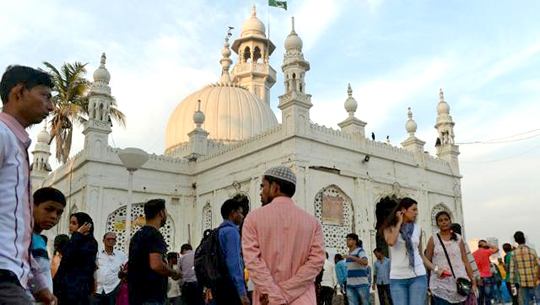
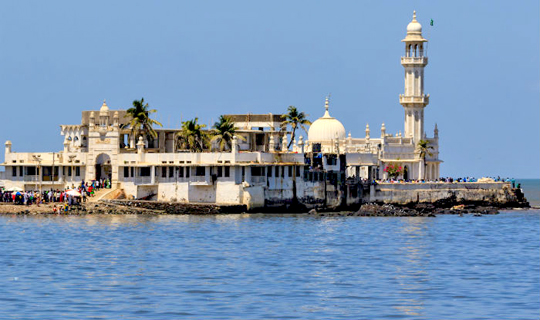
New Delhi, Aug 26: In a significant judgement, the Bombay High Court today lifted the ban imposed on women from entering the sanctum sanctorum of Haji Ali dargah here, saying it contravenes the fundamental rights of a person.

Haji1

The court has, however, stayed its order for six weeks following a plea by Haji Ali Dargah Trust, which wants to challenge it in the Supreme Court.

"The ban imposed on women from entering the Haji Ali dargah is contrary to Articles 14, 15, 19 and 25 of the Constitution of India. Women should be permitted to enter the dargah on par with men," a division bench of Justices V M Kanade and Revati Mohite Dere said.

Under the said Articles, a person is guaranteed equality before law and has the fundamental right to practice any religion he or she wants. They prohibit discrimination on grounds of religion, gender and so on, and provide freedom of conscience and free profession, practice and propagation of religion.

The bench allowed a PIL filed by two women, Zakia Soman and Noorjehan Niaz, challenging the ban on women's entry in the sanctum sanctorum of the dargah.

"The state government and the Haji Ali Dargah Trust will have to take proper steps to ensure safety and security of women entering the dargah," the court said.

The high court had in June this year reserved its verdict on the petition.

The PIL states that gender justice is inherent in Quran and the decision contravenes the Hadith, which proves that there is no prohibition on women visiting graves.

The Maharashtra government had earlier told the court that women should be barred from entering the inner sanctorum of Haji Ali dargah only if it is so enshrined in the Quran.

The ban on women's entry cannot be justified if it is on the basis of an expert's interpretation of the Quran, the then Maharashtra Advocate General Shrihari Aney had argued.

The dargah trust had defended its stand saying that it is referred in Quran that allowing women close proximity to the dargah of a male saint is a grievous sin.

Advocate Shoaib Memon, appearing for the trust had earlier said, "Women are not allowed inside mosques in Saudi Arabia. They are given a separate place to pray. We (trust) have not barred women. It is simply regulated for their safety. The trust not only administers the dargah but also manages the affairs of religion."

haji2

Comments

Rashid
 - 
Friday, 26 Aug 2016

Building structure on graves is prohibited in Islam, visiting such places by men or women both discouraged... It is a grave sin , invoke on graves...In islam it is permitted to men & women to visit graves of their relatives with proper dress with intention to pray for people of graves is permitted and even praying in masjid also permitted..

Mohammed
 - 
Friday, 26 Aug 2016

As a muslim to visit a dargah and pray is shirkh and I request all my muslim brothers and sisters to refrain from doing so as committing shirkh is the biggest sin in Islam. As for Rony`s comments as muslm`s did not support in independence it is high time you refresh your social studies subject. We all know how many muslim countries are supporting non-muslim brothers and sisters by giving them job in their countries in turn which helps them in survival and is this not much greater support from the muslims. This is Independence to live and survive. People grow up and be thankful for the number of muslim countries who have not objected to non-muslims working in their country and you have the audacity to talk against muslims without thinking once about the millions of non-muslim expats.

mohammad.n
 - 
Friday, 26 Aug 2016

Why HC and SC needed here? Our prophet muhammad already said that no grave must be built high, if u find one then u must level it to the ground. Thats it case closed already 1400+ years ago . Then why waste time of court and people who comment on such news? Check the whole quran and hadees you will never find something called darga in it.

Mohammed
 - 
Friday, 26 Aug 2016

To my non-muslim friends kindly note that in Masjid al haram (Makkah) both men and women pray together and for Ganesh Kamath Muslim women are allowed inside mosques and have a separate covered place from where they can pray behind the Imam. Kindly refrain from posting things which you do not have knowledge of and stick to only praying part of it and not compare it with women are not allowed to drive etc.

Add new comment

  • Coastaldigest.com reserves the right to delete or block any comments.
  • Coastaldigset.com is not responsible for its readers’ comments.
  • Comments that are abusive, incendiary or irrelevant are strictly prohibited.
  • Please use a genuine email ID and provide your name to avoid reject.
News Network
March 11,2020

Bengaluru, Mar 11: With the outbreak of coronavirus, Chief Minister BS Yediyurappa on Tuesday said that over 1,000 people in the state have been identified for observation.

"So far, 1048 people have been identified for observation. Out of which 446 samples have been sent for testing. 389 samples have tested negative. Four samples have tested positive," Chief Minister Yediyurappa told reporters.

Earlier today, Health Minister B Sriramulu said that family members of those who tested positive for COVID-19 have been isolated and their health is being monitored.

Comments

Add new comment

  • Coastaldigest.com reserves the right to delete or block any comments.
  • Coastaldigset.com is not responsible for its readers’ comments.
  • Comments that are abusive, incendiary or irrelevant are strictly prohibited.
  • Please use a genuine email ID and provide your name to avoid reject.
News Network
February 6,2020

Kalaburagi, Feb 6: The State government will take steps to ensure that Kannada as a language is taught in all private schools, Chief Minister B.S. Yediyurappa announced today at the 85th Akhila Bharata Kannada Sahitya Sammelana in Kalaburagi.

This comes in the wake of the demand by some Kannada activists for making Kannada medium compulsory in all schools in the State. Sammelana president H.S. Venkatesh Murthy, who spoke after the Chief Minister, also made this demand.

The Chief Minister said “We are committed to putting in place a series of steps to see that Kannada is taught in all schools, aided and private, as a language. Kannada should be taught as the first or second language. We will also take steps to strengthen government schools. However, the government alone cannot do much. The community and parents should offer support to make sure that government schools provide quality education to all.”

To inculcate the spirit of scientific inquiry, the State government is setting up mobile planetariums. This will increase the interest of children in space technology and India’s efforts in space exploration.

The government is committed to protecting the interests of the State in Mahadayi and other river water disputes. It will take the border row issue, based on the Mahajan Commission report pending in the Supreme Court, to its logical end.

The government will also address backwardness and related issues. It will make sure that adequate funds are allocated to the development of Kalyana Karnataka. Among other things, it will establish a hostel for students from Kalaburagi region in Bengaluru. Land has been allotted in Nagarabavi for the hostel that can accommodate around 200 students. The government has decided to celebrate Kalyana Karnataka Utsav once every two years. This will showcase the culture of the region.

“We are working towards forging sentimental and emotional unity of the State other than unity based on language or administration. Our dream is to see that Karnataka remains a homogeneous unit with equality and equal opportunity for all,’’ the Chief Minister added.

Kambar bats for technology

Chandrashekar Kambar, Sahitya Akademi president and former president of the Akhila Bharata Kannada Sahitya Sammelana, favoured effective implementation of technology in administration and for universal use of Kannada in computing and e-governance.

Speaking at the Sammelana inauguration, he said “Several years ago, at the insistence of writer Poornachandra Tejaswi, I appealed to the State government to give a push to Kannada computing. We were convinced that no language can survive without the use of modern technology and use of the language in computers. The Department of Kannada and Culture, headed by then director Manu Baligar, released ₹2 crore for the project. The work began in earnest and teams of technologists came up with software and fonts. Some departments started using Kannada software. But this work has stopped or slowed down at some level. I appeal to Chief Minister B.S. Yediyurappa to continue the work and ensure that computerised Kannada is used at all levels of government and in e-governance.’’

Supports dubbing

Mr. Kambar batted for content dubbing of informative TV channels in Kannada. Channels such as Discovery and History produce good quality content that can be educative and informative. They are very useful for children. These channels are now available in Tamil, Telugu and Hindi and some other Indian languages. But they are not available in Kannada. That is because some people in the film industry are opposing dubbing. Such opposition is not good. Informative channels are our window to the world and allowing dubbing will enhance our knowledge base. There is no merit in not allowing dubbing. I appeal to C.T. Ravi, Minister for Kannada and Culture, to allow dubbing in Kannada, he said.

Mr. Kambar favoured primary education in the mother tongue of the child and urged the State government to introduce universal and compulsory education in Kannada medium in all schools. “This will help preserve our culture. Nothing else can,’’ he said.

He blamed the East India Company administration for inculcating a craze for English education among the people. “The introduction of English education by the British was strongly welcomed by the masses in India as they had been denied the opportunity for education for millenia. The deprived classes and Dalits who had not been exposed to education till then, were excited about the opportunity. However, along with English education, the British were successful in introducing inferiority in our minds. We are yet to escape from this inferiority complex.”

Quoting from Greek mythology, Mr. Kambar said that Hercules had killed his children and relatives in a fit of alcohol-induced rage. “We should not behave like that. We may be very strong, but we should not kill our mother tongue, in our power-induced rage,’’ he said.


Comments

Add new comment

  • Coastaldigest.com reserves the right to delete or block any comments.
  • Coastaldigset.com is not responsible for its readers’ comments.
  • Comments that are abusive, incendiary or irrelevant are strictly prohibited.
  • Please use a genuine email ID and provide your name to avoid reject.
News Network
April 18,2020

Bengaluru, Apr 18: Amid fears that people from the unorganised sector are running out of cash to meet their daily expenses, the Karnataka government said there was no data available for such labourers, who can be provided financial assistance under the direct benefit transfer (DBT) scheme.

"The government does not have data of people in the unorganised sector such as drivers, farmers, domestic help and others. If we have to deposit directly into their account, we need data..," State Labour minister A Shivaram Hebbar told reporters.

The minister said a situation borne out of the COVID-19, where the entire nation has been lockdown was never anticipated.

To him, the pandemic has given an opportunity to gather information about the unorganised sector.

"This COVID-19 has taught the department and the workers a lesson that we should be prepared for a situation like this. We have learnt that all the information about labourers should be available with the labour department," Hebbar conceded.

The minister opined that the department should have had the list during the good times but nobody bothered to have it.

"During the good times nobody bothered about it -- neither they (beneficiaries) asked for it, nor we thought of it.," Hebbar said.

Now that the pandemic has struck, the government is focusing only on not letting anyone starve to death.

A three-level preparation has been made -- at the village level, Taluk level and the city level, the minister said.

Village anganwadis have been stuffed with food items to be cooked for the needy, whereas in Taluk level, government hostels have been turned into shelters for the labourers, he said, noting that lakhs of philanthropists in cities have come forward to feed the people from unorganised sector.

"The basic objective of our government is that no one should starve to death. The issue of organised or unorganised sector comes next," he explained.

On the fear of large-scale retrenchment, the minister said notices have been served on all the industries that no one should be expelled from the job.

However, Hebbar underlined that the industrialists today are as much in distress as the workers and his department was taking into account everyone's concern.

A decision will be taken in this connection by the government in the next two days, to provide assistance to small enterprises to keep them afloat.

Comments

Add new comment

  • Coastaldigest.com reserves the right to delete or block any comments.
  • Coastaldigset.com is not responsible for its readers’ comments.
  • Comments that are abusive, incendiary or irrelevant are strictly prohibited.
  • Please use a genuine email ID and provide your name to avoid reject.