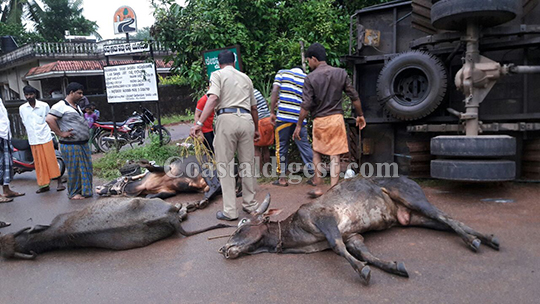
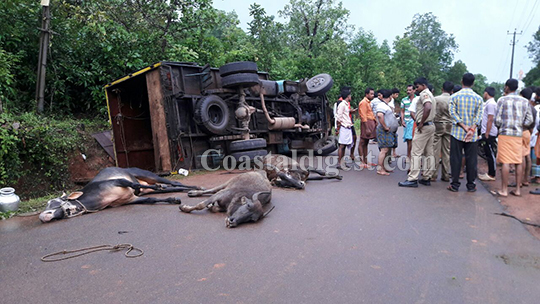
4 of 15 cattle killed as speeding truck topples during illegal' transportation

[email protected] (CD Network | Chakravarthi)
August 28, 2016

Mangaluru, Aug 28: Four cattle were killed and few more injured when a truck in which they were being transported illegally met with an accident near Kalladka in Bantwal taluk early on Sunday morning.

cattle 2

According to sources, the truck fell on its side while the driver was negotiating a curve at Amtur-Karingana Cross. Over speed is said to be the reason for the mishap.

The driver fled the scene leaving behind the damaged vehicle and cattle soon after the accident. It is not yet known whether the cattle-laden truck was being chased by gau rakshaks when the incident took place.

There were a total of 15 cattle on board the truck. Four among them were killed during the mishap and few more cattle suffered injuries.

Bantwal town police have registered a case and trying to find out who was transporting the cattle. This is a case of illegal transportation, they said.

The incident occurred nearly two weeks after a BJP worker was beaten to death by a group of gau rakshaks belonging to Hindutva groups while he was illegally transporting cattle in Udupi.

cattle 1

cattleD

Comments

Niya
 - 
Monday, 29 Aug 2016

Well done good job jobless chaddis n chaddis if u have guts then stop exporting beef will see

shakur
 - 
Monday, 29 Aug 2016

Mr. Imthiaz.. are you not reading Holy Quran.. in Quran no where mentioned to hurt other religion or beliefs.

mohammad.n
 - 
Sunday, 28 Aug 2016

Mr. Imthiyaz why do you post comment like that? Be sensible enough. Dont hurt anybody's feeling.

babu bajarangi
 - 
Sunday, 28 Aug 2016

THIS IS CHANCE TO SOCIAL SERVICE FOR CHADDI PARIVAR TO FUNAREL THERE MATA KILLD IN THERE FATHER ON PLACE.

Mohammed imthyaz
 - 
Sunday, 28 Aug 2016

Hindu GOD Go Matha Died in Road side like a dog...so baddddd

SK
 - 
Sunday, 28 Aug 2016

Luckily the driver did not meet the fate of Praveen Poojary ..... If the drivers are so afraid, then why are they indulging in such activities....
The vehicle is GONE and the owner will have to run after cases ....Kaad asa Bod na ....

Add new comment

  • Coastaldigest.com reserves the right to delete or block any comments.
  • Coastaldigset.com is not responsible for its readers’ comments.
  • Comments that are abusive, incendiary or irrelevant are strictly prohibited.
  • Please use a genuine email ID and provide your name to avoid reject.
IBTimes
June 3,2020

A pregnant elephant in Kerala ate a pineapple, which was filled with country-made bombs or dynamites. It led to a painful death as the elephant was pregnant and died standing in the Velliyar River in Palakkad in Kerala. People are venting out their anger and concerns all over social media about the gruesome incident.

Yesterday, it was reported that the pregnant elephant was killed after locals allegedly fed her a pineapple stuffed with crackers.

However, when International Business Times, India, reached out to Dr Ab Qayoom, who is an Indian Forest Service Officer, for his comments about what actually must have happened, we got to know that no one have fed the pineapple to the elephant.

Snares used for keeping animals away

Dr Qayoom stated that pineapples filled with firecrackers are used as a snare for catching wild boars. He said, "No one would have fed the pineapple to the elephant. The animal must have found it lying somewhere and must have consumed it herself not knowing what lies ahead for her."

He also stated a second possibility. He said, "Some people actually do such insane things as they consider wild animals as a threat to their property and life. Such incidents do happen at places where wild animals create problems for human beings."

Snares are often found around farms, coffee plantations

He added that wild boars often spoil crops and people use snares as a way to protect their farms and crops. This year, it was reported that the government would soon permit farmers with licensed firearms to shoot wild boars that wander into their lands. The problem is that people do not limit their snares to only wild boars and there have been several incidents when tigers, leopards and other animals have fallen prey to these haphazardly placed snares around farms, coffee farms and wildlife corridors.

Elephant kept standing in water before dying

The pregnant wild elephant originally belonged to Silent Valley National Park (SVNP), Palakkad. As the elephant died, she remained calm despite being in excruciating pain. The elephant kept standing and died at Velliyar River, Malappuram, with its trunk in the water.

The elephant was 15-years-old and was probably getting some relief as it stood in the water after her tongue and mouth exploded. Mohan Krishnan, Section Forest Officer, Nilambur, shared the sad incident on his Facebook page where he had acted as the Rapid Response Team official to rescue the elephant, which was in distress.

When a postmortem examination was carried out, it was learnt that the reason for the elephant's death was due to asphyxia where water had got into her lungs and trachea. Dr David Abraham, Assistant Forest Veterinary Officer, Thrissur, carried out the postmortem.

Dr David said, "I have so far done more than 250 postmortems of elephants alone in my more than two decades career. But this was the first time I was so moved as I could hold the foetus of the baby in my hands. Initially, none of us was aware that the elephant was pregnant. After seeing her heart, I spotted the amniotic fluid and realized that she was pregnant."

Claim reviewed :

Fact checking Palakkad elephant death

Claimed By :

Twitter, Facebook and Youtube posts.

Fact Check :

False

https://t.co/uR4p7rDUli

Comments

Peta
 - 
Thursday, 4 Jun 2020

Still killed by human, what this media want to justify the killing will be filing suit on this media soon...u will be in trouble soon.

MOHAMMED MOOLU…
 - 
Wednesday, 3 Jun 2020

A very cruel, henious and inhumen act. This culprit should be with murder and punished sevierly. 

Add new comment

  • Coastaldigest.com reserves the right to delete or block any comments.
  • Coastaldigset.com is not responsible for its readers’ comments.
  • Comments that are abusive, incendiary or irrelevant are strictly prohibited.
  • Please use a genuine email ID and provide your name to avoid reject.
News Network
March 31,2020

Udupi, Mar 31: Six people have committed suicide since liquor shops were shut down during a lockdown here to break the chain of the novel coronavirus.

Deputy Commissioner G Jagadeesha said in a statement here, "After continuous suicides out of depression over not being able to buy alcohol, the district administration decided to hold counselling sessions to such people.

"The district administration has appointed a team of Doctors for counselling. Anyone who needs counselling can call 1077 toll-free number," he added.

Comments

Add new comment

  • Coastaldigest.com reserves the right to delete or block any comments.
  • Coastaldigset.com is not responsible for its readers’ comments.
  • Comments that are abusive, incendiary or irrelevant are strictly prohibited.
  • Please use a genuine email ID and provide your name to avoid reject.
Agencies
May 8,2020

Washington D.C., May 8: The prime time for brain development in a child's life is the first year, where the infant spends most of the time asleep. It is the time when neural connections form and sensory memories are encoded.

However, when sleep is disrupted, as occurs more often among children with autism, brain development may be affected, too.

New research led by the University of Washington finds that sleep problems in a baby's first 12 months may not only precede an autism diagnosis but also may be associated with altered growth trajectory in a key part of the brain, the hippocampus.

The study, which was published in the American Journal of Psychiatry, researchers report that in a sample of more than 400 taken of 6- to 12-month-old infants, those who were later diagnosed with autism were more likely to have had difficulty falling asleep.

It also states that this sleep difficulty was associated with altered growth trajectories in the hippocampus.

"The hippocampus is critical for learning and memory, and changes in the size of the hippocampus have been associated with poor sleep in adults and older children.

As many as 80 per cent of the children with autism spectrum disorder have sleep problems," said Annette Estes, director of the UW Autism Center and senior author of the study.

"In our clinical experience, parents have a lot of concerns about their children's sleep, and in our work on early autism intervention, we observed that sleep problems were holding children and families back," added Estes, who is also a UW professor of speech and hearing sciences.

"It could be that altered sleep is part-and-parcel of autism for some children. One clue is that behavioural interventions to improve sleep don't work for all children with autism, even when their parents are doing everything just right. This suggests that there may be a biological component to sleep problems for some children with autism," said Estes.

To consider links among sleep, brain development, and autism, researchers at the IBIS Network looked at MRI scans of 432 infants, surveyed parents about sleep patterns, and measured cognitive functioning using a standardized assessment.

At the outset of the study, infants were classified according to their risk for developing autism: Those who were at higher risk of developing autism -- about two-thirds of the study sample -- had an older sibling who had already been diagnosed.

Infant siblings of children with autism have a 20 per cent chance of developing autism spectrum disorder -- a much higher risk than children in the general population.

In the current study, 127 of the 432 infants were identified as "low risk" at the time the MRI scans were taken because they had no family history of autism.

They later evaluated all the participants at 24 months of age to determine whether they had developed autism. Of the roughly 300 children originally considered "high familial risk," 71 were diagnosed with autism spectrum disorder at that age.

Problems with sleep were more common among the infants later diagnosed with an autism spectrum disorder, as were larger hippocampi. No other subcortical brain structures were affected, including the amygdala, which is responsible for certain emotions and aspects of memory, or the thalamus, a signal transmitter from the spinal cord to the cerebral cortex.

The authors note that while parents reported more sleep difficulties among infants who developed autism compared to those who did not, the differences were very subtle and only observed when looking at group averages across hundreds of infants.

Sleep patterns in the first years of life change rapidly as infants transition from sleeping around the clock to a more adult-like sleep/wake cycle. Until further research is completed, Estes said, it is not possible to interpret challenges with sleep as an early sign of increased risk for autism.


Comments

Add new comment

  • Coastaldigest.com reserves the right to delete or block any comments.
  • Coastaldigset.com is not responsible for its readers’ comments.
  • Comments that are abusive, incendiary or irrelevant are strictly prohibited.
  • Please use a genuine email ID and provide your name to avoid reject.