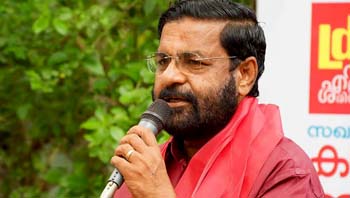
RSS, other outfits misusing temples for illegal activities: Kerala Minister

August 30, 2016

Thiruvananthapuram, Aug 30: Devaswom Minister Kadakampally Surendran today alleged that organisations including the RSS were using temples for illegal activities.

Kadkampally

In a Facebook post on his official page, Surendran said that he was getting several complaints each day about organisations including the RSS conducting illegal activities in temples under the Devaswom board.

"It is necessary to distance apprehensions in the society regarding this. Temples are centres of traditions and beliefs," he said.

Surendran also alleged that the RSS was trying to push believers away from temples making it a storage for weapons and by weapon training.

"Such anti-social activities that destroy the secular nature and peaceful environment of the state will not be allowed," the Minister warned.

Kadakampally Surendran also said that the LDF government will immediately intervene in such complaints and take urgent measures to end the illegal activities.

Comments

Suleman Beary
 - 
Tuesday, 30 Aug 2016

The biggest weapon of RSS is spreading lies and hatred. Who can stop that N Bomb?

Laugfing
 - 
Tuesday, 30 Aug 2016

Oh this big mouth minister from Left, I being a person from Kerala really know truth. CPIM uses their offices and politcians house to store arms. CM Vijayan and this fellow wanted to have special darshan tickets in Sabarimala and when it was shot down.... all this stories

Bajrangi
 - 
Tuesday, 30 Aug 2016

Raid all mosques, churches and temples and check for arms

Mahesh
 - 
Tuesday, 30 Aug 2016

Bamboo Sticks/ Lathis are not Weapons. Donot get Bogged down. They cannot use weapons to hurt. They just open their mouth and shout

Hindustan
 - 
Tuesday, 30 Aug 2016

Time for Hindus to take back Kerala and Kashmir.

Indian Politics
 - 
Tuesday, 30 Aug 2016

Chief Minister should order police raids on these arm stores and recover the arms, and install CCTV cameras to monitor the activities round the clock. CM needs to substantiate his allegations with proof. I fully agree with his view that no religious ceremony should take place during any official function, it has no place in secular democracy. Our constitution gives every citizen right to practice religion of his or her choice freely but not at state level. State has no religion.

Real Indian
 - 
Tuesday, 30 Aug 2016

Here is a Minister for Temples Administration. He defines a temple as a centre for traditions and beliefs. Sorry Comrade , a temple is a place for worship of God. If it is only a place of tradition and faith, there is the danger of it being appropriated by the communist Party, which has both tradition and faith. No temple in Kerala will allow storing of weapons within, may be in its offices or quarters of staff. Is it a plan for the commies to violate the sanctity of the temples?

Add new comment

  • Coastaldigest.com reserves the right to delete or block any comments.
  • Coastaldigset.com is not responsible for its readers’ comments.
  • Comments that are abusive, incendiary or irrelevant are strictly prohibited.
  • Please use a genuine email ID and provide your name to avoid reject.
News Network
July 25,2020

Hubballi,  Jul 25: South Western Railway (SWR) inducted seven lady sub-inspectors (SI) in the Railway Protection Force (RPF), in a first, on Friday. Three more women SI undergoing training in Lucknow are expected to join SWR soon.

According to the Chief Public Relations Officer (CPRO) of SWR, the inducted sub-inspectors are part of 164 women SI cadets who passed out of the RPF training centre in Moula Ali, Hyderabad, after a rigorous training of nine months. They will take care of the security of railway passengers, Railway property, and Railway premises, after resuming their duties.

They will also be responsible for giving special care to the vulnerable sections of society, women, and children while discharging their duties, the CPRO said.

The CPRO also informed that the newly admitted female SIs will be posted to major stations on SWR for regular duties on completion of their two months of practical training over the Zone. Further 120 ladies are undergoing constables training for various training centres across India.

This move is considered a step forward into women empowerment in Railways.

Comments

Add new comment

  • Coastaldigest.com reserves the right to delete or block any comments.
  • Coastaldigset.com is not responsible for its readers’ comments.
  • Comments that are abusive, incendiary or irrelevant are strictly prohibited.
  • Please use a genuine email ID and provide your name to avoid reject.
News Network
July 22,2020

Bengaluru, Jul 22: Karnataka's Covid-19 task force on Tuesday decided that the state government will regulate the supply of Remdesivir, the drug used in the treatment of coronavirus infected patients, to private hospitals to check black marketing and hoarding.

"Remdesivir which is currently available in the government hospitals will be supplied to private hospitals through the government.

This will help curb black marketing of this drug," Medical Education Minister K Sudhakar's office said in a release.

Along with Sudhakar, other task force members, including Health Minister Sriramulu, Deputy Chief Minister C N Ashwath Narayan and Chief Secretary T M Vijay Bhaskar attended the meeting. However, Home Minister Basavaraj Bommai was not part of it as he was out of Bengaluru.

At the meeting, the government has also fixed the rate for Covid-19 tests in private labs- Rs 2,000 for government referred cases and 3,000 for self-reporting cases.

It was also decided to purchase 4 lakh antigen test kits and 5 lakh swab test kits to ramp up testing, the release said, adding that approvals have also been given for additional drugs for the treatment of Covid-19 patients.

The decisions also included increasing monthly salary for Ayush doctors to 48,000, MBBS doctors to 80,000 and nurses to get 30,000 for next 6 months.

The task force also made it clear that private hospitals have to reserve 50 percent beds for the government for Covid-19 treatment. The remaining 50 percent can be used by the private hospitals for Covid-19 and non-Covid-19 treatment.

Private hospitals provide treatment under Ayushman Bharat scheme (ABARK) for Covid-19 patients.

Those cases in which treatment does not cover under the scheme can be charged as per the user charges, the release said.

A committee will be formed to supervise and recommend the purchase of equipment and medicines for Covid-19 treatment, which will be headed by ACS, ITBT Department.

Approval has been given for the procurement of N-95 masks and lakh PPE kits for the safety of healthcare workers. The decision also has been taken to connect oxygen pipeline to 4,736 beds in 17 government medical colleges, which will enable high flow oxygen for these beds besides being beneficial for future use as well.

According to the release, 16 RTPCR and 15 Automated RNA extraction units will be established to ramp up testing and this will help achieve the target of 50,000 tests per day. "On the whole approvals given for purchase of equipment and upgradation of existing facilities at government hospitals is estimated to be about Rs 500 Crore," it added.

Comments

Add new comment

  • Coastaldigest.com reserves the right to delete or block any comments.
  • Coastaldigset.com is not responsible for its readers’ comments.
  • Comments that are abusive, incendiary or irrelevant are strictly prohibited.
  • Please use a genuine email ID and provide your name to avoid reject.
Agencies
July 8,2020

The Central Board of Secondary Education (CBSE) has rationalised by up to 30 per cent the syllabus for classes 9 to 12 for the academic year 2020-21 to reduce course load on students amid the COVID-19 crisis, Union HRD Minister Ramesh Pokhriyal 'Nishank' announced on Tuesday.

The curriculum has been rationalised while retaining the core elements, the Human Resource Development said.

Among the chapters dropped after the rationalisation exercise are lessons on democracy and diversity, demonetisation, nationalism, secularism, India's relations with its neighbours and growth of local governments in India, among others.

"Looking at the extraordinary situation prevailing in the country and the world, CBSE was advised to revise the curriculum and reduce course load for the students of classes 9 to 12.

"To aid the decision, a few weeks back I also invited suggestions from all educationists on the reduction of syllabus for students and I am glad to share that we received more than 1.5K suggestions. Thank you, everyone, for the overwhelming response," Nishank tweeted.

"Considering the importance of learning achievement, it has been decided to rationalise syllabus up to 30 per cent by retaining the core concepts," he added.

The Union minister said the changes made in the syllabi have been finalised by the respective course committees with the approval of the curriculum committee and the Governing Body of the Board.

"The heads of schools and teachers have been advised by the board to ensure that the topics that have been reduced are also explained to the students to the extent required to connect different topics. However, the reduced syllabus will not be part of the topics for internal assessment and year-end board examination.

"Alternative academic calendar and inputs from the NCERT on transacting the curriculum using different strategies shall also be part of the teaching pedagogy in the affiliated schools," a senior official of the HRD ministry said.

For classes 1 to 8, the National Council of Education Research and Training (NCERT) has already notified an alternative calendar and learning outcomes.

According to the updated curriculum, among the chapters deleted from class 10 syllabus are-- democracy and diversity, gender, religion and caste, popular struggles and movement, challenges to democracy

For class 11, the deleted portions included chapters on federalism, citizenship, nationalism, secularism, growth of local governments in India.

Similarly, class 12 students will not be required to study chapters on India's relations with its neighbours, changing nature of India's economic development, social movements in India and demonetisation, among others.

Universities and schools across the country have been closed since March 16 when the central government announced a nationwide classroom shutdown as one of the measures to contain the COVID-19 outbreak.

A nationwide lockdown was announced on March 24, which came into effect the next day. While the government has eased several restrictions, schools and colleges continue to remain closed.


Comments

Add new comment

  • Coastaldigest.com reserves the right to delete or block any comments.
  • Coastaldigset.com is not responsible for its readers’ comments.
  • Comments that are abusive, incendiary or irrelevant are strictly prohibited.
  • Please use a genuine email ID and provide your name to avoid reject.