


India's bid to join US alliance could irk China, Pak: media

August 30, 2016

Beijing, Aug 30: Attempts by India to join US' alliance could "irritate" China, Pakistan or even Russia and bring "strategic troubles" to New Delhi while making it a centre of geopolitical rivalries in Asia, China's state-run media commented today.
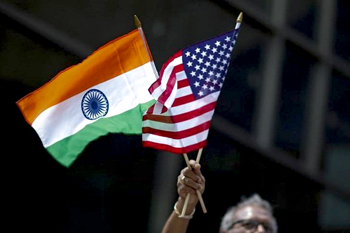
indusIn an editorial written ahead of Defence Minister Manohar Parrikar and US Defence Secretary Ashton Carter signing a logistics agreement, state-run Global Times said India may loose strategic independence if it leans towards the US.

The Logistics Exchange Memorandum of Agreement (LEMOA) allows India and US militaries to access each other's military facilities for refuelling and replenishment.

"This is undoubtedly a leap forward in US-India military cooperation. US media highly applauded this deal, with Forbes hailing it as a 'war pact' and believing that India is shifting away from Russia, its Cold War ally, toward a new alliance with the US," the editorial said.

"If India hastily joins the US alliance system, it may irritate China, Pakistan or even Russia. It may not make India feel safer, but will bring strategic troubles to itself and make itself a centre of geopolitical rivalries in Asia," it said.

"India holds dear its independence and sovereignty after squeezing out of the UK's colonialism. It views itself as a major power and is developing on the wave of the emerging countries," the editorial said.

While India has adopted a prudent attitude so far refraining from joining US alliance, some defence analysts expressed worries that India may lose strategic independence and warned that the pact may render New Delhi a "follower" of Washington, it said.

Observing that India attaches high importance to national security, the editorial said, "It feels it is an urgent task because its defence levels are a necessary condition of being a major power, rather than out of a sense of crisis that requires an intimacy to the US."

Due to its non-alignment policy, India has been given attention from all the major powers such as the US, Japan, China and Russia in recent years, it noted.

"However, in recent years, Washington has deliberately wooed New Delhi to become its quasi ally so as to impose geopolitical pressure on China. It is possible that the (Narendra) Modi administration is trying an unconventional way to lean toward the US with the logistics agreement," the editorial said.

Comments

REALITY
 - 
Tuesday, 30 Aug 2016

Liars will join hand with Liars...
Cheaters with cheaters
The world knows now that USA cheated its own people in 9/11..
The world knows now that USA cheated its own people on Iraq war..
Our indian politician are digging our own grave by joining the LIARS masters Club..

Add new comment

  • Coastaldigest.com reserves the right to delete or block any comments.
  • Coastaldigset.com is not responsible for its readers’ comments.
  • Comments that are abusive, incendiary or irrelevant are strictly prohibited.
  • Please use a genuine email ID and provide your name to avoid reject.
Agencies
January 9,2020

The World Bank says that a lack of credit and drop in private consumption have led to a gloomy growth outlook for India with a steep cut in growth rate for the current fiscal year and only a modest gain projected for the next year.

India's growth rate is forecast to be only 5 per cent for the current fiscal year, weighed down by a growth of only 4.5 per cent in the July-September quarter, according to the 2020 Global Economic Prospects report released on Wednesday.

"In India, [economic] activity was constrained by insufficient credit availability, as well as by subdued private consumption," the Bank said.

The growth rate is forecast by the Bank to pick up to 5.8 per cent in the next fiscal year and to 6.1 per cent in 2021-22.

India's growth rate was 6.8 per cent in 2018-19.

The 5 per cent growth rate projection for the current financial year is a sharp cut of 2.5 per cent from the 7.5 per cent forecast made by the Bank in January last year, toppling it from the rank of the world's fastest growing economy.

India's performance follows a global trend of lowered growth weighed down by developed economies.

The report estimated world economic growth rate to be only 2.4 per cent last year and forecast it to edge up 0.1 per cent to 2.5 per cent in the current year.

Even with the lower growth rate of 5 per cent in the current fiscal year and 5.8 per cent forecast for the next, India holds the second rank among large economies, behind only China with an estimated growth rate of 6.1 per cent for 2019 and 5.9 per cent this year.

The report blamed "weak confidence, liquidity issues in the financial sector" and "weakness in credit from non-bank financial companies" for India's slowdown.

The Bank predicated India's recovery to 5.8 per cent in the coming financial year for India but "on the monetary policy stance remaining accommodative" and the assumption that "the stimulative fiscal and structural measures already taken will begin to pay off."

It also warned that sharper-than-expected slowdown in major external markets such as United States and Europe, would affect South Asia through trade, financial, and confidence channels, especially for countries with strong trade links to these economies."

The Bank said that the growth of advanced economies was 1.6 per cent last year and "is anticipated to slip to 1.4 per cent in 2020 in part due to continued softness in manufacturing."

In contrast the growth of emerging market and developing countries is expected to accelerate from 3.5 per cent last year to 4.1 per cent this year, the report said.

In South Asia, Bangladesh is estimated to have the highest growth rate of 7.2 per cent in the current fiscal year, although down from 8.1 per cent last fiscal year.

But its higher regional growth rates are coming off a lower base with a per capital gross domestic product of $1,698 compared to $2,010 for India.

Bangladesh is expected to grow by 7.3 per cent in the next financial year.

Pakistan's growth rate is estimated at only 2.4 per cent in the current fiscal year and is projected to rise to 3 per cent in the next, according to the Bank.

The Bank blamed monetary tightening in Pakistan for a sharp deceleration in fixed investment and a considerable softening in private consumption for the fall in growth rate from 3.3 per cent in the 2018-19 fiscal year.

Sri Lanka's growth rate was estimated to be 2.7 per cent last year and forecast to grow to 3.3 per cent this year.

Nepal grew by an estimated 6.4 per cent in the current fiscal year and will rise to 6.5 per cent in the next.

Comments

Add new comment

  • Coastaldigest.com reserves the right to delete or block any comments.
  • Coastaldigset.com is not responsible for its readers’ comments.
  • Comments that are abusive, incendiary or irrelevant are strictly prohibited.
  • Please use a genuine email ID and provide your name to avoid reject.
Agencies
May 1,2020

New Delhi, May 1: The Centre has finalsed the criteria for delimitation of various zones after May 3. It has identified at least 130 districts as red zones, 284 orange zones and 319 green zones.

According to a letter written by Health Secretary Preeti Sudan to the Chief Secretaries of all States and UTs, all the states have to delineate the containment areas and buffer zones in the identified red and orange zone districts and notify the same.

The letter said, the national capital has at least 11 red zones, Uttar Pradesh 19 red zones, 36 orange zones and 20 green zones while, the state of Haryana has 2 red zones, 18 orange zones and 2 green zones.

The Gautam Buddha Nagar in Uttar Pradesh has been identified as a red zone district while, Ghaziabad has been designated as an orange zone. The national capital has no orange and green zone; there are only red zones according to the letter.

In Maharashtra, Mumbai, Pune, Thane, Nashik come in the red zone.

In West Bengal, Kolkata, Howrah, 24 Parganas -- both North and South have been identified as red zones while Hooghly, Nadia, Murshidabad etc have been marked as orange zones.

In the southern part of India, Kerala has 2 red zones and 10 orange zones, while Tamil Nadu has 12 red zones and 24 orange zones.

The Health Secretary said that the list will be revised on a weekly basis or earlier and communicated to states for further follow-up action in consonance with the directions issued by the Ministry of Home Affairs under the Disaster Management Act, 2005 based on field feedback and additional analysis at state level, states may designate additional red or orange zones as appropriate.

However, states may not relax the zonal classification of districts classified as red or orange as communicated by the Ministry. This classification is multi-factorial and takes into consideration incidence of cases, doubling rate, extent of testing and surveillance feedback to classify the districts.

A district will be considered under green zone, if there are no confirmed cases so far or there is no reported case since the last 21 days in the district.

Comments

Add new comment

  • Coastaldigest.com reserves the right to delete or block any comments.
  • Coastaldigset.com is not responsible for its readers’ comments.
  • Comments that are abusive, incendiary or irrelevant are strictly prohibited.
  • Please use a genuine email ID and provide your name to avoid reject.
News Network
March 26,2020

New Delhi, Mar 26: Despite repeated assurances by the Centre and state government of no shortage of food and essential services in Delhi, many daily wage earners have started fleeing the national capital on foot to return to their native villages in nearby Uttar Pradesh and other states because of the hardships being faced by them.
Most daily wage earners who are fleeing have complained that they are doing so because they will die of hunger due to lack of resources at their disposal.
"I am going to Azamgarh, my native place which is more than 800 kilometers from here. We have started walking towards our village. On the roads, if we get some vehicles then it will be all right otherwise we will continue on foot. I used to work in the construction sector but all work has stopped, we therefore have no other means to buy our rations. Atleast, food is guaranteed in our homes," Ghanshyam, a daily wage earner, told ANI here.
Rani, another daily wage earner, who was fleeing Delhi along with her family said, "Who would want to leave on foot, but what other options do we have. Our children will die of hunger, even if they are saved from the disease. That is why we are leaving."
While the government has been assuring that it will provide food and other essentials to the low-income groups, the people complained that they are yet to receive any help.
The departing of people has started despite repeated warnings by governments to prevent the influx of persons living in other states to curtail the spread of coronavirus.
Prince, who used to reside in Mongolpuri area of Delhi, said, "If we continue to stay the landlord will pester us for rent. The prices of all commodities are rising with each passing day, this way we will have nothing left to survive. We did not get any help from the government. I am, therefore, returning to Kasganj, which is close to 300 kilometres from Delhi. We will at least get food served twice a day in the village, nobody is offering us even water here."
Earlier on Tuesday, Delhi Chief Minister Arvind Kejriwal had announced Rs 5,000 for each construction worker under Construction Workers Welfare Board Fund.
Addressing a video conference here, he said, "The Delhi government will give Rs 5,000 to each construction worker as their livelihood has been affected due the outbreak of coronavirus."
He also said that the number of night shelters in the city has been increased and more food is being distributed to homeless people.
He also said that due to curfew, several people were not able to get food, and urged the public to send such people to the nearest shelters of the Delhi government, where food was being arranged.

Comments

Add new comment

  • Coastaldigest.com reserves the right to delete or block any comments.
  • Coastaldigset.com is not responsible for its readers’ comments.
  • Comments that are abusive, incendiary or irrelevant are strictly prohibited.
  • Please use a genuine email ID and provide your name to avoid reject.