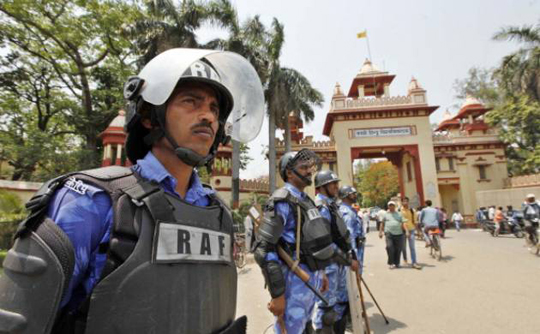
Petrol bombs seized from hostels at Banaras Hindu University

September 3, 2016

Varanasi, Sep 3: At least eight petrol bombs, dozens of iron rods, sticks, bricks, empty alcohol bottles and cigarette packets were recovered on Friday from different hostels of Banaras Hindu University following a search conducted after Wednesday night's violence at the campus, police said.

bomb

Police along with the BHU administration conducted searches at Acharya Narendra Dev, Birla and other hostels and sealed half-a-dozen of these hostels.

An investigation has also been launched to find how and why these bombs were kept and also their purpose. Meanwhile, BHU administration suspended 26 students for their alleged involvement in connection with Wednesday's violence and arson in the varsity campus and also formed a committee to probe and submit its report within a fortnight.

The petrol bombs were made in empty wine-beer bottles in which petrol was filled, police said.

An FIR has been registered against 175 students, including 25 identified and 150 unidentified students, at the Lanka police station following this incident.

FIR has been also registered against five junior doctors and four ward boys under various sections of IPC. The junior doctors of Trauma centre, who have been on strike since Thursday, called it off this evening even though medical services at Trauma centre and Sir Sunder Lal Hospital of BHU are in operation with senior doctors handling the patients.

District Magistrate Vijay Kiran Anand and SSP Akash Kulhary have ordered for opening of a new police outpost inside the trauma centre on the demand of doctors, who wanted security for themselves, complaining that scuffle breaks out quite often between the students and doctors.

A large number of police force and PAC personnel have been deployed in the BHU campus to prevent any fresh clashes between doctors and students. The two injured students, who were admitted in the hospital following the violence have now been discharged and their health condition was normal.

Violence erupted in BHU on Wednesday, with students resorting to arson and vandalism in the campus, after resident doctors and other staff at the trauma centre allegedly thrashed some students injuring six students.

Comments

Mohammed SS
 - 
Sunday, 4 Sep 2016

All the Universities belongs to Hindus should be checked properly. Most of the Hindu students became terrorists in all the universities, recently we have seen they are doing ruckus wearing saffron Dhupatta in one of the college in Mangalore about girls Hijab, these saffron in the colleges are either from terror group or from nasty cultured family.

Mohammed SS
 - 
Sunday, 4 Sep 2016

All the Universities belongs to Hindus should be checked properly, Most of the Hindu students became terrorists in all the universities, recently we have seen they are doing ruckus wearing saffron Dhupatta in one of the college in Mangalore about girls Hijab, these saffron in the colleges are either from terror group or from nasty cultured family.

muthhu
 - 
Saturday, 3 Sep 2016

Narenanna ...idella bare sullu alla....irbahudu....ekendre ee vidyarthigalu manasika aswastharu .....karana...................avarella Rashtriya spotaka sangahada membersgalalva

Enanthiri Naadig

SK
 - 
Saturday, 3 Sep 2016

As Kerala minister said, the temples in kerala are used as warehouses by RSS to store weapons.... Now the things are becoming clear, how the RSS is playing with the life of innocents, by storing weapons in Hostels, Temples, and placing meat in Nagabanas ....

SYED
 - 
Saturday, 3 Sep 2016

awaiting comments from so called hindutva groups....

Add new comment

  • Coastaldigest.com reserves the right to delete or block any comments.
  • Coastaldigset.com is not responsible for its readers’ comments.
  • Comments that are abusive, incendiary or irrelevant are strictly prohibited.
  • Please use a genuine email ID and provide your name to avoid reject.
News Network
July 28,2020

Hounde, Jul 28: Coronavirus and its restrictions are pushing already hungry communities over the edge, killing an estimated 10,000 more young children a month as meager farms are cut off from markets and villages are isolated from food and medical aid, the United Nations warned Monday.

In the call to action shared with The Associated Press ahead of publication, four UN agencies warned that growing malnutrition would have long-term consequences, transforming individual tragedies into a generational catastrophe.

Hunger is already stalking Haboue Solange Boue, an infant from Burkina Faso who lost half her former body weight of 5.5 pounds (2.5 kilograms) in just a month. Coronavirus restrictions closed the markets, and her family sold fewer vegetables. Her mother was too malnourished to nurse.

“My child,” Danssanin Lanizou whispered, choking back tears as she unwrapped a blanket to reveal her baby's protruding ribs.

More than 550,000 additional children each month are being struck by what is called wasting, according to the UN — malnutrition that manifests in spindly limbs and distended bellies. Over a year, that's up 6.7 million from last year's total of 47 million. Wasting and stunting can permanently damage children physically and mentally.

“The food security effects of the COVID crisis are going to reflect many years from now,” said Dr. Francesco Branca, the WHO head of nutrition. “There is going to be a societal effect.”

From Latin America to South Asia to sub-Saharan Africa, more poor families than ever are staring down a future without enough food.

In April, World Food Program head David Beasley warned that the coronavirus economy would cause global famines “of biblical proportions” this year. There are different stages of what is known as food insecurity; famine is officially declared when, along with other measures, 30% of the population suffers from wasting.

The World Food Program estimated in February that one Venezuelan in three was already going hungry, as inflation rendered salaries nearly worthless and forced millions to flee abroad. Then the virus arrived.

“Every day we receive a malnourished child,” said Dr. Francisco Nieto, who works in a hospital in the border state of Tachira.

In May, Nieto recalled, after two months of quarantine, 18-month-old twins arrived with bodies bloated from malnutrition. The children's mother was jobless and living with her own mother. She told the doctor she fed them only a simple drink made with boiled bananas.

“Not even a cracker? Some chicken?” he asked.

“Nothing,” the children's grandmother responded. By the time the doctor saw them, it was too late: One boy died eight days later.

The leaders of four international agencies — the World Health Organization, UNICEF, the World Food Program and the Food and Agriculture Organization — have called for at least dollar 2.4 billion immediately to address global hunger.

But even more than lack of money, restrictions on movement have prevented families from seeking treatment, said Victor Aguayo, the head of UNICEF's nutrition program.

“By having schools closed, by having primary health care services disrupted, by having nutritional programs dysfunctional, we are also creating harm,” Aguayo said. He cited as an example the near-global suspension of Vitamin A supplements, which are a crucial way to bolster developing immune systems.

In Afghanistan, movement restrictions prevent families from bringing their malnourished children to hospitals for food and aid just when they need it most. The Indira Gandhi hospital in the capital, Kabul, has seen only three or four malnourished children, said specialist Nematullah Amiri. Last year, there were 10 times as many.

Because the children don't come in, there's no way to know for certain the scale of the problem, but a recent study by Johns Hopkins University indicated an additional 13,000 Afghans younger than 5 could die.

Afghanistan is now in a red zone of hunger, with severe childhood malnutrition spiking from 690,000 in January to 780,000 — a 13% increase, according to UNICEF.

In Yemen, restrictions on movement have blocked aid distribution, along with the stalling of salaries and price hikes. The Arab world's poorest country is suffering further from a fall in remittances and a drop in funding from humanitarian agencies.

Yemen is now on the brink of famine, according to the Famine Early Warning Systems Network, which uses surveys, satellite data and weather mapping to pinpoint places most in need.

Some of the worst hunger still occurs in sub-Saharan Africa. In Sudan, 9.6 million people live from one meal to the next — a 65% increase from the same time last year.

Lockdowns across Sudanese provinces, as around the world, have dried up work and incomes for millions. With inflation hitting 136%, prices for basic goods have more than tripled.

“It has never been easy but now we are starving, eating grass, weeds, just plants from the earth,” said Ibrahim Youssef, director of the Kalma camp for internally displaced people in war-ravaged south Darfur.

Adam Haroun, an official in the Krinding camp in west Darfur, recorded nine deaths linked with malnutrition, otherwise a rare occurrence, over the past two months — five newborns and four older adults, he said.

Before the pandemic and lockdown, the Abdullah family ate three meals a day, sometimes with bread, or they'd add butter to porridge. Now they are down to just one meal of “millet porridge” — water mixed with grain. Zakaria Yehia Abdullah, a farmer now at Krinding, said the hunger is showing “in my children's faces.”

“I don't have the basics I need to survive,” said the 67-year-old, who who hasn't worked the fields since April. “That means the 10 people counting on me can't survive either.”


Comments

Add new comment

  • Coastaldigest.com reserves the right to delete or block any comments.
  • Coastaldigset.com is not responsible for its readers’ comments.
  • Comments that are abusive, incendiary or irrelevant are strictly prohibited.
  • Please use a genuine email ID and provide your name to avoid reject.
Agencies
January 12,2020

New Delhi, Jan 12: In a shocking revelation, one unemployed person committed suicide every hour during 2018 when a total of 1,34,516 suicides, including 92,114 male and 42,391 female, were reported in the country, NCRB's "Suicide in India 2018" says.

The latest data, issued by the National Crime Records Bureau (NCRB), which comes under Ministry of Home Affairs, last week reveals that a total of 12,936 unemployed persons committed suicide in 2018, which accounted for 9.6 per cent of the total suicides, and were of aged below 18 years to above 60 years.

Those below 18 years include 31 males and nine females while those between 18 and 30 years comprise 1,240 male and 180 female. A total of 868 male and 95 female were aged between 30 and 45 years. A number of 237 males and 21 females were aged between 45 and 60 years while 2,431 males and 310 females were above 60 years.

Of the total suicides by unemployed persons, males are 10,687 while the females are 2,249.

The highest number of suicides - 12.3 per cent - committed by unemployed persons were in Kerala (1,585 out of 12,936 suicides), 12.2 per cent in Tamil Nadu (1,579), 9.7 per cent in Maharashtra (1,260 suicides), 8.5 per cent in Karnataka (1,094 suicides) and 7 per cent in Uttar Pradesh (902 suicides).

"Each suicide is a personal tragedy that prematurely takes the life of an individual and has a continuing ripple effect, dramatically affecting the lives of families, friends and communities. Every year, more than 1 lakh people commit suicide in our country. There are various causes of suicides like professional/career problems, sense of isolation, abuse, violence, family problems, mental disorders, addiction to alcohol, financial loss, chronic pain etc," says the NCRB adding it collects data on suicides from police recorded suicide cases.

As per the NCRB, rate of suicides has been calculated using projected population for the non-census years whereas for 2011, the population of the Population Census 2011 was used.

The NCRB data says that a total of 1,34,516 suicides were reported in the country during 2018 showing an increase of 3.6 per cent in comparison to 2017 and the rate of suicides has increased by 0.3 during 2018 over 2017.

Government servants accounted for 1.3 per cent (1,707 out of 1,34,516) of the total suicide victims as compared to 6.1 per cent (8,246 out of 1,34,516) of total victims from Private Sector Enterprises.

Employees from Public Sector Undertakings formed 1.5 per cent (2,022 out of 1,34,516) of the total suicide victims, whereas students and unemployed victims accounted for 7.6 per (10,159 victims) of total suicides. Self-employed category accounted for 9.8 per cent of total suicide victims (13,149 out of 1,34,516).

A total of 10,349 persons involved in farming sector (consisting of 5,763 farmers and cultivators and 4,586 agricultural labourers) have committed suicide during 2018, accounting for 7.7 per cent of total suicides victims (1,34,516) in the country.

A total of 11 transgenders have committed suicide in which three were daily wage earners, one each were 'professionals and salaried persons' and 'unemployed persons' while six falls under 'Other Persons'.

Comments

Add new comment

  • Coastaldigest.com reserves the right to delete or block any comments.
  • Coastaldigset.com is not responsible for its readers’ comments.
  • Comments that are abusive, incendiary or irrelevant are strictly prohibited.
  • Please use a genuine email ID and provide your name to avoid reject.
coastaldigest.com news network
May 29,2020

Mangaluru, May 29: The southwest monsoon is expected to reach the Karnataka coast on June 1 or 2, earlier than forecast by the India Meteorological Department (IMD).

Normally, Karnataka witnesses the onset of monsoon either five or six days after it had entered Kerala. However, this time, Karnataka will also witness the arrival of monsoon either on June 1 or June 2, according to meteorologists at the Karnataka State Natural Disaster Monitoring Cell (KSNDMC).

The gradual formation of two low-pressure areas over the Arabian Sea located close to the western peninsular coast and gaining momentum has helped Karnataka mark the start of the four-month-long rainy season expected to revive the back-to-back drought-stricken state.

Confirming the changes in the atmospheric pattern, Dr GS Srinivasa Reddy, Director KSNDMC said, “Karnataka will also witness the onset of monsoon on the same time that of Kerala.”

The early onset of monsoon over Karnataka coast is attributed to prevailing to weather pattern over the Arabian Sea. 

“The two low-pressure areas over the Arabian Sea are steadily gaining momentum. They may reach the peak by the weekend and may concentrate further into depression causing widespread rainfall in the peninsular region and thereby advancing the onset of monsoon over the region,” Dr Reddy explained.

The KSNDMC, based on the Indian Meteorological Department (IMD) forecast, stated that due to 'prevailing favourable conditions over the Indian Ocean and Pacific Ocean regions', the monsoon will be normal and above normal over coastal and south-interior Karnataka according to the present scenario.

The IMD, which had initially issued a forecast of five-day delay in the onset, had issued a fresh forecast on Wednesday cautioning the states along the West coast about the formation of two intense low-pressure areas in South-East and East-Central Arabian Sea region.

Following the forecast, a yellow alert has also been issued in Kerala and coastal areas suggesting significant rainfall starting from this weekend. “Fishermen have also been advised not to venture into deep-sea due to high turbulent conditions,” an IMD official revealed.

Comments

Add new comment

  • Coastaldigest.com reserves the right to delete or block any comments.
  • Coastaldigset.com is not responsible for its readers’ comments.
  • Comments that are abusive, incendiary or irrelevant are strictly prohibited.
  • Please use a genuine email ID and provide your name to avoid reject.