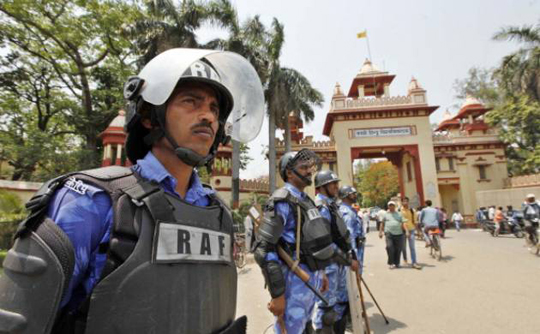
Petrol bombs seized from hostels at Banaras Hindu University

September 3, 2016

Varanasi, Sep 3: At least eight petrol bombs, dozens of iron rods, sticks, bricks, empty alcohol bottles and cigarette packets were recovered on Friday from different hostels of Banaras Hindu University following a search conducted after Wednesday night's violence at the campus, police said.

bomb

Police along with the BHU administration conducted searches at Acharya Narendra Dev, Birla and other hostels and sealed half-a-dozen of these hostels.

An investigation has also been launched to find how and why these bombs were kept and also their purpose. Meanwhile, BHU administration suspended 26 students for their alleged involvement in connection with Wednesday's violence and arson in the varsity campus and also formed a committee to probe and submit its report within a fortnight.

The petrol bombs were made in empty wine-beer bottles in which petrol was filled, police said.

An FIR has been registered against 175 students, including 25 identified and 150 unidentified students, at the Lanka police station following this incident.

FIR has been also registered against five junior doctors and four ward boys under various sections of IPC. The junior doctors of Trauma centre, who have been on strike since Thursday, called it off this evening even though medical services at Trauma centre and Sir Sunder Lal Hospital of BHU are in operation with senior doctors handling the patients.

District Magistrate Vijay Kiran Anand and SSP Akash Kulhary have ordered for opening of a new police outpost inside the trauma centre on the demand of doctors, who wanted security for themselves, complaining that scuffle breaks out quite often between the students and doctors.

A large number of police force and PAC personnel have been deployed in the BHU campus to prevent any fresh clashes between doctors and students. The two injured students, who were admitted in the hospital following the violence have now been discharged and their health condition was normal.

Violence erupted in BHU on Wednesday, with students resorting to arson and vandalism in the campus, after resident doctors and other staff at the trauma centre allegedly thrashed some students injuring six students.

Comments

Mohammed SS
 - 
Sunday, 4 Sep 2016

All the Universities belongs to Hindus should be checked properly. Most of the Hindu students became terrorists in all the universities, recently we have seen they are doing ruckus wearing saffron Dhupatta in one of the college in Mangalore about girls Hijab, these saffron in the colleges are either from terror group or from nasty cultured family.

Mohammed SS
 - 
Sunday, 4 Sep 2016

All the Universities belongs to Hindus should be checked properly, Most of the Hindu students became terrorists in all the universities, recently we have seen they are doing ruckus wearing saffron Dhupatta in one of the college in Mangalore about girls Hijab, these saffron in the colleges are either from terror group or from nasty cultured family.

muthhu
 - 
Saturday, 3 Sep 2016

Narenanna ...idella bare sullu alla....irbahudu....ekendre ee vidyarthigalu manasika aswastharu .....karana...................avarella Rashtriya spotaka sangahada membersgalalva

Enanthiri Naadig

SK
 - 
Saturday, 3 Sep 2016

As Kerala minister said, the temples in kerala are used as warehouses by RSS to store weapons.... Now the things are becoming clear, how the RSS is playing with the life of innocents, by storing weapons in Hostels, Temples, and placing meat in Nagabanas ....

SYED
 - 
Saturday, 3 Sep 2016

awaiting comments from so called hindutva groups....

Add new comment

  • Coastaldigest.com reserves the right to delete or block any comments.
  • Coastaldigset.com is not responsible for its readers’ comments.
  • Comments that are abusive, incendiary or irrelevant are strictly prohibited.
  • Please use a genuine email ID and provide your name to avoid reject.
News Network
April 29,2020

Bengaluru, Apr 29: Indian women have always been the epitome of beauty, strength, and intelligence. Today, the success of Indian women across various walks of life has proven that they have earned this reputation.

One such dedicated social worker is Dr Sunitha Manjunath, the Founder of 'Sumanaa Foundation' of Sanjay Nagar in Bengaluru.

Sumanaa Foundation, based out of Sanjay Nagar in Bengaluru has been on the forefront to support people in distress due to COVID-19. 

The foundation under the leadership of its founder Dr Sunitha Manjunath procured a total of 20000 kgs of farm-fresh produce in four phases from farmers who are unable to sell it due to the COVID Lockdown and have distributed it across 6000 families across Bengaluru city.

"We have procured these vegetables after identifying farmers who are unable to sell their produce due to the challenges of lockdown.

This initiative not only supports the farmers by helping them get the right price for their produce, but also gives us an opportunity to get vegetables at a reasonable price by escaping all middlemen and commissions. We have identified 6000 poor families mainly around Bengaluru city who have not been able to earn their daily wages and given them coupons.

The foundation members identify genuine cases and give them coupons which can be redeemed in exchange of an essential vegetables kit," said Dr Sunitha Manjunath, the founder of Sumanaa Foundation.

These vegetables have been procured from Chikkaballapura, Doddaballapura, and surrounding villages and included vegetables like onions, tomatoes, capsicum, green chillies, beans, carrots, brinjal, potatoes, beetroots etc. These farmers got a fair price for their produce and were overjoyed to know that their harvest is being distributed free of cost to needy and deserving families.

Sumanaa Foundation has been actively supporting the city administration in fighting COVID-19 pandemic. In the recent weeks the foundation has distributed sanitisers and masks to BBMP Pourakarmikas.

The foundation also cooked food for over 400 people each day. This food was handed over to the city administration, which further distributed this to the police department and other staff working across government departments during these testing times.

Dr Sunitha, an engineer by qualification, had enjoyed a high-flying corporate career with BOSCH. She was offered a global role, which she turned down to setup her NGO, 'Sumanaa Foundation' and to serve the needy in and around her locality. Over the past seven years, the NGO with 70 members has done a wide range of activities to support the poor and needy in Bengaluru.

The core team of Sumanaa Foundation works under the leadership of its president Dr Sunitha Manjunath and includes young and energetic individuals like Manjunath K, Prakash K, Vidya Prakash, Sindu Gowda, Byregowda, Nishita Arjun, Arjun Varadaraj and Manoj Kumar
'Meal of Humanity' is a notable initiative of Dr Sunitha Manjunath and her team. Under this program, over 300 poor people are served mid-day meals every day. 

This is currently a self-sustained program with no external funding. Dr Sunitha Manjunath, her family members, and friends contribute their hard-earned money to bring smiles to hundreds of migrant workers and daily wage laborers.

'Wall of Humanity' is another unique concept implemented by Sumanaa Foundation. People can leave used or unnecessary daily use products like clothes, toys, groceries, etc at a designated area. This can be picked by anyone in need of these items. This self-helping model has touched the lives of hundreds of people in and around the area of Sanjay Nagar.

Regular blood donation camps, eye checkups, scholarship for students, tailoring machine distribution, environmental initiatives, Swacch Bharath programs, wall painting across the roadside are just a few among the hundreds of activities undertaken by Sumanaa Foundation regularly under the leadership of Dr Sunitha Manjunath and her team of friends.

"A life without an aim is worthless and so is a death without achievement. The aim of my life is to touch the lives of the hundreds of people who are not as privileged as you and me. I'd like to thank my husband Manjunath, my In-Laws and my friends from Sumanaa Foundation who work tirelessly alongside me across all our initiatives," said an elated Dr Sunitha Manjuanth on receiving the 'ET Power Icons' award for Excellence in Social Service and Public Initiatives.

Dr Sunitha Manjunath has also been awarded the prestigious 'Kempegowda Award' and many more such awards for her contribution to the society.


Comments

Add new comment

  • Coastaldigest.com reserves the right to delete or block any comments.
  • Coastaldigset.com is not responsible for its readers’ comments.
  • Comments that are abusive, incendiary or irrelevant are strictly prohibited.
  • Please use a genuine email ID and provide your name to avoid reject.
News Network
April 3,2020

Bengaluru, April 3: Thirteen people in Karnataka, who had attended the Tablighi Jamaat event in Delhi, have tested positive for coronavirus, said state education minister S Suresh Kumar.

"13 attendees of Delhi's Tablighi Jamaat event have tested COVID-19 positive and 187 were tested negative," said Kumar, who has been entrusted to look into queries related to COVID-19.

He added, "A total number of four COVID-19 positive cases have been confirmed today -- a 75-year-old man in Bagalkote, a 70-year-old in Belagavi, a 26-year-old in Belagavi and a 20-year-old in Belagavi."

"The three people from Belagavi had attended the Tablighi Jamaat event in Delhi," he said, adding that the total number of cases in the state increased to 128.

The reports of 88 other people who had attended the Tablighi Jamaat event are yet to be received, the minister said.

The total number of COVID-19 positive cases in India on Friday rose to 2,547 including 162 cured/discharged and 62 deaths, according to the Ministry of Health and Family Welfare.

Comments

Add new comment

  • Coastaldigest.com reserves the right to delete or block any comments.
  • Coastaldigset.com is not responsible for its readers’ comments.
  • Comments that are abusive, incendiary or irrelevant are strictly prohibited.
  • Please use a genuine email ID and provide your name to avoid reject.
News Network
April 2,2020

The current physical distancing guidelines provided by the World Health Organisation (WHO) and by the US Centers for Disease Control and Prevention (CDC) may not be adequate to curb the coronavirus spread, according to a research which says the gas cloud from a cough or sneeze may help virus particles travel up to 8 metres. The research, published in the Journal of the American Medical Association, noted that the the current guidelines issued by the WHO and CDC are based on outdated models from the 1930s of how gas clouds from a cough, sneeze, or exhalation spread.

Study author, MIT associate professor Lydia Bourouiba, warned that droplets of all sizes can travel 23 to 27 feet, or 7-8 metres, carrying the pathogen.

According to Bourouiba, the current guidelines are based on "arbitrary" assumptions of droplet size, "overly simplified", and "may limit the effectiveness of the proposed interventions" against the deadly pandemic.

 She explained that the old guidelines assume droplets to be one of two categories, small or large, taking short-range semi-ballistic trajectories when a person exhales, coughs, or sneezes.

However based on more recent discoveries, the MIT scientist said, sneezes and coughs are made of a puff cloud that carries ambient air, transporting within it clusters of droplets of a wide range of sizes.

Bourouiba warned that this puff cloud, with ambient air entrapped in it, can offer the droplets moisture and warmth that can prevent it from evaporation in the outer environment.

"The locally moist and warm atmosphere within the turbulent gas cloud allows the contained droplets to evade evaporation for much longer than occurs with isolated droplets," she said.

"Under these conditions, the lifetime of a droplet could be considerably extended by a factor of up to 1000, from a fraction of a second to minutes," the researcher explained in the study.

The MIT scientist, who has researched the dynamics of coughs and sneezes for years, added that these droplets settle along the trajectory of a cough or sneeze contaminating surfaces, with their residues staying suspended in the air for hours.

"Even when maximum containment policies were enforced, the rapid international spread of COVID-19 suggests that using arbitrary droplet size cutoffs may not accurately reflect what actually occurs with respiratory emissions, possibly contributing to the ineffectiveness of some procedures used to limit the spread of respiratory disease," Bourouiba wrote in the study

Comments

Add new comment

  • Coastaldigest.com reserves the right to delete or block any comments.
  • Coastaldigset.com is not responsible for its readers’ comments.
  • Comments that are abusive, incendiary or irrelevant are strictly prohibited.
  • Please use a genuine email ID and provide your name to avoid reject.