


Petrol bombs seized from hostels at Banaras Hindu University

September 3, 2016

Varanasi, Sep 3: At least eight petrol bombs, dozens of iron rods, sticks, bricks, empty alcohol bottles and cigarette packets were recovered on Friday from different hostels of Banaras Hindu University following a search conducted after Wednesday night's violence at the campus, police said.
bomb

Police along with the BHU administration conducted searches at Acharya Narendra Dev, Birla and other hostels and sealed half-a-dozen of these hostels.

An investigation has also been launched to find how and why these bombs were kept and also their purpose. Meanwhile, BHU administration suspended 26 students for their alleged involvement in connection with Wednesday's violence and arson in the varsity campus and also formed a committee to probe and submit its report within a fortnight.

The petrol bombs were made in empty wine-beer bottles in which petrol was filled, police said.

An FIR has been registered against 175 students, including 25 identified and 150 unidentified students, at the Lanka police station following this incident.

FIR has been also registered against five junior doctors and four ward boys under various sections of IPC. The junior doctors of Trauma centre, who have been on strike since Thursday, called it off this evening even though medical services at Trauma centre and Sir Sunder Lal Hospital of BHU are in operation with senior doctors handling the patients.

District Magistrate Vijay Kiran Anand and SSP Akash Kulhary have ordered for opening of a new police outpost inside the trauma centre on the demand of doctors, who wanted security for themselves, complaining that scuffle breaks out quite often between the students and doctors.

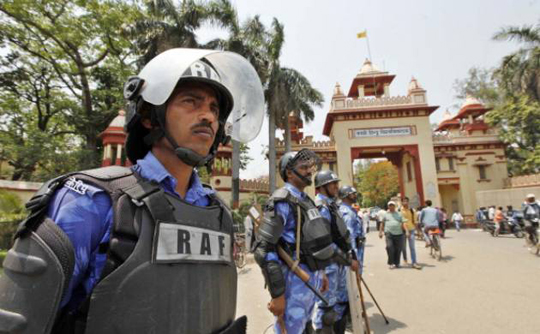
A large number of police force and PAC personnel have been deployed in the BHU campus to prevent any fresh clashes between doctors and students. The two injured students, who were admitted in the hospital following the violence have now been discharged and their health condition was normal.

Violence erupted in BHU on Wednesday, with students resorting to arson and vandalism in the campus, after resident doctors and other staff at the trauma centre allegedly thrashed some students injuring six students.

Comments

Mohammed SS
 - 
Sunday, 4 Sep 2016

All the Universities belongs to Hindus should be checked properly. Most of the Hindu students became terrorists in all the universities, recently we have seen they are doing ruckus wearing saffron Dhupatta in one of the college in Mangalore about girls Hijab, these saffron in the colleges are either from terror group or from nasty cultured family.

Mohammed SS
 - 
Sunday, 4 Sep 2016

All the Universities belongs to Hindus should be checked properly, Most of the Hindu students became terrorists in all the universities, recently we have seen they are doing ruckus wearing saffron Dhupatta in one of the college in Mangalore about girls Hijab, these saffron in the colleges are either from terror group or from nasty cultured family.

muthhu
 - 
Saturday, 3 Sep 2016

Narenanna ...idella bare sullu alla....irbahudu....ekendre ee vidyarthigalu manasika aswastharu .....karana...................avarella Rashtriya spotaka sangahada membersgalalva

Enanthiri Naadig

SK
 - 
Saturday, 3 Sep 2016

As Kerala minister said, the temples in kerala are used as warehouses by RSS to store weapons.... Now the things are becoming clear, how the RSS is playing with the life of innocents, by storing weapons in Hostels, Temples, and placing meat in Nagabanas ....

SYED
 - 
Saturday, 3 Sep 2016

awaiting comments from so called hindutva groups....

Add new comment

  • Coastaldigest.com reserves the right to delete or block any comments.
  • Coastaldigset.com is not responsible for its readers’ comments.
  • Comments that are abusive, incendiary or irrelevant are strictly prohibited.
  • Please use a genuine email ID and provide your name to avoid reject.
News Network
March 10,2020

Bengaluru, Mar 10: With concerns growing by the day, the Karnataka government is readying three more labs to test throat swab samples.

Currently, only two labs in Bengaluru — National Institute of Virology and Virus Research and Diagnostics Laboratory (VRDL) lab attached to Bangalore Medical College and Research Institute — are categorised biosafety level 2+, a requirement for coronavirus tests.

Now, the government is working on upgrading three more labs, one each in the government medical colleges at Hassan, Mysuru and Shivamogga. “The labs will be ready within one week,” the authorities said.

Currently, the labs are testing only throat swab samples of suspected patients and taking 24 hours to give the results. “A patient’s blood sample will be collected only if he or she tests positive for covid-19 infection in the first throat swab sample.

While earlier the state would send all samples of suspected coronavirus cases to NIV, Pune, the two labs were upgraded to biosafety level 2+ in mid-February.

Comments

Add new comment

  • Coastaldigest.com reserves the right to delete or block any comments.
  • Coastaldigset.com is not responsible for its readers’ comments.
  • Comments that are abusive, incendiary or irrelevant are strictly prohibited.
  • Please use a genuine email ID and provide your name to avoid reject.
News Network
March 30,2020

New Delhi, Mar 30: Congress MP Rajmohan Unnithan on Monday approached the Supreme Court seeking directions to open the Karnataka-Kerala border to allow movement of ambulances and other emergency vehicles for the transport of essential items to Kerala.

Unnithan, who is an MP From Kerala's Kasaragod constituency, filed a plea seeking direction to Karnataka to open the borders with Kerala and in particular Kasargod-Mangalore border at Talappadi.

The petition sought directions to Karnataka to allow the movement of ambulances, emergency vehicles, trucks and other vehicles carrying essential and non-essential items to Kerala. It also sought to stay the blockade imposed by Karnataka with its border states.

The plea also sought directions to Karnataka to register an FIR and constitute a special investigation team (SIT) under the supervision of this court to enquire against the concerned authorities including the police officials whose action led to the death of two citizens.

It said that the imposition of such a blockade at a time when the supply of commodities is itself hit hard and when a medical emergency has plagued the entire country is a clear violation of Articles 21 and 19(d) of the Constitution.

"This blockade has also resulted in cutting off the essential lifeline of National Highways and State Highways and major District Roads leading to the State of Kerala which has resulted in the shortage of supply of essential and non-essential items to the State of Kerala leading to shortage supply of food and medical supplies," the plea said.

"This ill-planned and dangerous blockade has claimed the life of a 70-year-old woman who was denied entry into Karnataka even for the purpose of urgent medical treatment which was only available in the medical hub of Mangalore. This is a clear case of violation of the right to life with dignity by the state as citizens are made to die on the roads because of the action of the state which is in total disregard to Article 21," it added.

This comes as the country is under a 21-day lockdown to prevent the spread of coronavirus, which according to the Ministry of Health and Family Affairs has claimed the lives of 29 people and infected a total of 1071 people as on Monday morning.

Comments

Add new comment

  • Coastaldigest.com reserves the right to delete or block any comments.
  • Coastaldigset.com is not responsible for its readers’ comments.
  • Comments that are abusive, incendiary or irrelevant are strictly prohibited.
  • Please use a genuine email ID and provide your name to avoid reject.
News Network
April 2,2020

The current physical distancing guidelines provided by the World Health Organisation (WHO) and by the US Centers for Disease Control and Prevention (CDC) may not be adequate to curb the coronavirus spread, according to a research which says the gas cloud from a cough or sneeze may help virus particles travel up to 8 metres. The research, published in the Journal of the American Medical Association, noted that the the current guidelines issued by the WHO and CDC are based on outdated models from the 1930s of how gas clouds from a cough, sneeze, or exhalation spread.

Study author, MIT associate professor Lydia Bourouiba, warned that droplets of all sizes can travel 23 to 27 feet, or 7-8 metres, carrying the pathogen.

According to Bourouiba, the current guidelines are based on "arbitrary" assumptions of droplet size, "overly simplified", and "may limit the effectiveness of the proposed interventions" against the deadly pandemic.

 She explained that the old guidelines assume droplets to be one of two categories, small or large, taking short-range semi-ballistic trajectories when a person exhales, coughs, or sneezes.

However based on more recent discoveries, the MIT scientist said, sneezes and coughs are made of a puff cloud that carries ambient air, transporting within it clusters of droplets of a wide range of sizes.

Bourouiba warned that this puff cloud, with ambient air entrapped in it, can offer the droplets moisture and warmth that can prevent it from evaporation in the outer environment.

"The locally moist and warm atmosphere within the turbulent gas cloud allows the contained droplets to evade evaporation for much longer than occurs with isolated droplets," she said.

"Under these conditions, the lifetime of a droplet could be considerably extended by a factor of up to 1000, from a fraction of a second to minutes," the researcher explained in the study.

The MIT scientist, who has researched the dynamics of coughs and sneezes for years, added that these droplets settle along the trajectory of a cough or sneeze contaminating surfaces, with their residues staying suspended in the air for hours.

"Even when maximum containment policies were enforced, the rapid international spread of COVID-19 suggests that using arbitrary droplet size cutoffs may not accurately reflect what actually occurs with respiratory emissions, possibly contributing to the ineffectiveness of some procedures used to limit the spread of respiratory disease," Bourouiba wrote in the study

Comments

Add new comment

  • Coastaldigest.com reserves the right to delete or block any comments.
  • Coastaldigset.com is not responsible for its readers’ comments.
  • Comments that are abusive, incendiary or irrelevant are strictly prohibited.
  • Please use a genuine email ID and provide your name to avoid reject.