


Gau rakshaks, Muslims unite to protest KFC's jhatka' chicken

[email protected] (Hindustan Times)
September 4, 2016

Bhopal, Sep 4: A section of Muslims and Hindus in Bhopal have come together to protest against global fast food chain KFC accusing it of hurting their religious sentiments.kfc
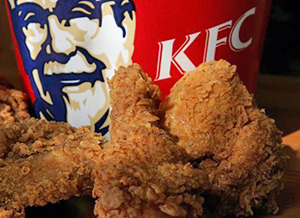
While Muslims accused the multinational giant of serving Jhatka' chicken or meat in the name of halal chicken', Hindus have joined the protests to save cows, considered sacred animal by the community.
However, no scientific tests of the KFC food items were done by any of the groups.

KFC spokesperson denied the charges vehemently, saying, “KFC holds the highest respect for the law of the land and complies with all government rules and regulations. These accusations are baseless and seem to be driven with malicious intent to harm our brand.”

“We serve chicken sourced from reputed Indian suppliers like Venky's and Godrej. We are always willing to provide consumers any clarifications they may require on the food served in our restaurants. We will be approaching the authorities to investigate this false propaganda and take appropriate action against those spreading misinformation,” the spokesperson said.

In Islam, meat obtained by severing the head of an animal instantly i.e. jhatka is considered diseased and not fit for eating. They have halal chicken or meat which is obtained by making a deep cut on the neck of a bird or animal from which blood is drained out completely.

On Friday, a joint group of protesters assembled at Iqbal Maidan and launched a signature campaign demanding a KFC-free India', with Shahar Qazi Syed Mushtaq Ali Nadvi and superintendent, Masajid Committee, Yasir Arafat appealing to people to take part in the campaign.

Anam Ibrahim who is leading the campaign claimed they had signatures of 50,112 persons and warned that if action was not taken against KFC, they would protest at the shopping mall in MP Nagar which has a KFC outlet next Friday.

Ibrahim and others had lodged a complaint at MP Nagar police station against the KFC outlet on August 6. However, KFC employees lodged a counter complaint against Ibrahim and others for their creating ruckus at the outlet.

In his complaint, Ibrahim said during Ramzan, when he sought a halal certificate from the KFC outlet, the staff showed him a certificate issued by a mufti in Mumbai Anwar Khan to a company named Venky's, for only 1,000 halal chicken whereas, KFC outlets in the country sold 2,000 to 2,500 chickens per day on an average. It did not have any mention of KFC on it.

Hence, the company did not have any certificate for halal chicken and was cheating customers who might be eating the meat of any animal in the name of chicken, which the company bought from slaughter houses in various states, he said.

Talking to HT, Arun Chawariya of Balmiki Samaj, who joined the signature campaign, said his protest was to save cows.
“We will continue our campaign till KFC closes its chain in the country,” he said.

Nadvi told HT that KFC must declare if it was selling halal or jhatka meat, where it procured the meat, what meat it was, and also if it had any certificate in this regard.

“If they are transparent, we don't have any problem. Then the option will lie with the consumers if they wish to have the kind of meat offered by KFC with a declaration,” he said.

SP Anshuman Singh said police were looking into the complaints from both sides.

He said as far as Ibrahim's complaint is concerned he had also written to the Bhopal collector to see if it was a case of adulteration and violated provisions of Food Safety and Standard Act.

Comments

AHMED
 - 
Monday, 5 Sep 2016

Please watch in yt

Why do Muslims eat Halal unbelievable (Watch until the end)

AHMED
 - 
Monday, 5 Sep 2016

www you tube com/watch?v=eVk8xF179sY

Please watch it to believe it... Dont beat the drums blindly...

vijay
 - 
Sunday, 4 Sep 2016

Icd is flooded with zakir naiks...only preachings...lol

shanu
 - 
Sunday, 4 Sep 2016

Dear Chedddis,
I have a few examples of halal, muslims have loats of reason for halal, circumcision & etc. etc.
Suresh,Rahul,Yogesh...first thing is, Why rituals in hindu marriage, mangalasutra, saptapadi, kanyadana. even without rituals also can be done, if you guys are bachelors just remember straight away go to register office and do the required procedures that is more than enough instead of rituals.... animal&bird slaughter in Islam to drain the bloods from veins (coz drinking blood is not permissible in islam ) animals and birds who died in wild cannot be eaten...

Fami
 - 
Sunday, 4 Sep 2016

What a reply by true indian. U made my day

TRUE INDIAN
 - 
Sunday, 4 Sep 2016

Suresh santhosh and yogesh. Here is the answer for ur question bro

I - Halal Method

1. The first three seconds from the time of Islamic slaughter as recorded on the EEG did not show any change from the graph before slaughter, thus indicating that the animal did not feel any pain during or immediately after the incision.

2. For the following 3 seconds, the EEG recorded a condition of deep sleep - unconsciousness. This is due to a large quantity of blood gushing out from the body.

3. After the above mentioned 6 seconds, the EEG recorded zero level, showing no feeling of pain at all.

4. As the brain message (EEG) dropped to zero level, the heart was still pounding and the body convulsing vigorously (a reflex action of the spinal cord) driving maximum blood from the body: resulting in hygienic meat for the consumer.

TRUE INDIAN
 - 
Sunday, 4 Sep 2016

Many of the five star hotels in india. They cut with halal method only. But looking at the blood. They can find out is the chicken is sick or no.

TRUE INDIAN
 - 
Sunday, 4 Sep 2016

Mr yogesh and suresh

Ur talking as if u haven't killed a single mosquito. Why god has given both sharp and flat teeth. If he wanted to eat only veg. He would have given flat teeth only. Even plant feel pain.

Coming to halaal. U will be shocked to hear that in proper halal method. Animals will feel zero pain.
When u accidently cut ur finger with blade or knife. U will feel pain after few seconds.
When u slaughter any animal during the halal method. While cutting. the brain connection gets disconnected. Only the body shakes and vibrates. They dont feel pain at all. And science have already proven it.
ALLAH is master he knows everything.

Santhosh
 - 
Sunday, 4 Sep 2016

Suresh, don't speak rubbish. Before you say something try to know the scientific reason behind it. Even now science says to follow islamic way of cutting the chicken. In this case am completely against you.

Rikaz
 - 
Sunday, 4 Sep 2016

Suresh, you wont understand, when you convert to Islam you will know why is it required to cut chicken or other eatable animals in accordance with Islamic teaching....if you need you can always ask nearest Muslim brothers.....come out of superstition beliefs.....

TRUE INDIAN
 - 
Sunday, 4 Sep 2016

KFC IS SLOW POISON. MORE DANGEROUS THAN SMOKING CIGARETTES.

MOST OF INDIANS GET PILES. DUE TO EATING KFC.

IN SWITZERLAND FRANCE AND MANY OF THE EUROPEAN COUNTRIES BANNED KFC. BECAUSE THEY USE CHEAP CHICKEN.

Add new comment

  • Coastaldigest.com reserves the right to delete or block any comments.
  • Coastaldigset.com is not responsible for its readers’ comments.
  • Comments that are abusive, incendiary or irrelevant are strictly prohibited.
  • Please use a genuine email ID and provide your name to avoid reject.
coastaldigest.com news network
January 8,2020

Mangaluru, Jan 8: No bandh-like situation prevailed in the coastal district of Dakshina Kannada, despite a nationwide strike called by trade union employees. Day-to-day activities are not disturbed, as buses and auto-rickshaws are moving as usual. 

However, in Bunder area, one of the business hubs of Mangaluru city, most of the shops today remained shut. As a result business was partially hit in the coastal city.

In other parts of Mangaluru city business firms, and market places are also open. Schools and colleges have not declared a holiday. government offices are also functioning as usually.

However, branches of many banks, excluding SBI, are closed for customers.

Members of various trade unions took out a rally and staged a protest in front of the Town Hall in Mangaluru.

Along with minimum wages, cancellation of contract labour system, no privatisation, welfare of farmers and other demands were also highlighted by the protestors. 

Slogans were also raised against Prime Minister Narendra Modi and anti-labour policies of his government. 

Members of AITUC, TUCC, AIUTUC, AIDYO, AIBEA, BSNLEU, INTUC, AIIEA, and associations of Anganwadi workers, mid-day meal workers, medical representatives, KSRTC employees, gram panchayat employees, and others took part in the protest.

Comments

Add new comment

  • Coastaldigest.com reserves the right to delete or block any comments.
  • Coastaldigset.com is not responsible for its readers’ comments.
  • Comments that are abusive, incendiary or irrelevant are strictly prohibited.
  • Please use a genuine email ID and provide your name to avoid reject.
Media Release
February 14,2020

Veteran journalist P. Sainath has said that the nation is in a crisis. And this crisis is not limited to just the rural area. It has become a national crisis at various areas such as agriculture, education, economy, job creation etc.

He was delivering the endowment lecture on the topic ‘Indian democracy at the post-liberalization and post-truth era’ at Media Manthan 2020 organized by the PG department of journalism and mass communication at St Aloysius College (Autonomous). 

Mr Sainath said that the many policies adopted in the 90s led to India becoming unusually unequal. Referring to the speech Ambedkar had made at the Constituent Assembly while handing over the draft of the Constitution, Mr Sainath said, “Ambedkar had warned about the weakness of Indian democracy that liberty without equality allows the supremacy of a few over the multitude. Liberty, equality and fraternity must be kept together as we cannot have one without the other.” 

Mr Sainath stated that the agrarian crisis was no longer about the loss of productivity, employment or about farmer suicide; it was a societal, civilizational crisis. Commenting on the lopsided policies such as cow-slaughter ban, he explained how cow slaughter ban had adversely affected many industries due to their interdependency. While Muslims who slaughtered cows were rendered helpless, the cattle traders who were mostly OBCs lost their earnings as the cattle prices crashed. An important industry like Kolhapur sandals industry in Maharashtra went bankrupt as a result of the cow slaughter ban in Maharashtra. He said the policymakers had no idea how the rural industries were interconnected. Demonetisation too devastated the rural economy as 98 percent of rural transactions happen through cash. 

Mr Sainath also spoke about the crisis of inequality which affects the Dalits and the Adivasis far more than anyone else as 90 percent of the rural households take home less than Rs 10,000/- per month. “Women are yet another group whose labour is never counted in the gross domestic product. Women and girls globally do unpaid work which amounts to about 12.5 billion working hours per year. Monetarily speaking, this is worth 10.8 trillion dollars,” Mr Sainath added. 

Speaking about the crisis of jobs Mr Sainath said that major companies were laying off employees just to create more profits for the investors and the adoption of artificial intelligence in the industry would further destroy millions of jobs.

Rector of St Aloysius College Institutions Fr Dionysius Vaz SJ, Principal Dr (Fr) Praveen Martis SJ, HOD of Journalism and Mass Communication department Dr (Fr) Melwyn Pinto SJ were present.

‘Veerappan and Vijay Mallya’s business models are interesting!’

Addressing the gathering during his endowment lecture on Friday, Mr Sainath made an interesting comment on the so called ‘revenue model’. “Whenever I visit IIMs and IITs for lectures on my PARI project, the students there ask me what my revenue model for my project is. I tell them that I do not have a revenue model. In fact, journalism does not begin with a revenue model. Gandhiji, Ambedkar, Bhagat Singh were all great journalists. But they did not have a revenue model,” Mr Sainath said.

On a lighter note, he said that the best revenue model that he liked was that of forest brigand Veerappan and liquor baron Vijay Mallya. “Veerappan ruled the forest for forty years and from the top ministers to the villagers he could dictate terms and liver royally. Similarly, Mallya’s revenue model was to steal the banks and run away abroad and live like a king,” Mr Sainath added.

Journalism is not and can never be a business. It is a calling, he opined. While newspaper can be a business, television can be a business, journalism per se cannot be reduced to a business. “Unfortunately today, journalists are recruited on a contract basis and they have no bargaining power; and there are no unions to fight for their cause. Hence, they are at the mercy of the corporate media houses for their survival and are made to write stories that cannot be called journalism,” Mr Sainath said.

Answering a question as to the pressures he faced as a journalist, he said that external pressures from the government or others could be very well handled. It is the internal pressures from once own media house that journalists find it difficult to manage.


Comments

Add new comment

  • Coastaldigest.com reserves the right to delete or block any comments.
  • Coastaldigset.com is not responsible for its readers’ comments.
  • Comments that are abusive, incendiary or irrelevant are strictly prohibited.
  • Please use a genuine email ID and provide your name to avoid reject.
News Network
January 12,2020

Bengaluru, Jan 12: Karnataka’s ranking in Niti Aayog’s sustainable development goals (SDG) index rose by one place to No. 6 in 2019, compared to the year before.

Of the 17 SDGs that are used to compute the overall index, Karnataka topped in two – ‘climate action’ and ‘life on water’. The former is a measure of how well a state integrates climate action into policies and strategies and promote mechanisms for raising capacity for effective climate change planning and management. The latter focuses on preventing marine pollution, ending illegal and destructive fishing practices, and sustainably managing and protecting marine and coastal ecosystems.

It also did well in ‘decent work and economic growth’ and ‘peace, justice and strong institutions’. But it fared poorly, slipping 16 places – from No. 5 in 2018 to No. 21 in 2019 – in ‘industry, innovation and infrastructure’. Rankings in ‘quality education’ and ‘zero hunger’ have also fallen. While in education it is now ranked 7, a drop of three places, in ‘zero hunger’, it has dropped to No. 17 from 13. SDG is a United Nations initiative. Niti Aayog has customised it for India, and 36 states and union territories are ranked. The organisation admits there is an issue of data availability in India, indicating the numbers may not exactly reflect the ground situation.

In ‘industry, innovation and infrastructure, Karnataka scored just 40 out of a target of 100. The country average was 65. It failed to achieve targets in all the four parameters for the category, except in the number of mobile connections, where it has 100 connections per 100 population. The biggest dip was in manufacturing industry jobs and in providing allweather roads under Pradhan Mantri Gram Sadak Yojana to targeted habitats. Niti Ayog has given a score of 0 for the latter. Speaking on the dismal performance in the ‘industry and infrastructure’ category, state planning commission vice-chairman BJ Puttaswamy said he was yet to look into this parameter. “I have asked the departments concerned to meet me by Monday,” he said.

Comments

Add new comment

  • Coastaldigest.com reserves the right to delete or block any comments.
  • Coastaldigset.com is not responsible for its readers’ comments.
  • Comments that are abusive, incendiary or irrelevant are strictly prohibited.
  • Please use a genuine email ID and provide your name to avoid reject.