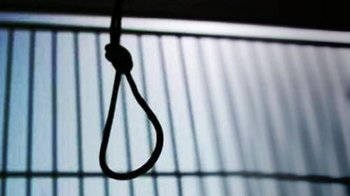
Under-trial rape accused from Sullia found hanging in Mangaluru jail

[email protected] (CD Network)
September 7, 2016

udupiraMangaluru, Sep 7: An under-trial inmate has allegedly killed himself inside the district prison in Mangaluru.

The deceased has been identified as Keshava Gowda (38), a resident of Bellare in Sullia taluk of Dakshina Kannada district.

He was an accused in a sexual assault case and the trial of the case was going on.

According to sources, he was found hanging by jail authorities on Wednesday morning. The body has been shifted to the mortuary of Government Wenlcok hospital for post-mortem.

It is leant that the undert-trial had used a piece of cloth to hang himself from the window grills inside the prison.

Comments

kavya
 - 
Wednesday, 7 Sep 2016

last week i heard one news regarding several mobiles found inside the jail?, in mangalore jail anything can happen.

Saleem
 - 
Wednesday, 7 Sep 2016

this is the position of our police in india, they even cant save inmates in jail.

sathish
 - 
Wednesday, 7 Sep 2016

suicide in jail. funny!!!

Pradeep
 - 
Wednesday, 7 Sep 2016

would have given second chance to him.

Karthik
 - 
Wednesday, 7 Sep 2016

i dont know what to comment on this but whatever happened we are happy in this case.

Monika
 - 
Wednesday, 7 Sep 2016

whatever happened should happen to everyone who rapes women.

Karan
 - 
Wednesday, 7 Sep 2016

may be he realized his mistake and punished himself.

Mahesh
 - 
Wednesday, 7 Sep 2016

shame on police department they cant even monitor jail inmates.

Priyanka
 - 
Wednesday, 7 Sep 2016

our constitution says: Is It Better That Ten Guilty Persons Go Free Than That One Innocent. this case must have some story of wrongfulness.

Mahesh
 - 
Wednesday, 7 Sep 2016

what will be the reason behind his suicide, may be he was wrongly inducted in this case.

Add new comment

  • Coastaldigest.com reserves the right to delete or block any comments.
  • Coastaldigset.com is not responsible for its readers’ comments.
  • Comments that are abusive, incendiary or irrelevant are strictly prohibited.
  • Please use a genuine email ID and provide your name to avoid reject.
Media Release
June 9,2020

Mangaluru: Continuing the relief work they started in the wake of the Corona Lockdown, ‘Team B-Human’ a local social organization is reaching out to the migrant workers who are stuck here in the region, unable to return to the homes.

Team of volunteers of the organization reached out to the migrant workers and distributed essential items including clothes and footwear of men, women, and kids.

Earlier, the organization had reached out to thousands of migrant workers and needy families and had helped them with food kits, Ramadan Kits along with medical assistance to many.

Several migrant workers recently moved back to their respective states, villages with their families, while others, unable to move back for various reasons are stuck here facing several difficulties and plights. The relief work by ‘Team B Human’ has helped several families of migrant workers in these distressing times.

Comments

Add new comment

  • Coastaldigest.com reserves the right to delete or block any comments.
  • Coastaldigset.com is not responsible for its readers’ comments.
  • Comments that are abusive, incendiary or irrelevant are strictly prohibited.
  • Please use a genuine email ID and provide your name to avoid reject.
News Network
March 11,2020

Bengaluru, Mar 11: The Insurance Regulatory Authority of India has asked insurers to settle all claims related to coronavirus expeditiously under existing health policies that provide for treatment of hospitalisation expenses.

It has also asked insurers to design products covering the cost of treatment of coronavirus that has fast spread across the world and also resulted in increasing number of infections in India. There has been over 3,000 deaths globally and 58 cases tested positive in India.

In order to provide need-based health insurance coverage, insurers are intro ducing products for various specific diseases, including vector borne diseases. "For the purpose of meeting health insurance requirements of various sections, insurers are advised to design products covering the costs of treatment for coronavirus," the IRDAI said in a circular.

The regulator said that under existing health insurance policies where hospitalisation is covered, not only the cases related to coronvirus disease (COVID-19) shall be expeditiously handled, but all the costs of admissible medic al expenses during the course of treatment, including the treatment during quarantine period, should be settled in accordance to the applicable terms and conditions of policy contract and the extant regulatory framework.

This would bring much needed relief to policy holders some of whom were facing difficulty in getting coverage for treatment takers to coronavirus. In the absence of clear information, a few hospitals were reportedly denying for forward such claims of policy holders to the insurers.

IRDAI has now said that all the claims reported under COVID-19 shall be thoro ughly reviewed by review committee before repudiating the claims. This would prevent blanket rejection of such claims.

But to get full claim for treatment of coronavirus, industry experts said, a person should be hospitalised at least for 24 hours. Most insurers do not c over outpatient treatment.

Comments

Add new comment

  • Coastaldigest.com reserves the right to delete or block any comments.
  • Coastaldigset.com is not responsible for its readers’ comments.
  • Comments that are abusive, incendiary or irrelevant are strictly prohibited.
  • Please use a genuine email ID and provide your name to avoid reject.
Agencies
May 8,2020

Washington D.C., May 8: The prime time for brain development in a child's life is the first year, where the infant spends most of the time asleep. It is the time when neural connections form and sensory memories are encoded.

However, when sleep is disrupted, as occurs more often among children with autism, brain development may be affected, too.

New research led by the University of Washington finds that sleep problems in a baby's first 12 months may not only precede an autism diagnosis but also may be associated with altered growth trajectory in a key part of the brain, the hippocampus.

The study, which was published in the American Journal of Psychiatry, researchers report that in a sample of more than 400 taken of 6- to 12-month-old infants, those who were later diagnosed with autism were more likely to have had difficulty falling asleep.

It also states that this sleep difficulty was associated with altered growth trajectories in the hippocampus.

"The hippocampus is critical for learning and memory, and changes in the size of the hippocampus have been associated with poor sleep in adults and older children.

As many as 80 per cent of the children with autism spectrum disorder have sleep problems," said Annette Estes, director of the UW Autism Center and senior author of the study.

"In our clinical experience, parents have a lot of concerns about their children's sleep, and in our work on early autism intervention, we observed that sleep problems were holding children and families back," added Estes, who is also a UW professor of speech and hearing sciences.

"It could be that altered sleep is part-and-parcel of autism for some children. One clue is that behavioural interventions to improve sleep don't work for all children with autism, even when their parents are doing everything just right. This suggests that there may be a biological component to sleep problems for some children with autism," said Estes.

To consider links among sleep, brain development, and autism, researchers at the IBIS Network looked at MRI scans of 432 infants, surveyed parents about sleep patterns, and measured cognitive functioning using a standardized assessment.

At the outset of the study, infants were classified according to their risk for developing autism: Those who were at higher risk of developing autism -- about two-thirds of the study sample -- had an older sibling who had already been diagnosed.

Infant siblings of children with autism have a 20 per cent chance of developing autism spectrum disorder -- a much higher risk than children in the general population.

In the current study, 127 of the 432 infants were identified as "low risk" at the time the MRI scans were taken because they had no family history of autism.

They later evaluated all the participants at 24 months of age to determine whether they had developed autism. Of the roughly 300 children originally considered "high familial risk," 71 were diagnosed with autism spectrum disorder at that age.

Problems with sleep were more common among the infants later diagnosed with an autism spectrum disorder, as were larger hippocampi. No other subcortical brain structures were affected, including the amygdala, which is responsible for certain emotions and aspects of memory, or the thalamus, a signal transmitter from the spinal cord to the cerebral cortex.

The authors note that while parents reported more sleep difficulties among infants who developed autism compared to those who did not, the differences were very subtle and only observed when looking at group averages across hundreds of infants.

Sleep patterns in the first years of life change rapidly as infants transition from sleeping around the clock to a more adult-like sleep/wake cycle. Until further research is completed, Estes said, it is not possible to interpret challenges with sleep as an early sign of increased risk for autism.


Comments

Add new comment

  • Coastaldigest.com reserves the right to delete or block any comments.
  • Coastaldigset.com is not responsible for its readers’ comments.
  • Comments that are abusive, incendiary or irrelevant are strictly prohibited.
  • Please use a genuine email ID and provide your name to avoid reject.