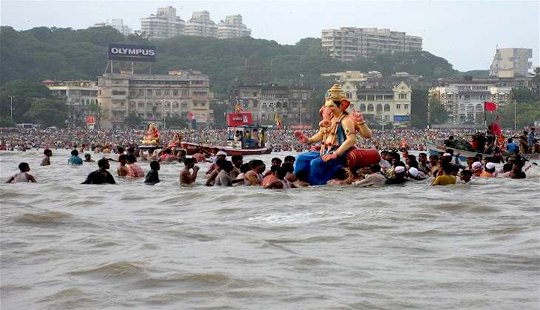
13 devotees drown as coracle overturns during Ganesh idol immersion

September 8, 2016

Shivamogga, Sep 8: As many as 13 persons are suspected to have drowned when a coracle overturned in the Tungabhadra river near Hadonahalli during the immersion of the Ganesh idol on Wednesday.

devote

The bodies of seven victims — Manjappa (35), Veerabhadra (28), Shivakumar (22), Veeresh (20), Jeevan (21), Ganesh (21), and Ramesh (23) were recovered by divers from Harihar town and the Fire and Emergency Services personnel.

The bodies of the six other victims — Nayan, Shankar, Gangesh, Chandrappa, Sagar and Ramesh are yet to be traced.

All the victims, aged between 20 and 35, were residents of Hadonahalli. Jeevan and Ganesh were students of a private engineering college in Shivamogga, while Manjappa and Chandrappa were married and have two children each.Strong currents

The incident took place at around 1 p.m. According to Sharanappa, an eyewitness, 22 youth ventured into the river to immerse the idol. When the coracle reached the centre of the river where the water current was strong, it overturned. Nine of them jumped off and swam to safety.

Superintendent of Police Abhinav Khare told presspersons that overloading of the coracle resulted in the accident. He said a team of expert divers from the Indian Navy in Karwar will join the search operations on Thursday.

Wednesday's search operations were suspended in the evening and it would start at first light on Thursday, he added.

As the news of the tragedy spread, relatives of the victims and neighbouring villagers thronged the banks of the river.

Police personnel had a difficult time managing the crowd. Deputy Commissioner V.P. Ikkeri supervised the search operations.

Shivamogga

Comments

SK
 - 
Thursday, 8 Sep 2016

In Mumbai, devotees attempted to immerse Police officer , But in this reverse happened .... Sad news.... People who do not know swimming, why they are undertaking such adventures, without thinking of their families and parents ....

FAIMAN
 - 
Thursday, 8 Sep 2016

Lot of losses, lives, financial losses due to Purely Superstition.

Religious / worshiping method in Hinduism should be re-studied, researched to ensure to be logic and not making any mistaken practices.

Umanath Poonja
 - 
Thursday, 8 Sep 2016

wow!! great death, they will directly go to heaven with a blessing from lord ganapa.

Add new comment

  • Coastaldigest.com reserves the right to delete or block any comments.
  • Coastaldigset.com is not responsible for its readers’ comments.
  • Comments that are abusive, incendiary or irrelevant are strictly prohibited.
  • Please use a genuine email ID and provide your name to avoid reject.
News Network
February 12,2020

Mumbai, Feb 12: The Income Tax department's Criminal Investigation wing has identified 2,000 Indian citizens who hold properties in Dubai but had failed to declare it in their IT returns.

In its ongoing crackdown on black money, the agency has identified Indian citizens who purchased properties in Dubai but failed to declare and explain the source of funds used to purchase these properties.

In the past few years, people have used shell companies to route illegal money and buy overseas properties to evade income tax.

However, the tax department has now increased its efforts to track down those involved in major tax evasion cases.

The 2,000 persons and companies identified mainly include businessmen, top professionals, and government officials.

The IT department will initiate action against the accused under the Black Money Act.

Citizens who own properties outside the country but fail to declare the source of funds or income used for the purchase could be prosecuted under the Black Money Act.

Under Section FA (Foreign Assets) of the Income Tax Act, an individual has to declare purchase and ownership of properties, assets, companies owned outside the country while filing the income tax returns annually.

In the recent drive against black money, the IT department identified 2,000 Indian nationals who failed to provide information on the same while filing IT returns.

Of the 2,000 citizens owning properties in Dubai, around 600 could not furnish details regarding purchase details.

Those who haven't been able to explain the source of funds used for the purchase of properties could be prosecuted and their properties can be attached by the agency.

Other than the attachment of the property, they can face a monetary penalty up to 300 per cent of the property value and also face imprisonment under the Black Money Act.

The properties owned by Indians in Dubai raised red flags as this pattern of parking money is used by money launderers, smugglers, underworld gangsters and drug traffickers for making payments.

It is worth mentioning that of the 2,000 citizens identified, most are residing in Mumbai, followed by Kerala and Gujarat.

The clause under section FA (foreign Assets) came into effect in the year 2011-12 and it is mandatory for people owning properties outside India to declare it in their IT returns.

Those identified by IT department could also face action under FEMA (Foreign Exchange Management Act) by the Enforcement Directorate under Section 4.

Recently the Enforcement Directorate (ED) launched a crackdown on black money parked overseas by tracking and identifying immovable assets bought overseas by Indian nationals illegally.

The move is being carried out under rules laid down under Section 4 of FEMA (Foregn Exchange Manipulation Act), 1999. Section 4 of FEMA states that no person resident in India shall acquire, hold, own, possess or transfer any foreign exchange, foreign security or any immovable property situated outside India.

On January 17, the Enforcement Directorate (ED) conducted searches at the residence of a former chief engineer of Brihanmumbai Municipal Corporation (BMC) in connection with an inquiry related to FEMA.

In the raids, the ED officials recovered documents related to the purchase of a property in Dubai in an allegedly illegal manner.

The ex-BMC chief engineer was posted with some of the most crucial wings of the municipal corporation -- the building proposal department and development plan department.

The agency did not disclose the name of the ex-BMC chief engineer but it has been learnt that he had superannuated around seven years ago from the municipal corporation.

ED, in a statement, said incriminating documents with regard to illegal acquisition of a property held in Dubai was recovered during the search operation.

The former BMC chief engineer has stated that he had purchased the property in Dubai at 'Park Island, Bonaire Marsa, Dubai' for Rs 70 lakh in 2012. The property is held jointly in his name, his spouse and son.

The retired BMC officials could not furnish any documents which would help ascertain the value of the property and also could not provide details on how the payments were made to buy the property in Dubai.

The citizens identified by the IT department recently also adopted a similar route to buy property in Delhi. It remains to be seen how the income tax department plans to penalise them.


Comments

Add new comment

  • Coastaldigest.com reserves the right to delete or block any comments.
  • Coastaldigset.com is not responsible for its readers’ comments.
  • Comments that are abusive, incendiary or irrelevant are strictly prohibited.
  • Please use a genuine email ID and provide your name to avoid reject.
News Network
March 5,2020

Bengaluru, Mar 5: Karnataka is facing unprecedented economic difficulties following a Rs 8,887 crore reduction in the state's share in central taxes, cut in allocation under 15th finance commission and a Rs 3,000 crore hit in GST compensation, Chief Minister B S Yediyurappa indicated on Thursday.

Presenting the state budget for 2020-21 in the Assembly, he said Karnataka's share in central taxes has come down by Rs 8,887 crore in 2019-20 as per the revised budget estimates of the central government. Therefore the state's revenue resources have been reduced. Apart from this, Rs 3,000 crore GST compensation will also be reduced as collection from the GST compensation cess is not as expected, the Chief Minister said. "With all this it has become difficult to reach to reach the 2019-20 budget targets and to manage this situation within the bounds of the Karnataka Fiscal Responsibility Act, an inevitable situation has arisen this year to cut down the expenditure of many departments," he added.

As per the interim report submitted by the 15th finance commission, there is a reduction in the state's share of central taxes to 3.64 per cent compared to 4.71 per cent fixed by the 14th finance commission. In view of this, there will be a reduction of Rs 11,215 crore in the state's share of central taxes in 2020-21 budget, when compared to the previous one.

He, however, noted that the allocation recommendation of the 15th finance commission is limited to one year only and the complete report for the period 2021-22 to 2025-26 will be submitted in October 2020.

"Our government will soon submit a revised memorandum to the commission to set right the loss caused to the state with regard allocation for the year 2020-21 and give more allocation for the remaining period," the Chief Minister said. He also said, when compared to the previous year, there is an increase of approximately Rs 10,000 crore for 2020-21 with regards to government employees salary, pension and interest on government loans, but there is no proportionate increase in resources as compared to committed expenditure. "Due to this reduction of the state's share of central taxes as per the 15th finance commission report and other developments, serious difficulties are being faced in resource mobilisation efforts of the state," Yediyurappa said. "This magnitude of economic difficulties was never faced in the previous years by our state," he added.

However, the state's own tax revenue collection is excellent during this year, he said. As compared to the previous year, there is a growth of 14 per cent in State GST collection. "Based on this, in the new budget, efforts are being made to manage the reduction in the share of central taxes by stabilising the state's own resources more", the Chief Minister said.

Karnataka recorded a gross state domestic product growth rate of 7.8 per cent in 2018-19 and Yediyurappa said for the current financial year it is estimated to be 6.8 per cent.

Comments

Add new comment

  • Coastaldigest.com reserves the right to delete or block any comments.
  • Coastaldigset.com is not responsible for its readers’ comments.
  • Comments that are abusive, incendiary or irrelevant are strictly prohibited.
  • Please use a genuine email ID and provide your name to avoid reject.
Agencies
July 8,2020

The Central Board of Secondary Education (CBSE) has rationalised by up to 30 per cent the syllabus for classes 9 to 12 for the academic year 2020-21 to reduce course load on students amid the COVID-19 crisis, Union HRD Minister Ramesh Pokhriyal 'Nishank' announced on Tuesday.

The curriculum has been rationalised while retaining the core elements, the Human Resource Development said.

Among the chapters dropped after the rationalisation exercise are lessons on democracy and diversity, demonetisation, nationalism, secularism, India's relations with its neighbours and growth of local governments in India, among others.

"Looking at the extraordinary situation prevailing in the country and the world, CBSE was advised to revise the curriculum and reduce course load for the students of classes 9 to 12.

"To aid the decision, a few weeks back I also invited suggestions from all educationists on the reduction of syllabus for students and I am glad to share that we received more than 1.5K suggestions. Thank you, everyone, for the overwhelming response," Nishank tweeted.

"Considering the importance of learning achievement, it has been decided to rationalise syllabus up to 30 per cent by retaining the core concepts," he added.

The Union minister said the changes made in the syllabi have been finalised by the respective course committees with the approval of the curriculum committee and the Governing Body of the Board.

"The heads of schools and teachers have been advised by the board to ensure that the topics that have been reduced are also explained to the students to the extent required to connect different topics. However, the reduced syllabus will not be part of the topics for internal assessment and year-end board examination.

"Alternative academic calendar and inputs from the NCERT on transacting the curriculum using different strategies shall also be part of the teaching pedagogy in the affiliated schools," a senior official of the HRD ministry said.

For classes 1 to 8, the National Council of Education Research and Training (NCERT) has already notified an alternative calendar and learning outcomes.

According to the updated curriculum, among the chapters deleted from class 10 syllabus are-- democracy and diversity, gender, religion and caste, popular struggles and movement, challenges to democracy

For class 11, the deleted portions included chapters on federalism, citizenship, nationalism, secularism, growth of local governments in India.

Similarly, class 12 students will not be required to study chapters on India's relations with its neighbours, changing nature of India's economic development, social movements in India and demonetisation, among others.

Universities and schools across the country have been closed since March 16 when the central government announced a nationwide classroom shutdown as one of the measures to contain the COVID-19 outbreak.

A nationwide lockdown was announced on March 24, which came into effect the next day. While the government has eased several restrictions, schools and colleges continue to remain closed.

Comments

Add new comment

  • Coastaldigest.com reserves the right to delete or block any comments.
  • Coastaldigset.com is not responsible for its readers’ comments.
  • Comments that are abusive, incendiary or irrelevant are strictly prohibited.
  • Please use a genuine email ID and provide your name to avoid reject.