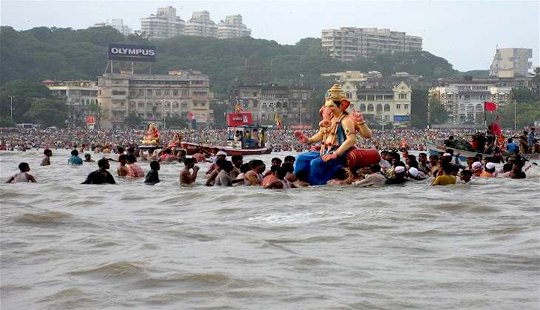
13 devotees drown as coracle overturns during Ganesh idol immersion

September 8, 2016

Shivamogga, Sep 8: As many as 13 persons are suspected to have drowned when a coracle overturned in the Tungabhadra river near Hadonahalli during the immersion of the Ganesh idol on Wednesday.

devote

The bodies of seven victims — Manjappa (35), Veerabhadra (28), Shivakumar (22), Veeresh (20), Jeevan (21), Ganesh (21), and Ramesh (23) were recovered by divers from Harihar town and the Fire and Emergency Services personnel.

The bodies of the six other victims — Nayan, Shankar, Gangesh, Chandrappa, Sagar and Ramesh are yet to be traced.

All the victims, aged between 20 and 35, were residents of Hadonahalli. Jeevan and Ganesh were students of a private engineering college in Shivamogga, while Manjappa and Chandrappa were married and have two children each.Strong currents

The incident took place at around 1 p.m. According to Sharanappa, an eyewitness, 22 youth ventured into the river to immerse the idol. When the coracle reached the centre of the river where the water current was strong, it overturned. Nine of them jumped off and swam to safety.

Superintendent of Police Abhinav Khare told presspersons that overloading of the coracle resulted in the accident. He said a team of expert divers from the Indian Navy in Karwar will join the search operations on Thursday.

Wednesday's search operations were suspended in the evening and it would start at first light on Thursday, he added.

As the news of the tragedy spread, relatives of the victims and neighbouring villagers thronged the banks of the river.

Police personnel had a difficult time managing the crowd. Deputy Commissioner V.P. Ikkeri supervised the search operations.

Shivamogga

Comments

SK
 - 
Thursday, 8 Sep 2016

In Mumbai, devotees attempted to immerse Police officer , But in this reverse happened .... Sad news.... People who do not know swimming, why they are undertaking such adventures, without thinking of their families and parents ....

FAIMAN
 - 
Thursday, 8 Sep 2016

Lot of losses, lives, financial losses due to Purely Superstition.

Religious / worshiping method in Hinduism should be re-studied, researched to ensure to be logic and not making any mistaken practices.

Umanath Poonja
 - 
Thursday, 8 Sep 2016

wow!! great death, they will directly go to heaven with a blessing from lord ganapa.

Add new comment

  • Coastaldigest.com reserves the right to delete or block any comments.
  • Coastaldigset.com is not responsible for its readers’ comments.
  • Comments that are abusive, incendiary or irrelevant are strictly prohibited.
  • Please use a genuine email ID and provide your name to avoid reject.
coastaldigest.com news network
May 25,2020

Bengaluru, May 25: Helpless dairy farmers in a village in Bangaluru Rural district have dumped around 4,000 litres of milk into drains and on anthills.

The shocking incident took place at Chikka Korati near Hoskote yesterday after the Karnataka Milk Federation (KMF) refused to collect the milk because a pregnant woman in the village had tested positive for Covid-19.

The village was sealed off three days ago and three of the woman’s family was sent to institutional quarantine. The incident is an embarrassment since the government has been urging people not to stigmatise patients or their contacts.

“In Hoskote taluk, we lead in milk production,” Guru Korati, a villager, said. “There are around 130 families in the village, but we have two milk producers’ cooperative societies (MPCSs) – Chikka Korati MPCS and Dinne Korati MPCS. Our village produces more than 4,000 litres per day. The KMF refused to collect milk from both societies after they learnt about the positive case. Frustrated, we poured the milk down the drain.”

Guru wanted the government to address the village’s problems. “We are not only struggling to sell milk, but we also cannot transport vegetables which we cultivate,” he said.

Veerabhadrappa, from Chikka Korati in Bayala Narasapura gram panchayat, said: “Several families have cows enough to yield more than 50 litres of milk. What will they do with such a huge quantity of milk?”

Mehaboob Sab, panchayat development officer (PDO) of Bayala Narasapura GP, said, “We aren’t sure how the woman contracted Covid-19. A family member had visited Tamil Nadu and the woman also frequently visited a hospital in Kolar for checkups. We are still tracing her contacts.” 

Comments

Add new comment

  • Coastaldigest.com reserves the right to delete or block any comments.
  • Coastaldigset.com is not responsible for its readers’ comments.
  • Comments that are abusive, incendiary or irrelevant are strictly prohibited.
  • Please use a genuine email ID and provide your name to avoid reject.
Agencies
February 20,2020

India ranked 77th on a sustainability index that takes into account per capita carbon emissions and ability of children in a nation to live healthy lives and secures 131st spot on a flourishing ranking that measures the best chance at survival and well-being for children, according to a UN-backed report.

The report was released on Wednesday by a commission of over 40 child and adolescent health experts from around the world. It was commissioned by the World Health Organization (WHO), UN Children's Fund (UNICEF) and The Lancet medical journal.

In the report assessing the capacity of 180 countries to ensure that their youngsters can survive and thrive, India ranks 77th on the Sustainability Index and 131 on the Flourishing Index, it said.

Flourishing is the geometric mean of Surviving and Thriving. For Surviving, the authors selected maternal survival, survival in children younger than 5 years old, suicide, access to maternal and child health services, basic hygiene and sanitation, and lack of extreme poverty.

For Thriving, the domains were educational achievement, growth and nutrition, reproductive freedom, and protection from violence.

Under the Sustainability Index, the authors noted that promoting today's national conditions for children to survive and thrive must not come at the cost of eroding future global conditions for children's ability to flourish.

The Sustainability Index ranks countries on excess carbon emissions compared with the 2030 target. This provides a convenient and available proxy for a country's contribution to sustainability in future.

The report noted that under realistic assumptions about possible trajectories towards sustainable greenhouse gas emissions, models predict that global carbon emissions need to be reduced from 39·7 giga­ tonnes to 22·8 gigatonnes per year by 2030 to maintain even a 66 per cent chance of keeping global warming below 1·5°C.

It said that the world's survival depended on children being able to flourish, but no country is doing enough to give them a sustainable future.

"No country in the world is currently providing the conditions we need to support every child to grow up and have a healthy future," said Anthony Costello, Professor of Global Health and Sustainability at University College London, one of the lead authors of the report.

"Especially, they're under immediate threat from climate change and from commercial marketing, which has grown hugely in the last decade," said Costello – former WHO Director of Mother, Child and Adolescent health.

Norway leads the table for survival, health, education and nutrition rates - followed by South Korea and the Netherlands. Central African Republic, Chad and Somalia come at the bottom.

However, when taking into account per capita CO2 emissions, these top countries trail behind, with Norway 156th, the Republic of Korea 166th and the Netherlands 160th.

Each of the three emits 210 per cent more CO2 per capita than their 2030 target, the data shows, while the US, Australia, and Saudi Arabia are among the 10 worst emitters. The lowest emitters are Burundi, Chad and Somalia.

According to the report, the only countries on track to beat CO2 emission per capita targets by 2030, while also performing fairly – within the top 70 – on child flourishing measures are: Albania, Armenia, Grenada, Jordan, Moldova, Sri Lanka, Tunisia, Uruguay and Vietnam.

"More than 2 billion people live in countries where development is hampered by humanitarian crises, conflicts, and natural disasters, problems increasingly linked with climate change," said Minister Awa Coll-Seck from Senegal, Co-Chair of the commission.

The report also highlights the distinct threat posed to children from harmful marketing.

Evidence suggests that children in some countries see as many as 30,000 advertisements on television alone in a single year, while youth exposure to vaping (e-cigarettes) advertisements increased by more than 250 per cent in the US over two years, reaching more than 24 million young people.

Studies in Australia, Canada, Mexico, New Zealand and the US – among many others – have shown that self-regulation has not hampered commercial ability to advertise to children.

Children's exposure to commercial marketing of junk food and sugary beverages is associated with purchase of unhealthy foods and overweight and obesity, linking predatory marketing to the alarming rise in childhood obesity, it said.

The number of obese children and adolescents increased from 11 million in 1975 to 124 million in 2016 – an 11-fold increase, with dire individual and societal costs, the report said.

To protect children, the authors call for a new global movement driven by and for children.

Specific recommendations include stopping CO2 emissions with the utmost urgency, to ensure children have a future on this planet; placing children and adolescents at the centre of global efforts to achieve sustainable development, the report said.

New policies and investment in all sectors to work towards child health and rights; incorporating children's voices into policy decisions and tightening national regulation of harmful commercial marketing, supported by a new Optional Protocol to the UN Convention on the Rights of the Child, it said.


Comments

Add new comment

  • Coastaldigest.com reserves the right to delete or block any comments.
  • Coastaldigset.com is not responsible for its readers’ comments.
  • Comments that are abusive, incendiary or irrelevant are strictly prohibited.
  • Please use a genuine email ID and provide your name to avoid reject.
News Network
February 3,2020

Feb 3: The Karnataka government is probably the only state to have so many nodal agencies to deal with investment proposals. There is the KIADB, Karnataka Udyoga Mitra, State High Level Clearance Committee (SHLCC), State Level Single Window Clearance Committee (SLSWCC) and District Level Single Window Clearance Committee.

While the government claims these have been created to speed up the process of setting up industries, they’re only delaying it. “A four-to-five year delay in acquiring land has become the norm,’’ say industry sources.

“These entities are only adding layers of obstacles to investors and is not really helping industries,” said a senior IAS officer.

While DLSWCCs are headed by deputy commissioners are empowered to clear investment proposals up to Rs 15 crore, SLSWCC, headed by the industries minister, clears proposals more than Rs 15 crore and up to Rs 500 crore. Proposals worth more than Rs 500 crore have to be cleared by SHLCC chaired by the CM. These entities have to meet regularly and clear proposals. But often, these meetings don’t happen as scheduled. “The delay starts from here,” said Vasant Ladava, industrialist and member of Karnataka Industries and Commerce, Bengaluru.

The single-window agencies involving representatives of departments like industries, revenue, pollution control board and forest are supposed to collectively give necessary clearances required for industries. “But, of late, they have become only project approvers without other responsibilities, leaving investors in the lurch,” said Ladava.

Comments

Add new comment

  • Coastaldigest.com reserves the right to delete or block any comments.
  • Coastaldigset.com is not responsible for its readers’ comments.
  • Comments that are abusive, incendiary or irrelevant are strictly prohibited.
  • Please use a genuine email ID and provide your name to avoid reject.