


New Delhi, Sep 8: A PIL has been filed in the Supreme Court questioning the sacrifice of animals on Eid-ul-Adha (Bakrid) and the validity of a provision of the Prevention of Cruelty to Animals Act, saying the practice was "cruel, inhuman, barbarian" and cannot be protected in the name of religion.
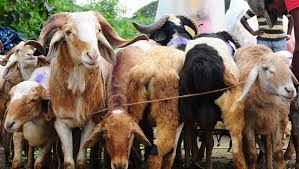 The PIL, filed by seven Uttar Pradesh residents, has sought the court's direction to ensure that no animal is killed during the festival, called the feast of sacrifice, which is to be celebrated early next week.
"Issue a writ, order or direction or declaration to the effect that the practice of sacrifice of animals on Eid-ul-Adha day is unconstitutional and same cannot be resorted to by any member of the public," the petition said.
The plea, filed through lawyer Vishnu Shankar Jain, has challenged the constitutional validity of Section 28 of the Prevention of Cruelty to Animals Act which exempts the killings under religious practices and reads: "Nothing contained in this Act shall render it an offence to kill any animal in a manner required by the religion of any community."
"Issue a writ, order or direction striking down Section 28 of Prevention of Cruelty to Animals Act, 1960 as unconditional, being ultra vires to Article 14,21 and 25 of the Constitution," it said.
The PIL has made Ministries of Home Affairs, Law and Justice and Environment and Forest and Animal Welfare Board of India as parties.
"Tendency to sacrifice animals, even on roads and public places, are developing fast every year on Eid-ul-Adha in the most uncouth and inhuman manner and litres of blood is spread at public places affecting the sentiments of public at large," the plea said.
"It is most respectfully submitted that animals sacrifice on Eid-ul-Adha day is cruel, inhuman, barbarian, decency and morality and the same cannot be protected in the name of religion as such practice is in violation of Article 14,21 and 25 of the Constitution of India," it said.


Comments
they train how to slit the throat for their kids .. no wonder ISIS militrants love throat slitting and beheading ...they rejoice the kill ... it must be banned ...countries throat slitting activities are terrorism , rapes , smugling , hawala , robbing and thefts .. needless to say who are in large no ... hahaha ... so it is the effect of this ..makla justification nodri .. upper part na slice maadi pain agda haage koltaranthe ...adu dodda rocket science nanmaklige ...haha.. 150 crores iddu ondu nobel tegello yogyathe illa ...science bagge maatu .. hogree hogree fish sales madi hogi ... delivery time aithu :)
Halal best method.
Even yogesh also certified that halal is best way. In halal method. Animals and plants doesnt feel pain.
@yogesh
Well said, that's why we say that halal method either veg or animal, is the best method. because of the speed both doesn't feel pain at all.
at last u agree Halal is the best Method. When u accidentally cut ur finger, u wont
in halal method animals don't feel pain. what about fish, which die very painfully.
stop eating fish also. fish is also vishnu's avatar, which is more holier than cow.
muslims don't eat pig, because it is dirty and filthy, carries lots of diseases
hindus don't eat cow. why. is it dirty and filthy too.
in halal method, animals feel zero pain, proved by science. it is also proved that halal food is more tastier than non halal. and there is no blood in the meat in halal method, even science says halal is the best method. even non-muslims in western countries wants halal chicken, just check the restaurant in usa name is halal guys restaurant. people stand in queue, most of them are non-muslims. next to the restaurant there is one more restaurant, which is non-halal. which is fully empty
Do animals have rights?
The vegetarian argument is that killing animals for the benefit of humans is cruel and an infringement of their rights. They put both on the same level without conceding any superiority to humans over animals. This argument is seriously flawed, because if animals had rights comparable to those of humans, they must also have equivalent duties. In other words, we must be able to blame them and punish them if they violate the rights of others. It is absurd that it should be considered a crime for humans to kill a sheep, but natural for a lion to do so. The problem stems from a misconception of the role of human life within the animal kingdom: a denial of purposeful creation within a clearly defined hierarchy degrades humans to the level of any other creature. Yet even then, the argument is illogical: Why should plants, for example, be denied the same protection from a violation of the sanctity of their life?
Is Islamic slaughter cruel?
The question of how an animal should be slaughtered to avoid cruelty is a different one. It is true that when the blood flows from the throat of an animal it looks violent, but just because meat is now bought neatly and hygienically packaged on supermarket shelves does not mean the animal didn’t have to die? Non-Islamic slaughter methods dictate that the animal should be rendered unconscious before slaughter. This is usually achieved by stunning or electrocution. Is it less painful to shoot a bolt into a sheep’s brain or to ring a chicken’s neck than to slit its throat? To watch the procedure does not objectively tell us what the animal feels.
The scientific facts
A team at the university of Hannover in Germany examined these claims through the use of EEG and ECG records during slaughter. Several electrodes were surgically implanted at various points of the skull of all the animals used in the experiment and they were then allowed to recover for several weeks. Some of the animals were subsequently slaughtered the halal way by making a swift, deep incision with a sharp knife on the neck, cutting the jugular veins and carotid arteries of both sides together with the trachea and esophagus but leaving the spinal cord intact. The remainder were stunned before slaughter using a captive bolt pistol method as is customary in Western slaughterhouses. The EEG and ECG recordings allowed to monitor the condition of the brain and heart throughout.
The Halal method
With the halal method of slaughter, there was not change in the EEG graph for the first three seconds after the incision was made, indicating that the animal did not feel any pain from the cut itself. This is not surprising. Often, if we cut ourselves with a sharp implement, we do not notice until some time later. The following three seconds were characterized by a condition of deep sleep-like unconsciousness brought about by the draining of large quantities of blood from the body. Thereafter the EEG recorded a zero reading, indicating no pain at all, yet at that time the heart was still beating and the body convulsing vigorously as a reflex reaction of the spinal cord. It is this phase which is most unpleasant to onlookers who are falsely convinced that the animal suffers whilst its brain does actually no longer record any sensual messages.
The Western method
Using the Western method, the animals were apparently unconscious after stunning, and this method of dispatch would appear to be much more peaceful for the onlooker. However, the EEG readings indicated severe pain immediately after stunning. Whereas in the first example, the animal ceases to feel pain due to the brain starvation of blood and oxygen – a brain death, to put it in laymen’s terms – the second example first causes a stoppage of the heart whilst the animal still feels pain. However, there are no unsightly convulsions, which not only means that there is more blood retention in the meat, but also that this method lends itself much more conveniently to the efficiency demands of modern mass slaughter procedures. It is so much easier to dispatch an animal on the conveyor belt, if it does not move.
Yogesh, Lol, you explained halal veg in best way... anyone can understand now.. all doubts cleared.
after sacrifice animal we are not throwing meat and not keeping meat to eat ghost. we share all the meat to poor people and our family.we are not wasting the meat. if you care that much about animal you should ban eating non veg (chicken mutton)
I am surprised to see why they dont file PIL from banning export of beef meat. Very strange. Why they are maintaining double standard.
Government can allow Indian cow meat for foreigners to eat....this is very bad and disgusting policy....
On Eid day he feels \Cruel\" other days ?
What about vegetables right? even number of studies prove that plants feel pain. Can people stop using plant and vegetable ?
Court should have right to panish if some one file the IPL which does not make any sence and causing unnessary focus, contradict the constituional rights and waste of court time etc.,"
We Muslims sacrifice animals once in a year.But our Hindu brother's sacrifices animals every now and then in the name of Balidhan.We Muslims are not bothered about the PIL.Bec we blindly believe in Almighty Allah.
You have to file PIL against killing of HUmans first
Add new comment