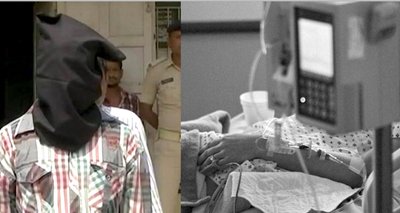
Doctor-sweeper duo arrested for raping dengue patient in ICU

September 9, 2016

Ahmedabad, Sep 9: A doctor and a sweeper of Apollo Hospital in Gandhinagar district of Gujarat have been arrested in connection with the rape of a 19-year-old dengue patient who was admitted in the ICU for treatment, police said today.

icuBoth the accused --Dr Ramesh Chauhan and sweeper Chandrakant Vankar--from Apollo Hospital, located at Bhat village in Gandhinagar were arrested yesterday.

"We have arrested Chauhan and Vankar on the charges of rape. The girl alleged that both of them took turns to rape her on the night of Saturday and Sunday at the hospital where she was undergoing treatment for dengue," said Adalaj police inspector A K Pandya.

The duo has been remanded to police custody by a local court till tomorrow. The girl was raped in the ICU unit of the hospital, where authorities do not allow relatives of the patient to stay back in the night.

On September 7, the girl had lodged a complaint with Adalaj police alleging that she was raped by the hospital sweeper, whom she identified as Chandu, besides a doctor, whom she could recognise by his face. Based on the complaint, police had lodged a case under section 376 (C)(D) of the Indian Penal Code for rape and subsequently arrested Vankar and Chauhan, said Pandya.

Apollo Hospital said that they are cooperating fully with the police in investigation. "The ward where the incident took place has 14 staff working round-the-clock, and is equipped with CCTV cameras. We are co-operating fully with the police which is examining CCTV footages and carrying out the investigations," said a statement issued by the hospital.

Comments

SK
 - 
Friday, 9 Sep 2016

Yogesh, Modi is responsible, he has given a free hand to the goondas to trash the Dalits and Minorities in the name of cow.... He is not opening his mouth, very bad smell....

SK
 - 
Friday, 9 Sep 2016

Sukesh, this must be Gujrat and Modi mind set ...

TRUE INDIAN
 - 
Friday, 9 Sep 2016

@yogesh.

number one: Modi trying to save sinking BJP in Gujarat by speaking against ‘gau rakshaks’.

Now if this is Proved, Then Bjp will be Govinda in Gujrat. He will put more effort to save them.

TRUE INDIAN
 - 
Friday, 9 Sep 2016

MODI WILL SHUT THIS CASE IMMEDIATELY. AND THEY WILL PUT BLAME ON THE PATIENT.

Mahesh
 - 
Friday, 9 Sep 2016

really inhuman act, we really fed up of this news. serious punishment should be given. should not happen next time.

Add new comment

  • Coastaldigest.com reserves the right to delete or block any comments.
  • Coastaldigset.com is not responsible for its readers’ comments.
  • Comments that are abusive, incendiary or irrelevant are strictly prohibited.
  • Please use a genuine email ID and provide your name to avoid reject.
News Network
June 20,2020

Bengaluru, Jun 20: A petition has been filed in Karnataka High Court to transfer Amulya Leona case to the National Investigation Agency (NIA). She raised pro-Pakistan slogans at an anti-CAA rally on February 20 at Freedom Park.

The petition, filed by advocate Vishal Raghu, blamed the probe team for not filing chargesheet on time and suggested the state government to approach the higher court against bail granted to Amulya Leona.

On June 11, she was granted conditional bail by the Bengaluru civil court.

She was charged with sedition for her actions in the presence of All India Majlis-e-Ittehad-ul-Muslimeen chief Asaduddin Owaisi.

The court granted bail after hearing the bail application. Amulya's advocate on behalf of the petitioner said, "the petitioner is just a 19-year-old lady and she is studying in a private college in the Bengaluru. She shouted 'Pakistan Zindabad' but she never mentioned Pakistan as her country."

Comments

Add new comment

  • Coastaldigest.com reserves the right to delete or block any comments.
  • Coastaldigset.com is not responsible for its readers’ comments.
  • Comments that are abusive, incendiary or irrelevant are strictly prohibited.
  • Please use a genuine email ID and provide your name to avoid reject.
News Network
June 10,2020

Bengaluru, Jun 10: Janata Dal-Secular (JD-S) supremo and former Prime Minister H.D. Deve Gowda said on Tuesday that he filed his nomination for the June 19 Rajya Sabha elections from Karnataka in response to a collective call from national leaders to be back in the Parliament.

"Though I was not personally interested to contest, national leaders from Congress President Sonia Gandhi, National Conference President Farooq Abdullah, TMC and Left parties want me back in Parliament," he told reporters here.

Gowda, 87, filed his nomination in the Vidhana Soudha, submitting the papers to Assembly Secretary and Returning Officer M.K. Vishalakshi, a party official told IANS.

Gowda''s second son and former minister H.D. Revanna and third son and former Chief Minister H.D. Kumaraswamy were present on the occasion.

"Our party''s all 34 legislators also urged me to contest as my presence is necessary in Parliament at a time when the country was grappling with multiple crises in the aftermath of coronavirus," said Gowda.

Claiming that there was no pressure from his two sons as they are more concerned with his health, Gowda said he was touched by the requests of the national leaders, especially Gandhi who personally called him and asked him to contest as the country needed his presence in Parliament.

Gowda agreed to contest in the bypoll as his party''s candidate after the Congress state unit assured him of its support with its surplus votes, as the JD-S with 34 legislators is short of 10 votes of the required 44 votes.

It will be second time Gowda will enter the Rajya Sabha, 24 years after he was its member as the Prime Minster from June 1996 to April 1997 of the United Front government.

"Congress General Secretary K.C. Venugopal informed Kumaraswamy on June 6 that the party was fielding only its senior leader Mallikarjun Kharge from Karnataka and had surplus votes to ensure my victory as our party is 10 votes short of the required 44 votes to win," Gowda said.

Kharge filed his nomination on Monday.

Party''s outgoing member Kupendra Reddy, whose 6-year term ends on June 25, told Gowda that he was not interested for a second term as he did not get enough time in the upper house to raise issues.

"As our party does not have numbers in Parliament to get more time allotted to raise issues and participate in debates, Reddy wanted me to be in the Rajya Sabha in his place so that I could serve the nation better," Gowda said.

Gowda lost in the May 2019 general elections from Tumkur to G.S. Basvaraj of the BJP.

With the term of the four members -- Congress'' B.K. Hariprasad and Rajeev Gowda, BJP''s Prabhakar Kore and JD-S''s Reddy ending on June 25, the Election Commission notified the poll on June 1.

According to the poll panel, the nominations will be scrutinised on Wednesday and last date for withdrawal by candidates is June 12. Polling and vote count is on June 19.

From the ruling BJP, its grassroot cadres Eranna Kadadi and Ashok Gasti filed their nominations after Gowda.

By fielding Gowda for the fourth seat, the Congress and JD-S, who had post-poll and pre-poll alliances for the Lok Sabha and state Assembly elections in May 2019 and May 2018, queered the pitch for the BJP, denying it the chance to win a third seat.


Comments

Add new comment

  • Coastaldigest.com reserves the right to delete or block any comments.
  • Coastaldigset.com is not responsible for its readers’ comments.
  • Comments that are abusive, incendiary or irrelevant are strictly prohibited.
  • Please use a genuine email ID and provide your name to avoid reject.
Ram Puniyani
January 14,2020

In the beginning of January 2020 two very disturbing events were reported from Pakistan. One was the attack on Nankana Sahib, the holy shrine where Sant Guru Nanak was born. While one report said that the place has been desecrated, the other stated that it was a fight between two Muslim groups. Prime Minister of Pakistan Imran Khan condemned the incident and the main accused Imran Chisti was arrested. The matter related to abduction and conversion of a Sikh girl Jagjit Kaur, daughter of Pathi (One who reads Holy Guru Granth Sahib in Gurudwara) of the Gurudwara. In another incident one Sikh youth Ravinder Singh, who was out on shopping for his marriage, was shot dead in Peshawar.

While these condemnable attacks took place on the Sikh minority in Pakistan, BJP was quick enough to jump to state that it is events like this which justify the Citizenship Amendment Act (CAA). Incidentally CAA is the Act which is discriminatory and relates to citizenship with Religion, which is not as per the norms of Indian constitution. There are constant debates and propaganda that population of Hindus has come down drastically in Pakistan and Bangla Desh. Amit Shah, the Home minister stated that in Pakistan the population of Hindus has come down from 23% at the time of partition to 3.7% at present. And in Bangla Desh it has come down from 22% to present 8%.

While not denying the fact that the religious minorities are getting a rough deal in both these countries, the figures which are presented are totally off the mark. These figures don’t take into consideration the painful migrations, which took place at the time of partition and formation of Bangla Desh later. Pakistan census figures tell a different tale. Their first census was held in 1951. As per this census the overall percentage of Non Muslim in Pakistan (East and West together) was 14.2%, of this in West Pakistan (Now Pakistan) it was 3.44 and in Eat Pakistan it was 23.2. In the census held in Pakistan 1998 it became 3.72%. As far as Bangla Desh is concerned the share of Non Muslims has gone down from 23.2 (1951) to 9.6% in 2011.

The largest minority of Pakistan is Ahmadis, (https://minorityrights.org/country/pakistan/) who are close to 4 Million and are not recognised as Muslims in Pakistan. In Bangla Desh the major migrations of Hindus from Bangla Desh took place in the backdrop of Pakistan army’s atrocities in the then East Pakistan.

As far as UN data on refugees in India it went up by 17% between 2016-2019 and largest numbers were from Tibet and Sri Lanka.  (https://www.un.org/en/development/desa/population/migration/publication…)

The state of minorities is in a way the index of strength of democracy. Most South Asian Countries have not been able to sustain democratic values properly. In Pakistan, the Republic began with Jinnah’s classic speech where secularism was to be central credo of Pakistan. This 11th August speech was in a way what the state policy should be, as per which people of all faiths are free to practice their religion. Soon enough the logic of ‘Two Nation theory” and formation of Pakistan, a separate state for Muslim took over. Army stepped in and dictatorship was to reign there intermittently. Democratic elements were suppressed and the worst came when Zia Ul Haq Islamized the state in collusion with Maulanas. The army was already a strong presence in Pakistan. The popular formulation for Pakistan was that it is ruled by three A’s, Army, America and Allah (Mullah).

Bangla Desh had a different trajectory. Its very formation was a nail in the coffin of ‘two nation theory’; that religion can be the basis of a state. Bangla Desh did begin as a secular republic but communal forces and secular forces kept struggling for their dominance and in 1988 it also became Islamic republic. At another level Myanmar, in the grip of military dictatorship, with democratic elements trying to retain their presence is also seeing a hard battle. Democracy or not, the army and Sanghas (Buddhist Sang has) are strong, in Myanmar as well. The most visible result is persecution of Rohingya Muslims.

Similar phenomenon is dominating in Sri Lanka also where Budhhist Sanghas and army have strong say in the political affairs, irrespective of which Government is ruling. Muslim and Christian minorities are a big victim there, while Tamils (Hindus, Christians etc.) suffered the biggest damage as ethnic and religious minorities. India had the best prospect of democracy, pluralism and secularism flourishing here. The secular constitution, the outcome of India’s freedom struggle, the leadership of Gandhi and Nehru did ensure the rooting of democracy and secularism in a strong way.

India so far had best democratic credentials amongst all the south Asian countries. Despite that though the population of minorities rose mainly due to poverty and illiteracy, their overall marginalisation was order of the day, it went on worsening with the rise of communal forces, with communal forces resorting to identity issues, and indulging in propaganda against minorities.

While other South Asian countries should had followed India to focus more on infrastructure and political culture of liberalism, today India is following the footsteps of Pakistan. The retrograde march of India is most visible in the issues which have dominated the political space during last few years. Issues like Ram Temple, Ghar Wapasi, Love Jihad, Beef-Cow are now finding their peak in CAA.

India’s reversal towards a polity with religion’s identity dominating the political scene was nicely presented by the late Pakistani poetess Fahmida Riaz in her poem, Tum bhi Hum Jaise Nikle (You also turned out to be like us). While trying to resist communal forces has been an arduous task, it is becoming more difficult by the day. This phenomenon has been variously called, Fundamentalism, Communalism or religious nationalism among others. Surely it has nothing to do with the religion as practiced by the great Saint and Sufi traditions of India; it resorts mainly to political mobilization by using religion as a tool.

Comments

Ashi
 - 
Tuesday, 14 Jan 2020

If Malaysia implement similar NRC/CAA, India and China are the loser.

Add new comment

  • Coastaldigest.com reserves the right to delete or block any comments.
  • Coastaldigset.com is not responsible for its readers’ comments.
  • Comments that are abusive, incendiary or irrelevant are strictly prohibited.
  • Please use a genuine email ID and provide your name to avoid reject.