


Gau rakshaks attack farmhouse, destroy property over qurbani; victims booked

[email protected] (CD Network)
September 15, 2016

Bengaluru, Sep 15: This is not a story from strife-torn Uttar Pradesh or Gujarat. This happened in a relatively peaceful village in Bengaluru district of Congress ruled Karnataka, where Muslims celebrated Eid-ul-Adha, the festival of sacrifice, earlier this week.saffron
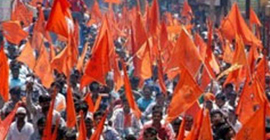
A group of around 100 miscreants armed with stones, and sticks laid siege to a farmhouse on Jigani Main Road under the limits of Begur police station about 25km from the heart of the city on Wednesday afternoon, alleging that a cow had been slaughtered inside.

Trapped inside the isolated house for more than two hours, the family members denied they slaughter the cow and said they sacrificed a bull on the day of Eid-ul-Adha (Bakrid) to accomplish qurbani ritual.

The so called gau rakshaks, who apparently belong to saffron groups, attacked the five-acre farm around 1:30 pm. They vandalized their family's car, bike and other property on the farm premises. Waseem Ahmed, the eldest son of the family, said he had gone outside when the attackers called him.

"When I reached the home, they were burying the bull while the police had arrived and listening to the mob. My parents and two brothers had been locked inside the house for over two hours. We were then taken to the jurisdictional Begur police station where we were made to stay till 11pm. Our phones were taken away as well," he said.

He further said if anyone had a problem with the slaughter, they should have called the police instead of storming their farmhouse. Police have not acted against any member of the mob which comprised mostly of locals.

Police, in the meanwhile, said they have recorded the family's statement and are ascertaining whether the family had relevant permissions for slaughter.
Superintendent of Police, Bengaluru Rural Amit Singh on Thursday said they collected samples of the animal to verify what it was and its age. "We have taken up a case against the family under cow slaughter laws," he said.

The family members were released on Thursday night on bail, Singh said, adding that they will investigate if there was any vandalism and take action against the culprits. Singh also claimed the situation is under control and police had reached the spot in time.

Ironically, the police neither arrested any of the miscreants who threatened the family and destroyed their property in the name of cow protection nor booked any case against them so far.

Comments

SK
 - 
Saturday, 17 Sep 2016

Ya Allah, kindly show wisdom to this arrogant Muslims, who can not sleep or digest, without Qurbani ..... What is the sense in risking life and property for the sake of Qurbani .... There are hundreds of ways to please Allah....

SK
 - 
Saturday, 17 Sep 2016

Bopanna KSA.... Muslims living in India are citizens,... Where as you are in KSA for your papi pet ( stomach ) ... You are not a citizen in KSA.. IF you are talking of rules and respect, why cant you / Modi show the balls to ban BEEF EXPORT from India ????? Any guts ??/ All hypocrites / humbaq people ..

NIHAL
 - 
Saturday, 17 Sep 2016

@Bopanna KSA.... what culture are you talking about. First of all know what India is, India is a country with unity in diversity and its democratic where as KSA is not democratic its kingdom. Indian culture do not belong to particular community its a mix

Bopanna
 - 
Friday, 16 Sep 2016

In India, respect OUR culture
in KSA we respect yours ....

Arun
 - 
Friday, 16 Sep 2016

I feel shame on muslim brothers; they can't even celebrate eid peacefully

I have question ; WHY U PEOPLE CAN'T TAKE same action like hit & kill on spot against this go rakshak or rss anti human beings.

Satyameva jayate
 - 
Friday, 16 Sep 2016

Communal goons....labelled rakshaks.
And Goongress govt. Supporting them.....mili juli politics

Ahmed K. C.
 - 
Friday, 16 Sep 2016

Ramesh Bhandari, Kudla.
Appreciate your comments.
Though Fish is \Matsya\" a avatar of Vishnu according to Mythology
and Pig is also \"Varaha\" a avatar of Vishnu according to Mythology,
Dharma Raakshas will not attack who consume Fish or Pork.
They just on to terrorize only Muslims on pretext of Gau Matha, Love Jihad or Conversion."

moshu
 - 
Thursday, 15 Sep 2016

Siddu's era seems over.

Ramesh bhandari
 - 
Thursday, 15 Sep 2016

Police should punish the culprits. I shame on my sangh parivar brothers. Will you damage my property if i kill fish ( even fish is also a avatar of our GOD ).

Stop acting as Dharm Rakshak and be human first

M2
 - 
Thursday, 15 Sep 2016

Saffron Terrorism is all supported by saffron police & saffron govt.

Add new comment

  • Coastaldigest.com reserves the right to delete or block any comments.
  • Coastaldigset.com is not responsible for its readers’ comments.
  • Comments that are abusive, incendiary or irrelevant are strictly prohibited.
  • Please use a genuine email ID and provide your name to avoid reject.
News Network
February 22,2020

Belagavi, Feb 22: A madrasa in Karnataka’s Belagavi district hosted a Hindu-Muslim mass marriage on its premises on Friday, sending a strong message of communal amity. As many as 76 Muslim couples and 25 Hindu couples entered marital life on the occasion.

Madarsa Al Arabia Anwarul Ulooma, an Islamic religious institute in Bailhongal, 50km from Belagavi district headquarters, played host to the event that was organised by Jamia Faizan-ul-Quran and Issa Foundation, which has conducted mass marriages on a bigger scale in Gujarat.

The mass marriage comes a month after the 100-year-old Cheravally Jamaat Masjid in Kerala’s Kayamkulam in Alappuzha hosted a Hindu wedding, complete with a vegetarian feast for 4,000 people. A Hindu priest led the rituals, and the couple sought the blessings of chief imam Riyasudeen Faizy of the mosque.

At Bailhongal, moulvis and pontiffs led the marriage proceedings and asked the couples to read passages from Quran and Bhagvad Gita.

The Hindu couples were gifted a copy of the Gita, and newly-married Muslim couples received a copy of Quran. The organisers provided each Hindu bride a mangalsutra. Bailhongal MLA Mahantesh Koujalagi blessed the couples at the event, which was attended by more than 4,000 people.

Mohammad Rafique A Naik, a member of Jamia Faizan-ul-Quran, said they have gifted each couple a refrigerator, an almirah and a tailoring machine. Ranjita Kalala, a bride who married a daily-wage labourer, said her family couldn’t afford the cost of a wedding, adding, “When we learnt about the Bailhongal madrassa’s plan, we agreed to sign up because it also sends out a message of communal harmony.”

Comments

Add new comment

  • Coastaldigest.com reserves the right to delete or block any comments.
  • Coastaldigset.com is not responsible for its readers’ comments.
  • Comments that are abusive, incendiary or irrelevant are strictly prohibited.
  • Please use a genuine email ID and provide your name to avoid reject.
News Network
January 25,2020

Mangaluru, Jan 25: Orange vendor Harekala Hajabba, popularly known as 'Akshara Santha' (the saint of alphabets), who went on to build a school at Newpadpu village on the city’s outskirts in 1999 is among this year’s Padma Shri awardees.

When Hajabba received the call on being nominated for the award, he was standing in a queue to buy rations.

As he is not fluent in Hindi, Hajabba handed over the phone to an auto driver, who conveyed the news that the Padma Shri award will be conferred on him.

The unlettered achiever set up a primary school from his meagre savings of Rs 150 per day,  selling oranges in Mangaluru. 

“The first time I felt bad for being an illiterate was when a foreigner enquired about the price of oranges in English. I did not know what he meant. So, I decided to start a school in my village,” Hajabba had said during a felicitation programme.

When Hajabba decided to start a school, he did not get any support. He started the school with 28 children.

The school today has been upgraded to a composite high school and is catering to the educational needs of hundreds of children in and around Newpadpu.

He ran from pillar to post in the Zilla Panchayat to make his dream come true. All cash awards he had received went into building the school. The United Christians Association, moved by the sight of his dilapidated house, built a 760-square-foot house costing Rs 15 lakh for him. 

Hajabba’s life was prescribed for the syllabus of three universities - Davangere, Kuvempu and Mangalore. His success story is also included in a Tulu textbook.

He won the Karnataka Rajyotsava award in 2013, Real Heroes award from TV channel CNN-IBN.

Hajabba, when contacted, said he could not believe his ears when told about the award.

New dreams

The frail vendor, in his 60s, humbly declared that he could achieve all this because of the support of all. Hajabba now dreams of upgrading the school into a full-fledged PU college.

Comments

Meethal Kasaragod
 - 
Sunday, 26 Jan 2020

A big Salute to him!

Great effort,

fairman
 - 
Sunday, 26 Jan 2020

Where there is will, there is way

May God help him.

Add new comment

  • Coastaldigest.com reserves the right to delete or block any comments.
  • Coastaldigset.com is not responsible for its readers’ comments.
  • Comments that are abusive, incendiary or irrelevant are strictly prohibited.
  • Please use a genuine email ID and provide your name to avoid reject.
Media Release
March 12,2020

Manipal, Mar 12: Team WGSHA is proud to announce that the culinary museum in WGSHA has been listed in Limca Book of Records as India's First Living Culinary Arts Museum.

Limca Book of Records (LBR) is a catalogue of achievements made by Indians, at home and abroad in diverse fields of human endeavour. LBR is a celebration of exemplary exploits and recognizes accomplishments such as firsts, inventions, discoveries, honours, awards and the truly extraordinary.

Chef Thirugnanasambantham, Principal of WGSHA, while thanking MAHE and ITC Leadership for extending all support towards instituting this museum in Manipal and WGSHA, also appreciated and thanked all those who have directly or indirectly helped towards setting up this museum in Manipal.

"The process for WGSHA's culinary museum to make an entry into the popular Limca Book of Records started almost six months back and after validation by LBR recently, has been listed in the book of records. We are glad that we could be the first of its kind in such endeavour and we also hope to be in Guinness World Records soon", said Chef Thiru.

"We are indeed grateful to Michelin-starred Indian celebrity Chef Vikas Khanna, the founder and curator of this museum, who had this idea of establishing a culinary museum and donated thousands of kitchen tools and equipment worth millions of dollars to this museum for preserving the history of India's rich tradition of culinary arts and to educate the future generations. Chef Vikas Khanna, 'Distinguished Alumnus' of WGSHA, being very desirous of making such a museum in India, what better place it would be than in his own Alma Mater!", he said on the background of having the museum.

Chef Thiru mentioned that Udupi, popular for the famous 'Udupi Cuisine', and being a temple town, is adjacent to International University Town of Manipal Academy of Higher Education (MAHE).

MAHE is home to thousands of international students and visitors. With a great heritage of Udupi, combined with the large number of Indian and International students residing in and around Manipal, it was very apt for the college to create a museum for today's Indian youth and the International visitors to understand the rich culinary heritage of India, through the priceless kitchen tools and equipment donated by Chef Vikas Khanna.

"Has placed WGSHA in the global culinary map and we are proud to have joined all such efforts to preserve the history of cuisines and cultures across the world", said Chef Thiru.

The culinary art academic block housing the museum was opened in April 2018, spread approximately over 25,000 sq ft and is shaped in the form of a giant pot very similar to the ones found in Harappa.

There are historical as well as regular household items such as plates made by the Portuguese in India, a 100-year-old ladle used to dole out food at temples and bowls dating to the Harappan era, an old seed sprinkler, an ancient Kashmiri tea brewer known as 'samovar', vessels from the Konkan, Udupi and Chettinad regions, apart from a large collection of rolling pins, utensils of all shapes and sizes, tea strainers of different types etc.

Comments

Add new comment

  • Coastaldigest.com reserves the right to delete or block any comments.
  • Coastaldigset.com is not responsible for its readers’ comments.
  • Comments that are abusive, incendiary or irrelevant are strictly prohibited.
  • Please use a genuine email ID and provide your name to avoid reject.