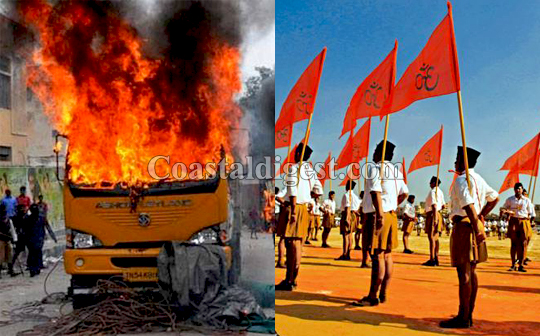
Govt will examine RSS role in stoking Cauvery violence: Home Minister

September 17, 2016

Bengaluru, Sep 17: The state government will examine if the Rashtriya Swayamsevak Sangha (RSS) had any role in stoking violence over the Cauvery issue in Bengaluru on September 12.

RSS

Speaking to reporters after presiding over the KPCC office-bearers meeting on Friday, Home Minister G Parameshwara said that during the meeting, a KPCC member wondered if the RSS had any role in instigating violence in the city.

He said the police had explored all angles during investigations and had no such suspicions on the RSS' role. However, his department would again look into the matter, he added. In his reaction, RSS Kshetreeya Sanghachalak V Nagaraj said that Parameshwara had the “malicious habit” of making immature charges against the RSS.

Meanwhile, BJP?state general?secretary and MLA?C?T?Ravi in a press note dubbed Parameshwara's statement as “irresponsible” and “politically motivated.” He made a counter-charge that violence in Bengaluru on Monday was stage-managed by Parameshwara with an intention to unseat Chief Minister Siddaramaiah.

Ravi charged that Parameshwara suspects Siddaramaiah's hand in his defeat from the Koratagere constituency in Tumakuru district in the 2013 Assembly elections and was keen on seeking revenge.

On Cauvery

Parameshwara said Karnataka would be “doomed” if the Supreme Court orders release of the Cauvery water to Tamil?Nadu beyond September 20. “If such a verdict is given, then I guess we will have no choice other than asking people of Bengaluru to go and settle down in Tamil Nadu,” he observed. He said Karnataka would impress upon the apex court on evolving a distress mechanism.

Comments

SHAJI
 - 
Sunday, 18 Sep 2016

I am sure that sangh parivar is involved in the rioting in Bangalore just to bring black dot to Sidhu Govt. They are the killers of Gandhiji who sacrificed his life for the freedom of India. What else we can expect from these unhuman, illogical, pro devil, terrorists organisations and their supporters. Its shame that Karnataka govt is soft for these terrorists.

Thoushi
 - 
Saturday, 17 Sep 2016

See the below comment of cheddi Mahesh.... govt has to investigate him, he may know all the information regarding RSS role in this violence....

AK
 - 
Saturday, 17 Sep 2016

Many times cheddis were caught doing their shit acts alll over india.. Y not .. They may be behind this ill act too..

ABD
 - 
Saturday, 17 Sep 2016

What else do you expect in a country when 60% of terrorists are in police force?

Mahesh
 - 
Saturday, 17 Sep 2016

this congress govt dont have any work, simply blaming rss instead of maintaining peace in the state.

Add new comment

  • Coastaldigest.com reserves the right to delete or block any comments.
  • Coastaldigset.com is not responsible for its readers’ comments.
  • Comments that are abusive, incendiary or irrelevant are strictly prohibited.
  • Please use a genuine email ID and provide your name to avoid reject.
coastaldigest.com news network
July 14,2020

Bengaluru, July 14: Girls outshone boys in the Second Pre-University Board examinations in Karnataka, results of which were announced on Tuesday.

As many as 6.75 lakh students had written the examination of which 4.17 lakh students passed.

Thus, the pass percentage is 61.80 per cent, Primary and Secondary Education Minister S Suresh Kumar said while announcing the results.

He said 68.73 per cent girls cleared the exam against the boys whose pass percentage was 54.77 per cent.

In terms of urban versus rural, 62.60 per cent students passed in the urban area while 58.99 per cent were from rural areas.

The three districts where the students' performance was excellent were Udupi, Dakshina Kannada and Kodagu whereas the districts where students fared badly were Chitradurga, Raichur and Vijayapura, the minister said.

Both Dakshina Kannada and Udupi have recorded 90.71 percent results. Kodagu has bagged second position with 81.53 pass percentage. Vijayapura district has recorded lowest pass percentage (54.22)

Combination wise, the pass percentage of students in science stream is 82.57 per cent, Commerce 72.60 per cent and Arts 47.90 per cent, said the Minister.

He also said of those who passed the examination, 72. 45 per cent were from English medium and 47.56 from Kannada medium.

There are 68,866 distinction scorers, 2,21,866 students who got first division and 77,455 students who passed the exam in second division, the minister added.

Comments

Add new comment

  • Coastaldigest.com reserves the right to delete or block any comments.
  • Coastaldigset.com is not responsible for its readers’ comments.
  • Comments that are abusive, incendiary or irrelevant are strictly prohibited.
  • Please use a genuine email ID and provide your name to avoid reject.
News Network
May 6,2020

Mangaluru, May 6: The Karnataka NRI Forum - UAE has collected the details of those seeking to return to Karnataka amidst coronavirus lockdown.

Of these, 121 of these expats are pregnant women, 27 are senior citizens, 157 are in urgent medical need, 522 are unemployed, 377 are in the UAE on visit visa, 109 are in the UAE on expired residency visa, 30 are students and 566 others.

On Tuesday, May 5, the Government of India released a list of flight schedules for the repatriation of Indians who are stranded abroad. "...sadly we do not see any flights going from UAE to Karnataka," the KNRI said in a letter to Union Minister of Chemicals and Fertilizers D V Sadananda Gowda, who is also a Kannadiga.

"We, Dubai Anivasi Kannadigaru and KNRI have collected the information of those who are in dire condition and would like to travel immediately. We would like to bring to your attention that in this list there are pregnant women and senior citizens who are in critical conditions and are waiting to travel," the KNRI wrote, urging the Union Minister to start at least one flight to Mangaluru as the majority are from this coastal city and not from Bengaluru.

Additionally, in order to help these struggling Kannadigas, the KNRI has notified the Government of India and Government of Karnataka several times through letters and conference calls, along with the Kannadiga's helpline, UAE.

With the help of likeminded businessmen and professionals, the KNRI Forum and Dubai Anivasi Kannadigaru have opened a helpline called "Kannadigas Helpline" through which they have received around 2,500 requests for food, medical, legal and other assistance.

Comments

Add new comment

  • Coastaldigest.com reserves the right to delete or block any comments.
  • Coastaldigset.com is not responsible for its readers’ comments.
  • Comments that are abusive, incendiary or irrelevant are strictly prohibited.
  • Please use a genuine email ID and provide your name to avoid reject.
Media Release
February 14,2020

Veteran journalist P. Sainath has said that the nation is in a crisis. And this crisis is not limited to just the rural area. It has become a national crisis at various areas such as agriculture, education, economy, job creation etc.

He was delivering the endowment lecture on the topic ‘Indian democracy at the post-liberalization and post-truth era’ at Media Manthan 2020 organized by the PG department of journalism and mass communication at St Aloysius College (Autonomous). 

Mr Sainath said that the many policies adopted in the 90s led to India becoming unusually unequal. Referring to the speech Ambedkar had made at the Constituent Assembly while handing over the draft of the Constitution, Mr Sainath said, “Ambedkar had warned about the weakness of Indian democracy that liberty without equality allows the supremacy of a few over the multitude. Liberty, equality and fraternity must be kept together as we cannot have one without the other.” 

Mr Sainath stated that the agrarian crisis was no longer about the loss of productivity, employment or about farmer suicide; it was a societal, civilizational crisis. Commenting on the lopsided policies such as cow-slaughter ban, he explained how cow slaughter ban had adversely affected many industries due to their interdependency. While Muslims who slaughtered cows were rendered helpless, the cattle traders who were mostly OBCs lost their earnings as the cattle prices crashed. An important industry like Kolhapur sandals industry in Maharashtra went bankrupt as a result of the cow slaughter ban in Maharashtra. He said the policymakers had no idea how the rural industries were interconnected. Demonetisation too devastated the rural economy as 98 percent of rural transactions happen through cash. 

Mr Sainath also spoke about the crisis of inequality which affects the Dalits and the Adivasis far more than anyone else as 90 percent of the rural households take home less than Rs 10,000/- per month. “Women are yet another group whose labour is never counted in the gross domestic product. Women and girls globally do unpaid work which amounts to about 12.5 billion working hours per year. Monetarily speaking, this is worth 10.8 trillion dollars,” Mr Sainath added. 

Speaking about the crisis of jobs Mr Sainath said that major companies were laying off employees just to create more profits for the investors and the adoption of artificial intelligence in the industry would further destroy millions of jobs.

Rector of St Aloysius College Institutions Fr Dionysius Vaz SJ, Principal Dr (Fr) Praveen Martis SJ, HOD of Journalism and Mass Communication department Dr (Fr) Melwyn Pinto SJ were present.

‘Veerappan and Vijay Mallya’s business models are interesting!’

Addressing the gathering during his endowment lecture on Friday, Mr Sainath made an interesting comment on the so called ‘revenue model’. “Whenever I visit IIMs and IITs for lectures on my PARI project, the students there ask me what my revenue model for my project is. I tell them that I do not have a revenue model. In fact, journalism does not begin with a revenue model. Gandhiji, Ambedkar, Bhagat Singh were all great journalists. But they did not have a revenue model,” Mr Sainath said.

On a lighter note, he said that the best revenue model that he liked was that of forest brigand Veerappan and liquor baron Vijay Mallya. “Veerappan ruled the forest for forty years and from the top ministers to the villagers he could dictate terms and liver royally. Similarly, Mallya’s revenue model was to steal the banks and run away abroad and live like a king,” Mr Sainath added.

Journalism is not and can never be a business. It is a calling, he opined. While newspaper can be a business, television can be a business, journalism per se cannot be reduced to a business. “Unfortunately today, journalists are recruited on a contract basis and they have no bargaining power; and there are no unions to fight for their cause. Hence, they are at the mercy of the corporate media houses for their survival and are made to write stories that cannot be called journalism,” Mr Sainath said.

Answering a question as to the pressures he faced as a journalist, he said that external pressures from the government or others could be very well handled. It is the internal pressures from once own media house that journalists find it difficult to manage.


 

Comments

Add new comment

  • Coastaldigest.com reserves the right to delete or block any comments.
  • Coastaldigset.com is not responsible for its readers’ comments.
  • Comments that are abusive, incendiary or irrelevant are strictly prohibited.
  • Please use a genuine email ID and provide your name to avoid reject.