British ambassador embraces Islam, performs Haj

September 15, 2016

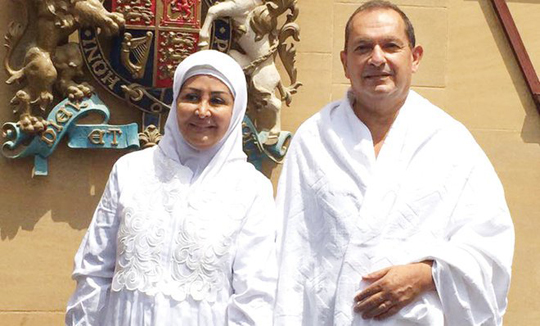
Mina, Sep 15: Among the 19,000 British pilgrims performing Haj this year was British Ambassador to Saudi Arabia Simon Paul Collis and his wife Huda Mujarkech.

simon1

It was known to some diplomats and journalists that he had embraced Islam but there had been no official word.

The confirmation came on last week in the form of a tweet from Saudi writer and academic Fawziah Al-Bakr (@fawziah1).

She posted two photos of Ambassador Collis and his wife in which he was wearing ihram.

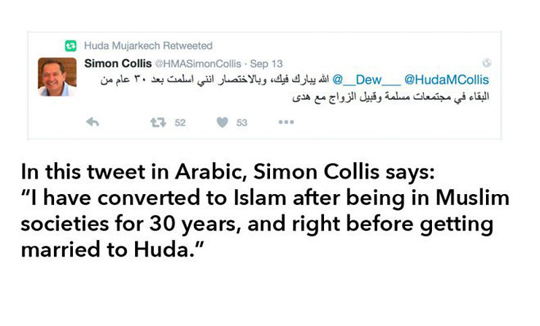
The ambassador replied to the post by thanking Al-Bakr via his official Twitter handle (@HMASimonCollis). The ambassador’s wife (@HudaMCollis) retweeted Al-Bakr’s post.

collistweet

Though Collis refused media requests for interviews on Wednesday, he said: “I have converted to Islam after being in Muslim societies for 30 years, and right before getting married to Huda.”

Collis has served as British ambassador to Saudi Arabia since January last year when Sir John Jenkins retired from the diplomatic service. The photos went viral on Twitter, Facebook, WhatsApp and Instagram, sending social media into overdrive.

Among the first who congratulated the ambassador and his wife was Princess Basmah bint Saud (@PrincessBasmah).

“Special congratulations to the ambassador and his wife,” wrote Princess Basmah.

“Thank you, Princess Basmah,” replied the ambassador.

British pilgrims were pleasantly surprised by the news.

“I would like to congratulate the ambassador on the historic occasion of his completion of Haj,” said Rashid Mogradia, CEO of the Council of British Hajis (CBHUK). “He is one of many thousands of British pilgrims to perform the journey of faith and we look forward to him sharing his experience and inspiring us all,” Mogradia added.

At a time when there is so much adverse publicity against Islam and Muslims, especially in the West, the ambassador’s embrace of Islam was seen by the faithful as a vindication of the religion’s universal appeal.

Collis speaks fluent Arabic. He joined the British Foreign and Commonwealth Office (FCO) in 1978 and, after studying Arabic, has served mainly in the Arab world.

A father of five children, his first posting was to Bahrain as second secretary (1981-1984). He served as British ambassador to Iraq (2012-2014), Syria (2007-2012) and Qatar (2005-2007). He was the British consul-general in Dubai (2000-2004) and in Basra (2004-2005). He also served in New Delhi as first secretary from 1991 to 1994.

Comments

Mohammed SS
 - 
Sunday, 18 Sep 2016

Allah made Heven for Muslims who believe him and Hell for non believers.
Allah hu Akbar

Ahmed
 - 
Thursday, 15 Sep 2016

NON MUSLIMs should PONDER on WHY many people are REVERTInG to ISLAM...
QURAN has the answer to YOUR QUESTION... despite there is lot of hate propaganda in the controlled MEDIA....
QURAN speaks the reality of Such MEDIA and those who control the MEDIA ... PLease read the QURAN ..
U can also check thequranproject online... which is well explained for the Non muslims... & FOR non arab muslims.

Please look for the TRUTH and come out of DARKNESS... ALLAH guides those who search for God... honestly.

Shaima umar farooq
 - 
Thursday, 15 Sep 2016

Allahu Akbar. Congragulations for accepting islam. May allah guide u both to right path. Ameen.

May Allah accept ur haj.

Ameen yarabbal alameen....

Add new comment

  • Coastaldigest.com reserves the right to delete or block any comments.
  • Coastaldigset.com is not responsible for its readers’ comments.
  • Comments that are abusive, incendiary or irrelevant are strictly prohibited.
  • Please use a genuine email ID and provide your name to avoid reject.
News Network
April 5,2020

Beirut, Apr 5: The novel coronavirus has put global trade on hold, placed half of the world population in confinement and has the potential to topple governments and reshape diplomatic relations.

The United Nations has appealed for ceasefires in all the major conflicts rocking the planet, with its chief Antonio Guterres on Friday warning "the worst is yet to come". But it remains unclear what the pandemic's impact will be on the multiple wars roiling the Middle East.

Here is an overview of the impact so far on the conflicts in Syria, Yemen, Libya and Iraq:

The COVID-19 outbreak turned into a pandemic just as a ceasefire reached by the two main foreign power brokers in Syria's nine-year-old war -- Russia and Turkey -- was taking effect.

The three million people living in the ceasefire zone, in the country's northwestern region of Idlib, had little hope the deal would hold.

Yet fears the coronavirus could spread like wildfire across the devastated country appear to have given the truce an extended lease of life.

According to the Syrian Observatory for Human Rights, the month of March saw the lowest civilian death toll since the conflict started in 2011, with 103 deaths.

The ability of the multiple administrations in Syria -- the Damascus government, the autonomous Kurdish administration in the northeast and the jihadist-led alliance that runs Idlib -- to manage the coronavirus threat is key to their credibility.

"This epidemic is a way for Damascus to show that the Syrian state is efficient and all territories should be returned under its governance," analyst Fabrice Balanche said.

However the pandemic and the global mobilisation it requires could precipitate the departure of US-led troops from Syria and neighbouring Iraq.

This in turn could create a vacuum in which the Islamic State jihadist group, still reeling from the demise of its "caliphate" a year ago, could seek to step up its attacks.

The Yemeni government and the Huthi rebels initially responded positively to the UN appeal for a ceasefire, as did neighbouring Saudi Arabia, which leads a military coalition in support of the government.

That rare glimmer of hope in the five-year-old conflict was short-lived however and last week Saudi air defences intercepted ballistic missiles over Riyadh and a border city fired by the Iran-backed rebels.

The Saudi-led coalition retaliated by striking Huthi targets in the rebel-held capital Sanaa on Monday.

Talks have repeatedly faltered but the UN envoy Martin Griffiths is holding daily consultations in a bid to clinch a nationwide ceasefire.

More flare-ups in Yemen could compound a humanitarian crisis often described as the worst in the world and invite a coronavirus outbreak of catastrophic proportions.

In a country where the health infrastructure has collapsed, where water is a rare commodity and where 24 million people require humanitarian assistance, the population fears being wiped out if a ceasefire doesn't allow for adequate aid.

"People will end up dying on the streets, bodies will be rotting in the open," said Mohammed Omar, a taxi driver in the Red Sea port city of Hodeida.

Much like Yemen, the main protagonists in the Libyan conflict initially welcomed the UN ceasefire call but swiftly resumed hostilities.

Fierce fighting has rocked the south of the capital Tripoli in recent days, suggesting the risk of a major coronavirus outbreak is not enough to make guns fall silent.

Turkey has recently played a key role in the conflict, throwing its weight behind the UN-recognised Government of National Accord.

Fabrice Balanche predicted that accelerated Western disengagement from Middle East conflicts could limit Turkish support to the GNA.

That could eventually favour forces loyal to eastern-based strongman Khalifa Haftar, who launched an assault on Tripoli one year ago and has the backing of Russia, Egypt and the United Arab Emirates.

Western countries have been hit hardest by the pandemic, which could prompt them to divert both military resources and peace-brokering capacity from foreign conflicts.

A report by the International Crisis Group said European officials had reported that efforts to secure a ceasefire in Libya were no longer receiving high-level attention due to the pandemic.

Iraq is no longer gripped by fully-fledged conflict but it remains vulnerable to an IS resurgence in some regions and its two main foreign backers are at each other's throats.

Iran and the United States are two of the countries most affected by the coronavirus but there has been no sign of any let-up in their battle for influence that has largely played out on Iraqi soil.

With most non-US troops in the coalition now gone and some bases evacuated, American personnel are now regrouped in a handful of locations in Iraq.

Washington has deployed Patriot air defence missiles, prompting fears of a fresh escalation with Tehran, whose proxies it blames for a spate of rocket attacks on bases housing US troops.


Comments

Add new comment

  • Coastaldigest.com reserves the right to delete or block any comments.
  • Coastaldigset.com is not responsible for its readers’ comments.
  • Comments that are abusive, incendiary or irrelevant are strictly prohibited.
  • Please use a genuine email ID and provide your name to avoid reject.
News Network
May 11,2020

May 11: Saudi Arabia will triple its value-added tax rate and suspend a cost of living allowance for state workers, it said on Monday, seeking to shield finances hit by low oil prices and a slump in demand for its lifeline export worsened by the new coronavirus.

Historic oil output cuts agreed by Riyadh and other major producers have given only limited support to prices after they sank on oversupply caused by a war for petroleum market share between the kingdom and its fellow oil titan Russia.

Saudi Arabia, the world's largest oil exporter, is also being hit hard by measures to fight the new coronavirus, which are likely to curb the pace and scale of economic reforms launched by Crown Prince Mohammed bin Salman.

"The cost of living allowance will be suspended as of June 1, and the value added tax will be increased to 15% from 5% as of July 1," Finance Minister Mohammed al-Jadaan said in a statement reported by the state news agency. "These measures are painful but necessary to maintain financial and economic stability over the medium to long term...and to overcome the unprecedented coronavirus crisis with the least damage possible."

The austerity measures come after the kingdom posted a $9 billion budget deficit in the first quarter.

The minister said non-oil revenues were affected by the suspension and decline in economic activity, while spending had risen due to unplanned strains on the healthcare sector and the initiatives taken to support the economy.

"All these challenges have cut state revenues, pressured public finances to a level that is hard to deal with going forward without affecting the overall economy in the medium to long term, which requires more spending cuts and measures to support non-oil revenues stability," he added.

The government has cancelled and put on hold some operating and capital expenditures for some government agencies, and cut allocations for some reform initiatives and projects worth a total 100 billion riyals ($26.6 billion), the statement said.

Central bank foreign reserves fell in March at their fastest rate in at least 20 years and to their lowest since 2011, while oil revenues in the first three months of the year fell 24% from a year earlier to $34 billion, pulling total revenues down 22%.

"The reforms are positive from a fiscal side as greater adjustment is essential. However, the tripling of VAT is unlikely to help that much in 2020 revenue wise with the expected fall in consumption," said Monica Malik, chief economist at Abu Dhabi Commercial Bank.

She said she kept unchanged her deficit forecast of 16.3% of GDP for this year, which already factors in a greater than previously announced spending cut.

About 1.5 million Saudis are employed in the government sector, according to official figures released in December.

In 2018, Saudi Arabia's King Salman ordered a monthly payment of 1,000 riyals ($267) to every state employee to compensate them for the rising living costs after the government hiked domestic gas prices and introduced value-added tax.

DIFFICULT TIMES

A committee has been formed to study all financial benefits paid to public sector employees and contractors, and will submit recommendations within 30 days, the statement said.

In late 2015, when oil prices fell from record highs, the kingdom slashed lavish bonuses, overtime payments and other benefits once considered routine perks in the public sector.

In a country without elections and with political legitimacy resting partly on distribution of oil revenue, the ability of citizens to adapt to such reforms is crucial for stability.

"Tripling the VAT will test the limits of the balance between revenues and consumption as the economy dives into a deep recession. The move will impact consumption and could also lower the expected revenues," said John Sfakianakis, a Gulf expert at the University of Cambridge.

"These are pro-austerity and pro-revenue moves rather than pro-growth ones," he said.

Hasnain Malik, head of equity strategy at Tellimer, said the VAT rise could bring about $24-$26.5 billion in additional non-oil fiscal revenue. The rise would hit consumer spending further but was a needed step towards fiscal sustainability, he said.

Comments

Add new comment

  • Coastaldigest.com reserves the right to delete or block any comments.
  • Coastaldigset.com is not responsible for its readers’ comments.
  • Comments that are abusive, incendiary or irrelevant are strictly prohibited.
  • Please use a genuine email ID and provide your name to avoid reject.
News Network
April 27,2020

Riyadh, Apr 27: The government of Saudi Arabia has signed a SR995 million (approx. Dh972m) contract with China to provide Covid-19 tests for nine million people in the Kingdom.

The Saudi Press Agency, SPA, reported that the decision came "as a result of a phone call made today (Sunday) between the Custodian of the Two Holy Mosques King Salman bin Abdulaziz Al Saud and Chinese President Xi Jinping."

The contract includes providing necessary equipment and supplies, making available of 500 Chinese specialists and technicians who are specialised in performing tests, establishing six large regional laboratories throughout the Kingdom; including a mobile laboratory with a capacity of performing 10,000 tests per day. Saudi cadres will also be trained to conduct daily tests and comprehensive field tests, under the new agreement

The contract was co-signed by the National Unified Procurement Company and Chinese company Huo-yan Laboratories by Dr. Abdullah Al Rabeeah, Advisor at the Royal Court, on behalf of the Government of Saudi Arabia, and Chinese Ambassador to the Kingdom Chen Weiqing, as a representative of the Chinese Government.

The contract is one of the largest contracts that will provide diagnostic tests for the novel Coronavirus.

Tests were also purchased from several other companies from the United States, Switzerland and South Korea, bringing the number of available tests to 14.5 million, covering around 40 percent of Saudi Arabia's population, SPA added.

Comments

Add new comment

  • Coastaldigest.com reserves the right to delete or block any comments.
  • Coastaldigset.com is not responsible for its readers’ comments.
  • Comments that are abusive, incendiary or irrelevant are strictly prohibited.
  • Please use a genuine email ID and provide your name to avoid reject.