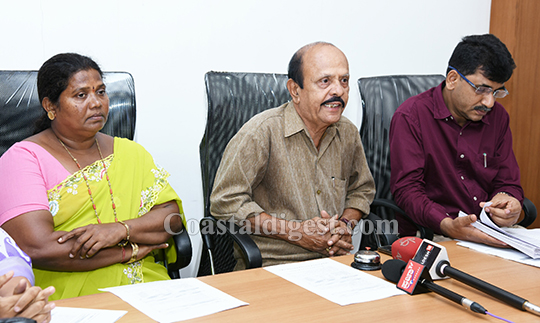
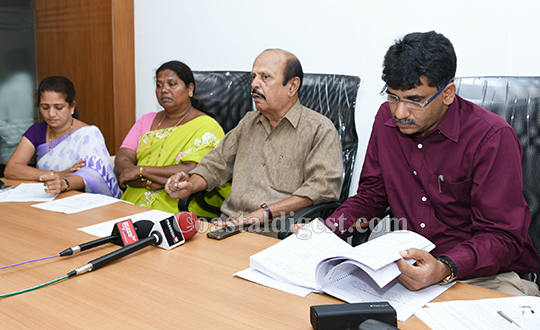
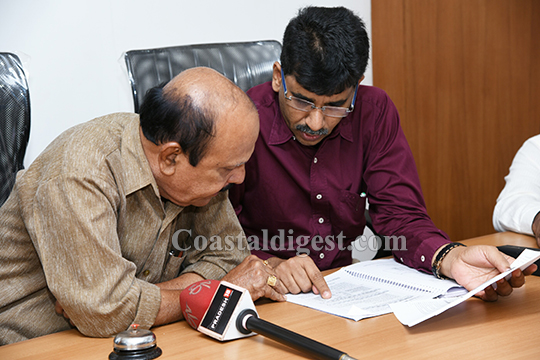
Mangaluru city gears up for smart growth, Rs 2K-cr investment envisaged

[email protected] (CD Network)
September 21, 2016

Mangaluru, Sep 21: Retrofitting downtown area of the city, re-development of old-port and fisheries harbour and development of a solar farm on an island facing the old port are some of the highlights of the smart city project proposal of the Mangaluru City Corporation, which envisaged a total investment of Rs. 2,000 crore in the next five years.

mayot 1

Welcoming the move of the Union government to include Mangaluru in its third Smart City list, the City Corporation has pledged to take necessary steps to implement its proposed projects expecting a speedy growth in economic activities in the city.

K Harinath, Mayor of MCC, said that the civic body would give priority to health, cleanliness and implementing the ban on plastic effectively, he said adding that the MCC has already renovated two to three public toilets, laying emphasis on the cleanliness of the city.

"An effective plan prepared by the City Corporation is one of the main reasons for the selection of Mangaluru for the smart city project. Along with the participation of the general public to prepare a plan, support of District in-Charge Minister, MLAs, and councillors is appreciable. We will start implementing various projects from now to make Mangaluru a model city," he explained.

Mohammed Nazir, Commissioner of MCC, said that now the government would constitute a special purpose vehicle (SPV), which is an entity or a company floated for implementing a specific task or project, for implementing the smart city project. It would be headed by an Indian Administrative Service officer.

He said that the detailed project report on how to implement the projects mooted under the smart city project would be prepared by the special purpose vehicle.

Joint Commissioner Gokuldas Nayak said, "The smart city project submitted by the MCC under the first list was long-term proposals worth Rs 20,000 crore to be implemented in nine phases over a period of 20 years. As it was not immediately useful for the public, Mangaluru could not bag the smart city project in the first list."

Area-based plan

The area based proposal submitted by the MCC include development of central business area - 100 acre, Hampankatta Junction - 27 acre, fisheries harbour redevelopment - 22 acre, Old Port redevelopment - 10 acre, waterfront and marine development - 25 acre, mixed use zone for IT service, offices, small scale industries, hospitality and leisure, alongside limited capacity factory functioning by adaptive reuse of tile factories - 42 acres, public connector streets leading to waterfront development as commercial and retail zone - 47 acre and solar farm on island facing Bunder - 20 acre.

mayot 2

mayot 3

Comments

Satyameva jayate
 - 
Thursday, 22 Sep 2016

When will the drainage flowing canals in the city will be cleaned and covered....still 50 % of Mangalore sinks in rain....roads are still incomplete and started feeling like hill wonder la ride sitting in vehicle..at least some main areas to be clear....

SK
 - 
Wednesday, 21 Sep 2016

If the rowdy goondas like Senas are ruling the roads of Mangalore, then the investments will be well secured .... Like what happened in Bengaluru in cauvery issue ..... It will be like doing homa on water....

Add new comment

  • Coastaldigest.com reserves the right to delete or block any comments.
  • Coastaldigset.com is not responsible for its readers’ comments.
  • Comments that are abusive, incendiary or irrelevant are strictly prohibited.
  • Please use a genuine email ID and provide your name to avoid reject.
News Network
March 8,2020

Bengaluru, Mar 8: Lieutenant General Milind Hemant Thakur, Director-General of Supply and Transport Corps of the Indian Army, unveiled the renovated Animal Memorial at Agram Grounds in ASC Centre and College here on Saturday.

The animal memorial signifies the contributions of mules and horses of the Indian Army. These animals belonging to the Army Service Corps, who have rendered their services relentlessly during the war in the Himalayas, often paying the highest price of sacrificing their lives in the line of duty have been chronicled in the Memorial.

To ensure that these hoof prints do not get obliterated, on approval by the Government of India, their saga was brought to life in the form of a sculptured monument in the Equestrian Training Area of the ASC Centre and College.

This animal transport memorial has now been extended by constructing two walls supported by Roman pillars on either side.

These walls highlight the role played by the animals in the Indian Army since the British Raj. It gives details of 637 gallantry awards won by the brave muleteers, 49 battle casualties since independence, 14 gallantry awards to mules since independence and 05 military recognitions bestowed by the Chief of the Army Staff and other Army Commanders on AT units, who have been relied upon heavily to fill an important niche in the logistics networks of the Indian Army.

Gen Thakur also declared that 26 September each year has been nominated as the AT Remembrance Day as it was on this day in 1914, that 9th mule Corps, as part of the Indian Expeditionary Force, landed at Marseilles in France, to a most hearty and enthusiastic welcome by the French to support the British and allied armies in World War One.

Comments

Add new comment

  • Coastaldigest.com reserves the right to delete or block any comments.
  • Coastaldigset.com is not responsible for its readers’ comments.
  • Comments that are abusive, incendiary or irrelevant are strictly prohibited.
  • Please use a genuine email ID and provide your name to avoid reject.
Press Release
January 2,2020

Mangaluru, Jan 2: Shwetha Rasquinha, Assistant Professor and Head of the Department of Social Work, St Aloysius College, Mangaluru, has been awarded Doctor of Philosophy (PhD) degree by the Mangalore University for her thesis titled “Effectiveness of Social work intervention on caretakers of cancer patients- A social work study in Mangalore”.

She did her studies under the guidance of Dr Rameela Shekhar, Professor (Rtd), School of Social work, Roshni Nilaya, Mangaluru.

Ms Shwetha Rasquinha hails from Vittal, D/o Vincent Rasquinha and Late Regina Rasquinha, and is the second person to complete doctoral studies from the Vittal Parish.

Her colleagues and well-wishers have congratulated her for her highest achievement in academics and successful completion of quality research.

Comments

Charles Menezes
 - 
Friday, 3 Jan 2020

Hearty congratulations for your achievements. God bless your mission

Add new comment

  • Coastaldigest.com reserves the right to delete or block any comments.
  • Coastaldigset.com is not responsible for its readers’ comments.
  • Comments that are abusive, incendiary or irrelevant are strictly prohibited.
  • Please use a genuine email ID and provide your name to avoid reject.
Ram Puniyani
January 14,2020

In the beginning of January 2020 two very disturbing events were reported from Pakistan. One was the attack on Nankana Sahib, the holy shrine where Sant Guru Nanak was born. While one report said that the place has been desecrated, the other stated that it was a fight between two Muslim groups. Prime Minister of Pakistan Imran Khan condemned the incident and the main accused Imran Chisti was arrested. The matter related to abduction and conversion of a Sikh girl Jagjit Kaur, daughter of Pathi (One who reads Holy Guru Granth Sahib in Gurudwara) of the Gurudwara. In another incident one Sikh youth Ravinder Singh, who was out on shopping for his marriage, was shot dead in Peshawar.

While these condemnable attacks took place on the Sikh minority in Pakistan, BJP was quick enough to jump to state that it is events like this which justify the Citizenship Amendment Act (CAA). Incidentally CAA is the Act which is discriminatory and relates to citizenship with Religion, which is not as per the norms of Indian constitution. There are constant debates and propaganda that population of Hindus has come down drastically in Pakistan and Bangla Desh. Amit Shah, the Home minister stated that in Pakistan the population of Hindus has come down from 23% at the time of partition to 3.7% at present. And in Bangla Desh it has come down from 22% to present 8%.

While not denying the fact that the religious minorities are getting a rough deal in both these countries, the figures which are presented are totally off the mark. These figures don’t take into consideration the painful migrations, which took place at the time of partition and formation of Bangla Desh later. Pakistan census figures tell a different tale. Their first census was held in 1951. As per this census the overall percentage of Non Muslim in Pakistan (East and West together) was 14.2%, of this in West Pakistan (Now Pakistan) it was 3.44 and in Eat Pakistan it was 23.2. In the census held in Pakistan 1998 it became 3.72%. As far as Bangla Desh is concerned the share of Non Muslims has gone down from 23.2 (1951) to 9.6% in 2011.

The largest minority of Pakistan is Ahmadis, (https://minorityrights.org/country/pakistan/) who are close to 4 Million and are not recognised as Muslims in Pakistan. In Bangla Desh the major migrations of Hindus from Bangla Desh took place in the backdrop of Pakistan army’s atrocities in the then East Pakistan.

As far as UN data on refugees in India it went up by 17% between 2016-2019 and largest numbers were from Tibet and Sri Lanka.  (https://www.un.org/en/development/desa/population/migration/publication…)

The state of minorities is in a way the index of strength of democracy. Most South Asian Countries have not been able to sustain democratic values properly. In Pakistan, the Republic began with Jinnah’s classic speech where secularism was to be central credo of Pakistan. This 11th August speech was in a way what the state policy should be, as per which people of all faiths are free to practice their religion. Soon enough the logic of ‘Two Nation theory” and formation of Pakistan, a separate state for Muslim took over. Army stepped in and dictatorship was to reign there intermittently. Democratic elements were suppressed and the worst came when Zia Ul Haq Islamized the state in collusion with Maulanas. The army was already a strong presence in Pakistan. The popular formulation for Pakistan was that it is ruled by three A’s, Army, America and Allah (Mullah).

Bangla Desh had a different trajectory. Its very formation was a nail in the coffin of ‘two nation theory’; that religion can be the basis of a state. Bangla Desh did begin as a secular republic but communal forces and secular forces kept struggling for their dominance and in 1988 it also became Islamic republic. At another level Myanmar, in the grip of military dictatorship, with democratic elements trying to retain their presence is also seeing a hard battle. Democracy or not, the army and Sanghas (Buddhist Sang has) are strong, in Myanmar as well. The most visible result is persecution of Rohingya Muslims.

Similar phenomenon is dominating in Sri Lanka also where Budhhist Sanghas and army have strong say in the political affairs, irrespective of which Government is ruling. Muslim and Christian minorities are a big victim there, while Tamils (Hindus, Christians etc.) suffered the biggest damage as ethnic and religious minorities. India had the best prospect of democracy, pluralism and secularism flourishing here. The secular constitution, the outcome of India’s freedom struggle, the leadership of Gandhi and Nehru did ensure the rooting of democracy and secularism in a strong way.

India so far had best democratic credentials amongst all the south Asian countries. Despite that though the population of minorities rose mainly due to poverty and illiteracy, their overall marginalisation was order of the day, it went on worsening with the rise of communal forces, with communal forces resorting to identity issues, and indulging in propaganda against minorities.

While other South Asian countries should had followed India to focus more on infrastructure and political culture of liberalism, today India is following the footsteps of Pakistan. The retrograde march of India is most visible in the issues which have dominated the political space during last few years. Issues like Ram Temple, Ghar Wapasi, Love Jihad, Beef-Cow are now finding their peak in CAA.

India’s reversal towards a polity with religion’s identity dominating the political scene was nicely presented by the late Pakistani poetess Fahmida Riaz in her poem, Tum bhi Hum Jaise Nikle (You also turned out to be like us). While trying to resist communal forces has been an arduous task, it is becoming more difficult by the day. This phenomenon has been variously called, Fundamentalism, Communalism or religious nationalism among others. Surely it has nothing to do with the religion as practiced by the great Saint and Sufi traditions of India; it resorts mainly to political mobilization by using religion as a tool.


Comments

Ashi
 - 
Tuesday, 14 Jan 2020

If Malaysia implement similar NRC/CAA, India and China are the loser.

Add new comment

  • Coastaldigest.com reserves the right to delete or block any comments.
  • Coastaldigset.com is not responsible for its readers’ comments.
  • Comments that are abusive, incendiary or irrelevant are strictly prohibited.
  • Please use a genuine email ID and provide your name to avoid reject.