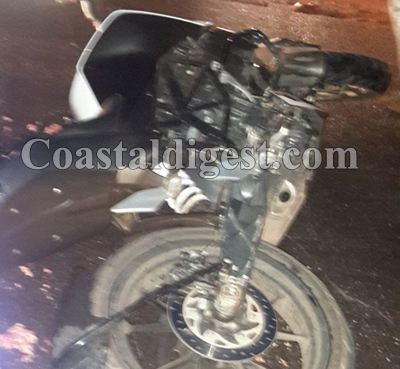
Mangaluru: Tipper kills Engg student; body lies on road for half an hour

[email protected] (CD Network | Chakravarthi)
September 21, 2016

Mangaluru, Sep 21: An engineering student died after his motorbike collided with a tipper-lorry in Naguri on Mangaluru-Bengaluru National Highway on Wednesday.

riyan

The deceased has been identified as Ahmed Raiyan (19), son of Riyaz Chenna, a native of Bhatkal. He was a first year Bachelor of Engineering student of Sahyadri College of Engineering, Adyar Mangaluru.

According to police, Raiyan was on his way to his hostel when the accident occurred. When the boy reached Nagori, a speeding tipper rammed into his motorbike

He was thrown onto the road and died on the spot. The driver of the tipper fled from the scene immediately.

For more than half an hour the body of Riyan was lying on the road as passersby and local residents decided to stay away.

For more than half an hour of the death of Ahmed Riyan, no efforts were made by anyone to shift the dead body from the road.

Police reached the spot after half an hour and shifted the body for Government Wenlock Hospital for post-mortem. When the news began to spread members of Bhatkal Hostel, Mangaluru and Bhatkal Muslim Jamaath Mangaluru rushed to the hospital.

The body was later handed over to family members. The final rites will be held in Bhatkal.

naguriacc 1

naguriacc 2

naguriacc 3

Comments

Satyameva jayate
 - 
Thursday, 22 Sep 2016

rip......
His life and more other daily must be lesson for parents of reckless motorists who feel proud of their kids showing circus in streets and putting others lives in danger too...young blood should warm up for their future and their parents dreams....not to kill themselves for cheap show off....may God save us all from such incidents..

Mr Frank
 - 
Thursday, 22 Sep 2016

All parents must take care and advise their boys before gifting them two wheeler.May ALmighty bless parents to bear loss.

Add new comment

  • Coastaldigest.com reserves the right to delete or block any comments.
  • Coastaldigset.com is not responsible for its readers’ comments.
  • Comments that are abusive, incendiary or irrelevant are strictly prohibited.
  • Please use a genuine email ID and provide your name to avoid reject.
News Network
January 5,2020

Mysuru, Jan 5: The ongoing pilot project on documentation of all unprotected monuments in Mysuru taluk has yielded significant results with over 100 sculptures recovered from the rural hinterland.

Launched by the Karnataka Department of Archaeology, Museums and Heritage, the project will help map and document the number of monuments in the Taluk. Based on their importance, they will be added to the protected list.

Sources in the Archaeology department said so far the team has completed mapping of monuments in two Hoblis--Varuna and Jayapura.

Comments

Add new comment

  • Coastaldigest.com reserves the right to delete or block any comments.
  • Coastaldigset.com is not responsible for its readers’ comments.
  • Comments that are abusive, incendiary or irrelevant are strictly prohibited.
  • Please use a genuine email ID and provide your name to avoid reject.
Agencies
April 19,2020

French Nobel prize winning scientist Luc Montagnier has sparked a fresh controversy by claiming that the SARS-CoV-2 virus came from a lab, and is the result of an attempt to manufacture a vaccine against the AIDS virus.

In an interview given to French CNews channel and during a podcast by Pourquoi Docteur, professor Montagnier who co-discovered HIV (Human Immunodeficiency Virus) claimed the presence of elements of HIV in the genome of the coronavirus and even elements of the "germ of malaria" are highly suspect, according to a report in Asia Times.

"The Wuhan city laboratory has specialized in these coronaviruses since the early 2000s. They have expertise in this area," he was quoted as saying.

The theory that Covid-19 virus originated in the lab is making rounds for quite some time.

US President Donald Trump last week acknowledged Fox News report that the novel coronavirus may have been accidentally leaked by an intern working at the Wuhan Institute of Virology in China.

The Fox News, in an exclusive report, based on unnamed sources has claimed that though the virus is a naturally occurring strain among bats and not a bioweapon, but it was being studied in Wuhan laboratory.

The initial transmission of the virus was bat-to-human, the news channel said, adding that the "patient zero" worked at the laboratory. The lab employee was accidentally infected before spreading the disease among the common people outside the lab in Wuhan city.

Professor Montagnier was awarded the 2008 Nobel Prize in Medicine for the identification of AIDS virus, with his colleague professor Franeoise Barre-Sinoussi.

His fresh claim on coronavirus, however, received criticism from scientists, including his colleagues.

"Just in case you don't know. Dr Montagnier has been rolling downhill incredibly fast in the last few years. From baselessly defending homeopathy to becoming an antivaxxer. Whatever he says, just don't believe him," tweeted Juan Carlos Gabaldon.

As per a recent Washington Post, two years ago, the US embassy officials in China raised concerns about the insufficient biosafety at the Chinese government's Wuhan Institute of Virology where deadly viruses and infectious diseases are studied.

Though the institute, located quite close to the Wuhan wet market, is China's first biosafety level IV lab, the US state department had warned in 2018 about "serious shortage of appropriately trained technicians and investigators needed to safely operate this high-containment laboratory".

Comments

Add new comment

  • Coastaldigest.com reserves the right to delete or block any comments.
  • Coastaldigset.com is not responsible for its readers’ comments.
  • Comments that are abusive, incendiary or irrelevant are strictly prohibited.
  • Please use a genuine email ID and provide your name to avoid reject.
News Network
April 2,2020

The current physical distancing guidelines provided by the World Health Organisation (WHO) and by the US Centers for Disease Control and Prevention (CDC) may not be adequate to curb the coronavirus spread, according to a research which says the gas cloud from a cough or sneeze may help virus particles travel up to 8 metres. The research, published in the Journal of the American Medical Association, noted that the the current guidelines issued by the WHO and CDC are based on outdated models from the 1930s of how gas clouds from a cough, sneeze, or exhalation spread.

Study author, MIT associate professor Lydia Bourouiba, warned that droplets of all sizes can travel 23 to 27 feet, or 7-8 metres, carrying the pathogen.

According to Bourouiba, the current guidelines are based on "arbitrary" assumptions of droplet size, "overly simplified", and "may limit the effectiveness of the proposed interventions" against the deadly pandemic.

 She explained that the old guidelines assume droplets to be one of two categories, small or large, taking short-range semi-ballistic trajectories when a person exhales, coughs, or sneezes.

However based on more recent discoveries, the MIT scientist said, sneezes and coughs are made of a puff cloud that carries ambient air, transporting within it clusters of droplets of a wide range of sizes.

Bourouiba warned that this puff cloud, with ambient air entrapped in it, can offer the droplets moisture and warmth that can prevent it from evaporation in the outer environment.

"The locally moist and warm atmosphere within the turbulent gas cloud allows the contained droplets to evade evaporation for much longer than occurs with isolated droplets," she said.

"Under these conditions, the lifetime of a droplet could be considerably extended by a factor of up to 1000, from a fraction of a second to minutes," the researcher explained in the study.

The MIT scientist, who has researched the dynamics of coughs and sneezes for years, added that these droplets settle along the trajectory of a cough or sneeze contaminating surfaces, with their residues staying suspended in the air for hours.

"Even when maximum containment policies were enforced, the rapid international spread of COVID-19 suggests that using arbitrary droplet size cutoffs may not accurately reflect what actually occurs with respiratory emissions, possibly contributing to the ineffectiveness of some procedures used to limit the spread of respiratory disease," Bourouiba wrote in the study


Comments

Add new comment

  • Coastaldigest.com reserves the right to delete or block any comments.
  • Coastaldigset.com is not responsible for its readers’ comments.
  • Comments that are abusive, incendiary or irrelevant are strictly prohibited.
  • Please use a genuine email ID and provide your name to avoid reject.