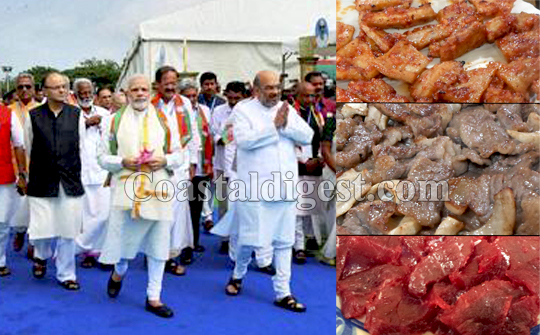
Trolls invite BJP leaders to try delicacies of beef-loving Kerala

September 26, 2016

Thiruvananthapuram, Sep 26: The BJP may be busy brainstorming on its strategy in the picturesque town of Kozhikode but a string of social media pages are having a field day baiting the saffron party leaders to try out the region's most famous culinary export: The beef biryani.

modibeef

A page with the hashtag #ShahtoRahmath' invites BJP leaders to Hotel Rahmath known for red meat dishes with a combo offer, a beef biryani with a sulaimani (lemon-blended black tea). “Amit Shah and Modi would love Gomata but that would dry up after eating beef biryani from Rahmath,” said one of the posts on the page.

Another reminded delegates not to forget to take a parcel of “Kozhikodan halwa” before leaving. Interestingly, non-vegetarian halwa is also available in select shops in the coast city where the Portuguese explorer Vasco da Gama landed first in 1498 in search of spices.

The trigger for the sarcasm: The BJP has repeatedly pitched in for cow protection statutes nationwide and many states ruled by the party have banned cow slaughter. The party is also accused by opposition leaders to be anti-beef consumption.

CPI(M) youth wing leader Mohamad Riyaz in his post said delegates can have their choicest meal fearlessly as no one would look or check their plates here. He also took a jibe at Modi, saying he could find such things in Kerala only, not in Somalia. During the assembly election campaign, the PM had courted trouble by equating Kerala with Somalia, citing the infant mortality rate of children in the tribal hamlets of Attapadi.

This isn't the first time other parties have tried to use beef to push the BJP on the back-foot. After Uttar Pradesh man Mohammad Ikhlaq was lynched last year for allegedly slaughtering a cow, many Left outfits organised beef festivals throughout the state. Embarrassed BJP state leaders had to come out saying they were against a beef ban in Kerala.

In Kerala, beef accounts for about 40% of the total meat consumed. Not only Muslim and Christians but also a majority of Hindus relish dishes made out of cow meat.

Comments

TRUE INDIAN
 - 
Wednesday, 28 Sep 2016

Bopanna ksa

And also, Allah commanded not to eat animals. Which eats non veg.

Thats why eating tiger, lion etc is banned

TRUE INDIAN
 - 
Wednesday, 28 Sep 2016

Bopanna ksa

Good question. But here is the answer

1. So that He(Allah) may test as to which of us(Humans) follow the command.

Eg: Allah commanded Adam not to consume the fruit in paradise. Just to test if Adam obeys the command.

Some creation are created, just as a test for mankind.

2. Pigs eat waste products, and their own shit, be it garbage/excreta/etc, so they eat humans' byproducts and keep drains clean. They are also used in land cleaning in many places.

Allah also created dinosaurs.

Bopanna
 - 
Tuesday, 27 Sep 2016

If allah knows everything why did he create the pig ?

TRUE INDIAN
 - 
Monday, 26 Sep 2016

@Alfred piggy

WHAT IS THE USE OF GOING CHURCH PRAYERS, WHEN U DONT FOLLOW UR OWN BIBLE.

TRUE INDIAN
 - 
Monday, 26 Sep 2016

@Alfred Piggy.

U r acting like pig, the one who eat pig, they will act as pig. Pig also eat shit of his own.

The one wont remain muslim, if he doesent believe in Jesus peace be upon him, i love jesus.

Jesus says many thin

Alfred Dmello
 - 
Monday, 26 Sep 2016

@Porki calling himself indian, You don't need book to lead a life. Eating is personal choice, no one can preach on that....Better read something useful than crap. why not join church prayers....better community life than terror mongering

Alfred Dmello
 - 
Monday, 26 Sep 2016

Sooraj, you talk like Mullah....chaddi, .... You are proving my point. Book teaching only to oppose...better join Sunday prayers in a church. It will enlighten you.

TRUE INDIAN
 - 
Monday, 26 Sep 2016

@Alfred

Suvvar is the only animal on earth, that eats his own shit.

Alfred Dmello
 - 
Monday, 26 Sep 2016

Sooraj,,,byri...pork eating and talking quran?

Alfred Dmello
 - 
Monday, 26 Sep 2016

Sooraj, when did you convert. No guts to put real name but talk like pure mullah....eat pork

Alfred Dmello
 - 
Monday, 26 Sep 2016

Rikaz, how about pork ? Why don't you offer it your god? Pork is very tasty...give it to you kids.

curious
 - 
Monday, 26 Sep 2016

cheap article,crap journalism.

Prakash Shetty
 - 
Monday, 26 Sep 2016

They don't say they don't eat Beef, they are against killing of Gomatha not her meet anyway. election nearing they have to take U-turn kyon ki mera bharat Mahan hai.........

Rikaz
 - 
Monday, 26 Sep 2016

Beef biriyani....very tasty....

Add new comment

  • Coastaldigest.com reserves the right to delete or block any comments.
  • Coastaldigset.com is not responsible for its readers’ comments.
  • Comments that are abusive, incendiary or irrelevant are strictly prohibited.
  • Please use a genuine email ID and provide your name to avoid reject.
News Network
June 1,2020

Bengaluru, Jun 1: Karnataka's Department of Health and Family Welfare on Sunday released the protocol for inter-state travellers to the State during phased reopening --#Unlock1.

Five points protocol in this regard are: 1. Mandatory Self- Registration on Seva Sindhu Portal by all travellers before entering Karnataka:

a. Name, Address and Mobile Number to be provided

b. No approval required

c. Use of same Mobile number for multiple registrations not allowed except in the case of a family.

d. Business visitors to give details (name, mobile and address of persons in Karnataka they intend to meet).

e. Transit travellers to provide an address in destination state and indicate exit check post from Karnataka.

2. Health Screening of all incoming persons at entry points.

a. Border Check-posts, Airports, Railway stations and Bus stand

b. Home Quarantine hand-stamping on hand for 14-days period as per quarantine norms

3. Quarantine norms are based on three parameters

I. Symptomatic on arrival from any State: 7 days of Hospital isolation at COVID Care Centre(CCC)/Dedicated COVID Health Centre (DCHC) followed by 7 days of home quarantine or manage as per symptoms.

II. Test immediately on arrival: If positive, shift to Dedicated COVID-19 Hospital (DCH). If negative, no further test required

III. Asymptomatic on arrival:

* For persons coming from Maharashtra

a) 7 days of institutional quarantine followed by 7 days of home quarantine

b) Test if they develop symptoms during the quarantine period

c) Exceptions for Special Category Asymptomatic persons--14-days home quarantine (one attendant to be permitted) and Special category passengers--Death in the family, Pregnant Women, Children aged below 10 years, Elderly aged above 60 years, Serious illness, Human Distress

d) Business travellers from Maharashtra: To establish that one is a business traveller, a person should show confirmed return flight/train ticket which should not be more than 7 days later from the date of arrival.

In case one is coming by road, he/she should provide the address proof of person in Karnataka he intends to meet. In addition, the person should produce -- one having COVID-19 negative test certificate, which is not more than two days old -- exempted from quarantine.

One does not have a COVID-19 negative test certificate, such a person should go for institutional quarantine of two days within which COVID-19 test should be conducted at his/her own cost. After the test result is negative, the person is exempted from quarantine. No hand stamping of the business visitor is required.

e) All travellers from Maharashtra who come with COVID-19 negative test certificate from an ICMR approved lab, which is not more than two days old from the date of arrival, are exempted from seven days of institution quarantine. They can be asked to go for 14 days of home quarantine.

f) Transit traveller from Maharashtra: To establish that one is a transit traveller, a person should show flight/ train ticket for the onward journey which should not be more than 1 day later from the date of arrival. In case one is travelling by road, he/she should provide the identity proof and address proof in the destination state. Such traveller should be hand stamped if travelling by road as "Transit Traveller."

*For persons coming from other States

a) 14 days of home quarantine

b) Test if they develop symptoms during the home quarantine period

c) For persons where home quarantine is not possible, then institutional quarantine should be done, especially when we have a large family or no separate room for home quarantine, slum or overcrowded areas where home quarantine can not be followed.

d) Business visitors from the Other States: To establish that one is a business traveller, a person should show confirmed return flight/train ticket which should not be more than 7 days later from the date of arrival. In case one is coming by road, he/she should provide the address proof of the native State. No quarantine, and no hand stamping for business visitors from other states.

e) Transit traveller from the other States: To establish that one is a transit traveller, the person should show flight/train ticket for the onward journey which should not be more than one day later from the date of arrival. In case one is travelling by road, he/she should provide the identity proof and address proof in the destination state. Such traveller should be hand stamped if travelling by road as "Transit Traveller."

4. Home Quarantine: Home quarantine follow-up for all incoming persons except business visitors and transit travellers

A. For Rural Areas--

* Home quarantine poster on the home door.

* Information to two neighbours

* Gram Panchayat Task Force to carry an overall responsibility of Home Quarantine

* 3-Member team in every village to monitor

* Flying Squad: FIR against violation of home quarantine and shift to institutional quarantine

* IVRS Call-centre outbound calls

* Quarantine watch App-daily self-monitoring upload-Temperature, Finger-tip pulse-oximetry for elderly and persons with co-morbidity

B. For BBMP and other Urban Areas--

* Home Quarantine Poster on the home door.

* Information to two neighbours and resident welfare/apartment owner's association.

* Ward level team to carry an overall responsibility of home quarantine

* 3-member team at booth level to monitor along with the involvement of Resident Welfare/Apartment Owners' Associations

* Flying Squad: FIR against violation of home quarantine and shift to institutional quarantine

* IVRS Call-centre outbound calls

* Quarantine watch App: Daily self-monitoring upload- temperature, finger-tip pulse-oximetry for elderly and persons with co-morbidity

Karnataka government on Sunday issued guidelines, which will come into force from June 1 and continue till June 30.

According to the new guidelines, religious places and places of worship for the public, hotels, restaurants and other hospitality services, and shopping malls will be permitted to open from June 8.

Union Ministry of Home Affairs (MHA) on Saturday announced new guidelines for phased re-opening of "all activities outside containment zones for the next one month beginning June 1.

In an order, Karnataka government said that phased re-opening of areas outside the containment zones, all activities will be permitted, except the following, which will be allowed, with the stipulation of following Standard Operating Procedures (SOPs) to be prescribed by the Ministry of Health and Family Welfare (MoHFW).

According to the Union Health Ministry, there are 2,922 confirmed COVID-19 cases in the State including 1,877 active cases, 997 recovered and 48 deaths.


Comments

Add new comment

  • Coastaldigest.com reserves the right to delete or block any comments.
  • Coastaldigset.com is not responsible for its readers’ comments.
  • Comments that are abusive, incendiary or irrelevant are strictly prohibited.
  • Please use a genuine email ID and provide your name to avoid reject.
News Network
April 28,2020

Bengaluru, Apr 28: Providing respite, Karnataka has decided to ‘conditionally’ allow economic activities to restart in green zones.

The green zones of Chamarajanagar, Koppal, Chikkamagaluru, Raichur, Chitradurga, Ramanagara, Hassan, Shivamogga, Haveri, Yadgir, Kolar, Davangere, Udupi and Kodagu will now see shops and industrial activities starting operations, according to an order issued by Chief Secretary TM Vijay Bhaskar on Tuesday.

Lockdown restrictions in the wake of COVID-19 will continue in Bengaluru Urban, Belagavi, Mysuru, Vijayapura, Bagalkot, Kalaburagi, Bidar and Dakshina Kannada. Here, only essential services and supplies will be allowed.

In green zones, all shops that include neighbourhood shops, standalone shops, shops in residential complexes within the limits of municipal corporations and municipalities can open with 50 per cent manpower but with masks and social distancing mandatory.

Shops in residential and marketing complexes are allowed to open in areas located outside municipal limits, the order states.

Multi-brand and single-brand malls will remain shut across Karnataka.

Industries operating in rural areas of these green zones (except Ramanagara) have been allowed to start. Also, manufacturing and other industrial establishments with access control in special economic zones and export-oriented units, industrial estates and industrial townships will be allowed to operate.

“These establishments shall make arrangements for stay of workers within their premises as far as possible and/ or adjacent buildings. The transportation of workers to workplace shall be arranged by the employers in dedicated transport by ensuring social distancing (sic),” Bhaskar said in the order.

This order comes a day after Chief Minister BS Yediyurappa participated in a video conference with Prime Minister Narendra Modi, and with all deputy commissioners.

No decision on relaxing lockdown restrictions has been taken for Ballari, Mandya, Bengaluru Rural, Gadag, Tumakuru, Chikkaballapur, Uttara Kannada and Dharwad. “The decision regarding opening of shops and industries in taluks where there are no active COVID-19 cases will be taken by the concerned district in-charge minister,” Bhaskar said.

Comments

Add new comment

  • Coastaldigest.com reserves the right to delete or block any comments.
  • Coastaldigset.com is not responsible for its readers’ comments.
  • Comments that are abusive, incendiary or irrelevant are strictly prohibited.
  • Please use a genuine email ID and provide your name to avoid reject.
News Network
April 19,2020

Kasaragod, Apr 19: Kasaragod, Kerala's COVID-19 hotspot, is the only district in the southern state lacking adequate health infrastructure.

In spite of treating the highest number of COVID-19 patients in the state with meagre infrastructural facilities and even without the support of a medical college in the north Kerala district, no deaths have been reported due to coronavirus.

The state health department views the performance of M Kunhiraman and his team, consisting of Janardhana Naik and Krishna Naik, at the General hospital in Kasaragod as a success story.

"Not only did they control the situation quickly with minimum infrastructure, they also started turning out a large number of negative cases within a few weeks and creditably ensured zero mortality.

This can be showcased as a best global model," Chairman of the Information Education and Communication (IEC) Committee and Project Director Kerala State Aids Control Society, R Ramesh said.

Recalling the ordeal, Janardhana Naik said his first major challenge was the physical examination of a patient with suspected COVID-19.

"Even with the PPE kit, nobody knew how effective they were and it took a whole 30 minutes to wear them properly.

But as time passed, we got accustomed to it," he said.

The traditional method of dealing with a patient involved knowing his or her history, observation and physical examination.

For hundreds of years, the hands-on body approach has been the soul of the doctor-patient relationship -- taking the pulse, tapping on and listening to the chest, feeling lumps.

With the onset of COVID-19 all that has changed.

"In fact, the whole exercise was fraught with grave risks because everything connected with COVID-19 was new.

Doctors have to keep a distance even though the physical examination wearing a Personal Protective Equipment (PPE) is difficult.

Sounds from the body are inaudible, vision is blurred through the smog-covered goggles and a stethoscope seldom has any use," Janardhana Naik said.

It was from March 15 that the hospital started receiving COVID-19 patients, primarily from Dubai.

By the time the first person came, the hospital was ready for him.

Soon, patient numbers began to swell and in a couple of weeks they reached about 91.

From then on, it was teamwork.

Committees were formed for each and every task, including the help desk, IT, treatment, medical board, training, food, waste disposal and data maintenance.

Initially, patients had many misgivings about the hospital.

"Some were disillusioned and even aggressive. Some were not happy with the facilities the hospital had to offer.

But gradually through good treatment and counselling by a psychiatrist, who visited the hospital on alternate days, the confidence and mood of the patients changed and they became friendly with the staff," Naik elaborated.

Counselling was also given to the concerned family members of the patients.

Besides treatment, the medical staff had to spend a considerable amount of time clearing the doubts of patients.

When they got discharged some patients insisted on seeing the faces of the medical staff, who till then were anonymous entities covered from head to toe.

Some even wanted to take selfies with them.

However, the medical team politely turned down their requests and preferred to remain hidden in their work attires.

The mood of the patients also rubbed off on the doctors and hospital staff.

All the physicians and hospital staff are now more confident of dealing with contagious diseases after treating COVID-19 patients.

"Our previous experience of treating H1N1, Chikungunya and Dengue cases helped us a lot.

Words of encouragement from the Health Minister K K Shailaja, Health Principal Secretary Dr Rajan N Khobragade and Health Services Director Dr Sarita R L gave us the impetus to build up confidence.

Moreover, the field health workers did a wonderful job in containing the viral spread," Naik added.

As the number of coronavirus cases rose, the state government on April 5 deputed a 26-member medical team from Thiruvananthapuram to set up a COVID-19 hospital in the district.

They turned a block of the under construction Government Medical College as a hospital-like facility, setting up a 200 bed facility to treat coronavirus patients.

Comments

Add new comment

  • Coastaldigest.com reserves the right to delete or block any comments.
  • Coastaldigset.com is not responsible for its readers’ comments.
  • Comments that are abusive, incendiary or irrelevant are strictly prohibited.
  • Please use a genuine email ID and provide your name to avoid reject.