Shiv Sena newspaper office attacked after cartoon 'mocks' Maratha protests

September 27, 2016

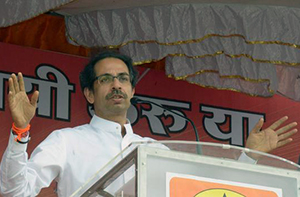
Mumbai, Sep 27: The Shiv Sena's mouthpiece Saamna on Tuesday enraged the Maratha community by publishing a cartoon that appears to poke fun at the campaign for Maratha reservations that's being organised in Maharashtra.siv

Samna's office in Navi Mumbai was attacked later in the day, and pro-Maratha social organisation, 'Sambhaji Brigade' claimed responsibility for the incident.

The controversial cartoon shows a man kissing a woman on the cheek. The woman is holding up a placard with the message, 'Mooka Morcha,' or 'kiss' protest. It's a pun on 'Mook Morcha' which means 'silent'protest - the kind that's happening across Maharashtra.

Police said three youths arrived at Saamna's office on Tuesday afternoon, and allegedly pelted the building with stones before fleeing, damaging two or three glasses on the outer wall. They added that an offence had been registered against the vandals and that action would be taken against them.

The spokesperson of the Sambhaji brigade, Shivanand Banuse, told PTI: "We are condemning a cartoon which was published in Saamana. Shiv Sena executive president Uddhav Thackeray and Saamana's executive editor Sanjay Raut must apologise to the women of Maharashtra. The attack was spontaneous and an expression of emotions of the Maratha community."

The Congress' spokesperson in Maharashtra, Sachin Sawant, has called Saamna's cartoon an insult to the Maratha community. The cartoon has also provoked angry responses on social media.

Maratha protests

In addition to asking for reservations, the protesting Marathas also want to see the Scheduled Castes Schedules Tribes (Prevention of Atrocities) Act amended.

The law was enforced to protect members of Scheduled Castes and Scheduled Tribes from atrocities perpetrated by those belonging to upper castes, but there have been allegations that the legislation has been misused to file false cases against members of the Maratha community.

The protestors also asking that the accused in the Kopardi case - in which a 15-year old Maratha girl from Kopardi was brutally raped and murdered - be given the death penalty.

Comments

Prakash Shetty
 - 
Thursday, 29 Sep 2016

Apart from Maratha / shivaji they know anything else............

shaji
 - 
Wednesday, 28 Sep 2016

you will be respected only if you respect others. These hate mongers have received the treatment which they gave to others. Wait and see for more to come.

Satyameva jayate
 - 
Wednesday, 28 Sep 2016

People will today or tomorrow react against yesterday's trouble makers....lot more to come...one day it will be our good hearted hindus attacking chaddeez

s
 - 
Wednesday, 28 Sep 2016

look at where we are heading? even an extreme party/organisation also has to face extremism. and i am sure this is hailed by the marathas. sad state of affairs in the country.

K K Prabhu
 - 
Tuesday, 27 Sep 2016

Very interesting development. So fare we used to hear about attack by Shiv Sena on offices of media establishments like The Hindu and NDTV. Now their own beloved Maratha's attacking Samna's office.

Add new comment

  • Coastaldigest.com reserves the right to delete or block any comments.
  • Coastaldigset.com is not responsible for its readers’ comments.
  • Comments that are abusive, incendiary or irrelevant are strictly prohibited.
  • Please use a genuine email ID and provide your name to avoid reject.
News Network
February 14,2020

Mangaluru, Feb 14: In a unique initiative, students of a government school in Dakshina Kannada have made a food stop in the campus to provide water and food to birds and squirrels.

The students have hung coconut shells on trees in the school premises with food and water in it for birds and squirrels.

Speaking about the same, the Principal of the school said: "Students are taking a lot of interest in the activity. Various types of birds visit the school campus, making the ambience very nice."

He added that he wants children to become socially and environmentally conscious. "The one area where children need to be given exposure is the protection of the environment, the upkeep of the campus and the greenery in and around their homes as well as in their schools."

Commenting on the recent initiative of the school's eco-club, he said, "Using this small idea, we can have a great beginning towards taking up bigger initiatives to take care of the environment."

Comments

Add new comment

  • Coastaldigest.com reserves the right to delete or block any comments.
  • Coastaldigset.com is not responsible for its readers’ comments.
  • Comments that are abusive, incendiary or irrelevant are strictly prohibited.
  • Please use a genuine email ID and provide your name to avoid reject.
News Network
January 2,2020

Tumakuru, Jan 2: Prime Minister Narendra Modi on Thursday paid respects to the 'Gadduge' (final resting place) of Shivakumara Swamiji at Siddaganga Math, a prominent Lingayat seminary here, and said the Swamiji's work would continue to inspire everyone.

The Swamiji, who was known as the 'Walking God' among his countless followers, had passed away last year at the age of 111. The Prime Minister, who arrived at the Yelahanka Airbase in Bengaluru, went directly to Tumakuru, where the Math is located, by a chopper along with Chief Minister B S Yediyurappa, Union Minister Pralhad Joshi and former Chief Minister D V Sadananda Gowda among others. Modi, after offering respects to the 'Gadduge', planted Bilva plant (Aegle marmelos) on the premises of the Math and also laid the foundation for the construction of a museum dedicated to Swamiji here before addressing the gathering, largely comprising students. Speaking on the occasion, Modi said he was feeling blessed to begin 2020 from the sacred land of Siddaganga, but at the same time was feeling the "vacuum" in the absence of Shivakumara Swamiji. "It is rare see the number of people swamiji had inspired during his life time. I'm really fortunate to lay the foundation for the museum in swamiji's memory. Through this museum, his works will continue to inspire generations," he said. Also, Prime Minister remembered Vishwesha Theertha of Udupi's Pejawar Math who passed away recently. Yediyurappa and the present pontiff of the Math Siddalinga Swamiji were among the others present. Known as "trivida dasohi" for his triple sacraments - food, shelter and education - among his followers, Shivakumara swamiji was considered as the incarnation of Basavanna, the 12th-century social reformer, as he accepted all irrespective of their religion or caste. There has been a growing clamour from people of different walks of life, including politicians, for conferring "Bharat Ratna" on the late Swamiji.

After the Swamiji's demise, the then Chief Minister H D Kumaraswamy had written to Modi urging him to confer the country's highest civilian order on the late seer.

Opposition Congress on Thursday questioned the Prime Minister about not conferring the"Bharat Ratna" on Shivakumara Swamiji.

Questioning Modi as to why he did not visit Tumakuru when Shivakumara Swamiji of Siddaganga Math passed away, the principal opposition party in the state assembly in a tweet also sought to know why the seer was not conferred with the Bharat Ratna yet, while pointing out that former Chief Minister Siddaramaiah had written a letter in this regard in January 2018.

The present seer of the seminary Siddalinga Swamiji presented Modi a silver statue of Shivakumara Swamiji as a memento.

Comments

Add new comment

  • Coastaldigest.com reserves the right to delete or block any comments.
  • Coastaldigset.com is not responsible for its readers’ comments.
  • Comments that are abusive, incendiary or irrelevant are strictly prohibited.
  • Please use a genuine email ID and provide your name to avoid reject.
News Network
July 28,2020

Hounde, Jul 28: Coronavirus and its restrictions are pushing already hungry communities over the edge, killing an estimated 10,000 more young children a month as meager farms are cut off from markets and villages are isolated from food and medical aid, the United Nations warned Monday.

In the call to action shared with The Associated Press ahead of publication, four UN agencies warned that growing malnutrition would have long-term consequences, transforming individual tragedies into a generational catastrophe.

Hunger is already stalking Haboue Solange Boue, an infant from Burkina Faso who lost half her former body weight of 5.5 pounds (2.5 kilograms) in just a month. Coronavirus restrictions closed the markets, and her family sold fewer vegetables. Her mother was too malnourished to nurse.

“My child,” Danssanin Lanizou whispered, choking back tears as she unwrapped a blanket to reveal her baby's protruding ribs.

More than 550,000 additional children each month are being struck by what is called wasting, according to the UN — malnutrition that manifests in spindly limbs and distended bellies. Over a year, that's up 6.7 million from last year's total of 47 million. Wasting and stunting can permanently damage children physically and mentally.

“The food security effects of the COVID crisis are going to reflect many years from now,” said Dr. Francesco Branca, the WHO head of nutrition. “There is going to be a societal effect.”

From Latin America to South Asia to sub-Saharan Africa, more poor families than ever are staring down a future without enough food.

In April, World Food Program head David Beasley warned that the coronavirus economy would cause global famines “of biblical proportions” this year. There are different stages of what is known as food insecurity; famine is officially declared when, along with other measures, 30% of the population suffers from wasting.

The World Food Program estimated in February that one Venezuelan in three was already going hungry, as inflation rendered salaries nearly worthless and forced millions to flee abroad. Then the virus arrived.

“Every day we receive a malnourished child,” said Dr. Francisco Nieto, who works in a hospital in the border state of Tachira.

In May, Nieto recalled, after two months of quarantine, 18-month-old twins arrived with bodies bloated from malnutrition. The children's mother was jobless and living with her own mother. She told the doctor she fed them only a simple drink made with boiled bananas.

“Not even a cracker? Some chicken?” he asked.

“Nothing,” the children's grandmother responded. By the time the doctor saw them, it was too late: One boy died eight days later.

The leaders of four international agencies — the World Health Organization, UNICEF, the World Food Program and the Food and Agriculture Organization — have called for at least dollar 2.4 billion immediately to address global hunger.

But even more than lack of money, restrictions on movement have prevented families from seeking treatment, said Victor Aguayo, the head of UNICEF's nutrition program.

“By having schools closed, by having primary health care services disrupted, by having nutritional programs dysfunctional, we are also creating harm,” Aguayo said. He cited as an example the near-global suspension of Vitamin A supplements, which are a crucial way to bolster developing immune systems.

In Afghanistan, movement restrictions prevent families from bringing their malnourished children to hospitals for food and aid just when they need it most. The Indira Gandhi hospital in the capital, Kabul, has seen only three or four malnourished children, said specialist Nematullah Amiri. Last year, there were 10 times as many.

Because the children don't come in, there's no way to know for certain the scale of the problem, but a recent study by Johns Hopkins University indicated an additional 13,000 Afghans younger than 5 could die.

Afghanistan is now in a red zone of hunger, with severe childhood malnutrition spiking from 690,000 in January to 780,000 — a 13% increase, according to UNICEF.

In Yemen, restrictions on movement have blocked aid distribution, along with the stalling of salaries and price hikes. The Arab world's poorest country is suffering further from a fall in remittances and a drop in funding from humanitarian agencies.

Yemen is now on the brink of famine, according to the Famine Early Warning Systems Network, which uses surveys, satellite data and weather mapping to pinpoint places most in need.

Some of the worst hunger still occurs in sub-Saharan Africa. In Sudan, 9.6 million people live from one meal to the next — a 65% increase from the same time last year.

Lockdowns across Sudanese provinces, as around the world, have dried up work and incomes for millions. With inflation hitting 136%, prices for basic goods have more than tripled.

“It has never been easy but now we are starving, eating grass, weeds, just plants from the earth,” said Ibrahim Youssef, director of the Kalma camp for internally displaced people in war-ravaged south Darfur.

Adam Haroun, an official in the Krinding camp in west Darfur, recorded nine deaths linked with malnutrition, otherwise a rare occurrence, over the past two months — five newborns and four older adults, he said.

Before the pandemic and lockdown, the Abdullah family ate three meals a day, sometimes with bread, or they'd add butter to porridge. Now they are down to just one meal of “millet porridge” — water mixed with grain. Zakaria Yehia Abdullah, a farmer now at Krinding, said the hunger is showing “in my children's faces.”

“I don't have the basics I need to survive,” said the 67-year-old, who who hasn't worked the fields since April. “That means the 10 people counting on me can't survive either.”


Comments

Add new comment

  • Coastaldigest.com reserves the right to delete or block any comments.
  • Coastaldigset.com is not responsible for its readers’ comments.
  • Comments that are abusive, incendiary or irrelevant are strictly prohibited.
  • Please use a genuine email ID and provide your name to avoid reject.