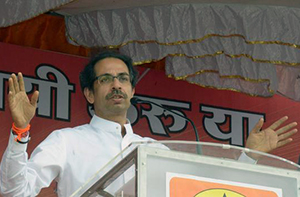
Shiv Sena newspaper office attacked after cartoon 'mocks' Maratha protests

September 27, 2016

Mumbai, Sep 27: The Shiv Sena's mouthpiece Saamna on Tuesday enraged the Maratha community by publishing a cartoon that appears to poke fun at the campaign for Maratha reservations that's being organised in Maharashtra.siv

Samna's office in Navi Mumbai was attacked later in the day, and pro-Maratha social organisation, 'Sambhaji Brigade' claimed responsibility for the incident.

The controversial cartoon shows a man kissing a woman on the cheek. The woman is holding up a placard with the message, 'Mooka Morcha,' or 'kiss' protest. It's a pun on 'Mook Morcha' which means 'silent'protest - the kind that's happening across Maharashtra.

Police said three youths arrived at Saamna's office on Tuesday afternoon, and allegedly pelted the building with stones before fleeing, damaging two or three glasses on the outer wall. They added that an offence had been registered against the vandals and that action would be taken against them.

The spokesperson of the Sambhaji brigade, Shivanand Banuse, told PTI: "We are condemning a cartoon which was published in Saamana. Shiv Sena executive president Uddhav Thackeray and Saamana's executive editor Sanjay Raut must apologise to the women of Maharashtra. The attack was spontaneous and an expression of emotions of the Maratha community."

The Congress' spokesperson in Maharashtra, Sachin Sawant, has called Saamna's cartoon an insult to the Maratha community. The cartoon has also provoked angry responses on social media.

Maratha protests

In addition to asking for reservations, the protesting Marathas also want to see the Scheduled Castes Schedules Tribes (Prevention of Atrocities) Act amended.

The law was enforced to protect members of Scheduled Castes and Scheduled Tribes from atrocities perpetrated by those belonging to upper castes, but there have been allegations that the legislation has been misused to file false cases against members of the Maratha community.

The protestors also asking that the accused in the Kopardi case - in which a 15-year old Maratha girl from Kopardi was brutally raped and murdered - be given the death penalty.

Comments

Prakash Shetty
 - 
Thursday, 29 Sep 2016

Apart from Maratha / shivaji they know anything else............

shaji
 - 
Wednesday, 28 Sep 2016

you will be respected only if you respect others. These hate mongers have received the treatment which they gave to others. Wait and see for more to come.

Satyameva jayate
 - 
Wednesday, 28 Sep 2016

People will today or tomorrow react against yesterday's trouble makers....lot more to come...one day it will be our good hearted hindus attacking chaddeez

s
 - 
Wednesday, 28 Sep 2016

look at where we are heading? even an extreme party/organisation also has to face extremism. and i am sure this is hailed by the marathas. sad state of affairs in the country.

K K Prabhu
 - 
Tuesday, 27 Sep 2016

Very interesting development. So fare we used to hear about attack by Shiv Sena on offices of media establishments like The Hindu and NDTV. Now their own beloved Maratha's attacking Samna's office.

Add new comment

  • Coastaldigest.com reserves the right to delete or block any comments.
  • Coastaldigset.com is not responsible for its readers’ comments.
  • Comments that are abusive, incendiary or irrelevant are strictly prohibited.
  • Please use a genuine email ID and provide your name to avoid reject.
Ram Puniyani
June 29,2020

In Minneapolis, US an African American, George Floyd lost his life as the white policeman, Derek Chauvin, caught hold of him and put his knee on his neck. This is a technique developed by Israel police. For nine long minutes the knee of the while policeman was on the neck of George, who kept shouting, I can’t breathe.

Following this gruesome murder America erupted with protests, ‘Black lives matter’. The protestors were not just African Americans but also a large section of whites. Within US one police Chief apologized for the act of this. In a touching gesture of apology the police force came on its knees. This had reverberations in different parts of the World.

The act was the outcome of the remnants of the racial hatred against blacks by the whites. It is the hatred and the perceptions which are the roots of such acts of violence. What was also touching that the state of democracy in US is so deep that even the police apologized, the nation, whites and blacks, stood up as a sensitive collective against this violence.

US is not the only country where the brutal acts of violence torment the marginalized sections of society. In India there is a list of dalits, minorities and adivasis who are regularly subjected to such acts. But the reaction is very different. We have witnessed the case of Tabrez Ansari, who was tied to the pole by the mob and beaten ruthlessly. When he was taken to police station, police took enough time to take him to hospital and Tabrez died.

Mohsin Sheikh, a Pune techie was murdered by Hindu Rashtra Sena mob, the day Modi came to power in 2014. Afrazul was killed by Shambhulal Regar, videotaped the act released on social media. Regar believed that Muslims are indulging in love Jihad, so deserve such a fate. Mohammad Akhlaq is one among many names who were mob lynched on the issue of beef cow. The list can fill pages after pages.

Recently a young dalit boy was shot dead for the crime of entering a temple. In Una four dalits were stripped above waste and beaten mercilessly. Commenting on this act the Union Minister Ramvilas Paswan commented that it is a minor incident. Again the list of atrocities against dalits is long enough. The question is what Paswan is saying is the typical response to such gruesome murders and tortures. In US loss of one black life, created the democratic and humane response. In India there is a general silence in response to these atrocities. Some times after a good lapse of time, the Prime Minister will utter, ‘Mother Bharati has lost a son’. Most of the time victim is blamed. Some social groups raise their voice in some fora but by and large the deafening silence from the country is the norm.

India is regarded as the largest democracy. Democracy is the rule of law, and the ground on which the injustices are opposed. In America though the present President is insensitive person, but its institutions and processes of democratic articulations are strong. The institutions have deepened their roots and though prejudices may be guiding the actions of some of the officers like the killer of George, there are also police officers who can tell their President to shut up if he has nothing meaningful to say on the issue. The prejudices against Blacks may be prevalent and deep in character, still there are large average sections of society, who on the principles of ‘Black lives matter’. There are large sections of vocal population who can protest the violation of basic norms of democracy and humanism.

In India by contrast there are multiple reasons as to why the lives of Tabrez Ansari, Mohammad Akhlaq, Una dalit victims and their likes don’t matter. Though we claim that we are a democracy, insensitivity to injustices is on the rise. The strong propaganda against the people from margins has become so vicious during last few decades that any violence against them has become sort of a new normal. The large populace, though disturbed by such brutalities, is also fed the strong dose of biases against the victims. The communal forces have a great command over effective section of media and large section of social media, which generates Hate against these disadvantaged groups, thereby the response is muted, if at all.

As such also the process of deepening of our democracy has been weak. Democracy is a dynamic process; it’s not a fixed entity. Decades ago workers and dalits could protest for their rights. Now even if peasants make strong protests, dominant media presents it as blocking of traffic! How the roots of democracy are eroded and are visible in the form where the criticism of the ruling dispensation is labelled as anti National..

Our institutions have been eroded over a period of time, and these institutions coming to the rescue of the marginalized sections have been now become unthinkable. The outreach of communal, divisive ideology, the ideology which looks down on minorities, dalits and Adivasis has risen by leaps and bounds.

The democracy in India is gradually being turned in to a hollow shell, the rule of law being converted in to rule of an ideology, which does not have faith in Indian Constitution, which looks down upon pluralism and diversity of this country, which is more concerned for the privileges of the upper caste, rich and affluent. The crux of the matter is the weak nature of democracy, which was on way to become strong, but from decades of 1980s, as emotive issues took over, the strength of democracy started dwindling, and that’s when the murders of the types of George Floyd, become passé. One does complement the deeper roots of American democracy and its ability to protect the democratic institutions, which is not the case in India, where protests of the type, which were witnessed after George Floyd’s murder may be unthinkable, at least in the present times. 

Comments

Add new comment

  • Coastaldigest.com reserves the right to delete or block any comments.
  • Coastaldigset.com is not responsible for its readers’ comments.
  • Comments that are abusive, incendiary or irrelevant are strictly prohibited.
  • Please use a genuine email ID and provide your name to avoid reject.
Agencies
February 12,2020

Bengaluru, Feb 12: Karnataka Sanghatanegala Okkoota, a congregation of various pro-Kannada organisations, has called for a state-wide bandh in Karnataka on Thursday (13 February 2020) demanding reservation in jobs for Kannadigas in both government and private sectors.

The Karnataka bandh, which will begin from 6 am to 6 pm, is likely to impact life in Bengaluru as well as in other parts of the state. Interestingly, Ola and Uber drivers have also extended support to the bandh. 

In Bengaluru, some other drivers’ associations, including Jai Bharatha Vehicle Owners and Drivers Association and Adarsha Auto and Taxi Union have also supported the bandh.

It is not yet clear as to whether the Karnataka State Road Transport Corporation (KSRTC) staff and workers associations will back Thursday’s bandh.

Several other organisations like the Karnataka Film Chamber of Commerce (KFCC), Centre of Indian Trade Unions (CITU), and Lorry Owners Association have supported the February 13 bandh.

In view of the bandh call, schools, colleges and hospitals across Karnataka are likely to remain closed on Thursday.

The Sarojini Mahishi report, which in 1984 suggested that Kannadigas should be given some reservation in jobs in private companies, public sector undertakings and multinational companies, is yet to be implemented.

It is to be noted that Sarojini Mahishi, a four-time MP and Janatha party leader, was appointed by the Ramakrishna Hegde government to head the panel in 1983. The committee submitted an interim report in June 1984. However, a final report was tabled in December 1986 with 58 recommendations, of which the Karnataka government had accepted 45.

Comments

Add new comment

  • Coastaldigest.com reserves the right to delete or block any comments.
  • Coastaldigset.com is not responsible for its readers’ comments.
  • Comments that are abusive, incendiary or irrelevant are strictly prohibited.
  • Please use a genuine email ID and provide your name to avoid reject.
News Network
February 28,2020

Bengaluru, Feb 28: “Those who struggle to come up can understand people’s problems better. Yediyurappa is one such leader who has reached this position after a struggle,’’ said former chief minister Siddaramaiah, in praise of Chief Minister BS Yediyurappa, who celebrated his 78th birthday on Thursday in Bengaluru.

Siddaramaiah was the only non-BJP leader on the dais, who not only attended the event, but was present throughout. He released a coffee table book, ‘A Leader who Saw Tomorrow’, on Yediyurappa’s life and achievements, compiled by The New Indian Express.

Dwelling on the political spectrum and human relationships, Siddaramaiah said, “Our ideologies are different, but that is limited to politics. Politics should not come between personal relationships.’’ Recalling his association with Yediyurappa, Siddaramaiah said that in 1983, he and Yediyurappa had entered the Assembly for the first time.

“Yediyurappa did not become chief minister just like that. It took years of struggle and hard work. We both have many similarities — neither of us came from political backgrounds. We came up through struggle and those who come from such backgrounds understand people,’’ he said.

Siddaramaiah said that it was Yediyurappa who first became chief minister, and he had reached the post only five years later. “I am five years younger than him, maybe that is the reason,’’ he said on a lighter note. Yediyurappa has become chief minister four times, but I have been chief minister only once, he added. He also spoke about how Yediyurappa had played an important role in bringing the BJP to power in the state, the party’s first government in South India. “Very few leaders know the pulse of the state and Yediyurappa is one among them,’’ he said.

Comments

Add new comment

  • Coastaldigest.com reserves the right to delete or block any comments.
  • Coastaldigset.com is not responsible for its readers’ comments.
  • Comments that are abusive, incendiary or irrelevant are strictly prohibited.
  • Please use a genuine email ID and provide your name to avoid reject.