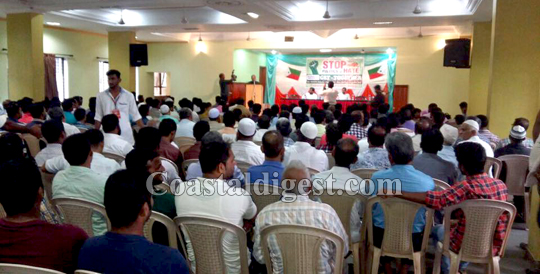
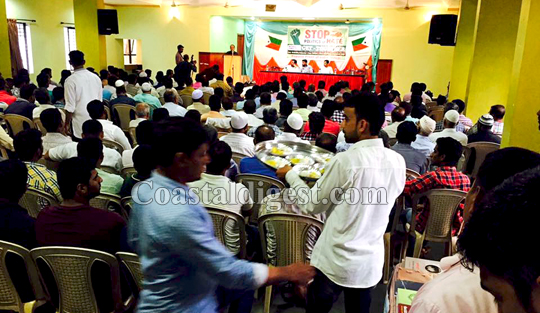
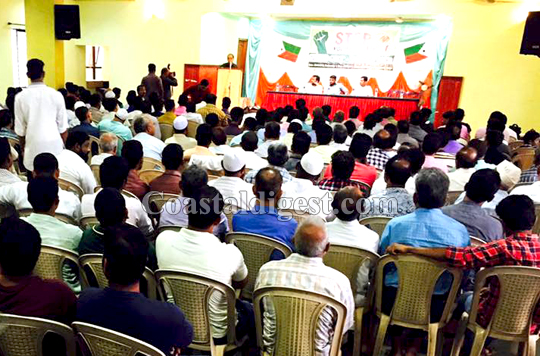
Udupi: Attacks on minorities, dalits condemned at PFI campaign

[email protected] (CD Network)
September 29, 2016

Udupi, Sep 29: Demolition of Babri mosque, Gujarat genocide and attack on churches in Mangaluru and other parts of India are glimpses of hate politics, said Prof Alban Rodrigues, administrator of Dandatheeratha Institutions, Kaup.

pfiudupi 1

Speaking at the Stop politics of hate' campaign organised by the district unit of the Popular Front of India here on Wednesday, he took on Prime Minister Narendra Modi led government for constant attacks on minorities across the country.

He said that the politics of hate, ultimately leads to communal violence and chaos in the country.

Shafi Bellary, secretary of the State unit of the PFI said that Dalits and minorities were at the receiving end of “majority politics” for the last two years.

Mr. Bellary said all people should accept the fact that India was a diverse multi-religious and multi-cultural country. It has a secular constitution.

The Bharatiya Janata Party-led National Democratic Alliance (NDA) government had got a mere 31 per cent of votes, which meant that a large majority was against it, he said.

Even those who had voted for the NDA had done so because they were fed up of the “corruption” of the previous Congress-led United Progressive Alliance (UPA) government. Hence it could not be concluded that it was a vote for the ideology espoused by the BJP, he said.
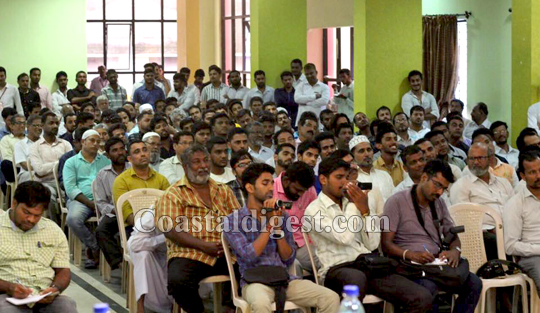
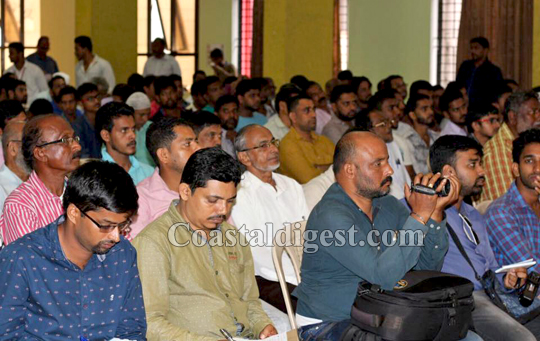
pfiudupi 2

pfiudupi 3

pfiudupi 4

pfiudupi 5

pfiudupi 6

Comments

TRUE INDIAN
 - 
Thursday, 29 Sep 2016

PEOPLE ARE EDUCATED. ONLY BJPS AND ITS ALLIANCES ARE UNEDUCATED COWS.

Traveller
 - 
Thursday, 29 Sep 2016

And Majority of those who voted BJP have now come to understand that BJP and cheddis are not their saviours .. They are killers of peace in the society ... anyway people believe when they saw it how Bjp and cheddis governing their people... atleast those who are honest and good at heart should change their position on cheddis and vote those who are really working for the society.

Add new comment

  • Coastaldigest.com reserves the right to delete or block any comments.
  • Coastaldigset.com is not responsible for its readers’ comments.
  • Comments that are abusive, incendiary or irrelevant are strictly prohibited.
  • Please use a genuine email ID and provide your name to avoid reject.
coastaldigest.com news network
July 30,2020

Manglauru, July 30: There will be no congregational prayer on Eid Al-Adha at the historic Eidgah mosque in Mangluru’s lighthouse hill this year due to covid-19 pandemic. 

The decision to suspend the Eid prayers in Eidgah was taken as per the guidelines issued by the State Board of Auqaf, said Haji Y Abdullah Kunhi, president of Zeenat Baksh Central Juma Masjid and Eidgah Masjid.

However, Eid prayer will be held at Zeenat Baksh Central Juma Masjid on July 31 at 7 a.m.

Muslims in coastal Karnataka will be celebrating Eid al-Adha on July 31 whereas Muslims in other parts of Karnataka and India are celebrating the festival on August 1.  

Comments

Add new comment

  • Coastaldigest.com reserves the right to delete or block any comments.
  • Coastaldigset.com is not responsible for its readers’ comments.
  • Comments that are abusive, incendiary or irrelevant are strictly prohibited.
  • Please use a genuine email ID and provide your name to avoid reject.
News Network
May 6,2020

Bengaluru, May 6: More than a month after international flights have been barred, Karnataka government is preparing to quarantine all 10,823 of the state''s people poised to return home from overseas amid the Covid pandemic, an official said on Tuesday.

"The state has planned to quarantine all 10,823 passengers coming back to Karnataka. The quarantine guidelines framed as below would be applicable," said Health Commissioner Pankaj Kumar Pandey in a statement.

According to the Government of India, 10,823 Karnataka residents have been stranded abroad by April 30, comprising 4,408 tourists, 3,074 students, 2,784 migrants and professionals and 557 ship crew.

Out of the 10,823 people, the state government is expecting 6,100 to return early as the government has decided to allow Indians stuck abroad to return.

"All the passengers arriving at points of entry (airports and seaports) will be compulsorily screened for symptoms of Covid-19," said Pandey.

Point of entry screening will include self-reporting form verification, thermal screening, pulse oximeter reading, briefing with instructions, categorisation, stamping for some and downloading of Aarogya Setu, Quarantine Watch and Apthamitra apps.

Arriving passengers are also required to declare existing comorbidities such hypertension, diabetes, asthma or any lung disease, organ transplantations, cancer, tuberculosis and other ailments.

Passengers will be categorised into three groups: Category A (symptomatic on arrival), Category B (asymptomatic with co-morbidity or aged above 60 years) and Category C (rest of asymptomatic passengers).

Depending on the category into which the people fall, their quarantine place and time will be determined.

Category A arrivals will be subjected to institutional quarantine for a fortnight, Category B one week quarantine at a hotel or hostel, followed by another week at home, and Category C home quarantine for a fortnight.

Karnataka government is making elaborate arrangements and logistical means, deploying healthcare, police and several other departments into action to handle the huge influx of Kannadigas and state residents.

Pandey has issued a 21-page elaborate standard operating procedure (SOP) guidelines on how to face the international returnees.

Comments

Add new comment

  • Coastaldigest.com reserves the right to delete or block any comments.
  • Coastaldigset.com is not responsible for its readers’ comments.
  • Comments that are abusive, incendiary or irrelevant are strictly prohibited.
  • Please use a genuine email ID and provide your name to avoid reject.
News Network
January 29,2020

Newsroom, Jan 29: Karnataka’s capital has earned the unwelcome distinction of global capital of traffic congestion. According to a report by TomTom, the Netherlands-based global provider of navigation, traffic and map products, Bengaluru beat 415 other cities across 57 countries to earn the title of world's most traffic congested city in 2019.

“Bengaluru takes the top spot this year with drivers in the southern Indian city expecting to spend an average of 71% extra travel time stuck in traffic," TomTom said in the ninth edition of its annual Traffic Index.

Three other Indian cities, namely, Mumbai, Pune and New Delhi are also ranked in the 2019 edition of TomTom’s Traffic Index of the world’s most traffic-congested cities. 

The report released on Tuesday ranks cities by the average time added to a trip. TomTom index also includes details on when congestion is heaviest and lightest, how highways compare with surface streets, and how much time drivers wasted waiting for other drivers to get out of their way.

Following closely on the heels of Bengaluru is Manila, Philippines, with the similar 71% traffic congestion. Among the top five worst traffic affected cities are Mumbai and Pune from India at the fourth and fifth place respectively, while Bogota, Colombia is on third spot.

Delhi, the national capital of India is on the 8th spot, while Moscow (Russia), Lima (Peru), Istanbul (Turkey) and Jakarta (Indonesia) are on 6th, 7th, 9th and 10th spot respectively.

Mumbai recorded a 65% traffic congestion with 9th September, 2019 being the worst day. On an average, a Mumbaikar lost 209 hours in traffic congestion. Pune has 59% traffic congestion with 2nd August, 2019 being the worst day. 193 hours are lost due to congestion. Delhi, on the other hand, has 56% traffic congestion. 23rd October, 2019 was the worst day, while 190 hours are lost in traffic congestion.

Interestingly, among all the four Indian cities, Delhi has the most number of cars. Previous studies have concluded that Delhi has the best road conditions among the Metro cities of India.

If you are wondering what exactly the percentages mean, a 53% congestion level in Bangkok, for example, means that a trip will take 53% more time than it would during Bangkok’s baseline uncongested conditions.

TomTom calculates the baseline per city by analyzing free-flow travel times of all vehicles on the entire road network – recorded 24/7, 365 days a year. The report by Dutch navigation and mapping company ranks cities by the average time added to a trip. It also includes details on when congestion is heaviest and lightest, and how much time drivers wasted waiting for other drivers to get out of their way.

Comments

Add new comment

  • Coastaldigest.com reserves the right to delete or block any comments.
  • Coastaldigset.com is not responsible for its readers’ comments.
  • Comments that are abusive, incendiary or irrelevant are strictly prohibited.
  • Please use a genuine email ID and provide your name to avoid reject.