Mangaluru: NRI's 2-year-old son drowns as boat capsizes at Panambur beach

[email protected] (CD Network)
October 5, 2016

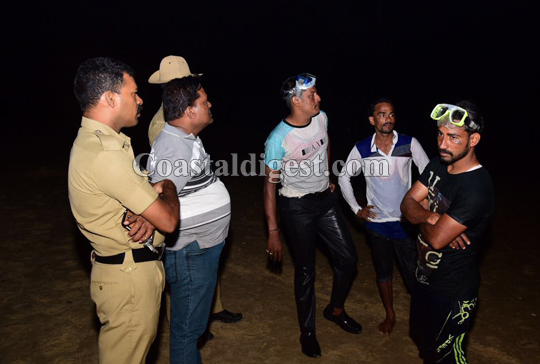
Mangaluru, Oct 5: In a gut-wrenching tragedy, a two-and-half-year-old boy drowned when a speedboat capsized at Panambur beach in Mangaluru on Wednesday evening.

baby

The victim, Mohammed Sadan, was one of the seven family members on board the ill-fated boat that sank due to some technical snag.

Even though the lifeguards helped the six others to reach ashore safe, they failed to rescue the little boy. His parents Shami Ilahi and Fathima, residents of Natekal near Deralakatte were among the rescued.

Shami Ilahi, an NRI, who had recently come to Indian on a vacation, took his family members to the beach on Wednesday evening. The family decided to enjoy a boat ride before returning home.

All of them were given life jackets before boarding the boat. As there was no small size life jacket, the little boy also was given adults' life jacket. When the boat sank the child slipped from his parents' hands. As soon as he fell into the sea, the life jacket also slipped from his body.

Negligence by lifeguards?

The family members and beach goers held lifeguards responsible for the tragedy. Had the lifeguards started rescue operation without delay the boy could have been saved, said Haneef, one of the family members. The boy's body washed ashore after several hours of search by coastal security police and lifeguards.

nridrown 2

nridrown 3

nridrown 4

nridrown 5

nridrown 6

nridrown 7

Comments

Safan
 - 
Thursday, 6 Oct 2016

innalillahi wa inna ilaihi rajioon

zameer
 - 
Thursday, 6 Oct 2016

Inna lillahi wa inna ilaihi raajiwoon.....even parents need to be held responsible rather than blaming life guards... how could they carry such a small child to sea??

aharkul
 - 
Thursday, 6 Oct 2016

Inna Lillahi Wa Inna Ilayhi Raajivoon.

Add new comment

  • Coastaldigest.com reserves the right to delete or block any comments.
  • Coastaldigset.com is not responsible for its readers’ comments.
  • Comments that are abusive, incendiary or irrelevant are strictly prohibited.
  • Please use a genuine email ID and provide your name to avoid reject.
News Network
March 26,2020

Udupi, Mar 26: As many as 1000 expatriates, who have arrived from foreign countries and have been placed in home quarantine, were warned against violating the guidelines given to them and leaving their houses. 

Deputy Commissioner G Jagadeesha, addressing reporters here on Thursday, said that the district administration and health department officials have sent notices to surrounding houses regarding those quarantined and requested them to bring to the notice of relevant authorities if anyone was found violating the quarantine rules.

'If anyone is found violating the quarantine rules and roaming in public, a complaint can be registered by calling on 9480242600. Strict action will be taken against such violators,' said Mr Jagadeesha.

Comments

Add new comment

  • Coastaldigest.com reserves the right to delete or block any comments.
  • Coastaldigset.com is not responsible for its readers’ comments.
  • Comments that are abusive, incendiary or irrelevant are strictly prohibited.
  • Please use a genuine email ID and provide your name to avoid reject.
Agencies
February 20,2020

India ranked 77th on a sustainability index that takes into account per capita carbon emissions and ability of children in a nation to live healthy lives and secures 131st spot on a flourishing ranking that measures the best chance at survival and well-being for children, according to a UN-backed report.

The report was released on Wednesday by a commission of over 40 child and adolescent health experts from around the world. It was commissioned by the World Health Organization (WHO), UN Children's Fund (UNICEF) and The Lancet medical journal.

In the report assessing the capacity of 180 countries to ensure that their youngsters can survive and thrive, India ranks 77th on the Sustainability Index and 131 on the Flourishing Index, it said.

Flourishing is the geometric mean of Surviving and Thriving. For Surviving, the authors selected maternal survival, survival in children younger than 5 years old, suicide, access to maternal and child health services, basic hygiene and sanitation, and lack of extreme poverty.

For Thriving, the domains were educational achievement, growth and nutrition, reproductive freedom, and protection from violence.

Under the Sustainability Index, the authors noted that promoting today's national conditions for children to survive and thrive must not come at the cost of eroding future global conditions for children's ability to flourish.

The Sustainability Index ranks countries on excess carbon emissions compared with the 2030 target. This provides a convenient and available proxy for a country's contribution to sustainability in future.

The report noted that under realistic assumptions about possible trajectories towards sustainable greenhouse gas emissions, models predict that global carbon emissions need to be reduced from 39·7 giga­ tonnes to 22·8 gigatonnes per year by 2030 to maintain even a 66 per cent chance of keeping global warming below 1·5°C.

It said that the world's survival depended on children being able to flourish, but no country is doing enough to give them a sustainable future.

"No country in the world is currently providing the conditions we need to support every child to grow up and have a healthy future," said Anthony Costello, Professor of Global Health and Sustainability at University College London, one of the lead authors of the report.

"Especially, they're under immediate threat from climate change and from commercial marketing, which has grown hugely in the last decade," said Costello – former WHO Director of Mother, Child and Adolescent health.

Norway leads the table for survival, health, education and nutrition rates - followed by South Korea and the Netherlands. Central African Republic, Chad and Somalia come at the bottom.

However, when taking into account per capita CO2 emissions, these top countries trail behind, with Norway 156th, the Republic of Korea 166th and the Netherlands 160th.

Each of the three emits 210 per cent more CO2 per capita than their 2030 target, the data shows, while the US, Australia, and Saudi Arabia are among the 10 worst emitters. The lowest emitters are Burundi, Chad and Somalia.

According to the report, the only countries on track to beat CO2 emission per capita targets by 2030, while also performing fairly – within the top 70 – on child flourishing measures are: Albania, Armenia, Grenada, Jordan, Moldova, Sri Lanka, Tunisia, Uruguay and Vietnam.

"More than 2 billion people live in countries where development is hampered by humanitarian crises, conflicts, and natural disasters, problems increasingly linked with climate change," said Minister Awa Coll-Seck from Senegal, Co-Chair of the commission.

The report also highlights the distinct threat posed to children from harmful marketing.

Evidence suggests that children in some countries see as many as 30,000 advertisements on television alone in a single year, while youth exposure to vaping (e-cigarettes) advertisements increased by more than 250 per cent in the US over two years, reaching more than 24 million young people.

Studies in Australia, Canada, Mexico, New Zealand and the US – among many others – have shown that self-regulation has not hampered commercial ability to advertise to children.

Children's exposure to commercial marketing of junk food and sugary beverages is associated with purchase of unhealthy foods and overweight and obesity, linking predatory marketing to the alarming rise in childhood obesity, it said.

The number of obese children and adolescents increased from 11 million in 1975 to 124 million in 2016 – an 11-fold increase, with dire individual and societal costs, the report said.

To protect children, the authors call for a new global movement driven by and for children.

Specific recommendations include stopping CO2 emissions with the utmost urgency, to ensure children have a future on this planet; placing children and adolescents at the centre of global efforts to achieve sustainable development, the report said.

New policies and investment in all sectors to work towards child health and rights; incorporating children's voices into policy decisions and tightening national regulation of harmful commercial marketing, supported by a new Optional Protocol to the UN Convention on the Rights of the Child, it said.


Comments

Add new comment

  • Coastaldigest.com reserves the right to delete or block any comments.
  • Coastaldigset.com is not responsible for its readers’ comments.
  • Comments that are abusive, incendiary or irrelevant are strictly prohibited.
  • Please use a genuine email ID and provide your name to avoid reject.
News Network
June 22,2020

Bengaluru, June 22: Even as the covid-19 positive cases are steadily increasing in Karnataka, an expert has claimed that community transmission has begun in Bengaluru and cases could keep rising over the next two months.

“If you look at the natural course of this virus across countries around the world, it is about six months. Now we’re in the fourth month. This will go on for another two months. It also sounds like this is the beginning of the peak. There is also a possibility of the number of cases going up from now on. Even across India, cases are increasing,” says Dr CN Manjunath, director of Sri Jayadeva Institute of Cardiovascular Sciences and Research and State Task Force member.

Besides the increase in number of cases, the virus is advancing silently, stealthily. A lot of people who are testing positive are asymptomatic. In areas like Padarayanapura, Nanjangud and many places in north Karnataka, there have been positive cases who have not had any contact with infected individuals. Some cases recorded in Bengaluru over the last two to three days have not had any contact with Covid-positive people.

Dr Manjunath adds: “We are in community transmission. This will happen because nature is ahead of everything. We have to take all possible precautionary measures at our command. This has to happen. Only then some kind of herd immunity will be developed.”

“We are expanding the guidelines of testing to include a large number of people to be tested. Now, according to the Indian Council for Medical Research (ICMR) guidelines, only symptomatic Influenza like Illness (ILI) or Severe Acute Respiratory Infection (SARI), or a person coming in contact with an infected person are being tested.

But since we have crossed 100 days in Karnataka from the first reported case and we’re getting cases with no travel history or contact with a Covid-positive person, we have to start random testing across the sub-group population. Only then will we understand the burden of the disease and what precautions need to be taken,” he says.

Comments

Add new comment

  • Coastaldigest.com reserves the right to delete or block any comments.
  • Coastaldigset.com is not responsible for its readers’ comments.
  • Comments that are abusive, incendiary or irrelevant are strictly prohibited.
  • Please use a genuine email ID and provide your name to avoid reject.