



Pak seeks bigger SAARC to counter India's influence

October 12, 2016

Islamabad, Oct 12: Pakistan is exploring the possibility of creating a greater South Asian economic alliance to include China, Iran and neighbouring Central Asian republics as part of its bid counter India's influence in SAARC, a media report said today.pak
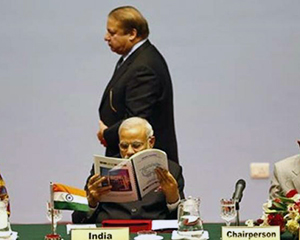
Dawn News, citing diplomatic observers, said Pakistan is exploring the possibility of creating a greater South Asian economic alliance to counter India's "controlling hold" on the eight-member South Asian Association for Regional Cooperation (SAARC).

A parliamentary delegation from Pakistan, which is now in New York, pitched this idea during its five-day visit to Washington last week, the report said.

"A greater South Asia is already emerging," Senator Mushahid Hussain Syed was quoted as saying in one of his interactions with the media.

"This greater South Asia includes China, Iran and the neighbouring Central Asian republics," he said.

He described the China-Pakistan Economic Corridor as the key economic route linking South Asia with Central Asia.

The Gwadar port, Syed said, would be the nearest warm water port, not only for China but also for the land-locked Central Asian states. "We want India to join this arrangement as well," said Syed.

Indians are "unlikely to accept" the offer as they are comfortable with the advantage that SAARC provides them, the report said.

"India used its influence in SAARC to isolate Pakistan when it announced that it would not attend the regional group's 19th summit, scheduled in Islamabad," the report said.

Citing continuous cross border terrorism by Pakistan, India had announced last month that "in the prevailing circumstances, the Indian government is unable to participate in the proposed Summit in Islamabad."

Besides India, four other SAARC members -- Bangladesh, Bhutan, Sri Lanka and Afghanistan -- had also pulled out of the summit.

"Among the eight SAARC nations, Afghanistan and Bangladesh are India's strong allies while Bhutan, surrounded by India from all sides, is too small to resist any move from New Delhi. The Maldives, Nepal and Sri Lanka have good ties with Pakistan, but they are not large enough to take on India," the report said.

The report cited that a senior diplomat had confirmed reports that Pakistan is actively seeking a new regional arrangement.

"Apparently, the showdown forced Pakistan to conclude that in its present shape, SAARC will always be dominated by India. That's why they are now talking about a greater South Asia," the diplomat was quoted as saying.

"Pakistan hopes that this new arrangement will give it more room to manoeuvre when India tries to force a decision on it," another diplomat said.

The report quoted diplomatic observers in Washington as saying that the proposed arrangement also suits China as it is also worried about India's rapidly growing influence in the region.

"They argue that China can play an important role in persuading Central Asian republics and Iran to join the new arrangement. But the observers warn that SAARC members will have little interest in supporting the idea," the report said.

"There is not much benefit for Bangladesh, Nepal and Sri Lanka in joining a land route far from their borders and Bangladesh and Sri Lanka have their own ports," it said.

The report stated thatt he member that is likely to get the most benefits from a greater South Asian alliance is Afghanistan, which is technically a land-locked Central Asian nation.

Any trade route that links South and Central Asian regions is good for Afghanistan, it noted.

"But observers believe that Afghanistan is too closely linked to India to join any arrangement that hurts India's interests. Afghanistan's presence in SAARC, however, justifies Pakistan's argument that Central Asian nations can be included in a greater South Asia.

Afghanistan applied for SAARC membership in 2006 and joined a year later, generating an interesting debate on the definition of South Asian identity because Afghanistan is a Central Asian country, the report said.

"But, as a South Asian diplomat pointed out, even if a greater South Asia became reality, there's no guarantee that its members would support Pakistan in its disputes with India," it said.

"Many Central Asian states have strong ties with India and Iran too has problems with Pakistan," the diplomat was quoted as saying.

Comments

Rikaz
 - 
Wednesday, 12 Oct 2016

India should not have cancelled this conference....

Add new comment

  • Coastaldigest.com reserves the right to delete or block any comments.
  • Coastaldigset.com is not responsible for its readers’ comments.
  • Comments that are abusive, incendiary or irrelevant are strictly prohibited.
  • Please use a genuine email ID and provide your name to avoid reject.
News Network
January 23,2020

Jan 23: Pakistan's Prime Minister Imran Khan called on Wednesday for the United Nations to help mediate between nuclear armed India and Pakistan over the disputed territory of Kashmir.

"This is a potential flashpoint," Khan said during a media briefing at the annual meeting of the World Economic Forum in Davos, Switzerland, adding that it was time for the "international institutions ... specifically set up to stop this" to "come into action".

The Indian government in August revoked the constitutional autonomy of Indian-administered Kashmir, splitting the Muslim-majority region into two federal territories in a bid to integrate it fully with the rest of the country.

Kashmir is claimed in full by both India and Pakistan. The two countries have gone to war twice over it, and both rule parts of it. India's portion has been plagued by separatist violence since the late 1980s.

Khan said his biggest fear was how New Delhi would respond to ongoing protests in India over a citizenship law that many feel targets Muslims.

"We're not close to a conflict right now ... What if the protests get worse in India, and to distract attention from that, what if ..."

The prime minister said he had discussed the prospect of war between his country and India in a Tuesday meeting with US President Donald Trump. Trump later said he had offered to help mediate between the two countries.

Khan said Pakistan and the United States were closer in their approach to the Taliban armed rebellion in Afghanistan than they had been for many years. He said he had never seen a military solution to that conflict.

"Finally the position of the US is there should be negotiations and a peace plan."

In a separate on-stage conversation later on Wednesday, Khan said he had told Trump in their meeting that a war with Iran would be "a disaster for the world". Trump had not responded, Khan said.

Khan made some of his most straightforward comments when asked why Pakistan has been muted in defence of Uighurs in China.

China has been widely condemned for setting up complexes in remote Xinjiang province that Beijing describes as "vocational training centres" to stamp out ""extremism and give people new skills.

The United Nations says at least one million ethnic Uighurs and other Muslims have been detained.

When pressed on China's policies, Khan said Pakistan's relations with Beijing were too important for him to speak out publicly.

"China has helped us when we were at rock bottom. We are really grateful to the Chinese government, so we have decided that any issues we have had with China we will handle privately."

Comments

Add new comment

  • Coastaldigest.com reserves the right to delete or block any comments.
  • Coastaldigset.com is not responsible for its readers’ comments.
  • Comments that are abusive, incendiary or irrelevant are strictly prohibited.
  • Please use a genuine email ID and provide your name to avoid reject.
News Network
March 6,2020

Beijing, Mar 6: World health officials have warned that countries are not taking the coronavirus crisis seriously enough, as outbreaks surged across Europe and in the United States where medical workers sounded warnings over a "disturbing" lack of hospital preparedness.

The World Health Organization warned Thursday that a "long list" of countries were not showing "the level of political commitment" needed to "match the level of the threat we all face".

"This is not a drill," WHO chief Tedros Adhanom Ghebreyesus told reporters.

"This epidemic is a threat for every country, rich and poor."

Tedros called on the heads of government in every country to take charge of the response and "coordinate all sectors", rather than leaving it to health ministries.

What is needed, he said, is "aggressive preparedness."

Comments

Add new comment

  • Coastaldigest.com reserves the right to delete or block any comments.
  • Coastaldigset.com is not responsible for its readers’ comments.
  • Comments that are abusive, incendiary or irrelevant are strictly prohibited.
  • Please use a genuine email ID and provide your name to avoid reject.
News Network
April 12,2020

Apr 12: India and other South Asian countries are likely to record their worst growth performance in four decades this year due to the coronavirus outbreak, the World Bank said on Sunday.

The South Asian region, comprising eight countries, is likely to show economic growth of 1.8 per cent to 2.8 per cent this year, the World Bank said in its South Asia Economic Focus report, well down from the 6.3 per cent it projected six months ago.

India's economy, the region's biggest, is expected to grow 1.5 per cent to 2.8 per cent in the fiscal year that started on April 1. The World Bank has estimated it will grow 4.8 per cent to 5 per cent in the fiscal year that ended on March 31.

"The green shoots of a rebound that were observable at the end of 2019 have been overtaken by the negative impacts of the global crisis," the World Bank report said.

Other than India, the World Bank forecast that Sri Lanka, Nepal, Bhutan and Bangladesh will also see sharp falls in economic growth.

Three other countries - Pakistan, Afghanistan and the Maldives - are expected to fall into recession, the World Bank said in the report, which was based on country-level data available as of April 7.

Measures taken to counter the coronavirus have disrupted supply chains across South Asia, which has recorded more than 13,000 cases so far - still lower than many parts of the world.

India's lockdown of 1.3 billion people has also left millions out of work, disrupted big and small businesses and forced an exodus of migrant workers from the cities to their homes in villages.

In the event of prolonged and broad national lockdowns, the report warned of a worst-case scenario in which the entire region would experience an economic contraction this year.

To minimize short-term economic pain, the Bank called for countries in the region to announce more fiscal and monetary steps to support unemployed migrant workers, as well as debt relief for businesses and individuals.

India has so far unveiled a $23 billion economic plan to offer direct cash transfers to millions of poor people hit by its lockdown. In neighbouring Pakistan, the government has announced a $6 billion plan to support the economy.

"The priority for all South Asian governments is to contain the virus spread and protect their people, especially the poorest who face considerable worse health and economic outcomes," said senior World Bank official Hartwig Schafer.

Comments

Add new comment

  • Coastaldigest.com reserves the right to delete or block any comments.
  • Coastaldigset.com is not responsible for its readers’ comments.
  • Comments that are abusive, incendiary or irrelevant are strictly prohibited.
  • Please use a genuine email ID and provide your name to avoid reject.