


Pak seeks bigger SAARC to counter India's influence

October 12, 2016

Islamabad, Oct 12: Pakistan is exploring the possibility of creating a greater South Asian economic alliance to include China, Iran and neighbouring Central Asian republics as part of its bid counter India's influence in SAARC, a media report said today.pak
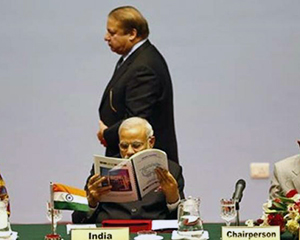
Dawn News, citing diplomatic observers, said Pakistan is exploring the possibility of creating a greater South Asian economic alliance to counter India's "controlling hold" on the eight-member South Asian Association for Regional Cooperation (SAARC).

A parliamentary delegation from Pakistan, which is now in New York, pitched this idea during its five-day visit to Washington last week, the report said.

"A greater South Asia is already emerging," Senator Mushahid Hussain Syed was quoted as saying in one of his interactions with the media.

"This greater South Asia includes China, Iran and the neighbouring Central Asian republics," he said.

He described the China-Pakistan Economic Corridor as the key economic route linking South Asia with Central Asia.

The Gwadar port, Syed said, would be the nearest warm water port, not only for China but also for the land-locked Central Asian states. "We want India to join this arrangement as well," said Syed.

Indians are "unlikely to accept" the offer as they are comfortable with the advantage that SAARC provides them, the report said.

"India used its influence in SAARC to isolate Pakistan when it announced that it would not attend the regional group's 19th summit, scheduled in Islamabad," the report said.

Citing continuous cross border terrorism by Pakistan, India had announced last month that "in the prevailing circumstances, the Indian government is unable to participate in the proposed Summit in Islamabad."

Besides India, four other SAARC members -- Bangladesh, Bhutan, Sri Lanka and Afghanistan -- had also pulled out of the summit.

"Among the eight SAARC nations, Afghanistan and Bangladesh are India's strong allies while Bhutan, surrounded by India from all sides, is too small to resist any move from New Delhi. The Maldives, Nepal and Sri Lanka have good ties with Pakistan, but they are not large enough to take on India," the report said.

The report cited that a senior diplomat had confirmed reports that Pakistan is actively seeking a new regional arrangement.

"Apparently, the showdown forced Pakistan to conclude that in its present shape, SAARC will always be dominated by India. That's why they are now talking about a greater South Asia," the diplomat was quoted as saying.

"Pakistan hopes that this new arrangement will give it more room to manoeuvre when India tries to force a decision on it," another diplomat said.

The report quoted diplomatic observers in Washington as saying that the proposed arrangement also suits China as it is also worried about India's rapidly growing influence in the region.

"They argue that China can play an important role in persuading Central Asian republics and Iran to join the new arrangement. But the observers warn that SAARC members will have little interest in supporting the idea," the report said.

"There is not much benefit for Bangladesh, Nepal and Sri Lanka in joining a land route far from their borders and Bangladesh and Sri Lanka have their own ports," it said.

The report stated thatt he member that is likely to get the most benefits from a greater South Asian alliance is Afghanistan, which is technically a land-locked Central Asian nation.

Any trade route that links South and Central Asian regions is good for Afghanistan, it noted.

"But observers believe that Afghanistan is too closely linked to India to join any arrangement that hurts India's interests. Afghanistan's presence in SAARC, however, justifies Pakistan's argument that Central Asian nations can be included in a greater South Asia.

Afghanistan applied for SAARC membership in 2006 and joined a year later, generating an interesting debate on the definition of South Asian identity because Afghanistan is a Central Asian country, the report said.

"But, as a South Asian diplomat pointed out, even if a greater South Asia became reality, there's no guarantee that its members would support Pakistan in its disputes with India," it said.

"Many Central Asian states have strong ties with India and Iran too has problems with Pakistan," the diplomat was quoted as saying.

Comments

Rikaz
 - 
Wednesday, 12 Oct 2016

India should not have cancelled this conference....

Add new comment

  • Coastaldigest.com reserves the right to delete or block any comments.
  • Coastaldigset.com is not responsible for its readers’ comments.
  • Comments that are abusive, incendiary or irrelevant are strictly prohibited.
  • Please use a genuine email ID and provide your name to avoid reject.
News Network
April 8,2020

Washington, Apr 8: President Donald Trump has threatened to put a "very powerful" hold on US' funding to the World Health Organization, accusing the UN agency of being "very China centric" and criticising it for having "missed the call" in its response to the coronavirus pandemic.

Trump slammed the global health agency for its early guidance aimed at countering the international spread of the coronavirus.

"We're going to put a hold on money spent to the WHO. We're going to put a very powerful hold on it and we're going to see. It's a great thing if it works. But when they call every shot wrong, that's no good," Trump told reporters at his daily White House news conference on Tuesday.

The Geneva-headquartered World Health Organization (WHO), receives vast amounts of money from the United States.

"We pay for a majority or the biggest portion of their money. They actually criticized and disagreed with my travel ban at the time I did it. They were wrong. They've been wrong about a lot of things. They had a lot of information early and they didn't want to - they're very - they seem to be very China centric," Trump said.

The president said his administration was going to look into the US funding to the WHO.

"We give a majority of the money that they get, and it's much more than the USD 58 million. USD 58 million is a small portion of what they've got over the years. Sometimes they get much more than that. Sometimes it's for programs that they're doing, and-it's much bigger numbers. If the programmes are good, that's great as far as we're concerned," he said.

"But we want to look into it, WHO, because they called it wrong. They (WHO) called it wrong. They missed the call. They could've called it months earlier. They would have known and they should have known and they probably did know. So, we'll be looking into that very carefully, and we're going to put a hold on money spent to the WHO," Trump said.

Meanwhile, Senator Jim Risch, chairman of Senate Foreign Relations Committee, called for an independent investigation into the WHO's handling of the COVID-19 response.

"The WHO has failed not only the American people, it has failed the world with its flagrant mishandling of the response to COVID-19," said Risch.

WHO Director general Tedros Adhanom Ghebreyesus' apparent unwillingness to hold the Chinese Communist Party to even the minimum standard of global health and transparency hindered the world's ability to blunt the spread of this pandemic, he said.

"It is completely unacceptable that the world's global health organization has become a political puppet of the Chinese government," he alleged, adding that "an independent investigation into the WHO's handling of the COVID-19 response is imperative."

The United States is the largest contributor to the WHO.

"Our valuable tax payer dollars should go towards investments to prevent the spread of disease, not to aid and abet cover-ups that cost lives and isolate portions of the world's population on political grounds, as has been the case with Taiwan," Senator Risch said.

A bipartisan group of nearly two dozen lawmakers announced Tuesday to introduce a resolution to defund the WHO until Ghebreyesus resigns and an international commission investigates the organisation's role in covering up the Chinese Communist Party's failed COVID-19 response.

"The WHO helped the Chinese Communist Party hide the threat of COVID-19 from the world and now more than 10,000 Americans are dead, a number that is expected to rise dramatically in the coming weeks," Congressman Guy Reschenthaler alleged.

"The United States is the largest contributor to WHO. It is not right that Americans' hard-earned tax dollars are being used to propagate China's lies and hide information that could have saved lives. This bill will hold the WHO accountable for their negligence and deceit," he asserted.

The United States' intelligence community has reported that the Chinese government hid the threat of COVID-19 and, as a result, made it difficult for the rest of the world to respond early, appropriately and aggressively, said Congressman Fred Keller.

"For reasons beyond understanding, the WHO acted as a silent partner in this effort instead of protecting the lives of millions across the world, including hundreds of thousands of American citizens. Our hard-earned tax dollars should not go to a global organization more concerned with not offending the Chinese government than providing accurate information and protecting innocent lives," Keller said.

Senator Marco Rubio accused the Chinese Communist Party of using WHO "to mislead the world."

"The organisation's leadership is either complicit or dangerously incompetent. I will work with the Trump Administration to ensure that WHO is independent and has not been compromised by the CCP before we continue our current funding, he added.

According to Johns Hopkins University, there are over 1.43 million confirmed coronavirus cases across the world and over 82,000 people have died due to the disease. The US has nearly 400,000 infections, the highest in the world.

Comments

Add new comment

  • Coastaldigest.com reserves the right to delete or block any comments.
  • Coastaldigset.com is not responsible for its readers’ comments.
  • Comments that are abusive, incendiary or irrelevant are strictly prohibited.
  • Please use a genuine email ID and provide your name to avoid reject.
News Network
July 6,2020

Beijing, Jul 6: A city in northern China on Sunday sounded an alert after a suspected case of bubonic plague was reported, according to official media here.

Bayannur, Inner Mongolia Autonomous Region, announced a level III warning of plague prevention and control, state-run People’s Daily Online reported.

The suspected bubonic plague case was reported on Saturday by a hospital in Bayannur. The local health authority announced that the warning period will continue until the end of 2020.

"At present, there is a risk of a human plague epidemic spreading in this city. The public should improve its self-protection awareness and ability, and report abnormal health conditions promptly,” the local health authority said.

On July 1, state-run Xinhua news agency said that two suspected cases of bubonic plague reported in Khovd province in western Mongolia have been confirmed by lab test results.

The confirmed cases are a 27-year-old resident and his 17-year-old brother, who are being treated at two separate hospitals in their province, it quoted a health official as saying.

The brothers ate marmot meat, the health official said, warning people not to eat marmot meat.

A total of 146 people who had contact with them have been isolated and treated at local hospitals, according to Narangerel.

Bubonic plague is a bacterial disease that is spread by fleas living on wild rodents such as marmots. It can kill an adult in less than 24 hours if not treated in time, according to the World Health Organization (WHO).

A couple died of bubonic plague in the western Mongolian province of Bayan-Ulgii last year after eating raw marmot meat.

The news of bubonic plague came after Chinese researchers issued an early warning over another potential pandemic caused by an influenza virus in pigs.

Scientists from China Agricultural University, the Chinese Centre for Disease Control and Prevention and other institutes detected a pig influenza virus bearing genotype 4 (G4), which is contagious among pigs and has the possibility of jumping to humans, as the G4 virus is able to bind with human cells, state-run Global Times reported last week.

The researchers are concerned that it could mutate further so that it can spread easily from person to person, and trigger a global outbreak, BBC reported.

"Controlling the prevailing G4 EA H1N1 viruses in pigs and close monitoring in human populations, especially workers in the swine industry, should be urgently implemented," Chinese researchers warned in the paper.

The new diseases were reported even as China grappled with the second attack of Covid-19 in Beijing after controlling it in Wuhan where it was first reported in December last year.

On Saturday, Beijing reported a single-digit Covid-19, local authorities said Sunday.

The number of newly confirmed Covid-19 cases reached a peak in Beijing on June 13 and 14 and then started declining in general, Xinhua quoted local officials as saying.

From June 11 to July 4, the city reported 334 confirmed locally transmitted cases, 47 per cent of whom are workers of the Xinfadi wholesale food market, the official said.

Comments

Add new comment

  • Coastaldigest.com reserves the right to delete or block any comments.
  • Coastaldigset.com is not responsible for its readers’ comments.
  • Comments that are abusive, incendiary or irrelevant are strictly prohibited.
  • Please use a genuine email ID and provide your name to avoid reject.
Agencies
May 10,2020

Paris, May 10: The number of coronavirus cases worldwide topped four million as some of the hardest-hit countries readied Sunday to lift lockdown restrictions despite concern about a second wave of infections.

Governments around the world are trying to stop the spread of the deadly disease while scrambling for ways to relieve pressure on their economies, which are facing a historic downturn with millions pushed into unemployment.

Despite the intense political pressure to reopen, nations are also keen to avoid second waves of infections that could overwhelm healthcare systems, with reminders over the weekend of the threat posed by the virus.

In the United States, media reported Saturday that the nation's top infectious disease expert, Anthony Fauci, was among three members of the White House coronavirus task force who will self-isolate after potential exposure.

And in South Korea, the capital Seoul shut all bars and clubs on Saturday as more than 50 cases were linked to a man who tested positive after spending time in one of the city's busiest nightlife districts.

Despite the risks, some governments in hard-hit Europe have said are signs of progress that justify cautious steps towards normality.

Officials in France on Saturday said the day's death toll of 80 was the lowest since early April, while nursing home fatalities also fell sharply as the nation prepared to relax curbs on public movement imposed eight weeks ago.

The easing, to begin Monday, has brought mixed reactions.

"I've been scared to death" about the reopening, said Maya Flandin, a bookshop manager from Lyon. "It's a big responsibility to have to protect my staff and my customers."

French health officials have warned that social distancing must be kept up even as restrictions are eased.

In Spain, about half the population will be allowed out on Monday for limited socialisation, and restaurants will be able to offer some outdoor service as the country begins a phased transition set to last through June.

With lingering fears of a resurgence, authorities excluded Madrid and Barcelona -- two COVID-19 hotspots -- from the first phase.

Belgium is also easing some restrictions on Monday, and in some parts of Germany, bars and restaurants reopened on Saturday with further easing set for Monday.

In Britain, Prime Minister Boris Johnson is expected Sunday to lay out a plan for the nation to emerge out of its current lockdown.

Media reports have suggested that Britain may introduce a mandatory 14-day quarantine for international arrivals to stop the spread of the virus.

Global economic figures are pointing to the most acute downturn in nearly a century, with businesses forced to shut and supply lines badly disrupted, and pressure is growing on leaders around the world to find a way out as the worldwide death toll topped 277,000 and infections crossed four million.

In the United States, the country with the highest death toll and where more than 20 million people have lost their jobs, President Donald Trump has insisted that next year would be "phenomenal" for the economy, urging reopening despite the virus still claiming well over 1,000 lives daily in the country.

The scale of the challenge was brought in sharp focus over the weekend as US media reported that top disease expert Anthony Fauci, who has become the trusted face of the government response to the pandemic, is going to self-isolate after possible exposure to an infected White House staffer.

Fauci told CNN that he will undergo a "modified quarantine" as he had not been in close proximity to the staffer, the network reported. He will remain at home teleworking, and will wear a mask for two weeks.

Robert Redfield, the director of the Centers for Disease Control and Prevention, and Stephen Hahn, the commissioner of the Food and Drug Administration, will also self-isolate, CNN added.

All three will still testify at Tuesday's Senate coronavirus hearing, with Redfield and Hahn participating via video link, according to Senator Lamar Alexander, chairman of the chamber's health committee.

It is believed Fauci will attend wearing a mask, CNN reported.

President Trump has faced sharp criticism from his predecessor Barack Obama, who said on a leaked tape that Trump's handling of the crisis was an "absolute chaotic disaster".

With people wearying of being indoors and under economic pressure, anti-lockdown protests have been held in a number of countries in recent weeks, with some demonstrators arguing that such restrictions violate their rights and others promoting conspiracy theories about the pandemic.

Ten people were arrested and a police officer injured in Melbourne, Australia, on Sunday in the latest such protest, where around 150 people gathered to demand an end to the shutdown.

Participants were promoting a number of conspiracy theories, such as linking 5G cellular communications to the disease.

Australian chief medical officer Brendan Murphy said there was "a lot of very silly misinformation out there", including the 5G allegation.

"I have unfortunately received a lot of communication from these conspiracy theorists myself," he said.

"It is complete nonsense. 5G has got nothing at all to do with coronavirus."

Comments

Add new comment

  • Coastaldigest.com reserves the right to delete or block any comments.
  • Coastaldigset.com is not responsible for its readers’ comments.
  • Comments that are abusive, incendiary or irrelevant are strictly prohibited.
  • Please use a genuine email ID and provide your name to avoid reject.