



Pak seeks bigger SAARC to counter India's influence

October 12, 2016

Islamabad, Oct 12: Pakistan is exploring the possibility of creating a greater South Asian economic alliance to include China, Iran and neighbouring Central Asian republics as part of its bid counter India's influence in SAARC, a media report said today.pak
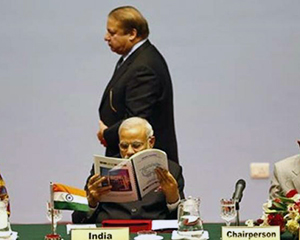
Dawn News, citing diplomatic observers, said Pakistan is exploring the possibility of creating a greater South Asian economic alliance to counter India's "controlling hold" on the eight-member South Asian Association for Regional Cooperation (SAARC).

A parliamentary delegation from Pakistan, which is now in New York, pitched this idea during its five-day visit to Washington last week, the report said.

"A greater South Asia is already emerging," Senator Mushahid Hussain Syed was quoted as saying in one of his interactions with the media.

"This greater South Asia includes China, Iran and the neighbouring Central Asian republics," he said.

He described the China-Pakistan Economic Corridor as the key economic route linking South Asia with Central Asia.

The Gwadar port, Syed said, would be the nearest warm water port, not only for China but also for the land-locked Central Asian states. "We want India to join this arrangement as well," said Syed.

Indians are "unlikely to accept" the offer as they are comfortable with the advantage that SAARC provides them, the report said.

"India used its influence in SAARC to isolate Pakistan when it announced that it would not attend the regional group's 19th summit, scheduled in Islamabad," the report said.

Citing continuous cross border terrorism by Pakistan, India had announced last month that "in the prevailing circumstances, the Indian government is unable to participate in the proposed Summit in Islamabad."

Besides India, four other SAARC members -- Bangladesh, Bhutan, Sri Lanka and Afghanistan -- had also pulled out of the summit.

"Among the eight SAARC nations, Afghanistan and Bangladesh are India's strong allies while Bhutan, surrounded by India from all sides, is too small to resist any move from New Delhi. The Maldives, Nepal and Sri Lanka have good ties with Pakistan, but they are not large enough to take on India," the report said.

The report cited that a senior diplomat had confirmed reports that Pakistan is actively seeking a new regional arrangement.

"Apparently, the showdown forced Pakistan to conclude that in its present shape, SAARC will always be dominated by India. That's why they are now talking about a greater South Asia," the diplomat was quoted as saying.

"Pakistan hopes that this new arrangement will give it more room to manoeuvre when India tries to force a decision on it," another diplomat said.

The report quoted diplomatic observers in Washington as saying that the proposed arrangement also suits China as it is also worried about India's rapidly growing influence in the region.

"They argue that China can play an important role in persuading Central Asian republics and Iran to join the new arrangement. But the observers warn that SAARC members will have little interest in supporting the idea," the report said.

"There is not much benefit for Bangladesh, Nepal and Sri Lanka in joining a land route far from their borders and Bangladesh and Sri Lanka have their own ports," it said.

The report stated thatt he member that is likely to get the most benefits from a greater South Asian alliance is Afghanistan, which is technically a land-locked Central Asian nation.

Any trade route that links South and Central Asian regions is good for Afghanistan, it noted.

"But observers believe that Afghanistan is too closely linked to India to join any arrangement that hurts India's interests. Afghanistan's presence in SAARC, however, justifies Pakistan's argument that Central Asian nations can be included in a greater South Asia.

Afghanistan applied for SAARC membership in 2006 and joined a year later, generating an interesting debate on the definition of South Asian identity because Afghanistan is a Central Asian country, the report said.

"But, as a South Asian diplomat pointed out, even if a greater South Asia became reality, there's no guarantee that its members would support Pakistan in its disputes with India," it said.

"Many Central Asian states have strong ties with India and Iran too has problems with Pakistan," the diplomat was quoted as saying.

Comments

Rikaz
 - 
Wednesday, 12 Oct 2016

India should not have cancelled this conference....

Add new comment

  • Coastaldigest.com reserves the right to delete or block any comments.
  • Coastaldigset.com is not responsible for its readers’ comments.
  • Comments that are abusive, incendiary or irrelevant are strictly prohibited.
  • Please use a genuine email ID and provide your name to avoid reject.
News Network
February 17,2020

Feb 17: Chinese authorities on Monday reported a slight upturn in new virus cases and 105 more deaths for a total of 1,770 since the outbreak began two months ago.

The 2,048 new cases followed three days of declines but was up by just 39 cases from the previous day’s figure. Another 10,844 people have recovered from COVID-19, a disease caused by the new coronavirus, and have been discharged from hospitals, according to Monday’s figures.

The update followed the publication late Saturday in China’s official media of a recent speech by President Xi Jinping in which he indicated for the first time that he had led the response to the outbreak from early in the crisis. While the reports were an apparent attempt to demonstrate the Communist Party leadership acted decisively from the start, it also opened Xi up to criticism over why the public was not alerted sooner.

In his speech, Xi said he gave instructions on fighting the virus on Jan. 7 and ordered the shutdown of the most-affected cities that began on Jan. 23.

The disclosure of his speech indicates top leaders knew about the outbreak’s potential severity at least two weeks before such dangers were made known to the public. It was not until late January that officials said the virus can spread between humans and public alarm began to rise.

New cases in other countries are raising growing concerns about containment of the virus.

Taiwan on Sunday reported its first death from COVID-19, the fifth fatality outside of mainland China. Taiwan’s Central News Agency, citing health minister Chen Shih-chung, said the man who died was in his 60s and had not traveled overseas recently and had no known contact with virus patients.

Japanese Prime Minister Shinzo Abe convened an experts meeting to discuss containment measures in his country, where more than a dozen cases have emerged in the past few days without any obvious link to China.

“The situation surrounding this virus is changing by the minute,” Abe said.

Japanese Health Minister Katsunobu Kato said the country is “entering into a phase that is different from before,” requiring new steps to stop the spread of the virus.

Japan now has 413 confirmed cases, including 355 from a quarantined cruise ship, and one death from the virus. Its total is the highest number of cases among about two dozen countries outside of China where the illness has spread.

Hundreds of Americans from the cruise ship took charter flights home, as Japan announced another 70 infections had been confirmed on the Diamond Princess. Canada, Hong Kong and Italy were planning similar flights.

The 300 or so Americans flying on U.S.-government chartered aircraft back to the U.S. will face another 14-day quarantine at Travis Air Force Base in California and Lackland Air Force Base in Texas. The U.S. Embassy said the departure was offered because people on the ship were at a high risk of exposure to the virus. People with symptoms were banned from the flights.

About 255 Canadians and 330 Hong Kong residents are on board the ship or undergoing treatment in Japanese hospitals. There are also 35 Italians, of which 25 are crew members, including the captain.

In China’s Hubei province, where the outbreak began in December, all vehicle traffic will be banned in another containment measure. It expands a vehicle ban in the provincial capital, Wuhan, where public transportation, trains and planes have been halted for weeks.

Exceptions were being made for vehicles involved in epidemic prevention and transporting daily necessities.

Hubei has built new hospitals with thousands of patient beds and China has sent thousands of military medical personnel to staff the new facilities and help the overburdened health care system.

Last Thursday, Hubei changed how it recognized COVID-19 cases, accepting a doctor’s diagnosis rather than waiting for confirmed laboratory test results, in order to treat patients faster. The tally spiked by more than 15,000 cases under the new method.

Comments

Add new comment

  • Coastaldigest.com reserves the right to delete or block any comments.
  • Coastaldigset.com is not responsible for its readers’ comments.
  • Comments that are abusive, incendiary or irrelevant are strictly prohibited.
  • Please use a genuine email ID and provide your name to avoid reject.
News Network
June 13,2020

Jun 13: Requiring the wearing of masks to prevent the spread of the novel coronavirus in areas at the epicenter of the global pandemic may have prevented tens of thousands of infections, a new study suggests.

Mask-wearing is even more important for preventing the virus' spread and the sometimes deadly COVID-19 illness it causes than social distancing and stay-at-home orders, researchers said, in the study published in PNAS: The Proceedings of the National Academy of Sciences of the USA.

Infection trends shifted dramatically when mask-wearing rules were implemented on April 6 in northern Italy and April 17 in New York City - at the time among the hardest hit areas of the world by the health crisis - the study found.

"This protective measure alone significantly reduced the number of infections, that is, by over 78,000 in Italy from April 6 to May 9 and over 66,000 in New York City from April 17 to May 9," researchers calculated.

When mask-wearing went into effect in New York, the daily new infection rate fell by about 3% per day, researchers said. In the rest of the country, daily new infections continued to increase.

Direct contact precautions - social distancing, quarantine and isolation, and hand sanitizing - were all in place before mask-wearing rules went into effect in Italy and New York City. But they only help minimize virus transmission by direct contact, while face covering helps prevent airborne transmission, the researchers say.

"The unique function of face covering to block atomization and inhalation of virus-bearing aerosols accounts for the significantly reduced infections," they said. That would indicate "that airborne transmission of COVID-19 represents the dominant route for infection."

The U.S. Center for Disease Control and Prevention on Friday urged organizers of large gatherings that involve "shouting, chanting or singing to strongly encourage the use of cloth face coverings to lower the risk of spreading the coronavirus."

Comments

Add new comment

  • Coastaldigest.com reserves the right to delete or block any comments.
  • Coastaldigset.com is not responsible for its readers’ comments.
  • Comments that are abusive, incendiary or irrelevant are strictly prohibited.
  • Please use a genuine email ID and provide your name to avoid reject.
Agencies
February 4,2020

The death toll in China's coronavirus rose sharply to 425 with 64 deaths on Monday alone while 3,235 new confirmed cases were reported, taking the number of those infected with the deadly disease to 20,438, Chinese health authorities said on Tuesday.

The 64 people who died on Monday were all from the Hubei province, the epicentre of the virus, China's National Health Commission said.

Also, 3,235 new confirmed cases of novel coronavirus infection were reported, a big increase in a day.

Another 5,072 new suspected cases were reported on Monday, said the commission, adding that 492 patients became seriously ill.

The commission said that 2,788 patients remained in severe condition and 23,214 people were suspected of being infected with the virus, a pointer that it is increasingly turning virulent.

The overall confirmed cases on the Chinese mainland had reached 20,438 by the end of Monday, the commission said, noting that a total of 425 people had died of the disease.

A total of 632 people had been discharged from hospital after recovery, state-run Xinhua news agency reported As the virus spreads from human to human, 221,015 close contacts had been traced, with 171,329 others still under medical observation.

By the end of Monday, 15 confirmed cases had been reported in Hong Kong, eight in the Macao and 10 in Taiwan.

The Philippines reported the first overseas death from the virus on Sunday while 148 cases have been reported from abroad.

India has reported three cases of the coronavirus. All the three patients from Kerala recently returned from the affected Wuhan city.

Currently, 647 Indians and seven Maldivians who have been evacuated from Wuhan and Hubei are in 14-day quarantine at a medical camp in Manesar, near Delhi.

As the virus continued to spread at an alarming rate, Chinese President Xi Jinping on Monday warned officials of punishment if they shirked responsibility in tackling the virus outbreak.

On Monday, China has opened a 1,000-bed hospital built in record nine days in Wuhan city and started trials for new drug to contain the virus and is set to open another 1,300 bed hospital next to it on Wednesday.

The ruling Communist Party of China on Monday held its political bureau meeting presided by President Xi to review the steps being taken on various fronts to halt the spread of the deadly virus.

The outcome of the epidemic prevention and control directly affects people's lives and health, the overall economic and social stability and the country's opening-up, Xi said.

"Those who disobey the unified command or shirk off responsibilities will be punished," Xi was quoted as saying by the state-run Xinhua news agency.

Xi said that the party and government leaders supervising them would also be held accountable in severe cases.

Chinese armament firms, including those building aircraft carrier and military aircraft, have postponed planned work in order to concentrate on controlling the risk of coronavirus, state-run Global Times reported.

Noted Chinese health expert Zhong Nanshan has said that based on the fresh evidence, the novel coronavirus, which is spreading rapidly in China and the world, may reach its peak in the next 10 to 14 days, contrary to earlier estimates of climaxing sooner.

This means that the cases would drastically increase in the next two weeks before slowing down.

Also, China has begun clinical trials to test a drug to treat the patients of the coronavirus which till now has no cure.

Currently, patients are being treated with a combination of antivirals and other measures, as scientists race to find a vaccine.

Some reports said drugs to treat HIV too was being tried to treat the patients.

The experimental antiviral drug, Remdesivir, to be tested in field trials is developed by US-based Gilead Sciences. It is aimed at treating infectious diseases such as Ebola and SARS, South China Morning Post reported.

It was given to the first US patient last week - a 35-year-old man whose condition appeared to improve within a day, it said.

Comments

Add new comment

  • Coastaldigest.com reserves the right to delete or block any comments.
  • Coastaldigset.com is not responsible for its readers’ comments.
  • Comments that are abusive, incendiary or irrelevant are strictly prohibited.
  • Please use a genuine email ID and provide your name to avoid reject.