


Pak seeks bigger SAARC to counter India's influence

October 12, 2016

Islamabad, Oct 12: Pakistan is exploring the possibility of creating a greater South Asian economic alliance to include China, Iran and neighbouring Central Asian republics as part of its bid counter India's influence in SAARC, a media report said today.pak
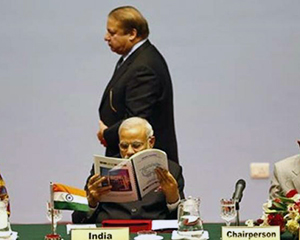
Dawn News, citing diplomatic observers, said Pakistan is exploring the possibility of creating a greater South Asian economic alliance to counter India's "controlling hold" on the eight-member South Asian Association for Regional Cooperation (SAARC).

A parliamentary delegation from Pakistan, which is now in New York, pitched this idea during its five-day visit to Washington last week, the report said.

"A greater South Asia is already emerging," Senator Mushahid Hussain Syed was quoted as saying in one of his interactions with the media.

"This greater South Asia includes China, Iran and the neighbouring Central Asian republics," he said.

He described the China-Pakistan Economic Corridor as the key economic route linking South Asia with Central Asia.

The Gwadar port, Syed said, would be the nearest warm water port, not only for China but also for the land-locked Central Asian states. "We want India to join this arrangement as well," said Syed.

Indians are "unlikely to accept" the offer as they are comfortable with the advantage that SAARC provides them, the report said.

"India used its influence in SAARC to isolate Pakistan when it announced that it would not attend the regional group's 19th summit, scheduled in Islamabad," the report said.

Citing continuous cross border terrorism by Pakistan, India had announced last month that "in the prevailing circumstances, the Indian government is unable to participate in the proposed Summit in Islamabad."

Besides India, four other SAARC members -- Bangladesh, Bhutan, Sri Lanka and Afghanistan -- had also pulled out of the summit.

"Among the eight SAARC nations, Afghanistan and Bangladesh are India's strong allies while Bhutan, surrounded by India from all sides, is too small to resist any move from New Delhi. The Maldives, Nepal and Sri Lanka have good ties with Pakistan, but they are not large enough to take on India," the report said.

The report cited that a senior diplomat had confirmed reports that Pakistan is actively seeking a new regional arrangement.

"Apparently, the showdown forced Pakistan to conclude that in its present shape, SAARC will always be dominated by India. That's why they are now talking about a greater South Asia," the diplomat was quoted as saying.

"Pakistan hopes that this new arrangement will give it more room to manoeuvre when India tries to force a decision on it," another diplomat said.

The report quoted diplomatic observers in Washington as saying that the proposed arrangement also suits China as it is also worried about India's rapidly growing influence in the region.

"They argue that China can play an important role in persuading Central Asian republics and Iran to join the new arrangement. But the observers warn that SAARC members will have little interest in supporting the idea," the report said.

"There is not much benefit for Bangladesh, Nepal and Sri Lanka in joining a land route far from their borders and Bangladesh and Sri Lanka have their own ports," it said.

The report stated thatt he member that is likely to get the most benefits from a greater South Asian alliance is Afghanistan, which is technically a land-locked Central Asian nation.

Any trade route that links South and Central Asian regions is good for Afghanistan, it noted.

"But observers believe that Afghanistan is too closely linked to India to join any arrangement that hurts India's interests. Afghanistan's presence in SAARC, however, justifies Pakistan's argument that Central Asian nations can be included in a greater South Asia.

Afghanistan applied for SAARC membership in 2006 and joined a year later, generating an interesting debate on the definition of South Asian identity because Afghanistan is a Central Asian country, the report said.

"But, as a South Asian diplomat pointed out, even if a greater South Asia became reality, there's no guarantee that its members would support Pakistan in its disputes with India," it said.

"Many Central Asian states have strong ties with India and Iran too has problems with Pakistan," the diplomat was quoted as saying.

Comments

Rikaz
 - 
Wednesday, 12 Oct 2016

India should not have cancelled this conference....

Add new comment

  • Coastaldigest.com reserves the right to delete or block any comments.
  • Coastaldigset.com is not responsible for its readers’ comments.
  • Comments that are abusive, incendiary or irrelevant are strictly prohibited.
  • Please use a genuine email ID and provide your name to avoid reject.
News Network
February 9,2020

Nakhon Ratchasima, Feb 9: The Thai soldier who killed at least 20 people and holed up in a mall overnight was shot dead Sunday morning by commandos, ending a near-17-hour ordeal which left dozens wounded and stunned the country.

It was unclear how many people remained trapped inside the Terminal 21 mall in Nakhon Ratchasima -- also known as Korat -- where the gunman held out through the night, armed with assault weapons stolen from his barracks.

Volleys of gunfire rang out as the siege ran into dawn, hours after Thai security services stormed the ground floor and freed scores of stunned, terrified shoppers from a bloody rampage that the gunman -- a junior army officer identified as Sergeant-Major Jakrapanth Thomma -- had relayed via Facebook posts.

"He was shot dead thirty minutes ago" (0200 GMT), chief of the Crime Suppression Division Jirabhob Bhuridej told AFP.

Commandos from elite Thai police units killed the gunman, a police spokesman added, after an operation involving hundreds of security personnel.

"The official death toll is 20 and wounded 42... nine are in surgery," Narinrat Pitchayakamin, a Korat doctor told reporters, revising down an initial death toll of 21.

But it was unclear if there were more victims inside the multi-level complex which was packed with Saturday shoppers when the gunman stormed in.

A fleet of ambulances left the front of the complex and forensic police poured into the grim crime scene, shortly before the gunman's death was confirmed.

The night was peppered with heavy exchanges of gunfire and sporadic evacuations.

A police officer who took part in a raid to flush out the gunman died, according to deputy prime minister Anutin Charnvirakul. "He had been hit and unfortunately, he couldn't make it," said Anutin.

Shocked evacuees recounted how an ordinary Saturday shopping day at the busy mall descended into horror as the gunman entered.

"It was like a dream... I'm grateful I survived," Sottiyanee Unchalee, 48, told AFP, explaining she hid in the toilet of a gym inside the mall as she heard the gunfire.

"I'm so sorry for those who died... (and) the people still trapped inside."

Stolen weapons

Jakrapanth relayed his shooting spree through Facebook posts which charted the attack from the army barracks in the city to the mall, where an unknown number of shoppers remained trapped.

A volunteer rescue worker recounted a bloody scene of horror after his team carried four corpses to the hospital.

"I've never seen anything like this," Peerapong Chatadee told AFP.

"I just feel so sad. He is a soldier, he should not have fired at unarmed people."

The bloodshed began Saturday afternoon when Jakrapanth shot three people -- among them at least one soldier -- at a senior officer's house and then at the nearby army barracks, before driving an army vehicle to the town centre.

There the gunman used weapons stolen from the military arsenal to unleash carnage in the town centre.

He "used a machine gun and shot innocent victims resulting in many injured and dead", said police spokesman Krissana Pattanacharoen.

Throughout the day, Jakrapanth posted images of himself and wrote several posts on his Facebook page as the attack unfolded.

In one Facebook video -- since deleted -- the assailant, wearing an army helmet, filmed from an open-top jeep, saying, "I'm tired... I can't pull my finger anymore" as he made a trigger symbol with his hand.

There were also photos of a man in a ski mask holding up a pistol.

A Facebook spokesperson said: "We have removed the gunman's accounts from our services and will work around the clock to remove any violating content related to this attack as soon as we become aware of it."

The city is home to one of the largest barracks in Thailand, a country where the military is enmeshed in politics and society.

The nation also has one of the highest rates of gun ownership in the world, and several shootings at courthouses last year renewed concern about gun violence.

Comments

Add new comment

  • Coastaldigest.com reserves the right to delete or block any comments.
  • Coastaldigset.com is not responsible for its readers’ comments.
  • Comments that are abusive, incendiary or irrelevant are strictly prohibited.
  • Please use a genuine email ID and provide your name to avoid reject.
News Network
March 24,2020

New Delhi, Mar 24: Reports of a person in China dying due to a virus called hantavirus have spread panic at a time when the world is battling the pandemic of novel coronavirus, which began in China.

The novel coronavirus has killed over 16,000 people around the world and the outbreak is yet to be brought under control.

This morning, hantavirus became one of the top trends on Twitter after the Chinese state media tweeted about one person in the country dying due the virus. However, it turns out, hantavirus is not a new virus and has been infecting humans for decades.

Global Times, a state-run English-language newspaper, wrote on Twitter on Tuesday, "A person from Yunnan Province died while on his way back to Shandong Province for work on a chartered bus on Monday. He was tested positive for hantavirus. Other 32 people on bus were tested."

Global Times's hantavirus report on Twitter has been shared over 6,000 times.

On Tuesday, hantavirus was one of the top trends on Twitter.

WHAT IS HANTAVIRUS?

Some people are calling it a new virus but so is not the case. United States's National Center for Biotechnology Information (NCBI) in a journal writes that currently, the hantavirus genus includes more than 21 species.

"Hantaviruses in the Americas are known as 'New World' hantaviruses and may cause hantavirus pulmonary syndrome [HPS]," CDC says. "Other hantaviruses, known as 'Old World' hantaviruses, are found mostly in Europe and Asia and may cause hemorrhagic fever with renal syndrome [HFRS]."

Any man, woman, or child who is around mice or rats that carry harmful hantaviruses can get HPS.

People get HPS when they breath in hantaviruses. This can happen when rodent urine and droppings that contain a hantavirus are stirred up into the air. People can also become infected when they touch mouse or rat urine, droppings, or nesting materials that contain the virus and then touch their eyes, nose, or mouth. They can also get HPS from a mouse or rat bite.

In the US, 10 confirmed cases of hantavirus infection in people who visited Yosemite National Park in California, US, in November 2012, were reported. Similarly, in 2017, CDC assisted health officials in investigating an outbreak of Seoul virus infection that infected 17 people in seven states.

WHAT ARE THE SYMPTOMS OF HANTAVIRUS?

If people get HPS, they will feel sick one to five weeks after they were around mice or rats that carried a hantavirus.

At first people with HPS will have:

Fever
Severe muscle aches
Fatigue

After a few days, they will have a hard time breathing. Sometimes people will have headaches, dizziness, chills, nausea, vomiting, diarrhoea, and stomach pain.

Usually, people do not have a runny nose, sore throat, or a rash.

Comments

Add new comment

  • Coastaldigest.com reserves the right to delete or block any comments.
  • Coastaldigset.com is not responsible for its readers’ comments.
  • Comments that are abusive, incendiary or irrelevant are strictly prohibited.
  • Please use a genuine email ID and provide your name to avoid reject.
News Network
January 2,2020

Washington, Jan 2: The number of people killed in large commercial airplane crashes fell by more than 50% in 2019 despite a high-profile Boeing 737 MAX crash in Ethiopia in March, a Dutch consulting firm said on Wednesday. Aviation consulting firm To70 said there were 86 accidents involving large commercial planes - including eight fatal incidents - resulting in 257 fatalities last year. In 2018, there were 160 accidents, including 13 fatal ones, resulting in 534 deaths, the firm said.

To70 said the fatal accident rate for large airplanes in commercial passenger air transport was just 0.18 fatal accident per million flights in 2019, or an average one fatal accident every 5.58 million flights, a significant improvement over 2018. The fatality numbers include passengers, air crew such as flight attendants and any people on the ground killed in a plane accident

Large passenger airplanes in the study are aircraft used by nearly all travelers on airlines worldwide but excludes small commuter airplanes in service, including the Cessna Caravan and some smaller turboprop airplanes, according to To70.

On Dec. 23, Boeing's board said it had fired Chief Executive Dennis Muilenburg after a pair of fatal crashes involving the 737 MAX forced it to announce it was halting output of its best-selling jetliner. The 737 MAX has been grounded since March after an October 2018 crash in Indonesia and the crash of a MAX in Ethiopia in March killed a total of 346 people.

To70 said the aviation industry spent significant effort in 2019 "focusing on so-called 'future threats' such as drones." But the MAX crashes "are a reminder that we need to retain our focus on the basics that make civil aviation so safe: well-designed and well-built aircraft flown by fully informed and well-trained crews."

The Aviation Safety Network said on Wednesday that, despite the MAX crash, 2019 "was one of the safest years ever for commercial aviation." The 157 people killed in March on Ethiopian Airlines Flight 302 accounted for more than half of all deaths last year worldwide in passenger airline crashes.

Over the last two decades, aviation deaths around the world have been falling dramatically even as travel has increased. As recently as 2005, there were 1,015 deaths aboard commercial passenger flights worldwide, the Aviation Safety Network said.

Last week, 12 people were killed when a Fokker 100 operated by Kazakh carrier Bek Air crashed near Almaty after takeoff. In May, a Russian Sukhoi Superjet 100 aircraft caught fire as it made an emergency landing at Moscow’s Sheremetyevo airport, killing 41 people.

The figures do not include accidents involving military flights, training flights, private flights, cargo operations and helicopters.

Comments

Add new comment

  • Coastaldigest.com reserves the right to delete or block any comments.
  • Coastaldigset.com is not responsible for its readers’ comments.
  • Comments that are abusive, incendiary or irrelevant are strictly prohibited.
  • Please use a genuine email ID and provide your name to avoid reject.