


Pak seeks bigger SAARC to counter India's influence

October 12, 2016

Islamabad, Oct 12: Pakistan is exploring the possibility of creating a greater South Asian economic alliance to include China, Iran and neighbouring Central Asian republics as part of its bid counter India's influence in SAARC, a media report said today.pak
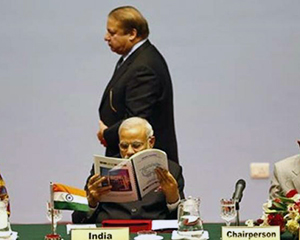
Dawn News, citing diplomatic observers, said Pakistan is exploring the possibility of creating a greater South Asian economic alliance to counter India's "controlling hold" on the eight-member South Asian Association for Regional Cooperation (SAARC).

A parliamentary delegation from Pakistan, which is now in New York, pitched this idea during its five-day visit to Washington last week, the report said.

"A greater South Asia is already emerging," Senator Mushahid Hussain Syed was quoted as saying in one of his interactions with the media.

"This greater South Asia includes China, Iran and the neighbouring Central Asian republics," he said.

He described the China-Pakistan Economic Corridor as the key economic route linking South Asia with Central Asia.

The Gwadar port, Syed said, would be the nearest warm water port, not only for China but also for the land-locked Central Asian states. "We want India to join this arrangement as well," said Syed.

Indians are "unlikely to accept" the offer as they are comfortable with the advantage that SAARC provides them, the report said.

"India used its influence in SAARC to isolate Pakistan when it announced that it would not attend the regional group's 19th summit, scheduled in Islamabad," the report said.

Citing continuous cross border terrorism by Pakistan, India had announced last month that "in the prevailing circumstances, the Indian government is unable to participate in the proposed Summit in Islamabad."

Besides India, four other SAARC members -- Bangladesh, Bhutan, Sri Lanka and Afghanistan -- had also pulled out of the summit.

"Among the eight SAARC nations, Afghanistan and Bangladesh are India's strong allies while Bhutan, surrounded by India from all sides, is too small to resist any move from New Delhi. The Maldives, Nepal and Sri Lanka have good ties with Pakistan, but they are not large enough to take on India," the report said.

The report cited that a senior diplomat had confirmed reports that Pakistan is actively seeking a new regional arrangement.

"Apparently, the showdown forced Pakistan to conclude that in its present shape, SAARC will always be dominated by India. That's why they are now talking about a greater South Asia," the diplomat was quoted as saying.

"Pakistan hopes that this new arrangement will give it more room to manoeuvre when India tries to force a decision on it," another diplomat said.

The report quoted diplomatic observers in Washington as saying that the proposed arrangement also suits China as it is also worried about India's rapidly growing influence in the region.

"They argue that China can play an important role in persuading Central Asian republics and Iran to join the new arrangement. But the observers warn that SAARC members will have little interest in supporting the idea," the report said.

"There is not much benefit for Bangladesh, Nepal and Sri Lanka in joining a land route far from their borders and Bangladesh and Sri Lanka have their own ports," it said.

The report stated thatt he member that is likely to get the most benefits from a greater South Asian alliance is Afghanistan, which is technically a land-locked Central Asian nation.

Any trade route that links South and Central Asian regions is good for Afghanistan, it noted.

"But observers believe that Afghanistan is too closely linked to India to join any arrangement that hurts India's interests. Afghanistan's presence in SAARC, however, justifies Pakistan's argument that Central Asian nations can be included in a greater South Asia.

Afghanistan applied for SAARC membership in 2006 and joined a year later, generating an interesting debate on the definition of South Asian identity because Afghanistan is a Central Asian country, the report said.

"But, as a South Asian diplomat pointed out, even if a greater South Asia became reality, there's no guarantee that its members would support Pakistan in its disputes with India," it said.

"Many Central Asian states have strong ties with India and Iran too has problems with Pakistan," the diplomat was quoted as saying.

Comments

Rikaz
 - 
Wednesday, 12 Oct 2016

India should not have cancelled this conference....

Add new comment

  • Coastaldigest.com reserves the right to delete or block any comments.
  • Coastaldigset.com is not responsible for its readers’ comments.
  • Comments that are abusive, incendiary or irrelevant are strictly prohibited.
  • Please use a genuine email ID and provide your name to avoid reject.
News Network
June 2,2020

Jun 2: Pakistan's COVID-19 cases reached 76,398 on Tuesday after 3,938 new infections were reported across the country, while the death toll due to the coronavirus has gone up to 1,621, according to the health ministry.

The Ministry of National Health Services said that 78 COVID-19 deaths were recorded in the last 24 hours, taking the total number of fatalities in Pakistan to 1,621.

A total of 27, 110 people have recovered, it said.

Sindh has 29,647 patients, Punjab 27,850, Khyber-Pakhtunkhwa 10,485, Balochistan 4,514, Islamabad 2,893, Gilgit-Baltistan 738 and Pakistan-occupied Kashmir 271, it added.

The authorities have conducted 577,974 tests, including 16,548 in the last 24 hours.

The jump in the number of cases comes a day after Prime Minister Imran Khan said that people should learn to live with COVID-19 until a vaccine is developed.

Khan addressed the media after chairing the meeting of National Coordination Committee, the highest body to tackle the pandemic.

"Coronavirus will not go away until the vaccine is discovered. We need to learn to live with it and we can live with it if we follow precautions," he said.

He said the one million volunteers of the government's coronavirus force will raise awareness of the need to follow guidelines.

The government also said that all sectors will be opened slowly after deciding the negative list of businesses which will not be allowed.

Comments

Add new comment

  • Coastaldigest.com reserves the right to delete or block any comments.
  • Coastaldigset.com is not responsible for its readers’ comments.
  • Comments that are abusive, incendiary or irrelevant are strictly prohibited.
  • Please use a genuine email ID and provide your name to avoid reject.
News Network
May 20,2020

Washington, May 20: The United States recorded another 1,536 coronavirus deaths over the past 24 hours, the Johns Hopkins University tracker said.

That figure, tallied as of 8:30 pm (0030 GMT), raises to 91,845 the total number of COVID-19 deaths in the US.

The US tops the global rankings both for the highest death toll and the highest number of infections, with more than 1.5 million cases.

Comments

Add new comment

  • Coastaldigest.com reserves the right to delete or block any comments.
  • Coastaldigset.com is not responsible for its readers’ comments.
  • Comments that are abusive, incendiary or irrelevant are strictly prohibited.
  • Please use a genuine email ID and provide your name to avoid reject.
News Network
June 19,2020

United Nations, Jun 19: Half of the world's children -- one billion every year -- are affected by physical, sexual or psychological violence, suffering injuries and death because countries have failed to follow established strategies to protect them, the first report of its kind from the UN has said, with experts noting that the coronavirus-related lockdowns have left far too many youngsters stuck with their abusers.

While nearly all countries (88 per cent) have laws in place to protect minors, less than half (47 per cent) say they strongly enforce them, said the Global Status Report on Preventing Violence Against Children 2020 launched on Thursday.

Because countries have failed to follow established strategies to protect children, about one billion are affected each year by physical, sexual or psychological violence, it said.

"There is never any excuse for violence against children," WHO Director-General Tedros Adhanom Ghebreyesus said.

"We have evidence-based tools to prevent it, which we urge all countries to implement. Protecting the health and well-being of children is central to protecting our collective health and well-being, now and for the future," he said.

The report -- launched by the World Health Organisation, the UNICEF, the UNESCO, the Special Representative of the UN Secretary-General on Violence against Children and the End Violence Partnership -- charted progress in 155 countries against the "INSPIRE" framework, a set of seven strategies for preventing and responding to violence against children.

The report signaled a clear need in all countries to scale up efforts to implement them. It included the first ever global homicide estimates specifically for children under 18 years of age -- previous estimates were based on data that included 18 to 19-year olds.

According to the findings, in 2017, around 40,000 children were victims of homicide.

"Violence against children has always been pervasive, and now things could be getting much worse," UNICEF Executive Director Henrietta Fore said.

"Lockdowns, school closures and movement restrictions have left far too many children stuck with their abusers, without the safe space that school would normally offer. It is urgent to scale up efforts to protect children during these times and beyond, including by designating social service workers as essential and strengthening child helplines," she said.

UNESCO Director-General Audrey Azoulay said during the COVID-19 pandemic, and the related school closures, "we have seen a rise in violence and hate online – and this includes bullying".

"Now, as schools begin to re-open, children are expressing their fears about going back to school. It is our collective responsibility to ensure that schools are safe environments for all children. We need to think and act collectively to stop violence at school and in our societies at large," Azoulay said.

Stay-at-home measures including school closures have limited the usual sources of support for families and individuals such as friends, extended family or professionals.

This further erodes victims’ ability to successfully cope with crises and the new routines of daily life. Spikes in calls to helplines for child abuse and intimate partner violence have been observed, the report said.

While online communities have become central to maintain many children's learning, support and play, an increase in harmful online behaviors including cyberbullying, risky online behavior and sexual exploitation have been identified.

“Whilst this report was being finalised, confinement measures and the disrupted provision of already limited child protection services exacerbated the vulnerability of children to various forms of violence," said Najat Maalla M’jid, Special Representative of the UN Secretary-General on Violence against Children.

Of the INSPIRE strategies, only access to schools through enrolment showed the most progress with 54 per cent of the countries reporting that a sufficient number of children in need were being reached in this way.

Between 32 per cent and 37 per cent of the countries considered that victims of violence could access support services, while 26 per cent of the countries provided programmes on parent and caregiver support; 21 per cent of the countries had programmes to change harmful norms; and 15 per cent of the countries had modifications to provide safe physical environments for children, the report said.

Although a majority of countries (83 per cent) have national data on violence against children, only 21 per cent used these to set baselines and national targets to prevent and respond to violence against children, it added.

The report said about 80 per cent of countries have national plans of action and policies but only one-fifth have plans that are fully funded or have measurable targets. A lack of funding combined with inadequate professional capacity are likely contributing factors and a reason why implementation has been slow.

"Ending violence against children is the right thing to do, a smart investment to make - and it's possible. We can and must create a world where every child can thrive," Howard Taylor of the End Violence Partnership said.

Comments

Add new comment

  • Coastaldigest.com reserves the right to delete or block any comments.
  • Coastaldigset.com is not responsible for its readers’ comments.
  • Comments that are abusive, incendiary or irrelevant are strictly prohibited.
  • Please use a genuine email ID and provide your name to avoid reject.