


Pak seeks bigger SAARC to counter India's influence

October 12, 2016

Islamabad, Oct 12: Pakistan is exploring the possibility of creating a greater South Asian economic alliance to include China, Iran and neighbouring Central Asian republics as part of its bid counter India's influence in SAARC, a media report said today.pak
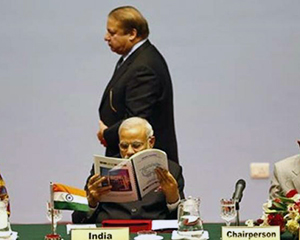
Dawn News, citing diplomatic observers, said Pakistan is exploring the possibility of creating a greater South Asian economic alliance to counter India's "controlling hold" on the eight-member South Asian Association for Regional Cooperation (SAARC).

A parliamentary delegation from Pakistan, which is now in New York, pitched this idea during its five-day visit to Washington last week, the report said.

"A greater South Asia is already emerging," Senator Mushahid Hussain Syed was quoted as saying in one of his interactions with the media.

"This greater South Asia includes China, Iran and the neighbouring Central Asian republics," he said.

He described the China-Pakistan Economic Corridor as the key economic route linking South Asia with Central Asia.

The Gwadar port, Syed said, would be the nearest warm water port, not only for China but also for the land-locked Central Asian states. "We want India to join this arrangement as well," said Syed.

Indians are "unlikely to accept" the offer as they are comfortable with the advantage that SAARC provides them, the report said.

"India used its influence in SAARC to isolate Pakistan when it announced that it would not attend the regional group's 19th summit, scheduled in Islamabad," the report said.

Citing continuous cross border terrorism by Pakistan, India had announced last month that "in the prevailing circumstances, the Indian government is unable to participate in the proposed Summit in Islamabad."

Besides India, four other SAARC members -- Bangladesh, Bhutan, Sri Lanka and Afghanistan -- had also pulled out of the summit.

"Among the eight SAARC nations, Afghanistan and Bangladesh are India's strong allies while Bhutan, surrounded by India from all sides, is too small to resist any move from New Delhi. The Maldives, Nepal and Sri Lanka have good ties with Pakistan, but they are not large enough to take on India," the report said.

The report cited that a senior diplomat had confirmed reports that Pakistan is actively seeking a new regional arrangement.

"Apparently, the showdown forced Pakistan to conclude that in its present shape, SAARC will always be dominated by India. That's why they are now talking about a greater South Asia," the diplomat was quoted as saying.

"Pakistan hopes that this new arrangement will give it more room to manoeuvre when India tries to force a decision on it," another diplomat said.

The report quoted diplomatic observers in Washington as saying that the proposed arrangement also suits China as it is also worried about India's rapidly growing influence in the region.

"They argue that China can play an important role in persuading Central Asian republics and Iran to join the new arrangement. But the observers warn that SAARC members will have little interest in supporting the idea," the report said.

"There is not much benefit for Bangladesh, Nepal and Sri Lanka in joining a land route far from their borders and Bangladesh and Sri Lanka have their own ports," it said.

The report stated thatt he member that is likely to get the most benefits from a greater South Asian alliance is Afghanistan, which is technically a land-locked Central Asian nation.

Any trade route that links South and Central Asian regions is good for Afghanistan, it noted.

"But observers believe that Afghanistan is too closely linked to India to join any arrangement that hurts India's interests. Afghanistan's presence in SAARC, however, justifies Pakistan's argument that Central Asian nations can be included in a greater South Asia.

Afghanistan applied for SAARC membership in 2006 and joined a year later, generating an interesting debate on the definition of South Asian identity because Afghanistan is a Central Asian country, the report said.

"But, as a South Asian diplomat pointed out, even if a greater South Asia became reality, there's no guarantee that its members would support Pakistan in its disputes with India," it said.

"Many Central Asian states have strong ties with India and Iran too has problems with Pakistan," the diplomat was quoted as saying.

Comments

Rikaz
 - 
Wednesday, 12 Oct 2016

India should not have cancelled this conference....

Add new comment

  • Coastaldigest.com reserves the right to delete or block any comments.
  • Coastaldigset.com is not responsible for its readers’ comments.
  • Comments that are abusive, incendiary or irrelevant are strictly prohibited.
  • Please use a genuine email ID and provide your name to avoid reject.
News Network
January 10,2020

Washington, Jan 10: It is “highly likely” that Iran shot down the civilian Ukrainian jetliner that crashed near Tehran late Tuesday, killing all 176 people on board, U.S., Canadian and British officials declared Thursday.

They said the fiery missile strike could well have been a mistake amid rocket launches and high tension throughout the region.

The crash came just a few hours after Iran launched a ballistic attack against Iraqi military bases housing U.S. troops in its violent confrontation with Washington over the U.S. drone strike that killed an Iranian Revolutionary Guard general. The airliner could have been mistaken for a threat, said four U.S. officials, speaking on condition of anonymity to discuss sensitive intelligence.

Canadian prime minister Justin Trudeau, whose country lost at least 63 citizens in the downing, said in Toronto: “We have intelligence from multiple sources including our allies and our own intelligence. The evidence indicates that the plane was shot down by an Iranian surface-to-air missile.”

Likewise, U.K. prime Minister Boris Johnson and Australian prime minister Scott Morrison offered similar statements. Morrison also said it appeared to be a mistake. “All of the intelligence as presented to us today does not suggest an intentional act,” he said.

The assessment that 176 people were killed as collateral damage in the Iranian-U.S. conflict cast a new pall over what had at first appeared to be a relatively calm aftermath following the U.S. military operation that killed Iranian Gen. Qassem Soleimani.

At the White House, U.S. president Donald Trump suggested he believed Iran was responsible for the shootdown and dismissed Iran's initial claim that it was a mechanical issue with the plane.

“Somebody could have made a mistake on the other side.” Trump said, noting the plane was flying in a “pretty rough neighborhood."

Comments

Add new comment

  • Coastaldigest.com reserves the right to delete or block any comments.
  • Coastaldigset.com is not responsible for its readers’ comments.
  • Comments that are abusive, incendiary or irrelevant are strictly prohibited.
  • Please use a genuine email ID and provide your name to avoid reject.
Agencies
March 8,2020

Washington, Mar 8: An attendee at last week's Conservative Political Action Conference (CPAC), which also saw the participation of US President Donald Trump, has tested positive for COVID-19, the American Conservative Union (ACU) said.

The exposure occurred prior to the conference held in National Harbor, Maryland, just south of Washington D.C., Xinhua news agency quoted the ACU as saying in a statement on Saturday.

A New Jersey hospital tested the person, and the Centers for Disease Control and Prevention (CDC) confirmed the positive result, said the statement.

"The individual is under the care of medical professionals in the state of New Jersey, and has been quarantined," it said.

Trump and Vice President Mike Pence spoke at the gathering, which took place from February 26-29.

Also present at the event were a number of administration and cabinet officials, including Secretary of State Mike Pompeo, Health and Human Services Secretary Alex Azar, and newly-appointed White House Chief of Staff Mark Meadows.

White House Press Secretary Stephanie Grisham said in a statement Saturday that the White House was aware of the development.

"At this time there is no indication that either President Trump or Vice President Pence met with or were in close proximity to the attendee," Grisham said in a statement.

"The President's physician and US Secret Service have been working closely with White House Staff and various agencies to ensure every precaution is taken to keep the First Family and the entire White House Complex safe and healthy."

The news emerged as Washington D.C. and neighbouring state of Virginia respectively confirmed their first cases of COVID-19 on Saturday.

In a press conference on Saturday night, Washington D.C. Mayor Muriel Bowser said a resident in his 50s showed symptoms of a respiratory virus in February. He was admitted to a hospital in the District on March 5.

The patient had no history of recent international travel, nor had he been exposed to anyone who was confirmed to be infected, according to Bowser.

The Mayor said D.C. health authorities were investigating the man's contact with other people before he went to the hospital.

A US Marine assigned to Fort Belvoir in Fairfax County, Virginia, tested positive on Saturday for COVID-19 and is currently being treated at Fort Belvoir Community Hospital, according to a Pentagon spokesman.

"The Marine recently returned from overseas where he was on official business," tweeted Jonathan Rath Hoffman, adding that Secretary of Defence Mark Esper and the White House have been briefed.

As of Saturday night, more than 420 cases of COVID-19 were reported in the US with 17 deaths, according to the Center for Systems Science and Engineering at Johns Hopkins University.

Comments

Add new comment

  • Coastaldigest.com reserves the right to delete or block any comments.
  • Coastaldigset.com is not responsible for its readers’ comments.
  • Comments that are abusive, incendiary or irrelevant are strictly prohibited.
  • Please use a genuine email ID and provide your name to avoid reject.
News Network
February 19,2020

London, Feb 19: UK Home Secretary Priti Patel today announced the launch of the Britain's new points-based visa system, aimed at attracting the "brightest and the best" from the world, including from India, and cutting down numbers of cheap, low-skilled workers coming to the country.

The new system will come into force from January 1, 2021 at the end of the transition period after the UK's exit from the European Union (EU) last month, which will formally end free movement of people within the economic bloc for the UK as a non-member.

The new post-Brexit system, which will apply equally to the EU and non-EU countries like India, is based on assigning points for specific skills, qualifications, salaries and professions, with visas only awarded to those who gain enough points.

"Today is a historic moment for the whole country. We're ending free movement, taking back control of our borders and delivering on the people's priorities by introducing a new UK points-based immigration system, which will bring overall migration numbers down," said Ms Patel, the senior-most Indian-origin Cabinet minister.

"We will attract the brightest and the best from around the globe, boosting the economy and our communities, and unleash this country's full potential," Ms Patel, in charge of the UK's visa and immigration system, said.

The UK Home Office said the new system is a direct response to the 2016 referendum in favour of Brexit, which was seen as a vote to end the country's reliance on cheap migrant labour and reduce overall levels of migration with tighter security.

"The new single global system will treat the EU and non-EU citizens equally. It will give top priority to those with the highest skills and the greatest talents, including scientists, engineers and academics," the Home Office said.

The Global Talent Scheme, a fast-track visa to be in operation from Friday, will also apply to the EU citizens from next year to allow highly-skilled scientists and researchers to come to the UK without a job offer.

Professor Alice Gast, President of Imperial College London, said: "British science is global. The new post-study work and Global Talent visas will help us to attract the world's brightest students and researchers, wherever they come from."

"From the race to develop a coronavirus vaccine to clean energy, British science's international collaborations drive innovation and excellence."

The government said the points threshold for the new system will be carefully set to attract the talent the UK needs. Skilled workers will need to meet a number of relevant criteria, including specific skills and the ability to speak English, to be able to work in the UK. All applicants will be required to have a job offer and, in line with the Migration Advisory Committee''s (MAC) recommendations, the minimum salary threshold will be set at 25,600 pounds - lower than the previous 30,000 pounds level for Tier 2 work visas.

The new points-based system will also expand the skills threshold for skilled workers.

Those looking to live and work in the UK will need to be qualified up to A-level or equivalent, rather than degree-level under the current system. This will provide greater flexibility and ensure UK business has access to a wide pool of skilled workers, the Home Office said.

In line with the British Prime Minister Boris Johnson's manifesto commitment in the December 2019 General Election, there will be no specific route for low-skilled workers.

"It is estimated 70 per cent of the existing EU workforce would not meet the requirements of the skilled worker route, which will help to bring overall numbers down in future," the Home Office said.

Student visa routes will also be points-based and be opened up to EU citizens from next year.

Those wishing to study in the UK will need to demonstrate that they have an offer from an approved educational institution, that they can support themselves financially and that they speak English.

To address the specific labour concerns of the agricultural sector reliant on seasonal workers from the EU, the Seasonal Workers Pilot will be expanded in time for the 2020 harvest from 2,500 to 10,000 places.

EU citizens and other non-visa nationals will not require a visa to enter the UK when visiting the UK for up to six months.

However, the use of national identity cards will be phased out for travel to the UK and the Home Office highlighted that as part of its post-Brexit offer, those EU citizens resident in the UK by December 31 2020 can still apply to settle in the UK through the EU Settlement Scheme until June 2021.

Comments

Add new comment

  • Coastaldigest.com reserves the right to delete or block any comments.
  • Coastaldigset.com is not responsible for its readers’ comments.
  • Comments that are abusive, incendiary or irrelevant are strictly prohibited.
  • Please use a genuine email ID and provide your name to avoid reject.