


Pak seeks bigger SAARC to counter India's influence

October 12, 2016

Islamabad, Oct 12: Pakistan is exploring the possibility of creating a greater South Asian economic alliance to include China, Iran and neighbouring Central Asian republics as part of its bid counter India's influence in SAARC, a media report said today.pak
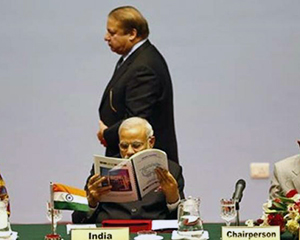
Dawn News, citing diplomatic observers, said Pakistan is exploring the possibility of creating a greater South Asian economic alliance to counter India's "controlling hold" on the eight-member South Asian Association for Regional Cooperation (SAARC).

A parliamentary delegation from Pakistan, which is now in New York, pitched this idea during its five-day visit to Washington last week, the report said.

"A greater South Asia is already emerging," Senator Mushahid Hussain Syed was quoted as saying in one of his interactions with the media.

"This greater South Asia includes China, Iran and the neighbouring Central Asian republics," he said.

He described the China-Pakistan Economic Corridor as the key economic route linking South Asia with Central Asia.

The Gwadar port, Syed said, would be the nearest warm water port, not only for China but also for the land-locked Central Asian states. "We want India to join this arrangement as well," said Syed.

Indians are "unlikely to accept" the offer as they are comfortable with the advantage that SAARC provides them, the report said.

"India used its influence in SAARC to isolate Pakistan when it announced that it would not attend the regional group's 19th summit, scheduled in Islamabad," the report said.

Citing continuous cross border terrorism by Pakistan, India had announced last month that "in the prevailing circumstances, the Indian government is unable to participate in the proposed Summit in Islamabad."

Besides India, four other SAARC members -- Bangladesh, Bhutan, Sri Lanka and Afghanistan -- had also pulled out of the summit.

"Among the eight SAARC nations, Afghanistan and Bangladesh are India's strong allies while Bhutan, surrounded by India from all sides, is too small to resist any move from New Delhi. The Maldives, Nepal and Sri Lanka have good ties with Pakistan, but they are not large enough to take on India," the report said.

The report cited that a senior diplomat had confirmed reports that Pakistan is actively seeking a new regional arrangement.

"Apparently, the showdown forced Pakistan to conclude that in its present shape, SAARC will always be dominated by India. That's why they are now talking about a greater South Asia," the diplomat was quoted as saying.

"Pakistan hopes that this new arrangement will give it more room to manoeuvre when India tries to force a decision on it," another diplomat said.

The report quoted diplomatic observers in Washington as saying that the proposed arrangement also suits China as it is also worried about India's rapidly growing influence in the region.

"They argue that China can play an important role in persuading Central Asian republics and Iran to join the new arrangement. But the observers warn that SAARC members will have little interest in supporting the idea," the report said.

"There is not much benefit for Bangladesh, Nepal and Sri Lanka in joining a land route far from their borders and Bangladesh and Sri Lanka have their own ports," it said.

The report stated thatt he member that is likely to get the most benefits from a greater South Asian alliance is Afghanistan, which is technically a land-locked Central Asian nation.

Any trade route that links South and Central Asian regions is good for Afghanistan, it noted.

"But observers believe that Afghanistan is too closely linked to India to join any arrangement that hurts India's interests. Afghanistan's presence in SAARC, however, justifies Pakistan's argument that Central Asian nations can be included in a greater South Asia.

Afghanistan applied for SAARC membership in 2006 and joined a year later, generating an interesting debate on the definition of South Asian identity because Afghanistan is a Central Asian country, the report said.

"But, as a South Asian diplomat pointed out, even if a greater South Asia became reality, there's no guarantee that its members would support Pakistan in its disputes with India," it said.

"Many Central Asian states have strong ties with India and Iran too has problems with Pakistan," the diplomat was quoted as saying.

Comments

Rikaz
 - 
Wednesday, 12 Oct 2016

India should not have cancelled this conference....

Add new comment

  • Coastaldigest.com reserves the right to delete or block any comments.
  • Coastaldigset.com is not responsible for its readers’ comments.
  • Comments that are abusive, incendiary or irrelevant are strictly prohibited.
  • Please use a genuine email ID and provide your name to avoid reject.
News Network
June 26,2020

Washington, Jun 26: The US is reviewing its global deployment of forces to ensure it is postured appropriately to counter the People's Liberation Army, given the increasing threat posed by China to Asian countries like India, Malaysia, Indonesia, and the Philippines, Secretary of State Mike Pompeo said on Thursday.

Mr Pompeo made those remarks in response to a question during the virtual Brussels Forum 2020 of the German Marshall Fund.

"We're going to make sure we're postured appropriately to counter the PLA. We think that the challenge of our times, and we're going to make sure we have resources in place to do that," Mr Pompeo said.
 
The force posture review is being done at the direction of President Donald Trump, as part of which the US is reducing the number of its troops in Germany from about 52,000 to 25,000, he said.

Mike Pompeo said that the force posture would be dictated by the ground realities.

"In certain places there will be fewer American resources. There'll be other places - I just talked about the threat from the Chinese Communist Party, so now threats to India, threats to Vietnam, threats to Malaysia, Indonesia, South China Sea challenges, the Philippines," he said.

"To the extent that that changed, the difference in what the US decided to do impacts adversely a threat some place, it may be that other nations need to step up and take responsibility for their own defense in ways that they hadn't done previously. So, we want to do this in full consultation with all of our partners all around the world, and certainly our friends in Europe," Mr Pompeo said.

President Trump is being criticised for reducing troops from Germany. His critics say that this will increase the threat from Russia to Europe.

Mike Pompeo, however, did not agree with that argument.

It has been a long time since there has been a strategic review of our force posture all across the world. The US undertook that starting about 2.5 years ago, whether that was our forces in Africa, our forces in Asia, the force we have in the Middle East and in Europe, he said.

"We began to say these are often decisions that were made in a different time. Should we reallocate those a different way? Should we have a different composition of those forces? Everyone always wants to talk about ground troops. I get it. I was a young tank officer. You described that. There's nothing I like as much as a good M1 tank.

"But it's often the case that the capacity to deter Russia or other adversaries isn''t determined any longer by just having a bunch of folks garrisoned someplace. So, we really went to back fundamentally relook, what is the nature of the conflict, what''s the nature of the threat, and how should we allocate our resources, whether that''s our resources in the intelligence community, our resources from the Air Force or the Marines and Army," Mr Pompeo said.

Last week, Mike Pompeo criticised the Chinese Army for "escalating" the border tension with India and militarising the strategic South China Sea. He also described the ruling Communist Party of China (CPC) as a "rogue actor".

"Our broad set of allocation of security apparatus, our ability to counter cyber threats, how do we allocate them? What''s the best way to do this? And the decision that you see the president made with respect to Germany is an outcome from a collective set of decisions about how we''re going to posture our resources around the world," said the top American diplomat on Thursday.

Changes in force posture is being taken in consultations with allies and friends, Mr Pompeo said.

"President Trump has spoken to this. (Defense) Secretary (Mark) Esper will be in London today and in Brussels tomorrow. We''ll talk about our plan and how we''re thinking about delivering it," he said.

"But you should understand this, and I hope our European partners will understand this as well. When you see what we ultimately conclude, how we ultimately deliver on the statements of the president made, that they''re aimed squarely at what we believe to be democracies'' fundamental interest and certainly America's most fundamental interest," Mr Pompeo said.

Earlier this month, Mike Pompeo had said that China's actions, be it on the India border, or in Hong Kong or in the South China Sea, were part of the behaviour of the ruling Communist Party in Beijing in the recent past.

China has been fast expanding military and economic influence in the Indo-Pacific region, triggering concern in various countries of the region and beyond.

China is engaged in hotly contested territorial disputes in both the South China Sea and the East China Sea. Beijing has built up and militarised many of the islands and reefs it controls in the region. Both areas are stated to be rich in minerals, oil and other natural resources and are vital to global trade.

Comments

Add new comment

  • Coastaldigest.com reserves the right to delete or block any comments.
  • Coastaldigset.com is not responsible for its readers’ comments.
  • Comments that are abusive, incendiary or irrelevant are strictly prohibited.
  • Please use a genuine email ID and provide your name to avoid reject.
News Network
May 18,2020

Beijing, May 18: China has reported 25 new COVID-19 patients, the health authorities said on Monday, as 14 asymptomatic cases were detected in Wuhan, the first epicentre of the coronavirus where officials are doing mass testing of the city's entire 11 million population, taking the number of such cases in the city to 337, the highest in the country.

The death toll in China remained at 4,634 on Sunday with no new fatalities reported.

China's National Health Commission (NHC) reported seven new confirmed cases of COVID-19 and 18 asymptomatic cases on Sunday.

Jilin province where the government has implemented strict control measures in the last few days following reports of clusters of cases in Jilin city reported two cases on Sunday, while Shanghai city has reported one.

As of Sunday, the overall confirmed cases in China had reached 82,954, including 82 patients who are still being treated, and 78,238 people who have been discharged after recovery.

Also on Sunday, 18 new asymptomatic cases including two from abroad were reported in China, taking the total number under medical observation to 448, the NHC said.

Asymptomatic cases pose a problem as the patients are tested COVID-19 positive but develop no symptoms such as fever, cough or sore throat. However, they pose a risk of spreading the disease to others.

Wuhan which is undergoing mass testing of the city's entire over 11 million population to determine the prevalence of the virus has reported no new confirmed cases, but 14 new asymptomatic infections, taking the number of such cases in the city to 337, the highest in the country, according to the figures released by the local health commission on Sunday.

The death toll in Hubei province stood at 4,512, including 3,869 in Wuhan.

The province so far has reported 68,134 confirmed COVID-19 cases in total, including 50,339 in Wuhan, according to the officials figures.

As the cases dropped, China on Sunday exempted people in Beijing from wearing masks, signalling that the virus is under control in the national capital.

As the virus is abating in the country, China is opening up all its business including entertainment centres like Shanghai Disneyl and to show that it has managed to control the dreaded virus while the world is struggling with it with lockdowns and massive casualties.

The novel coronavirus which originated in Wuhan in December last year has claimed 315,185 lives and infected over 4.7 million people globally, according to Johns Hopkins University data.

Comments

Add new comment

  • Coastaldigest.com reserves the right to delete or block any comments.
  • Coastaldigset.com is not responsible for its readers’ comments.
  • Comments that are abusive, incendiary or irrelevant are strictly prohibited.
  • Please use a genuine email ID and provide your name to avoid reject.
News Network
April 26,2020

Islamabad, Apr 26: Pakistan Prime Minister Imran Khan has been trumped by the country's powerful military yet again, this time over his government's inadequate steps and its poor response in curbing the coronavirus outbreak in the country, even as cases soared over 12,500.

In his address to the nation on March 22, Khan explained the reasons for not imposing a countrywide lockdown, asserting that millions would lose their jobs and affect families, who are below the poverty line, struggling to find enough food to eat. However, less than 24 hours later, Pakistan Army spokesperson Major General Babar Iftikhar announced the implementation of lockdown in the country having a population of over 200 million, contradicting the statements made by Imran Khan.

As lockdown was imposed, the military has deployed troops across Pakistan and is orchestrating the COVID-19 response through the National Core Committee, a body set up to coordinate policy between the national and provincial governments.

"The government left a big gap in its handling of the coronavirus. The army has tried to fill that gap, there was no choice," an unnamed retired general was quoted by Financial Times as saying.

The virus crisis in Pakistan has once again made things crystal clear about who is calling the shots -- the military, widely believed to bring Imran Khan to power in 2018.

The armymen have taken over the COVID-19 crisis as an opportunity to prove their competency in contrast to Imran Khan, who was mocked after urging youth to come forward and join Corona Relief Tigers Force, a volunteer body to wage "jihad" against the virus.

According to analysts, the military's seizure of the coronavirus response marks yet another policy failure for Imran Khan in the eyes of the generals, as per the Financial Times report.

The 67-year-old cricketer-turned-politician has repeatedly failed to gain international traction over the Kashmir issue and has struggled to convince the Financial Action Task Force (FATF) in getting his country removed from 'grey list' for terror funding.

In times of emergency, one has to take clear decisions and take them through. You can't dither. The whole world is advising strong lockdown. If the prime minister does not show that he is decisive, somebody else will," said Nafisa Shah, a Member of Parliament from the opposition Pakistan Peoples Party (PPP).

Even after the lockdown was imposed, Imran Khan continued to question the need for its implementation, raising eyebrows over the country's response in tackling the virus, as cases continue to rise. This comes even as such drastic measures are in place in many countries across the world, including neighbouring India.

According to The Dawn, the country has 12,657 confirmed cases of COVID-19, which includes 2,755 recoveries and 265 deaths. Punjab has the highest number of cases -- 5,326 --, followed by 4,232 in Sindh.

However, experts suggest that the actual numbers could be more given the low testing rates and inadequate supply of testing kits.

Doctors and nurses across the country have staged protests over the lack of personal protective equipment, as increasing numbers of health workers contract COVID-19.

"Because of the lack of resources, there is chaos among the doctors and healthcare workers. They know people are dying, they know the severity of the illness and they have to work without PPE," Shoaib Hasan Tarar, a doctor working in Rawalpindi, was quoted as saying.

As the coronavirus crisis continues to ravage Pakistan, the country's overwhelming health infrastructure has put a toll on its already floundering economy. The IMF said that the GDP will shrink 1.5 per cent in 2020. The cash-strapped nation is set to be the first major emerging economy to apply to a G-20 initiative to request debt repayment relief, according to Financial Times.

In early March, Pakistan saw a surge in coronavirus cases, when infected pilgrims and workers crossed the border from Qom, a religious city in Iran, which is a hotspot.

Pakistan's limited resources were exposed when quarantined pilgrims agitated against unhealthy conditions at Taftan camp on Pakistan-Iran border, where five people were living in a tent with no access to toilets.

While the lockdown is in place, authorities have been confronted by hardline clerics who have defied social distancing terms and downplayed the threat of the virus. During Friday prayers every week, worshippers violate the restrictions by gathering at various mosques.

Last week, Islamabad inked an agreement allowing mosques to stay open for Ramzan. It stipulated that people should follow 20 rules, including maintaining a six feet distance from each other.

"There is little consistency in terms of how the lockdown is being approached. Coronavirus has shown the disconnect between the national government, regional governments and the military. Imran Khan has been left behind as the cheerleader for keeping Pakistan's morale high. I think people are starting to ask, 'How long is he going to last?'", said Sajjan Gohel, South Asia expert and guest teacher at the London School of Economics.

Comments

Add new comment

  • Coastaldigest.com reserves the right to delete or block any comments.
  • Coastaldigset.com is not responsible for its readers’ comments.
  • Comments that are abusive, incendiary or irrelevant are strictly prohibited.
  • Please use a genuine email ID and provide your name to avoid reject.