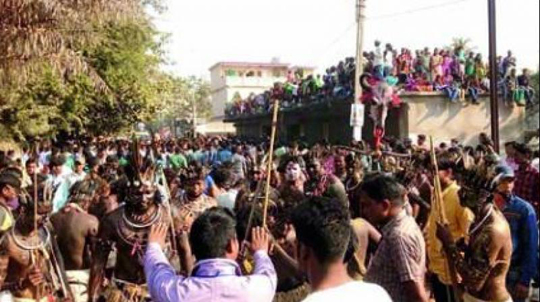
50,000 animals butchered near Hindu temple to appease goddess

[email protected] (CD Network)
October 12, 2016

Bhawanipatna, Oct 12: In spite of public awareness campaigns and ban imposed by the Odisha government, people belonging to Hindu community have mercilessly butchered over 50,000 animals and birds to “appease” goddess Manikeswari during the annual “Chhattar Yatra” near the Manikeswari temple, here like previous years.

goddess

The district administration had also made fervent appeals to the people to refrain from killing animals and birds. However, the slaughtering continued tillSunday afternoon despite 15 CCTV and drone cameras being installed.

The huge deployment of police personnel also failed to check the slaughter, as most of the locals extended their patronage to the act, arguing that animal sacrifice was a long-practiced religious tradition during Chhattar Yatra, and the government's ban is an infringement of their right to religion.

Since no political parties want to earn the displeasure of the locals, they also don't raise their voice against the practice, nor do they cooperate with the administration's effort to enforce the law.

According to reports, over 1.5 lakh people took part in the annual festival, and had a glimpse of the presiding deity while it was taken out in a procession.

As many as 11 platoons of police personnel were deployed to maintain law and order. Besides, 41 sub-inspectors, 15 inspectors, five deputy superintendents of police and one additional SP, were deployed at the festival.

“We had initiated awareness campaigns to prevent animal sacrifice. I believe it will be on the wane due to massive awareness programmest,” Kalahandi SP Brijesh Kumar Rai was quoted as saying.

During the Chhattar Yatra, the goddess is taken in a procession from Jenakhal after Sandhi Puja to Bhawanipatna town, the permanent abode of the deity.

On Sunday, the Chhattar procession took off at around 5.20 am with people making beeline to have a glimpse of the presiding deity. The town reverberated amid the rhythmic beats of Jenabadya, Nisan and Ghanta (traditional musical instruments) and dancers performing Ghumura' and martial art forms.

“We eagerly wait for the festival to participate in it. The people of Kalahandi have immense faith in Maa Manikeswari. We offer sacrifices on fulfillment of our wishes in which people across caste and religion participate in it,” Sudharam Sarap, a devotee.

Before the start of the sacrifice ritual on Asthami tithi of the Hindu month of Ashwina every year, two swords belonging to the goddess are washed in the pond located behind the palace. The swords are then worshipped and brought back to the temple in a procession. Then a buffalo is sacrificed at the Budharaja or Vairab temple, a satellite shrine of the Manikeswari temple.

Following this ritual, the Chhattar or umbrella of the goddess, along with two swords of the deity, are taken out for the procession.

Comments

Satyameva jayate
 - 
Thursday, 13 Oct 2016

Where our beloved maa lovers and nationalists......
Muslims sacrifice animals In the name of the world's creator and consume it as food with respect.....these people sacrifice in the names of story book characters and dump them as waste....so which is cruel......

Raj
 - 
Wednesday, 12 Oct 2016

This is not hinduism. If this is hinduism then i think. Islam is better religion. They don't sacrifice to please god. As per true indian. What he said is true. I gone through quran app just now. And god says he only feed and he is not fed.

Many hindus including my self eat kfc. It DOESN'T please God.

If they continue like this. Then many hindus will convert to Muslim.

Every year hindu population is decreasing and muslim population is increasing. May be this is the reason.

suresh
 - 
Wednesday, 12 Oct 2016

VERY BAD.
god does not need anything from us.
Love, live and let live.

In Nepal, infamous Gadhimai temple sacrifice has banned completely by people. Now we have to be caring for all the living beings on earth.

H A Dsouza
 - 
Wednesday, 12 Oct 2016

Where is gavrakshakas their aim is to target minorities

TRUE INDIAN
 - 
Wednesday, 12 Oct 2016

WHY GOD NEEDS BLOOD. THEY EVEN KILL YOUNG KIDS TO PLEASE GOD. DISGUSTING.

Quran 6:14 He who feeds and is not fed?

Best way of life Islam.

SHABEER AHAMME…
 - 
Wednesday, 12 Oct 2016

OH my god..Bajarangdal / RSS / VHP / RAMASENE / & 100 many more Hindu wrong wings sleeping or RIP. Oh yeah political game. maneka gandhi / and many more on vacation it seems.
OH What about Arnab Cow Swamy. Still at large

Rikaz
 - 
Wednesday, 12 Oct 2016

Where is Maneka Gandhi, is she sleeping.....

Add new comment

  • Coastaldigest.com reserves the right to delete or block any comments.
  • Coastaldigset.com is not responsible for its readers’ comments.
  • Comments that are abusive, incendiary or irrelevant are strictly prohibited.
  • Please use a genuine email ID and provide your name to avoid reject.
Agencies
May 8,2020

Washington D.C., May 8: The prime time for brain development in a child's life is the first year, where the infant spends most of the time asleep. It is the time when neural connections form and sensory memories are encoded.

However, when sleep is disrupted, as occurs more often among children with autism, brain development may be affected, too.

New research led by the University of Washington finds that sleep problems in a baby's first 12 months may not only precede an autism diagnosis but also may be associated with altered growth trajectory in a key part of the brain, the hippocampus.

The study, which was published in the American Journal of Psychiatry, researchers report that in a sample of more than 400 taken of 6- to 12-month-old infants, those who were later diagnosed with autism were more likely to have had difficulty falling asleep.

It also states that this sleep difficulty was associated with altered growth trajectories in the hippocampus.

"The hippocampus is critical for learning and memory, and changes in the size of the hippocampus have been associated with poor sleep in adults and older children.

As many as 80 per cent of the children with autism spectrum disorder have sleep problems," said Annette Estes, director of the UW Autism Center and senior author of the study.

"In our clinical experience, parents have a lot of concerns about their children's sleep, and in our work on early autism intervention, we observed that sleep problems were holding children and families back," added Estes, who is also a UW professor of speech and hearing sciences.

"It could be that altered sleep is part-and-parcel of autism for some children. One clue is that behavioural interventions to improve sleep don't work for all children with autism, even when their parents are doing everything just right. This suggests that there may be a biological component to sleep problems for some children with autism," said Estes.

To consider links among sleep, brain development, and autism, researchers at the IBIS Network looked at MRI scans of 432 infants, surveyed parents about sleep patterns, and measured cognitive functioning using a standardized assessment.

At the outset of the study, infants were classified according to their risk for developing autism: Those who were at higher risk of developing autism -- about two-thirds of the study sample -- had an older sibling who had already been diagnosed.

Infant siblings of children with autism have a 20 per cent chance of developing autism spectrum disorder -- a much higher risk than children in the general population.

In the current study, 127 of the 432 infants were identified as "low risk" at the time the MRI scans were taken because they had no family history of autism.

They later evaluated all the participants at 24 months of age to determine whether they had developed autism. Of the roughly 300 children originally considered "high familial risk," 71 were diagnosed with autism spectrum disorder at that age.

Problems with sleep were more common among the infants later diagnosed with an autism spectrum disorder, as were larger hippocampi. No other subcortical brain structures were affected, including the amygdala, which is responsible for certain emotions and aspects of memory, or the thalamus, a signal transmitter from the spinal cord to the cerebral cortex.

The authors note that while parents reported more sleep difficulties among infants who developed autism compared to those who did not, the differences were very subtle and only observed when looking at group averages across hundreds of infants.

Sleep patterns in the first years of life change rapidly as infants transition from sleeping around the clock to a more adult-like sleep/wake cycle. Until further research is completed, Estes said, it is not possible to interpret challenges with sleep as an early sign of increased risk for autism.

Comments

Add new comment

  • Coastaldigest.com reserves the right to delete or block any comments.
  • Coastaldigset.com is not responsible for its readers’ comments.
  • Comments that are abusive, incendiary or irrelevant are strictly prohibited.
  • Please use a genuine email ID and provide your name to avoid reject.
Muhammad Abdullah Javed
May 20,2020

One of the distinguish features of the Noble Quran is that it presents different sorts of classifications. It is quite evident as one of the names of the Quran is Furqan that is it differentiates between things through its unique style of classification. The Quran openly proclaims the difference between right and wrong, truth and falsehood, literate and illiterate, light and darkness and so on. The system of Quranic taxonomy has a pivotal element with regard to ranking of human beings. It classifies them into two groups, one, who is honorable in the sight of their Creator and the second, disliked by Him.

This Quranic approach of classification is quite genuine, void of all sorts of bias. Since humans have no say in their birth, color or region, therefore the Quran doesn’t recognize these parameters to classify two groups of people.

The crux of Quranic taxonomy rests with the human ability which has been equally distributed among all humans. In terms of abilities to perform, barring those tasks performed with exceptional talents, all humans are equal. This is where Quran draws a line and specify who is most honorable in the sight of their Creator, it says:

 O mankind, We created you from one man and one woman, and then divided you into nations and tribes so that you may recognize one another. Indeed, the most honorable among you in the sight of Allah is he who is the most pious of you. Surely, Allah is All-knowing, All-Wise. (Chapter 49, Verse 13).

Criterion of judgement

To be most righteous in the sight of God, one has to be of pious nature. The Quran uses term Taqwa (a sense of distinguishing between right and wrong, piety) to exemplify the pious nature. It further specifies that the source of pious nature - Taqwa is an inherent quality of human beings. Along with the faculties of hearing, seeing and speaking they have been bestowed with (Taqwa) the criterion of distinguishing between virtues and vices, it has been mentioned in the Quran as:

And by the human self and by Him Who balanced it, then inspired it with its wickedness and piety (Chapter 91, Verses 7 & 8).

Good deeds and human nature

With the advent of human race on earth, the equation has been set in simple terms. Humans have to be obedient to their Creator by means of using their intellect, smart enough to use their ability to judge between right and wrong and spend their lives in performing good deeds. For this very reason God has created life and death:

Who created death and life that He may try you to see which of you is best in deeds, and He is All-Mighty as well as All-Forgiving (Chapter 67, Verse 2)

Since life is all about performing good deeds, the ability to perform any good action has been made as natural as recognizing any color with naked eyes. It is within the reach of a person to identify the difference between colors, so is his criterion of judgement that tells what to perform and what to refrain from?

Good actions have been synchronized with human nature whereas evil deeds are quite detrimental, that’s why there is a universal consensus over the conception of virtues and vices. No one can dare to differ with virtues like truth, justice and honesty etc, and no one appreciates vices like falsehood, violations and corruption. With this inherent ability of humans to identify good and bad, the concept of virtues and vices has been described with the same bent of human intellect, there is no philosophical and ideological kind of description to tell what truth and falsehood are, it is as simple as this:

Prophet Muhammad (peace be upon him) said: Give up what is doubtful to you for that which is not doubtful; for truth is peace of mind and falsehood is doubt (Tirmidhi)

Highway of actions

The Quran presents a highway of actions for everyone who believes in it and intend to be most honorable in the sight of the Creator. For each and every day, there is a definite plan of action to go ahead with it to please the Creator. Again, for every week and month, there are clear specifications with regard to individual and collective actions. So no place for claims and reservations, no place for any excuse either, things have been made clear. For a person to be honored, he has to be man of deeds, that’s it. Every person has fair chances of performing better, as the life has been given, criterion of judgement between right and wrong has been given, and plan of action has been provided with. Now one has to energize himself for everyday action and try to set right the intention.

Difference in human efficiencies

No doubt there are differences in human abilities and efficiencies, one may argue about the quality and magnitude of actions. Those who are of high efficiency may perform well and those who are inefficient may not? True, to convince what Quran emphasizes is, God doesn’t look at the magnitude of an action, rather He sees with what intention in what circumstances it has been performed? If any person keep fast in scorching heat for more than 16 hours a day will get high rewards compare to the one who fast less than 10 hours a day at a cold place. Again, if the intention is to please the God, than every action, no matter how small or big it is in its scale, will fetch rich dividends. A poor’s donation of few rupees will be equal in rewards as compare to what a millionaire gets by donating thousands of rupees from his enormous wealth. The act of charity has demanded sacrifice; both of them have sacrificed in accordance with their capacities. Therefore upon asking whose charity is noble in the sight of God, the Prophet Muhammad (pbuh) said: The charity of poor person who tries hard to get few rupees from his hard earn money to donate in the way of God (NasaiBook of Hadith).

The Quranic taxonomy of human is quite justifiable as every human bear testimony to its genuine and unbiased classification through what we term as actions. Therefore the world has to witness a race between men and women to see who can compete with others in order to please their Creator?

Whosoever acts righteously – whether a man or a woman and embraces belief, We will surely grant him a good life; and will surely grant such persons their reward according to the best of their deeds. (Chapter 16, Verse 97)

God-oriented actions, privilege for the Humanity

It’s very unpleasant to notice that in today’s world the parameters like statuses, resources and wealth have been regarded as privilege and honor for both humans and their societies. No doubt they are, but not at the cost of losing the very essence of human nature and sacrificing its interest. Today’s advancements speak of this dark phase where the height of inventions and discoveries touching the skies while the dignity and honor of humans have gone to the lowest of the low. The ever increasing poverty, hunger, untimely deaths, different forms of corruption in the land, violation of human rights are just to remind a few. The presence of rich and poor, highs and lows in the society speaks of disparity of actions, lack of selfless service and hearts void of God’s love and fear.

The beauty of humanity is to remain in the service of God and always stand on the toes to help those who are in need. This God-oriented action enables every doer to be dear to his God as the classification of good and the bad is purely based on the actions performed for the sake of the Creator:

Everyone is assigned a rank according to his deed. Your Lord is not heedless of what they do (Chapter 6, Verse 132).


Muhammad Abdullah Javed is the Director of AJ Academy for Research & Development. He can be reached at [email protected]

Comments

Add new comment

  • Coastaldigest.com reserves the right to delete or block any comments.
  • Coastaldigset.com is not responsible for its readers’ comments.
  • Comments that are abusive, incendiary or irrelevant are strictly prohibited.
  • Please use a genuine email ID and provide your name to avoid reject.
News Network
May 18,2020

Bengaluru, May 18: Senior Congress leader and former Union Minister Mallikarjuna Kharge on Monday slammed the State Government’s decision to appoint administrative committees to Panchayats, which completes their five-year term, shortly.

Speaking to media persons, the Congress leader described the State Government’s decision on appointing committees as a ‘death knell ‘ to the basic characters of the Panchayat bodies, which were elected on a non-party basis.

Strongly recommending the BJP-led government to desist from its decision, Kharge urged Chief minister B S Yediyurappa to extend the term of the elected bodies of the Panchayats by six months.

Comments

Add new comment

  • Coastaldigest.com reserves the right to delete or block any comments.
  • Coastaldigset.com is not responsible for its readers’ comments.
  • Comments that are abusive, incendiary or irrelevant are strictly prohibited.
  • Please use a genuine email ID and provide your name to avoid reject.