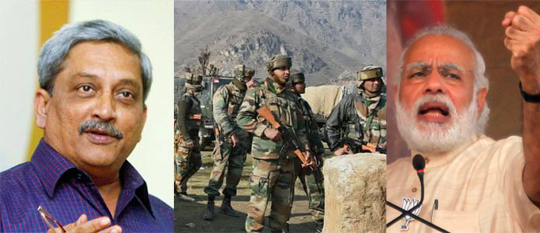
Major credit for Army's surgical strike goes to PM Modi: Parrikar

October 12, 2016

Mumbai, Oct 12: Defence Minister Manohar Parrikar today rejected claims that surgical strikes were undertaken during the UPA regime and asserted that a "major" share of credit for the army action last month goes to Prime Minister Narendra Modi.

Untitled-1 copy

Speaking at two different events, he said all the 127 crore people of India, including "doubting Thomases", and the army share and deserve credit for the operation as it was done by the armed forces and not by any political party.

At the same time, he said that "major share" of credit does go to Prime Minister Narendra Modi and the government for decision-making and planning.

He also made it clear that claims of having carried out such strikes earlier were wrong as such actions were undertaken by border action teams at local level "without the knowledge" of the government.

"I don't mind sharing the credit, including on surgical strike, with every countryman because it is done by our armed forces and not by any political party. So all Indians, including, those doubting Thomases, can share the credit," he said at a function here, adding it will settle the nerves of many.

The Minister said he understands the sentiments of the people who are satisfied after the strikes. Several political leaders and parties have raised questions on the surgical strike and some have sought proof. The Congress, while officially supporting the government over the strike, has also said that similar operations were undertaken during its tenure also.

"I have been the Defence Minister for two years. From whatever I have known, there is no surgical strike from previous years. What they are quoting are actions taken by border action teams. These are common actions across the globe and by the Indian army," he said.

Explaining the concept, the Minister said such operations are carried out without official order or prior sanction of the government.

"It is done without the knowledge of anyone. Report is subsequently given," he said underlining the action is taken by the local commander for settling scores.

Parrikar made it clear that unlike earlier, this time it was a surgical strike because "decision was taken and conveyed" and the army did the job well.

"This was an operation which clearly indicates the intent of the government and the nation," he said. Parrikar said that if the government wanted to take political mileage out of this, then he would have announced it rather than the Director General of Military Operations.

Comments

Satyameva jayate
 - 
Thursday, 13 Oct 2016

Foolish act.....party members praising each other..this means our jawans did nothing.......for sure credit goes to modi and BJP as this strike was part of next elections....ha haa....

Wellwisher
 - 
Wednesday, 12 Oct 2016

Funny things ek dusre ka -----lal kar raha hai. Real credit goes to our brave soldiers and to their family.
Politicians n their chelaas are looking for political benefit. And not because of patriotism.
Salute to our Brave Soldiers.

Rikaz
 - 
Wednesday, 12 Oct 2016

Good job Army, and PM but still terrorists are entering our territory unabated....war is the best solution for it....

Add new comment

  • Coastaldigest.com reserves the right to delete or block any comments.
  • Coastaldigset.com is not responsible for its readers’ comments.
  • Comments that are abusive, incendiary or irrelevant are strictly prohibited.
  • Please use a genuine email ID and provide your name to avoid reject.
News Network
April 9,2020

Udupi, Apr 9: Deputy Commissioner G. Jagadeesha said that criminal cases would be booked against owners of houses and sheds who were collecting rent from those, including workers, staying in rented houses.

In a statement issued here on Wednesday, Mr Jagadeesha said that to prevent the spread of COVID-19, restrictions had been imposed throughout the district under Section 144 (3) of the Criminal Procedure Code.

The administration had through an earlier order made it clear that house owners and shed owners should not collect rent from their tenants and workers for March and April.

But the administration had received complaints that some house owners and shed owners were collecting rent despite the order.

Comments

Add new comment

  • Coastaldigest.com reserves the right to delete or block any comments.
  • Coastaldigset.com is not responsible for its readers’ comments.
  • Comments that are abusive, incendiary or irrelevant are strictly prohibited.
  • Please use a genuine email ID and provide your name to avoid reject.
News Network
May 17,2020

Bengaluru, May 17: Karnataka Deputy Chief Minister and Transport Minister Laxman Savadi on Sunday wrote to Union Minister Nitin Gadkari requesting to issue new lockdown guidelines including permission to operate public transport and said the lockdown has caused a financial loss of Rs 16,00 crore to all four Karnataka Transport Undertakings.

In view of these problems, the state Transport Minister requested Gadkari to permit the deployment of Non-AC buses on scheduled routes to ensure the adequacy of services.

The four State Transport Undertakings (STUs) in Karnataka which are providing bus-based public transport services within the state and to the neighbouring states are Karnataka State Road Transport Corporation (KSRTC), North West Karnataka Road Transport Corporation (NWKRTC), North Eastern Karnataka Road Transport Corporation (NEKRTC) and Bangalore Metropolitan Transport Corporation (BMTC).

"KSRTC, NWKRTC and NEKRTC operate buses for mofussil services i.e. Interdistrict, intradistrict and interstate, whereas BMTC operates only in urban and suburban areas in the city of Bengaluru. The four STUs put together hold a fleet of about 24,900 buses including 1,520 air-conditioned buses and operate about 71.00 lakh km. per day and carries about 98.00 lakh passengers every single day," Savadi outlined in the letter.

The Minister said due to the COVID-19 outbreak and the lockdown that ensued have brought regular bus operations and functioning to a grinding halt.

"This has caused a devastating impact on the operations of all the four STUs due to the combination of lack of revenue and continuing fixed costs such as salaries and pensions to staff, payables against existing loans etc. It has been estimated that the lockdown has caused a financial loss of INR 1,600/- crore to these four STUs," he added.

Savadi said even after post-COVID lockdown, operations and revenues won't reach its previous demand& supply patterns in the next six to eight months due to reduced economic activity and users' perceived risk of contacting COVID in public transport.

In addition to that, "occupancy should be allowed up to seating capacity (without standees). This is essential to meet minimal demand," he said in the letter.

"The crew should wear facemask and hand gloves. The crew with health issues should not be deployed. The face masks should be made mandatory for all the passengers. Only asymptomatic persons should be allowed to travel in public transport. The Government of India may consider staggering working hours for various sectors to reduce peak hour traffic demand," the minister listed out these recommendations in the letter.

Savadi said that with social distancing norm of reduced seating capacity in public transport, it will not be possible to provide transport facility to all the daily passengers. This will create demand for more buses, which cannot be met.

"Restrictions on public transport will lead to passenger commute by overcrowding in smaller vehicles like cars, maxi cabs, goods tempos etc. which will adversely affect preventive measures," he added.

Therefore, Savadi requested Union Minister to look into the above matter and issue fresh guidelines to all the states / UT's.

Comments

Add new comment

  • Coastaldigest.com reserves the right to delete or block any comments.
  • Coastaldigset.com is not responsible for its readers’ comments.
  • Comments that are abusive, incendiary or irrelevant are strictly prohibited.
  • Please use a genuine email ID and provide your name to avoid reject.
Ram Puniyani
January 14,2020

In the beginning of January 2020 two very disturbing events were reported from Pakistan. One was the attack on Nankana Sahib, the holy shrine where Sant Guru Nanak was born. While one report said that the place has been desecrated, the other stated that it was a fight between two Muslim groups. Prime Minister of Pakistan Imran Khan condemned the incident and the main accused Imran Chisti was arrested. The matter related to abduction and conversion of a Sikh girl Jagjit Kaur, daughter of Pathi (One who reads Holy Guru Granth Sahib in Gurudwara) of the Gurudwara. In another incident one Sikh youth Ravinder Singh, who was out on shopping for his marriage, was shot dead in Peshawar.

While these condemnable attacks took place on the Sikh minority in Pakistan, BJP was quick enough to jump to state that it is events like this which justify the Citizenship Amendment Act (CAA). Incidentally CAA is the Act which is discriminatory and relates to citizenship with Religion, which is not as per the norms of Indian constitution. There are constant debates and propaganda that population of Hindus has come down drastically in Pakistan and Bangla Desh. Amit Shah, the Home minister stated that in Pakistan the population of Hindus has come down from 23% at the time of partition to 3.7% at present. And in Bangla Desh it has come down from 22% to present 8%.

While not denying the fact that the religious minorities are getting a rough deal in both these countries, the figures which are presented are totally off the mark. These figures don’t take into consideration the painful migrations, which took place at the time of partition and formation of Bangla Desh later. Pakistan census figures tell a different tale. Their first census was held in 1951. As per this census the overall percentage of Non Muslim in Pakistan (East and West together) was 14.2%, of this in West Pakistan (Now Pakistan) it was 3.44 and in Eat Pakistan it was 23.2. In the census held in Pakistan 1998 it became 3.72%. As far as Bangla Desh is concerned the share of Non Muslims has gone down from 23.2 (1951) to 9.6% in 2011.

The largest minority of Pakistan is Ahmadis, (https://minorityrights.org/country/pakistan/) who are close to 4 Million and are not recognised as Muslims in Pakistan. In Bangla Desh the major migrations of Hindus from Bangla Desh took place in the backdrop of Pakistan army’s atrocities in the then East Pakistan.

As far as UN data on refugees in India it went up by 17% between 2016-2019 and largest numbers were from Tibet and Sri Lanka.  (https://www.un.org/en/development/desa/population/migration/publication…)

The state of minorities is in a way the index of strength of democracy. Most South Asian Countries have not been able to sustain democratic values properly. In Pakistan, the Republic began with Jinnah’s classic speech where secularism was to be central credo of Pakistan. This 11th August speech was in a way what the state policy should be, as per which people of all faiths are free to practice their religion. Soon enough the logic of ‘Two Nation theory” and formation of Pakistan, a separate state for Muslim took over. Army stepped in and dictatorship was to reign there intermittently. Democratic elements were suppressed and the worst came when Zia Ul Haq Islamized the state in collusion with Maulanas. The army was already a strong presence in Pakistan. The popular formulation for Pakistan was that it is ruled by three A’s, Army, America and Allah (Mullah).

Bangla Desh had a different trajectory. Its very formation was a nail in the coffin of ‘two nation theory’; that religion can be the basis of a state. Bangla Desh did begin as a secular republic but communal forces and secular forces kept struggling for their dominance and in 1988 it also became Islamic republic. At another level Myanmar, in the grip of military dictatorship, with democratic elements trying to retain their presence is also seeing a hard battle. Democracy or not, the army and Sanghas (Buddhist Sang has) are strong, in Myanmar as well. The most visible result is persecution of Rohingya Muslims.

Similar phenomenon is dominating in Sri Lanka also where Budhhist Sanghas and army have strong say in the political affairs, irrespective of which Government is ruling. Muslim and Christian minorities are a big victim there, while Tamils (Hindus, Christians etc.) suffered the biggest damage as ethnic and religious minorities. India had the best prospect of democracy, pluralism and secularism flourishing here. The secular constitution, the outcome of India’s freedom struggle, the leadership of Gandhi and Nehru did ensure the rooting of democracy and secularism in a strong way.

India so far had best democratic credentials amongst all the south Asian countries. Despite that though the population of minorities rose mainly due to poverty and illiteracy, their overall marginalisation was order of the day, it went on worsening with the rise of communal forces, with communal forces resorting to identity issues, and indulging in propaganda against minorities.

While other South Asian countries should had followed India to focus more on infrastructure and political culture of liberalism, today India is following the footsteps of Pakistan. The retrograde march of India is most visible in the issues which have dominated the political space during last few years. Issues like Ram Temple, Ghar Wapasi, Love Jihad, Beef-Cow are now finding their peak in CAA.

India’s reversal towards a polity with religion’s identity dominating the political scene was nicely presented by the late Pakistani poetess Fahmida Riaz in her poem, Tum bhi Hum Jaise Nikle (You also turned out to be like us). While trying to resist communal forces has been an arduous task, it is becoming more difficult by the day. This phenomenon has been variously called, Fundamentalism, Communalism or religious nationalism among others. Surely it has nothing to do with the religion as practiced by the great Saint and Sufi traditions of India; it resorts mainly to political mobilization by using religion as a tool.


Comments

Ashi
 - 
Tuesday, 14 Jan 2020

If Malaysia implement similar NRC/CAA, India and China are the loser.

Add new comment

  • Coastaldigest.com reserves the right to delete or block any comments.
  • Coastaldigset.com is not responsible for its readers’ comments.
  • Comments that are abusive, incendiary or irrelevant are strictly prohibited.
  • Please use a genuine email ID and provide your name to avoid reject.