


50,000 animals butchered near Hindu temple to appease goddess

[email protected] (CD Network)
October 12, 2016

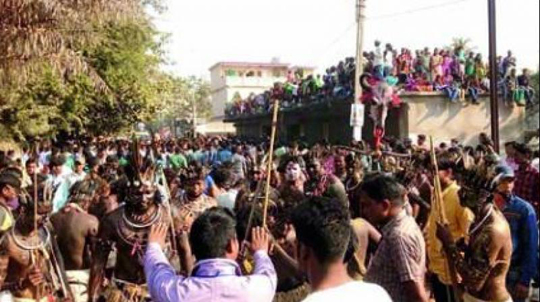
Bhawanipatna, Oct 12: In spite of public awareness campaigns and ban imposed by the Odisha government, people belonging to Hindu community have mercilessly butchered over 50,000 animals and birds to “appease” goddess Manikeswari during the annual “Chhattar Yatra” near the Manikeswari temple, here like previous years.
goddess

The district administration had also made fervent appeals to the people to refrain from killing animals and birds. However, the slaughtering continued tillSunday afternoon despite 15 CCTV and drone cameras being installed.

The huge deployment of police personnel also failed to check the slaughter, as most of the locals extended their patronage to the act, arguing that animal sacrifice was a long-practiced religious tradition during Chhattar Yatra, and the government's ban is an infringement of their right to religion.

Since no political parties want to earn the displeasure of the locals, they also don't raise their voice against the practice, nor do they cooperate with the administration's effort to enforce the law.

According to reports, over 1.5 lakh people took part in the annual festival, and had a glimpse of the presiding deity while it was taken out in a procession.

As many as 11 platoons of police personnel were deployed to maintain law and order. Besides, 41 sub-inspectors, 15 inspectors, five deputy superintendents of police and one additional SP, were deployed at the festival.

“We had initiated awareness campaigns to prevent animal sacrifice. I believe it will be on the wane due to massive awareness programmest,” Kalahandi SP Brijesh Kumar Rai was quoted as saying.

During the Chhattar Yatra, the goddess is taken in a procession from Jenakhal after Sandhi Puja to Bhawanipatna town, the permanent abode of the deity.

On Sunday, the Chhattar procession took off at around 5.20 am with people making beeline to have a glimpse of the presiding deity. The town reverberated amid the rhythmic beats of Jenabadya, Nisan and Ghanta (traditional musical instruments) and dancers performing Ghumura' and martial art forms.

“We eagerly wait for the festival to participate in it. The people of Kalahandi have immense faith in Maa Manikeswari. We offer sacrifices on fulfillment of our wishes in which people across caste and religion participate in it,” Sudharam Sarap, a devotee.

Before the start of the sacrifice ritual on Asthami tithi of the Hindu month of Ashwina every year, two swords belonging to the goddess are washed in the pond located behind the palace. The swords are then worshipped and brought back to the temple in a procession. Then a buffalo is sacrificed at the Budharaja or Vairab temple, a satellite shrine of the Manikeswari temple.

Following this ritual, the Chhattar or umbrella of the goddess, along with two swords of the deity, are taken out for the procession.

Comments

Satyameva jayate
 - 
Thursday, 13 Oct 2016

Where our beloved maa lovers and nationalists......
Muslims sacrifice animals In the name of the world's creator and consume it as food with respect.....these people sacrifice in the names of story book characters and dump them as waste....so which is cruel......

Raj
 - 
Wednesday, 12 Oct 2016

This is not hinduism. If this is hinduism then i think. Islam is better religion. They don't sacrifice to please god. As per true indian. What he said is true. I gone through quran app just now. And god says he only feed and he is not fed.

Many hindus including my self eat kfc. It DOESN'T please God.

If they continue like this. Then many hindus will convert to Muslim.

Every year hindu population is decreasing and muslim population is increasing. May be this is the reason.

suresh
 - 
Wednesday, 12 Oct 2016

VERY BAD.
god does not need anything from us.
Love, live and let live.

In Nepal, infamous Gadhimai temple sacrifice has banned completely by people. Now we have to be caring for all the living beings on earth.

H A Dsouza
 - 
Wednesday, 12 Oct 2016

Where is gavrakshakas their aim is to target minorities

TRUE INDIAN
 - 
Wednesday, 12 Oct 2016

WHY GOD NEEDS BLOOD. THEY EVEN KILL YOUNG KIDS TO PLEASE GOD. DISGUSTING.

Quran 6:14 He who feeds and is not fed?

Best way of life Islam.

SHABEER AHAMME…
 - 
Wednesday, 12 Oct 2016

OH my god..Bajarangdal / RSS / VHP / RAMASENE / & 100 many more Hindu wrong wings sleeping or RIP. Oh yeah political game. maneka gandhi / and many more on vacation it seems.
OH What about Arnab Cow Swamy. Still at large

Rikaz
 - 
Wednesday, 12 Oct 2016

Where is Maneka Gandhi, is she sleeping.....

Add new comment

  • Coastaldigest.com reserves the right to delete or block any comments.
  • Coastaldigset.com is not responsible for its readers’ comments.
  • Comments that are abusive, incendiary or irrelevant are strictly prohibited.
  • Please use a genuine email ID and provide your name to avoid reject.
News Network
June 14,2020

Mangaluru, June 14: Private schools under the aegis of Association of English Medium Schools in Dakshina Kannada and Udupi urged the State government to reimburse the arrears of the fee related to admission of students under the Right to Education (RTE) Act.

Speaking to newsmen here on Sunday association president Y. Mohammed Beary said the State government has not cleared the arrears for the last two years. “The 400 private schools in two districts have to get around Rs 2 crore,” he said and added that the overall arrears that the government has to pay to schools in the State are around Rs1,200 crore.

Mr. Beary said arrears have made the school managements like his, who collect annual fees of about Rs 20,000 from a student, hard to function. Due to lockdown from March the schools could not conduct annual examinations and hence they could not collect pending fees from parents.

Comments

Add new comment

  • Coastaldigest.com reserves the right to delete or block any comments.
  • Coastaldigset.com is not responsible for its readers’ comments.
  • Comments that are abusive, incendiary or irrelevant are strictly prohibited.
  • Please use a genuine email ID and provide your name to avoid reject.
coastaldigest.com news network
February 23,2020

Mangalore University has been participating in the campus bird count a sub-event of ‘Great backyard bird count’ (GBBC) organized by Bird Count India for the past 5 years. This year, CBC was held from 14th to 17th February of 2020 across various campuses in India.

This year the four days event was successfully ended up with the sightings of 103 species of birds from various locations across the campus spread on 300 acres. In this Black Drongo, Black Kite, Brahminy Kite, Common Iora, Green Wabler, Purple-rumed Sunbird, Red-whiskered Bulbul, White-cheeked Barbet, Jungle Babbler and Plum headed parakeets were the common birds, and also observed House Crow with nest and nestlings, Indian Robin nest with eggs, Bronzed Drongo constructing the nest and Shikra mating and carrying nesting materials.  Whereas Yellow-billed Babbler is rare in the campus, Ashy Drongo, Barn Swallow, Booted Eagle, Grey Wagtail, Indian Pitta etc. were migratory birds, Grey-headed Bulbul (Near Threatened bird), Rufous Babbler and Grey-headed Bulbul were Western Ghats Endemics  and Brown Wood Owl, Barn Owl, Spotted Owlet, Nightjars (Savanna, Indian and Jerdon’s) and Sri Lanka Frogmouth were nocturnal birds. Blue-eared Kingfisher Grey-bellied Cuckoo which was very rare and new additions to avian list of the campus.

In the first year (2016) of Mangalore University’s CBC recorded 77 species, in 2017 recorded 95 species, in 2018 recorded 110 species and in 2019 recorded 107 species of birds. However some of the common species like Rose ringed parakeets, Blue tailed bee-eater, Nilgiri Flowerpecker and Indian roller etc., sighted last year were not seen this year. But with 2 new additions from this CBC, the checklist of Mangalore University Campus has been updated with a total of 141 species.

This event was coordinated by Vivek Hasyagar from the Department of Applied Zoology and Maxim Rodrigues from the Department of Marine Geology. Survey trails were led by more than 60 students and research scholars from various Departments of Mangalore University includes Applied Zoology, Biosciences, Microbiology, Botany, Physics, Chemistry and Material Science.  In addition, some enthusiastic participants from St. Aloysius College had involved in identifying the birds around the campus.

Quote:

Wild/planned fire affects negatively on the existing ecologically sensitive areas in and around the campus especially in lateritic grasslands. Because many insectivorous birds are dependent on these lateritic grassland habitats for their food and breeding grounds for many ground dwelling birds like Yellow wattled lapwing, Red wattled lapwing, Indian Robin and Barred buttonquails. Conserving these habitats will be helpful in protecting these birds.

Quotes from the participants: “The Campus Bird Count 2020 at Mangalore University was an experience of its own kind. Observing birds in their natural habitat gave me new perspective of viewing them not only as another living being, but as equals, or even of higher intelligence. The Campus Bird Count is an important step towards documenting bird life year after year, and creating awareness amongst youngsters, so that proper conservation steps can be taken to protect them from human interference”.

-Jyotsna Dessai ( 1 M.Sc Zoology)

Comments

Add new comment

  • Coastaldigest.com reserves the right to delete or block any comments.
  • Coastaldigset.com is not responsible for its readers’ comments.
  • Comments that are abusive, incendiary or irrelevant are strictly prohibited.
  • Please use a genuine email ID and provide your name to avoid reject.
News Network
February 3,2020

Feb 3: The Karnataka government is probably the only state to have so many nodal agencies to deal with investment proposals. There is the KIADB, Karnataka Udyoga Mitra, State High Level Clearance Committee (SHLCC), State Level Single Window Clearance Committee (SLSWCC) and District Level Single Window Clearance Committee.

While the government claims these have been created to speed up the process of setting up industries, they’re only delaying it. “A four-to-five year delay in acquiring land has become the norm,’’ say industry sources.

“These entities are only adding layers of obstacles to investors and is not really helping industries,” said a senior IAS officer.

While DLSWCCs are headed by deputy commissioners are empowered to clear investment proposals up to Rs 15 crore, SLSWCC, headed by the industries minister, clears proposals more than Rs 15 crore and up to Rs 500 crore. Proposals worth more than Rs 500 crore have to be cleared by SHLCC chaired by the CM. These entities have to meet regularly and clear proposals. But often, these meetings don’t happen as scheduled. “The delay starts from here,” said Vasant Ladava, industrialist and member of Karnataka Industries and Commerce, Bengaluru.

The single-window agencies involving representatives of departments like industries, revenue, pollution control board and forest are supposed to collectively give necessary clearances required for industries. “But, of late, they have become only project approvers without other responsibilities, leaving investors in the lurch,” said Ladava.

Comments

Add new comment

  • Coastaldigest.com reserves the right to delete or block any comments.
  • Coastaldigset.com is not responsible for its readers’ comments.
  • Comments that are abusive, incendiary or irrelevant are strictly prohibited.
  • Please use a genuine email ID and provide your name to avoid reject.